Have you ever told a story and then remembered an important part you forgot? Writers do that too. Good writing is not always perfect the first time. Writers often go back, fix parts, add better details, and make their words easier to read. That is how writing grows stronger.
When you write, it helps to focus on one idea. Then, with support from adults and peers, you can improve your work. A teacher may help you notice a missing capital letter. A classmate may say, "I want to know more about what happened next." When you listen and make changes, your writing becomes clearer and stronger.
Writing is a process. A process means something happens in steps. Writers think, write, reread, revise, and edit. They do not need to do everything perfectly at once.
First, a writer chooses a topic. A topic is what the writing is mostly about. If you are writing about your dog, your sentences should tell about your dog. If you are writing about a rainy day, your ideas should match that rainy-day topic.
Revising means changing writing to make ideas clearer and stronger. Editing means checking writing carefully to fix spelling, capitalization, grammar, and punctuation.
These two jobs are different. When you revise, you improve the ideas. When you edit, you fix mistakes. Writers often do both.
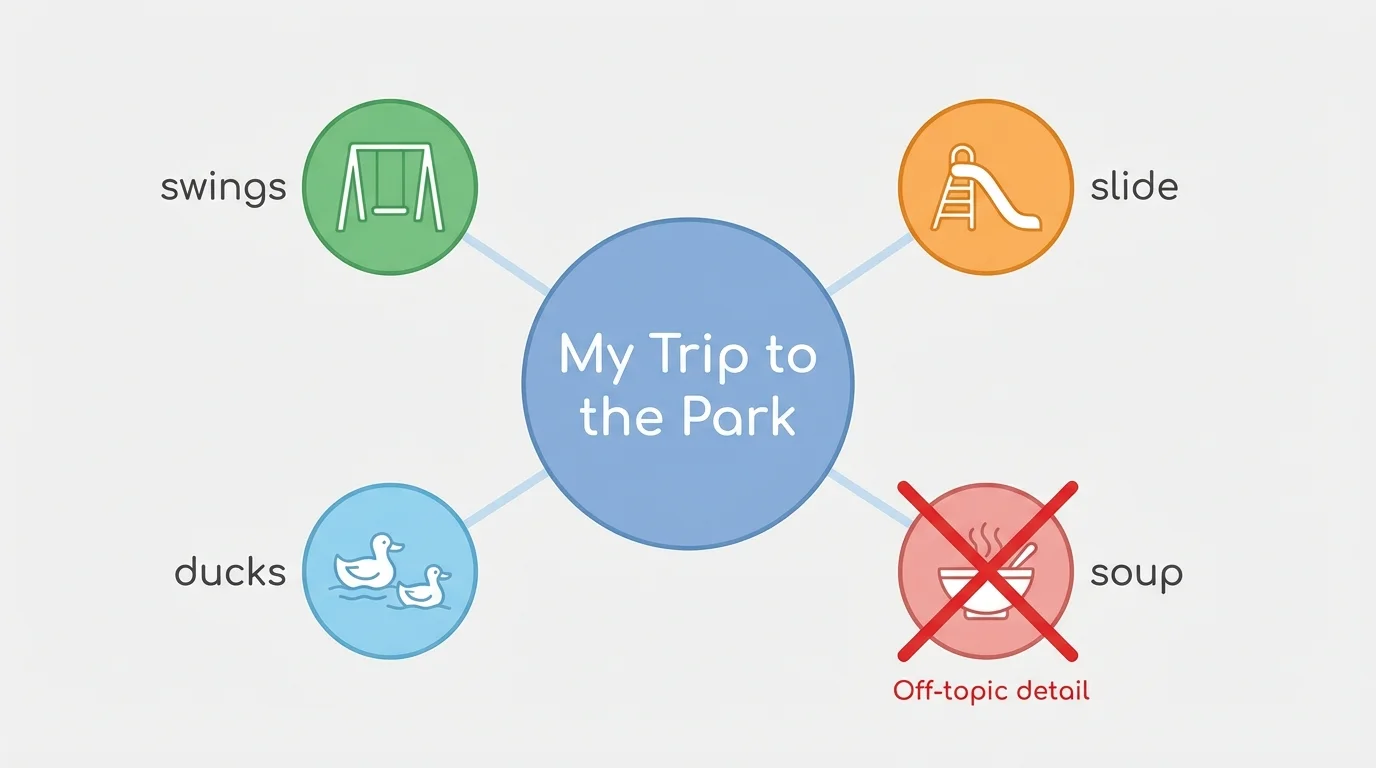
A clear piece of writing stays on one main idea, as [Figure 1] shows with a topic and matching details. If your topic is "My Trip to the Park," you might write about the swings, the slide, and the ducks in the pond. Those details all fit.
Sometimes writers add a sentence that does not belong. If you are writing about the park and suddenly write, "My grandmother makes tasty soup," that sentence is off-topic. It may be true, but it does not match the main idea.
Focusing on one topic helps the reader follow your thoughts. The reader should not feel confused or wonder why a sentence is there. Each part of the writing should help tell more about the same subject.
You can ask yourself simple questions while writing: "What am I writing about?" "Do all my sentences match?" "Is there anything I should take out?" These questions help you stay focused.
Even professional authors change their writing many times. Books in libraries usually start as rough drafts before they become polished stories.
Later, when you revise, you can look back at your topic again. If one sentence does not fit, you can remove it. Just as we saw in [Figure 1], strong details connect to the main idea, and extra details can be left out.
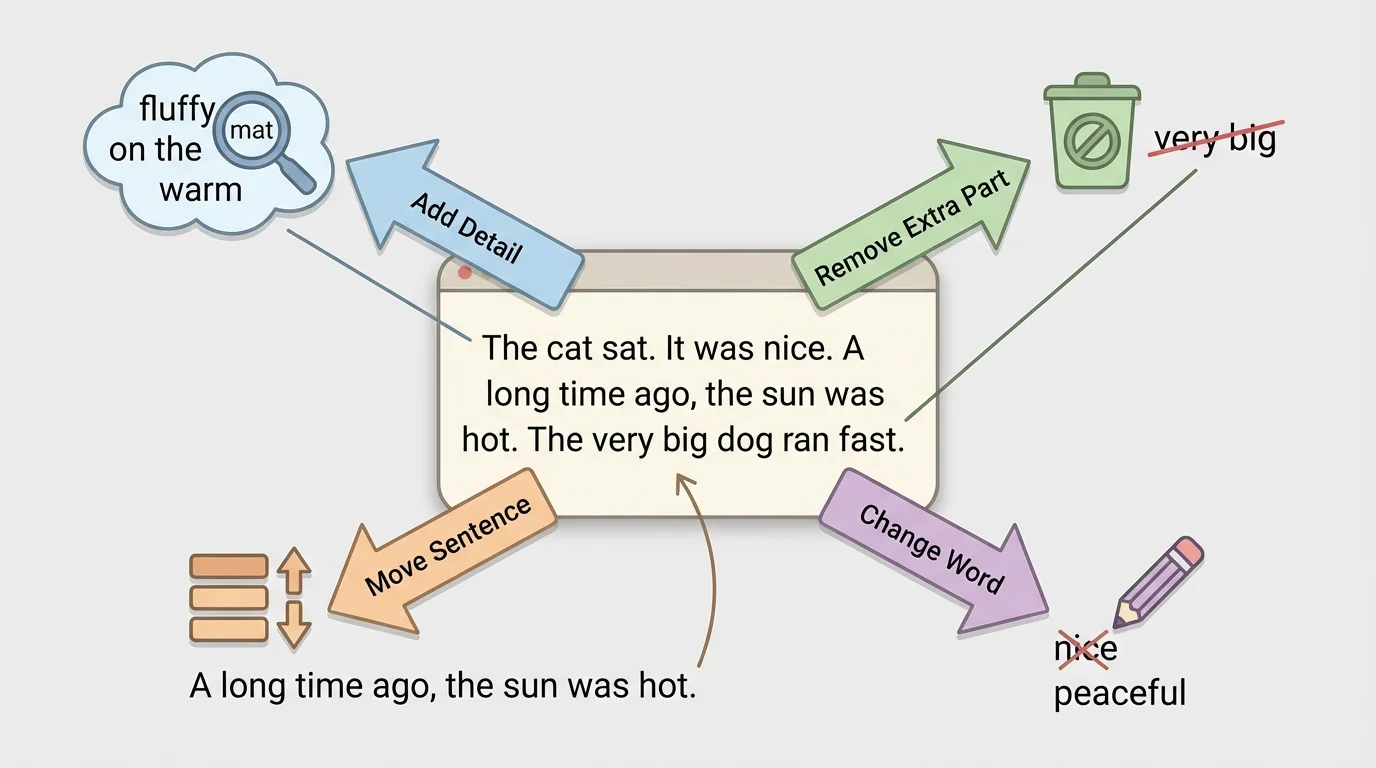
Revise means to look again at your writing and make it better, as [Figure 2] illustrates with different ways to change a draft. Revising is not just fixing tiny mistakes. It is about helping your reader understand your message.
When writers revise, they may add details, remove parts, move ideas, or change words. Maybe your sentence says, "I had fun." You could revise it to say, "I had fun on the tall slide because I zoomed down fast." The second sentence gives the reader a clearer picture.
Writers also revise when something sounds confusing. If ideas are out of order, a writer can move sentences around. If a word is not the best word, the writer can choose a stronger one. If a detail is missing, the writer can add it.
Here is a simple example. A child writes: "I went to the beach. It was nice." That tells a little, but not much. After revising, it could become: "I went to the beach with my family. We built a sand castle and splashed in the waves." Now the reader knows more.
Revision helps meaning grow. Think of revising like cleaning a window so more light shines through. The ideas were there before, but now they are easier to see. Writers revise so readers can understand exactly what they mean.
Revision can happen with help. A teacher might ask, "Can you tell more about what you saw?" A classmate might say, "This part is my favorite, but I do not understand this sentence." Those comments help the writer know what to improve.
When you revisit your writing later, [Figure 2] still helps you remember the main revision moves: add, remove, move, and change. These small decisions can make a big difference.
After revising, writers edit their work. [Figure 3] shows some of the corrections writers make while editing. Editing means checking carefully for correct spelling, capitals, punctuation, and grammar. Editing helps writing look neat and sound right.
Start by checking capitalization. Does each sentence begin with a capital letter? Are names of people, places, and days capitalized? For example, "my friend sara went to denver on monday" should be "My friend Sara went to Denver on Monday."
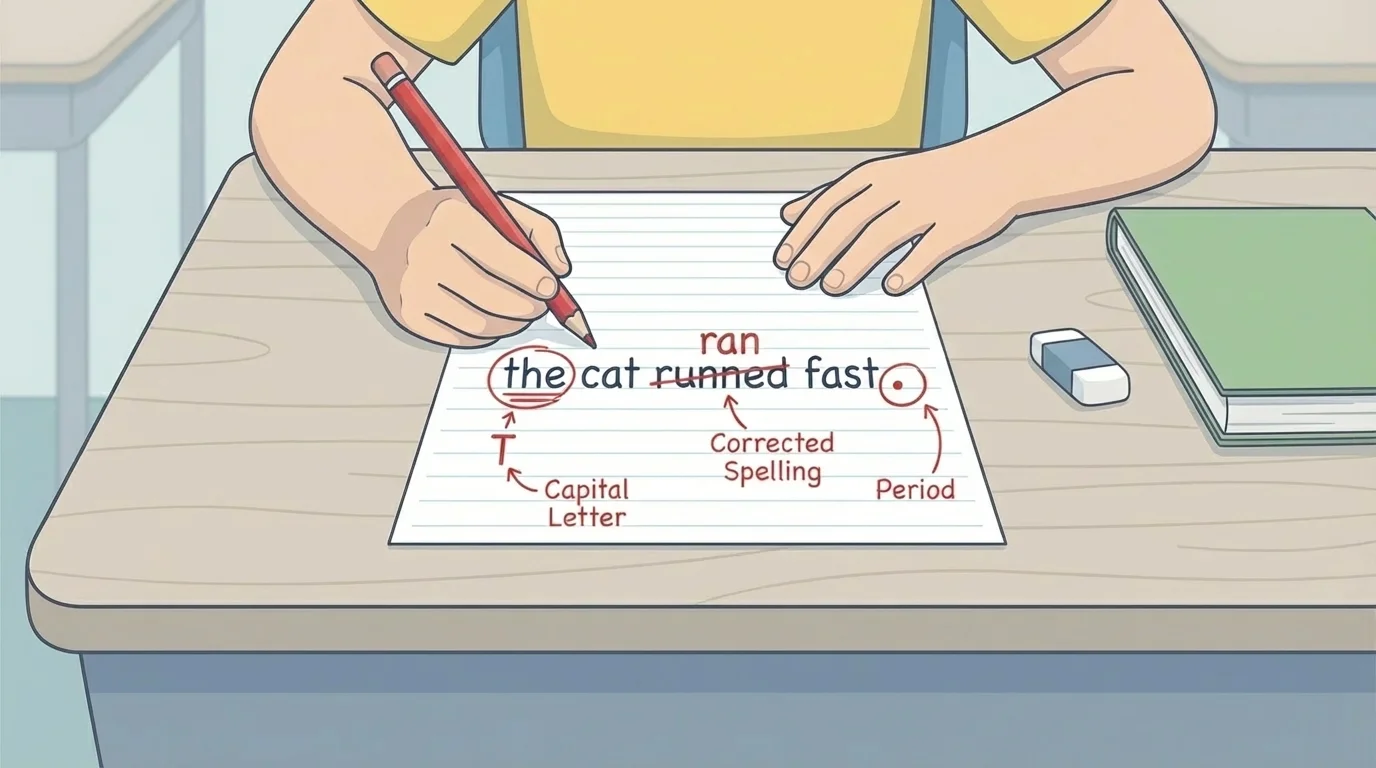
Next, check punctuation. Sentences need end marks such as a period, question mark, or exclamation mark. Punctuation helps readers know when to stop and how to read the sentence.
Then check spelling. Read each word carefully. If a word does not look right, try sounding it out, looking at a word wall, or asking an adult for help. Correct spelling helps readers understand your message without guessing.
Last, check grammar. Grammar helps words go together in a way that makes sense. For example, "He run to school" should be "He runs to school" or "He ran to school," depending on the time.
| What to Check | What to Ask | Example |
|---|---|---|
| Capital letters | Did I start sentences and names with capitals? | "my dog max" becomes "My dog Max" |
| Punctuation | Did I end each sentence correctly? | "We played outside" becomes "We played outside." |
| Spelling | Do the words look right? | "frend" becomes "friend" |
| Grammar | Do the words sound right together? | "She walk home" becomes "She walks home" |
Table 1. A simple editing checklist for young writers.
Later, while doing a final read, writers can remember to look for small marks and corrections that make writing easier to read.
Writers do not have to work alone. Adults and classmates can help in kind and useful ways. A teacher may point to a sentence and ask, "Can you say more here?" A parent may help you notice a misspelled word. A friend may tell you which part is exciting.
Feedback tells what is working and what could be clearer. Good feedback is kind, specific, and about the writing. Instead of saying, "It is bad," a peer can say, "I like your first sentence. Maybe add more details about the game."
When people help with writing, they are helping the piece of writing, not judging the writer. Everyone can improve a draft, and every writer keeps learning.
Writers also use feedback wisely. They listen, think, and decide what changes will help most. If two people are confused by the same sentence, that is a clue the sentence may need revision.
Being a good peer helper matters too. Read carefully. Say one thing you like. Then ask a question or suggest one change. This keeps the writing conversation kind and useful.
It helps to compare a rough draft with an improved draft, and [Figure 4] presents that change clearly. Watch how one short piece becomes stronger through revision and editing.
Here is a student's first draft: "i went to my cousins house. we played. it was fun"
Improving the draft
Step 1: Revise for more details.
The writer adds what they played and why it was fun: "I went to my cousin's house. We played a board game and built a blanket fort. It was fun."
Step 2: Edit capitalization and punctuation.
The first letter of each sentence is changed to a capital letter, and each sentence ends with the correct punctuation.
Step 3: Read again for smoothness.
The writer makes one more change for clarity: "I went to my cousin's house after school. We played a board game and built a blanket fort. It was a fun afternoon."
The new draft gives the reader more information and has correct writing conventions.
This improved version is clearer because it stays on one topic, gives details, and uses correct capitals and punctuation. The writing does more than say "fun." It shows what happened.
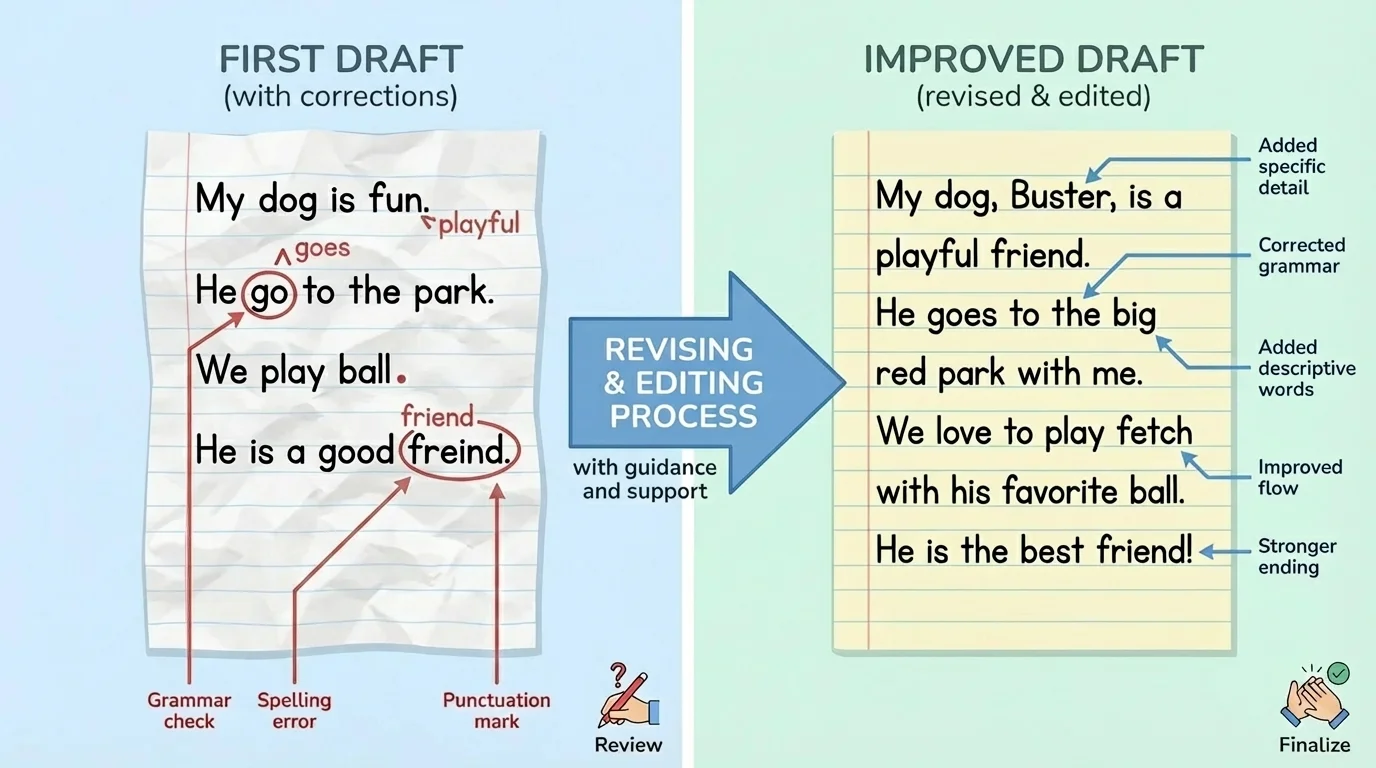
When students look back at drafts later, [Figure 4] helps them notice that stronger writing often comes from both kinds of work: revising ideas and editing mistakes.
Careful writers build strong habits. They reread their work slowly. They read aloud to hear whether it makes sense. They check whether every sentence matches the topic. They ask for help when they need it.
They also remember that making changes is a good thing. Changing writing does not mean the first draft was wrong. It means the writer is growing.
"Good writers are brave enough to change their words so readers can understand them better."
Each time you focus on your topic, revise for clear ideas, and edit for correct writing, you become a stronger writer. Your words become easier to follow, and your reader can enjoy what you are trying to say.
