Have you ever been asked, "What happened when we planted the seeds?" or "Why do birds build nests?" Sometimes the answer is already in your mind because you saw it, heard it, or did it yourself. Other times, you need to look in a book, study a picture, listen to a person, or watch a video. Good learners know how to do both. They use what they remember, and they use what they can find out.
A question is something we want to know. Questions help us think, wonder, and learn. Some questions are about things we have done. For example, "What did we do first during our butterfly observation?" Other questions ask about something we need to learn from somewhere else, such as "What do caterpillars eat?"
When we answer a question, we should listen carefully to what is being asked. A good answer matches the question. If the question is "Where did the class go on the field trip?" the answer should tell the place. If the question is "What did you notice at the pond?" the answer should tell what was seen, heard, or learned.
Recall means to remember something you saw, heard, did, or learned before.
Source means a place where information comes from, such as a book, picture, chart, video, or person.
Detail means a small but important piece of information.
Sometimes one question can be answered by remembering. Sometimes it can be answered by using a source. Sometimes the best answer uses both. That is how shared research and inquiry work: people ask questions together, gather information, and build answers carefully.
There are two big ways to find information. The first way is to think back to your own experience. Maybe you remember what happened during a science walk, what your teacher read aloud, or what you saw when snow melted in the sun. The second way is to gather information from a source. You might use a nonfiction book, a photograph, a class chart, a short video, or an adult who knows about the topic.
Both ways are useful. Your own experiences can give true and helpful information, especially when the question is about something you did or observed. Sources are useful when you need facts that you do not already know or when you want to check your memory.
Strong learners know the difference between guessing and knowing. Guessing means saying something without enough information. Knowing means using a memory, a source, or both to answer the question.
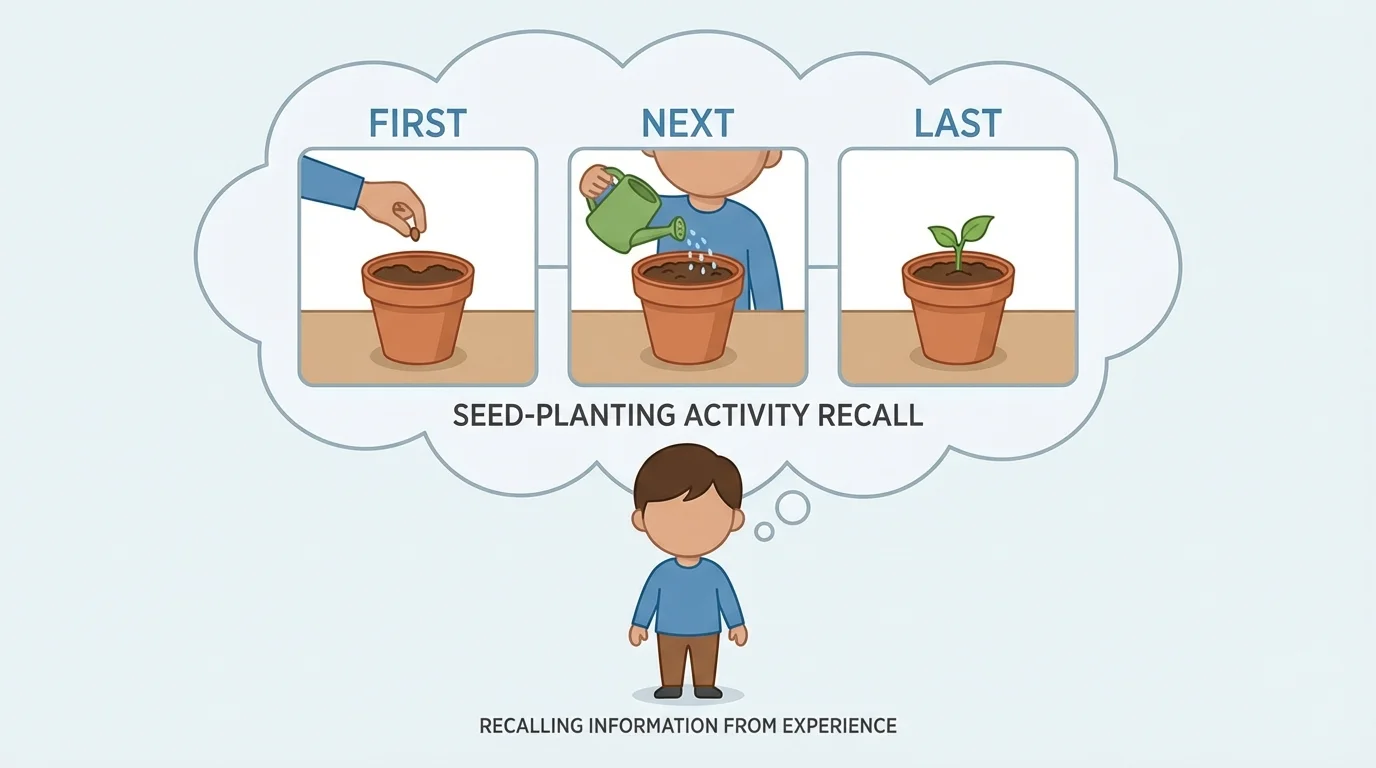
When you recall information, you think about something that already happened. You may remember what you saw, what you heard, what you touched, or what you did. Organizing memories by thinking about what happened first, next, and last helps make the answer clearer, as [Figure 1] shows.
Suppose the question is, "How did we make applesauce in class?" You might recall: first we washed the apples, next we cut them, then we cooked them, and last we mashed them. These details come from your own experience. You are not making them up. You are remembering the steps.
Recalling works best when you pay attention during an activity. Looking closely, listening carefully, and noticing changes all help your memory later. If you watched a plant grow, you might remember that the seed went into soil, water was added, and a green sprout appeared after several days.
Good recall also uses specific details. Instead of saying, "We did stuff with seeds," a stronger answer is, "We put bean seeds in cups with soil and watered them." Specific details help the listener understand exactly what happened.
Sometimes memory is not complete. You may remember part of an event but not all of it. That is normal. In that case, you can say what you remember and then look at a source to learn more. The ordered steps in [Figure 1] remind us that events are often easier to remember when we put them in sequence.
Example: Answering from experience
Question: "What happened when the ice cube was left in the sun?"
Step 1: Think about the experience.
Remember what you saw during the observation.
Step 2: Choose the important details.
The ice cube became smaller, water formed, and the solid ice changed into liquid water.
Step 3: Say the answer clearly.
"When the ice cube was left in the sun, it melted and turned into water."
This answer is clear because it uses a real observation and includes the important change that happened.
A source gives information that helps answer a question. Sources can include books, texts read aloud by a teacher, labeled pictures, class charts, videos, websites chosen by an adult, and people with knowledge about a topic. A variety of sources can help us learn different kinds of details, as [Figure 2] illustrates.
If the question is "What do butterflies eat?" you may not know the answer from your own experience. A nonfiction book might tell you that many butterflies drink nectar from flowers. A picture might show a butterfly near a flower. A short video might show how it uses its mouthpart to sip liquid food.
People can be sources too. A park ranger, librarian, teacher, gardener, or family member may know useful facts. When we learn from a person, we should listen carefully and think about whether the information matches the question.
Sources do not all look the same. Some have words. Some have pictures. Some have both. A chart may show information in rows and columns. A photograph may help you notice shape, color, or place. A video may show movement or change over time.
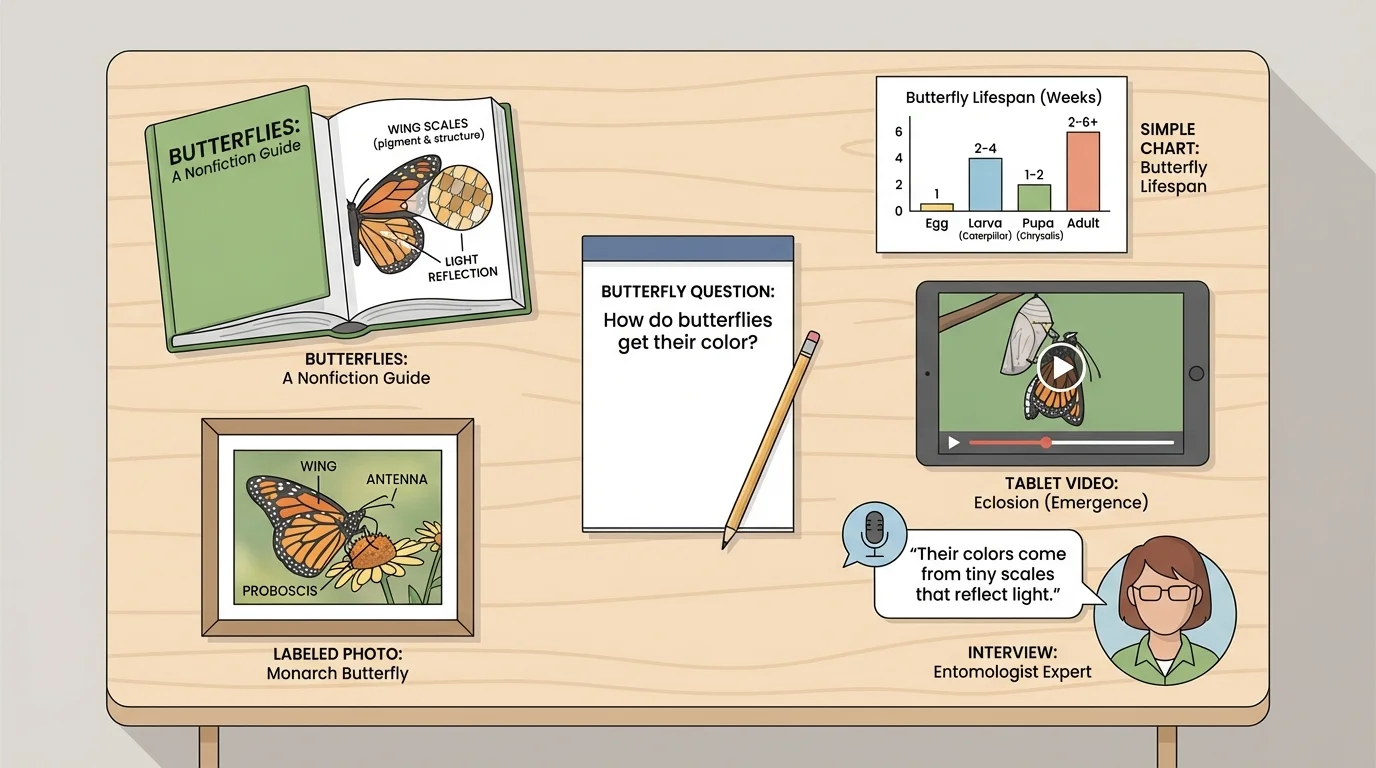
Using more than one source can make an answer stronger. A book may give one fact, and a picture may add another detail. For example, a book might say birds use twigs for nests, and a photo might show that the nest is placed high in a tree. Looking at several sources helps you learn more completely.
Some questions can be answered in more than one way. If the class watched ants carry food, students can recall what they observed and also read a book to learn why ants work together.
When using a source, we should focus on the information that matters. Not every detail is needed. If the question is "Where do frogs lay eggs?" then the important detail is the place, such as water. The color of the page or the name of the photographer does not answer that question.
Different questions need different sources. If the question is about your class trip, your own memory may be the best place to start. If the question is about sharks in the ocean, a book or video is probably a better source. Matching the question to the source is an important skill.
Here are some examples. For "What did our class do during the weather experiment?" use recall first. For "What do clouds tell us about weather?" use a science book, chart, or teacher-approved video. For "What birds did we see outside the window?" use recall and maybe also a bird guide to identify what you saw.
| Question Type | Helpful Way to Find Information |
|---|---|
| Something you did in class | Recall from experience |
| Fact about animals or plants | Book, chart, video, or expert |
| Something you saw and want to check | Recall plus a source |
| Steps in an activity | Recall, notes, or class chart |
Table 1. Different kinds of questions and helpful ways to find information.
Choosing a good source also means choosing one that is clear and trustworthy. In school, teachers often provide sources that are right for the topic and the age of the students. These sources help learners find true information in a safe and understandable way.
When you gather information, you do not need to remember every single thing. You need to find the details that answer the question. That means looking for key words in the question. If the question asks "when," look for time. If it asks "where," look for place. If it asks "why," look for a reason.
Suppose the question is "Why do plants need sunlight?" The important detail is that sunlight helps plants make food and grow. A less helpful detail might be the color of the pot in the picture. Good researchers learn to tell the difference between important and unimportant details.
Important details match the question. A strong answer does not tell everything about a topic. It tells the right information. If the question asks one thing, answer that one thing clearly before adding extra facts.
It also helps to use your own words when possible. That means you tell what you learned in a simple, clear way. You do not need to copy every sentence from a source. You can listen, look, think, and then explain the answer.
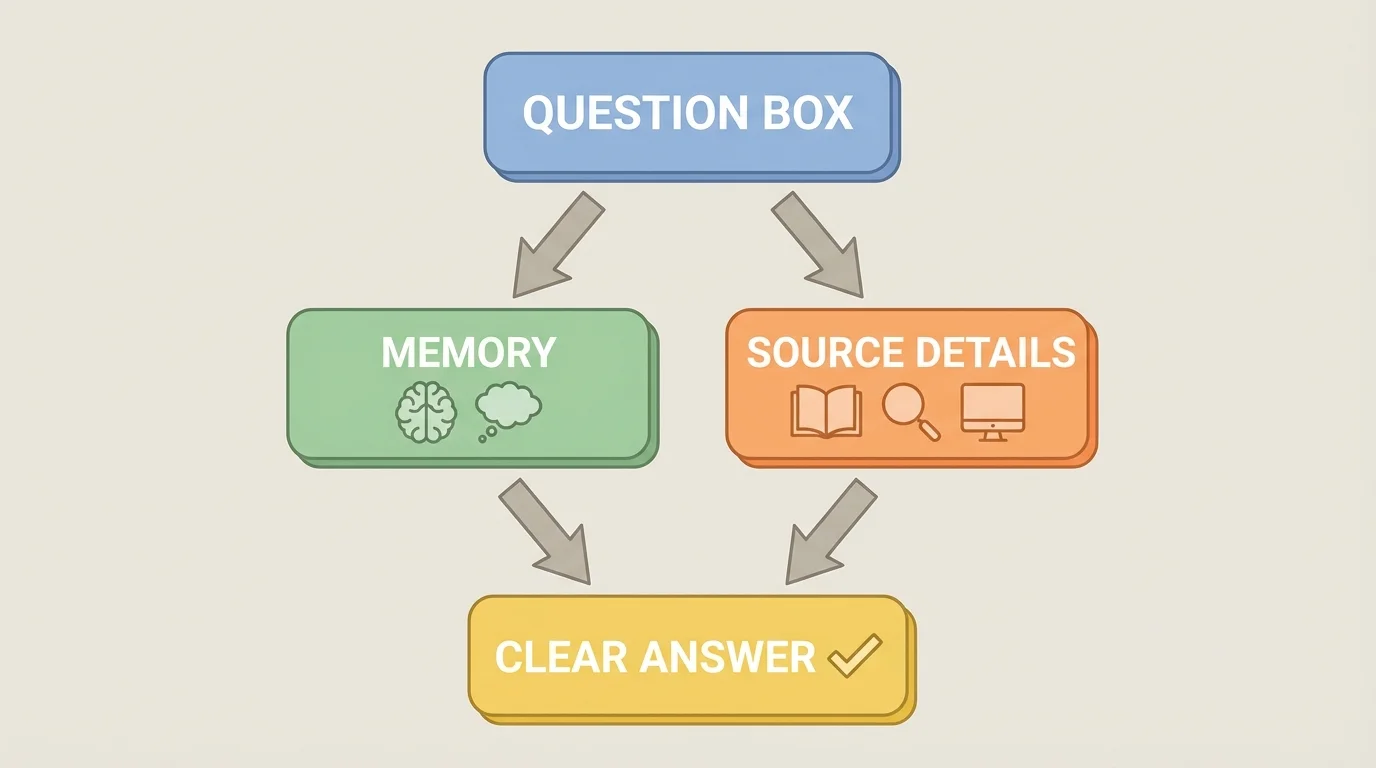
Many strong answers come from combining what you remember with what you learned from a source. This process of gathering information and connecting it to your own observations helps you build a fuller answer, as [Figure 3] shows.
Imagine the question is "How do birds build nests?" You may recall seeing a bird carry twigs. Then a book may tell you that birds choose materials such as grass, leaves, mud, or twigs to make a safe place for eggs. Now your answer can include both your observation and the new fact.
A clear answer often has three parts: the question idea, the important detail, and, if needed, where the detail came from. For example: "Birds build nests with materials like twigs and grass. I saw a bird carry twigs, and our book explained that nests help keep eggs safe."
When we put information together, we should make sure the pieces fit. If your memory says one thing and a source says something different, stop and check again. Maybe you remembered only part of what happened, or maybe you need another source.
Example: Using memory and a source together
Question: "How did our class learn that worms help soil?"
Step 1: Recall the class experience.
You remember seeing worms in the garden soil and noticing that the soil looked loose.
Step 2: Gather information from a source.
A book or teacher explains that worms move through the soil and help air and water reach plant roots.
Step 3: Combine the details.
"We saw worms in the garden soil, and we learned from a book that worms help keep soil loose so air and water can move through it."
The flowchart in [Figure 3] shows that the answer comes after thinking about both memory and source details.
After answering, it is smart to check your work. Ask yourself: Did I answer the right question? Did I include an important detail? Did I use a memory, a source, or both? Does my answer make sense?
If the question was "What did the caterpillar become?" and you answered, "It was on a leaf," the answer does not fully match the question. The question asks what it became, so a better answer is, "It became a butterfly," if that is what your source or observation showed.
Checking helps you improve. You might need to add one more detail, use a clearer word, or look back at a source. Careful learners do not just answer quickly. They answer thoughtfully.
When you listen to a read-aloud, watch a demonstration, or study a picture, you are already collecting information. This lesson builds on those skills by helping you use that information to answer questions carefully.
Another good habit is to explain how you know. You might say, "I know because I saw it during our experiment," or "I know because the chart showed it." Explaining how you know makes your answer stronger and clearer.
These skills are useful in many parts of life. At school, students answer questions about stories, science investigations, class trips, weather observations, and social studies topics. At home, they may recall how to follow a recipe step or gather information to learn how a pet should be cared for.
For example, if a family asks, "What does our new plant need?" a child might remember that the teacher said plants need water and light. Then the child might look at the plant tag or a gardening book to learn how much sunlight that kind of plant needs. That is research in everyday life.
When students work together, they can share what each person remembers and what each person finds in sources. One student may notice a detail in a picture. Another may remember something from a class activity. Together they can build a better answer than one person alone.
"Good questions help us look, listen, remember, and learn."
Learning to recall information and gather it from sources helps you become a careful thinker. You learn not only to answer questions, but also to support your answers with what you know and what you discover.
