Have you ever followed directions for making something and found out that doing one step too early or too late changes everything? Informational texts work like that too. They often tell about things that happen in an order, ideas that fit together, or steps that must be done one by one. Good readers do more than read each sentence. They notice how one part connects to the next part.
In informational reading, a connection is the way one part of the text links to another part. A text may show that one event happened before another event. It may show that one idea caused another idea. It may show that one step must be finished before the next step can begin.
When readers describe connections, they explain how the pieces fit together. They might say, "First this happened, then that happened," or "This happened because of that," or "This step comes next, so the job can be finished."
Connection means a link between two or more parts of a text.
Sequence means the order in which things happen or are done.
Cause and effect means one thing makes another thing happen.
Procedure means a set of steps that tells how to do something.
These kinds of links help us understand a text better. If we know how the parts connect, we do not just know what the text says. We also know how the ideas work together.
Readers often find connections in three big ways. First, a text may tell about historical events. These are things that happened in the past, and the text shows how one event came before or after another.
Second, a text may explain scientific ideas or concepts. A science text often shows what causes something to happen. For example, it may explain that plants need light and water, and because they get those things, they grow.
Third, a text may give technical procedures. These are directions for doing something. The order matters because each step helps the next step happen correctly.
Many nonfiction books use the same reading skill in different subjects. A reader may trace connections in a book about presidents, butterflies, or building a birdhouse.
Even though these texts are about different topics, the same question helps: How are these parts connected?
Authors often give us clue words. These clue words are sometimes called signal words. They tell us to pay attention to order or cause.
Words for order include first, next, then, after, later, and finally. Words for cause and effect include because, so, since, and as a result.
| Type of connection | Helpful clue words |
|---|---|
| Order in time | first, next, then, after, finally |
| Cause and effect | because, so, since, as a result |
| Steps in a procedure | first, second, next, last |
Table 1. Clue words that help readers notice different kinds of connections in a text.
When you see these words, stop and think. Ask yourself whether the author is showing time order, cause and effect, or a set of steps.
[Figure 1] A history text often tells about events in time order with a simple timeline of a garden project. One event happens, and then another event happens after it. To describe the connection, tell which event comes first, which comes next, and how the events lead forward in time.
For example, read these ideas: "The class chose seeds. Next, the students dug holes. Then they planted the seeds. After that, they watered the garden." These events are connected by chronological order. That means they are arranged by time, from earlier to later.
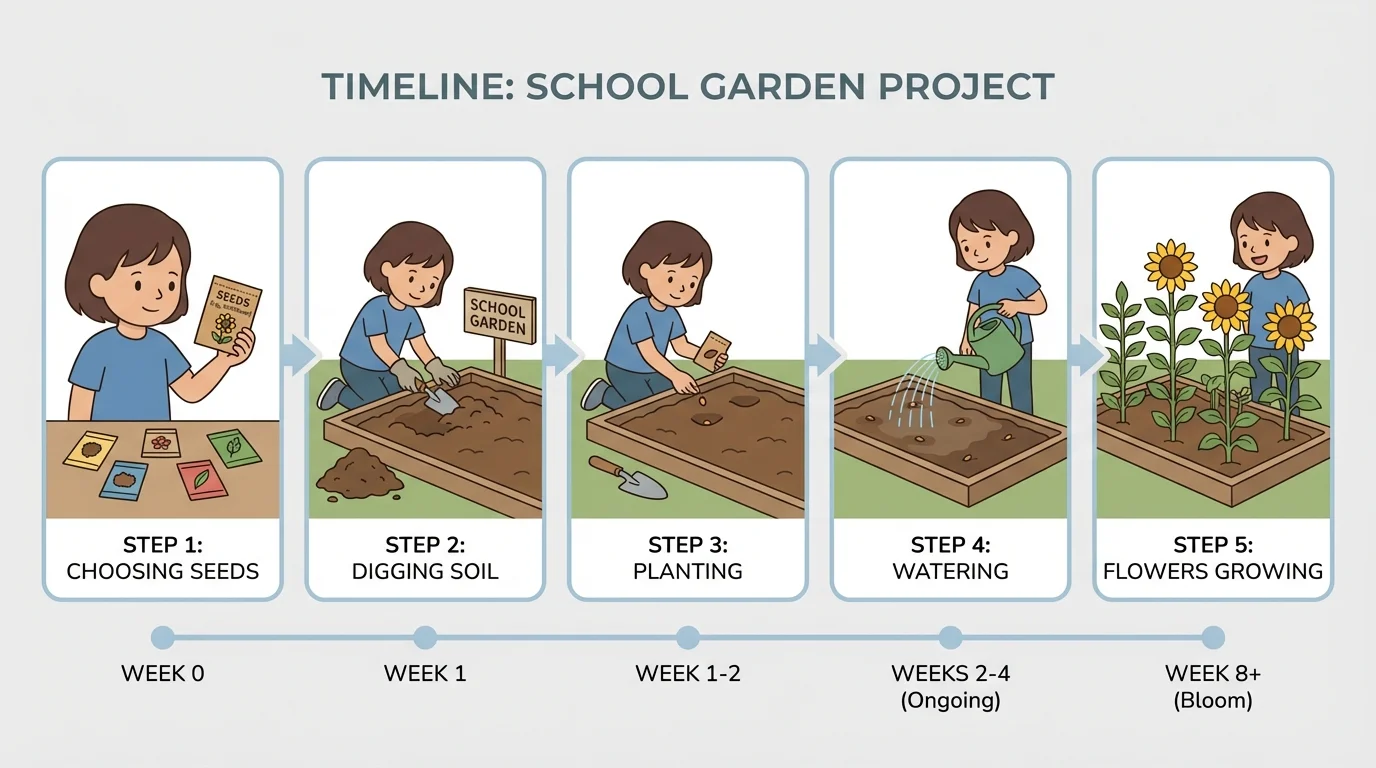
If we mix up the order, the text stops making sense. The class cannot water seeds that were never planted. The students must choose the seeds before they know what to plant. The connection between the events is not random. It is organized in a sequence.
Example: Describing historical connections
Text: "Long ago, people in a town wanted clean water. First, they found a place for a well. Next, workers dug deep into the ground. Then, the town used the well for water."
Step 1: Find the events.
The town wanted clean water, workers found a place, workers dug, and people used the well.
Step 2: Notice the order words.
The words first, next, and then show the sequence.
Step 3: Explain the connection.
You can say, "The events are connected in time order. First the town chose a place for the well, next workers dug it, and then people used the well for water."
Later, when you read another history text, the same idea still works. Each event can be placed on a line of time so you can see what happened before and after.
[Figure 2] Science texts often connect ideas by showing cause and effect, as a growing plant illustrates. One thing happens, and that causes something else to happen. Readers should ask, "What made this happen?"
Think about this text: "A plant gets sunlight and water. Because it gets what it needs, the plant grows. As it grows, leaves open and flowers bloom." The ideas connect because the plant's needs help cause its growth.
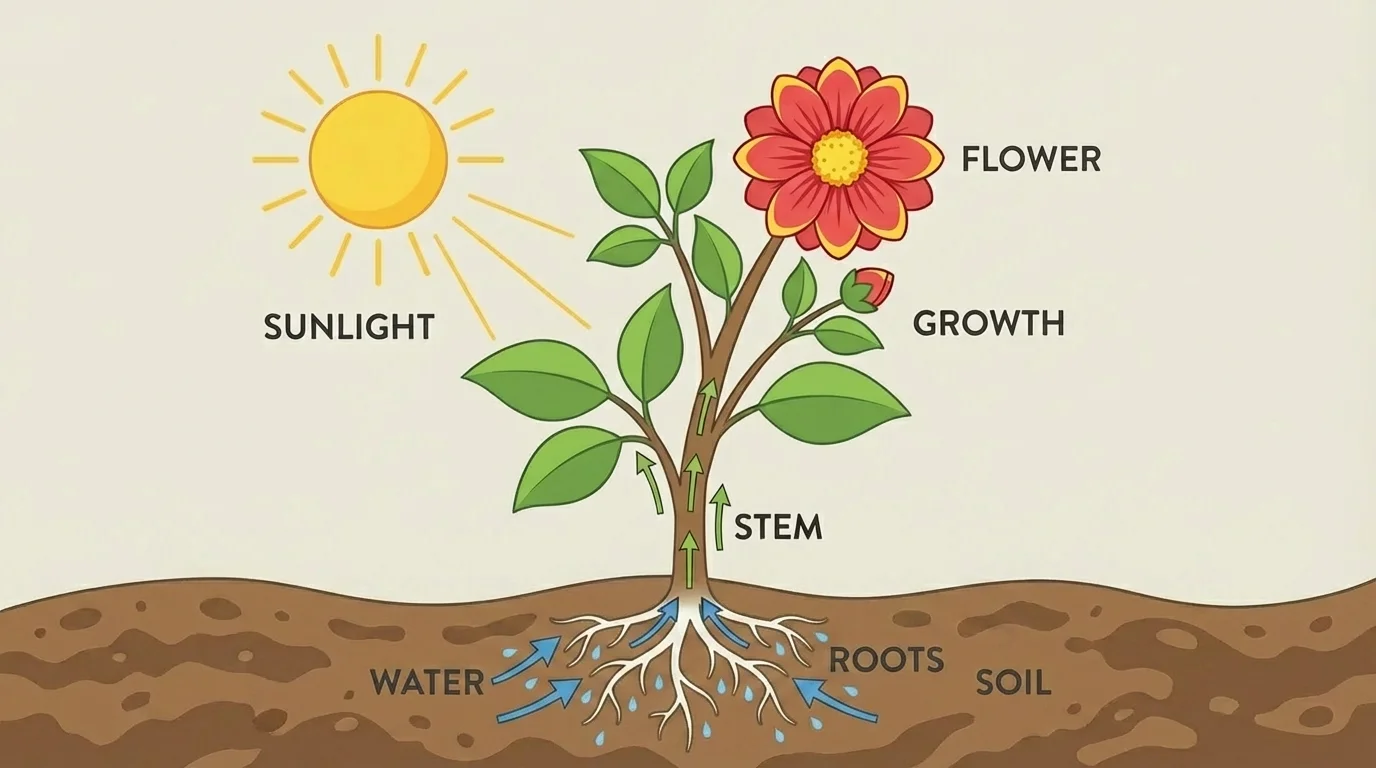
Science texts may also connect ideas by showing parts that belong together. A text about weather might explain that clouds, rain, and wind are all parts of a storm. A text about animals might explain that wings help birds fly. These are connections between ideas, parts, and results.
How science ideas connect
In science, authors often explain a chain of thinking: a need, a change, and a result. For example, water and sunlight help a plant make food, and that helps the plant grow. The reader's job is to notice how one idea leads to the next.
When you explain a science connection, use words like because and so. You might say, "The plant grew because it had sunlight and water." That answer tells not just what happened, but why it happened. The roots, stem, leaves, and flower all play a part in the connected process of growth.
[Figure 3] A technical text gives directions, and the order matters, as the hand-washing steps make clear. If a reader misses a step or switches two steps, the job may not work the right way.
Read this procedure: "First, turn on the water. Next, wet your hands. Then add soap. Scrub well. Finally, rinse and dry." Each step connects to the next one. You need water before rinsing. You add soap before scrubbing. The sequence helps the procedure work.
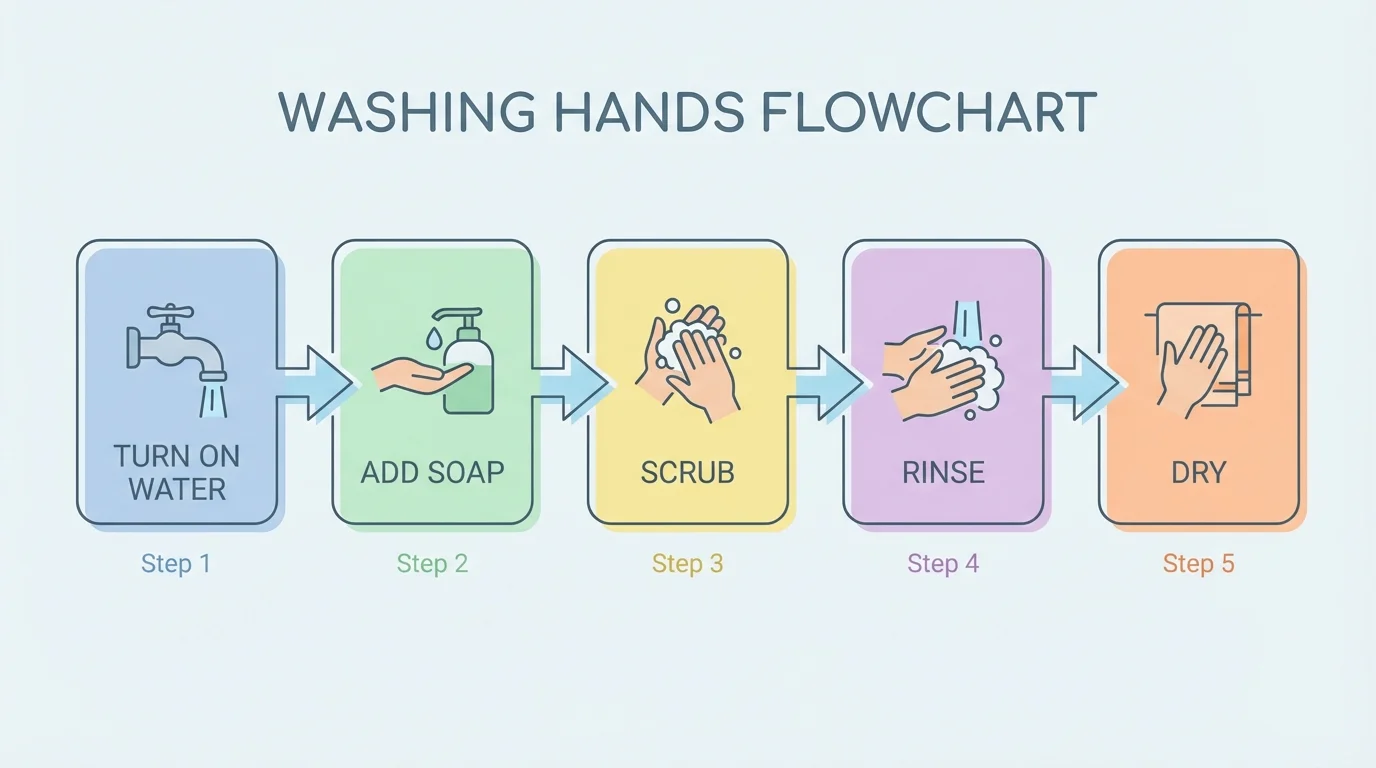
Directions for building, cooking, cleaning, and using tools often work this way. A recipe tells what to do in order. Instructions for planting a seed tell what step comes next. A game manual tells how to set up before playing. In all of these, each step supports the next step.
Example: Explaining a procedure
Text: "First, put paper on the table. Next, squeeze paint into a tray. Then dip the brush in paint. Last, paint the picture."
Step 1: Identify the steps.
Put paper down, get paint ready, dip the brush, and paint.
Step 2: Notice the order.
The words first, next, then, and last show the sequence.
Step 3: Tell how they connect.
You can say, "The steps are connected in order. The paper is set out first, the paint is prepared next, the brush is dipped after that, and the picture is painted last."
This example helps us remember an important idea: procedures are not just lists. They are connected steps that lead to a result.
When you answer a question about connections, start by finding the important parts of the text. Then decide what kind of connection you see. Is it time order? Is it cause and effect? Is it steps in a procedure?
After that, use details from the text in your answer. Good readers do not only say, "They are connected." They explain how they are connected.
These sentence frames can help:
When you read nonfiction, always look for the most important details. Those details help you explain how one part of the text links to another part.
A strong answer uses the author's information. For example, instead of saying, "The plant grew," you can say, "The plant grew because it had sunlight and water." Instead of saying, "The class made a garden," you can say, "First the class chose seeds, next they planted them, and then they watered them."
Informational texts often include text features such as headings, captions, labels, and pictures. These can help readers understand connections too. A heading may tell what part comes next. A caption may explain what is happening in a picture. A labeled diagram may show how parts work together.
For example, a timeline helps you see history in order. A science diagram helps you see what causes growth or change. A flowchart helps you see steps in a procedure. These features support the words in the text.
Smart readers use both the sentences and the text features. They do not look at one and ignore the other. Together, they make the connections easier to understand.
To build a strong explanation, follow a simple plan. First, name the kind of connection. Second, tell the parts that are connected. Third, explain the link using details from the text.
Here is a complete model: "The events are connected in time order. First the students dug holes, then they planted the seeds, and finally they watered them." Here is another model: "The ideas are connected by cause and effect. The plant got sunlight and water, so it grew."
When you speak or write about a text this way, you show true understanding. You are not just repeating words. You are showing how the author built the information so the reader can learn from it.
