Have you ever heard a great word in a story and wanted to use it right away? That is how vocabulary grows. Every day, you collect words when you talk with people, read books, listen to someone read aloud, and share your ideas about what you heard or read. The more words you know, the better you can understand stories and the better you can explain your own thoughts.
New words do not come from just one place. They come from many places, as [Figure 1] shows. You may hear a friend say, "That game was exciting," and learn a strong word to describe it. You may read a book that says the sky was gloomy. You may listen to a teacher read a story and hear that a character whispered softly. You may also learn words when you answer questions and talk about a text.
When you speak with others, you hear how words are used in real life. In conversations, people use words to tell what happened, how they feel, what they noticed, and what they think. If someone says, "I felt nervous before the race," you learn a word for a feeling. If someone says, "The puppy wagged happily," you learn a word that tells how an action happened.
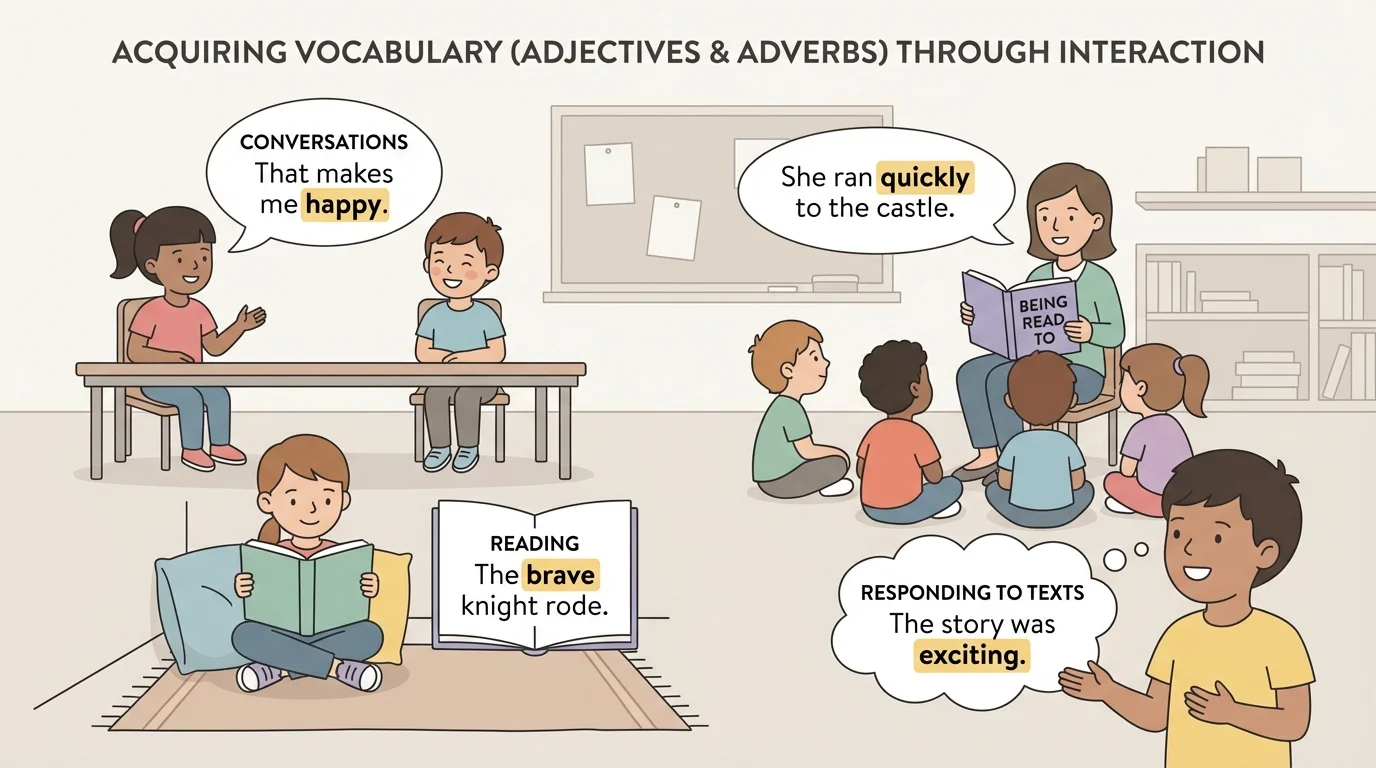
Reading gives you another powerful way to gather words. Books often use words that are more exact than everyday talk. A book might say a giant was enormous instead of just big. It might say a stream sparkled instead of just looked nice. These words help readers build a clearer picture in their minds.
Being read to is important too. When someone reads aloud, you can hear the sounds and expression of rich language. Sometimes you may understand a word because of the voice, the picture, or what is happening in the story. Later, when you see that word again, it feels more familiar.
Responding to a text also builds vocabulary. When you talk or write about a story, you practice words again. If you say, "The bear was sleepy," then later say, "The bear was very drowsy," you are stretching your vocabulary. Using a word helps it stay in your memory.
Vocabulary means the words a person knows and uses.
Text means something you read, hear, or respond to, such as a story, poem, article, or read-aloud.
Good readers and speakers keep collecting words all the time. They notice unfamiliar words, listen carefully, look for clues, and try the words in speaking and writing.
To acquire a word means more than just hearing it once. First, you notice the word. Next, you begin to figure out what it means. Then you hear or read it again. Finally, you start to use it yourself.
Suppose you hear the sentence, "The kitten curled up on the cozy blanket." Even if you have never heard the word cozy before, the rest of the sentence gives clues. A curled-up kitten and a blanket suggest comfort and warmth. Soon you understand that cozy means comfortable and snug.
Sometimes pictures help. Sometimes the words around the new word help. Sometimes a person explains the word. And sometimes a word part helps you understand it. Learning words is like putting together clues from many places.
How context helps When readers use the words, pictures, and ideas around a new word to figure out its meaning, they are using context clues. Context clues do not always tell the whole meaning, but they often help enough for you to keep reading and learning.
When you use a new word, even in a simple sentence, you make it stronger in your mind. If you learned the word cheerful, you might say, "My grandma sounds cheerful when she sings." That shows you understand the word and can use it in your own way.
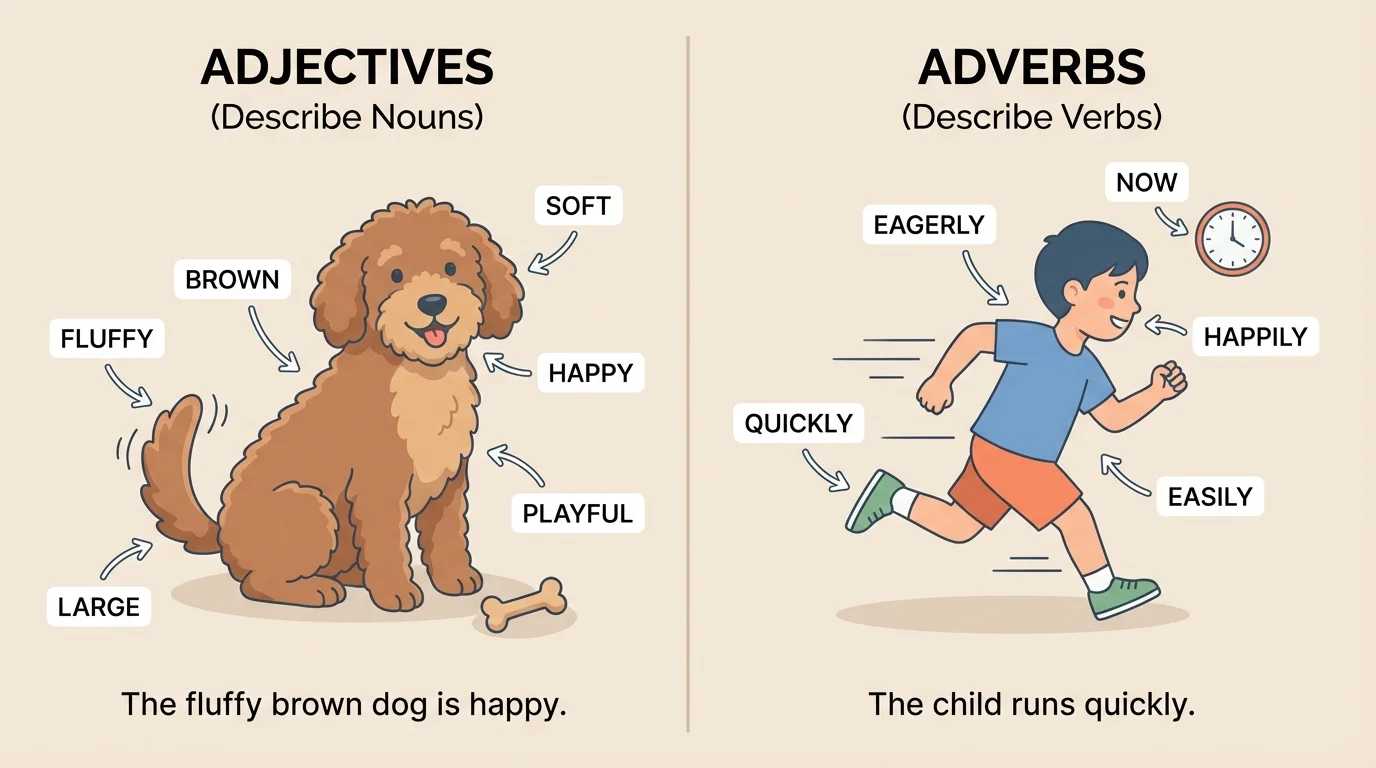
Some of the most useful new words are describing words. These words help your speaking and writing become clearer, as [Figure 2] illustrates. Two important kinds of describing words are adjectives and adverbs.
An adjective describes a noun, which is a person, place, thing, or animal. In the sentence "The fuzzy cat slept," the word fuzzy tells about the cat. In "We saw a bright moon," the word bright tells about the moon. Adjectives can describe color, size, shape, number, or feeling. Words like blue, tiny, round, three, and cheerful can all be adjectives.
An adverb tells more about an action. It often describes how something happens. In "The turtle moved slowly," the word slowly tells how the turtle moved. In "Jada sang beautifully," the word beautifully tells how Jada sang. Many adverbs end with -ly, but not all of them do.
These two kinds of words help listeners and readers picture what is happening. Compare "The dog barked" with "The little dog barked loudly." The second sentence gives more information. You can imagine the dog better, and you can almost hear the bark.
You can use adjectives and adverbs to describe feelings too. For example: "When other kids are happy, that makes me happy." In that sentence, happy describes how the kids feel and also how the speaker feels. You could make the idea even stronger by saying, "When other kids are truly happy, that makes me feel warm inside." The adverb truly adds detail, and the phrase warm inside gives a clearer feeling.
Here are some examples of adjectives and adverbs in sentences:
| Sentence | Describing word | Kind |
|---|---|---|
| The shiny fish swam away. | shiny | adjective |
| The fish swam quickly. | quickly | adverb |
| A gentle rain fell. | gentle | adjective |
| Rain fell softly. | softly | adverb |
Table 1. Examples showing how adjectives describe nouns and adverbs describe actions.
Later, when you answer questions about stories, these describing words help you explain your thinking. As shown in [Figure 2], the difference matters: one kind tells what something is like, and the other tells how something happens.
After you read or hear a text, you often respond by speaking, drawing, or writing. A strong response uses words from the text and words that describe your ideas clearly. Instead of saying, "I liked it," you can say, "I liked the story because the ending was surprising." Instead of saying, "The character was nice," you can say, "The character was kind and patient."
When you respond to a text, you may talk about characters, setting, problem, solution, feelings, or important events. New words help you say exactly what you mean. For example, if a character keeps trying even when something is hard, you might describe the character as determined. If the forest in the story feels dark and quiet, you might call it mysterious.
Using stronger words in a response
A weak response might be: "The girl was good."
Step 1: Think about what "good" means in the story.
Did she help someone? Did she tell the truth? Did she share?
Step 2: Choose a more exact word.
You might choose kind, honest, brave, or helpful.
Step 3: Say or write the idea with details.
"The girl was brave because she rescued the lost puppy in the storm."
The stronger response paints a much clearer picture.
You can also borrow words from the text itself. If the author says the wind howled, you might respond, "The storm felt scary because the wind howled outside the cabin." Using a text word correctly shows close listening or close reading.
Talking about books with others grows your vocabulary too. One student may say, "The fox was sneaky," while another says, "I think he was clever." Both words help the group think more deeply about the character.
Readers do not only memorize whole words. They also look at spelling patterns and word parts, as [Figure 3] shows. This helps them decode words with accuracy and understand what the words mean. A word can have a base word and an ending. When you know the parts, you can often read and understand the whole word.
For example, if you know the word quick, then quickly becomes easier to read. If you know joy, then joyful makes sense. If you know help, then helpless gives you a clue too. The spelling may change a little when endings are added, but the base word still helps.
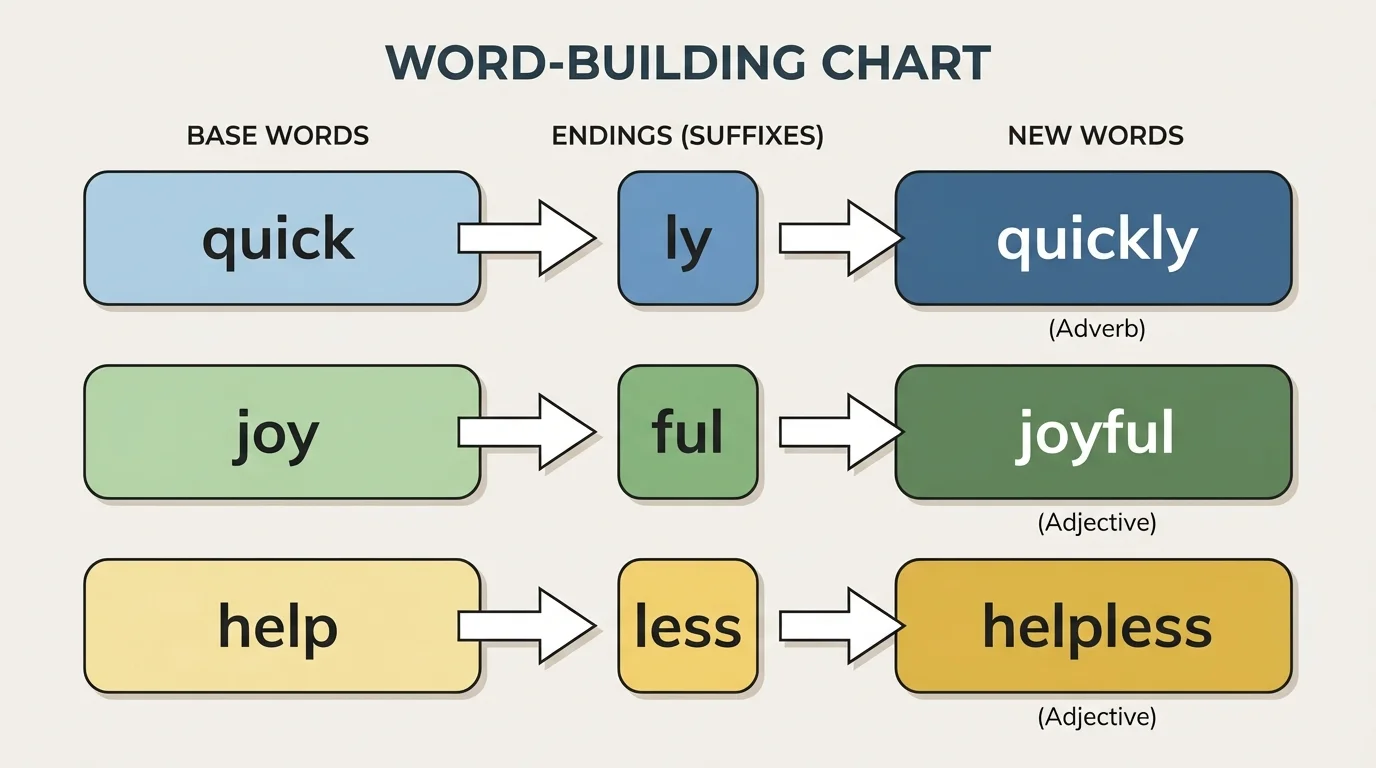
Some common endings are -ly, -ful, and -less. The ending -ly often helps make an adverb, such as softly or slowly. The ending -ful often means full of, as in joyful or helpful. The ending -less often means without, as in fearless or helpless.
Knowing these patterns helps in two ways. First, it helps you pronounce a new word. Second, it helps you think about the meaning. If you read the word cheerful, you may notice the base word cheer. That tells you the word probably has something to do with happiness or gladness.
You already know that letters and groups of letters make sounds in words. Now you are adding a new skill: noticing meaningful parts inside words. Good readers use both sound patterns and meaning patterns together.
Sometimes understanding one word helps you understand a whole family of words. If you know act, you may later meet acting, acted, and action. If you know care, you may meet careful and carefully. This is one reason reading often makes vocabulary grow quickly.
As shown earlier in [Figure 3], small endings can change both the job of a word and its meaning. Quick can describe something, but quickly tells how something happens.
Some words are okay, and some words are much better because they are more exact. Good speakers and writers choose the best word for the idea. The words big, huge, and enormous all relate to size, but they do not feel exactly the same. Enormous feels stronger than big.
This is called precise word choice. A precise word matches the meaning very well. If a child is only a little tired, sleepy might fit. If the child is extremely tired, exhausted would be stronger. Choosing exact words helps others understand you better.
One new word can lead to many more. If you learn the word joy, you may soon understand joyful, joyfully, and overjoyed when you meet them in books or conversation.
Writers often choose exact adjectives and adverbs to set a mood. "The candle glowed dimly" feels different from "The candle glowed brightly." "The old house stood silently" feels different from "The old house stood proudly." Small word changes can create very different pictures and feelings.
When you talk about your own life, precise words help too. Instead of saying, "I felt bad," you might say, "I felt lonely," "I felt worried," or "I felt disappointed." Each word tells something different.
The best way to keep a new word is to use it. You can use new words when you answer questions, tell a story, explain an idea, or write about reading. If you learned the word cautious, you might say, "The rabbit was cautious near the road." If you learned the word eagerly, you might say, "We eagerly opened the box."
Listening carefully matters too. When other people use strong words, notice them. Ask yourself, "What does that word mean here?" and "Can I use that word too?" Word learning becomes easier when you pay attention on purpose.
As you become a stronger reader, you will notice more patterns. You will hear richer words in conversations, read more interesting words in books, and use more exact words in your responses. Over time, your sentences will sound more vivid, clear, and thoughtful.
"The right word can help others see exactly what you mean."
Every conversation, every story, and every response is a chance to grow your word power. With adjectives, adverbs, careful listening, close reading, and attention to word parts, you can understand more and say more.
