Have you ever picked up a book because you wanted to know something right away, like why leaves change color or how bees make honey? Authors know readers are curious. That is why they write texts for different reasons. Some texts help answer a question. Some explain how or why something happens. Some describe a person, place, thing, or event so readers can picture it clearly. Good readers learn to notice the author's most important reason for writing.
The main purpose of a text is the biggest reason the author wrote it. When we read an informational text, we ask, "What does the author most want me to learn?" The answer helps us understand the text better.
An author is the person who writes the text. The author might want to give facts, teach an idea, or help readers understand something in the world. Even when a text has many details, those details usually work together for one main job.
Main purpose means the most important reason a text was written.
Informational text is writing that gives real facts and teaches about a topic.
In many grade 2 informational texts, the author's main purpose fits into one of three big kinds: to answer, to explain, or to describe. Learning these three helps you become a stronger reader.
Authors often do one of three jobs, as [Figure 1] shows. They may answer a question, explain an idea or process, or describe something with facts and details. When you know these jobs, you can listen for what the text is really doing.
To answer means the text responds to a question. The question may be in the title, such as Why Do Penguins Huddle? The text gives facts that tell the answer. If the author keeps returning to the question and gives facts that solve it, the purpose is likely to answer.
To explain means the text helps readers understand how something works or why something happens. A book about how a seed grows into a plant is explaining. It tells steps or causes. It teaches the reader how one thing leads to another.
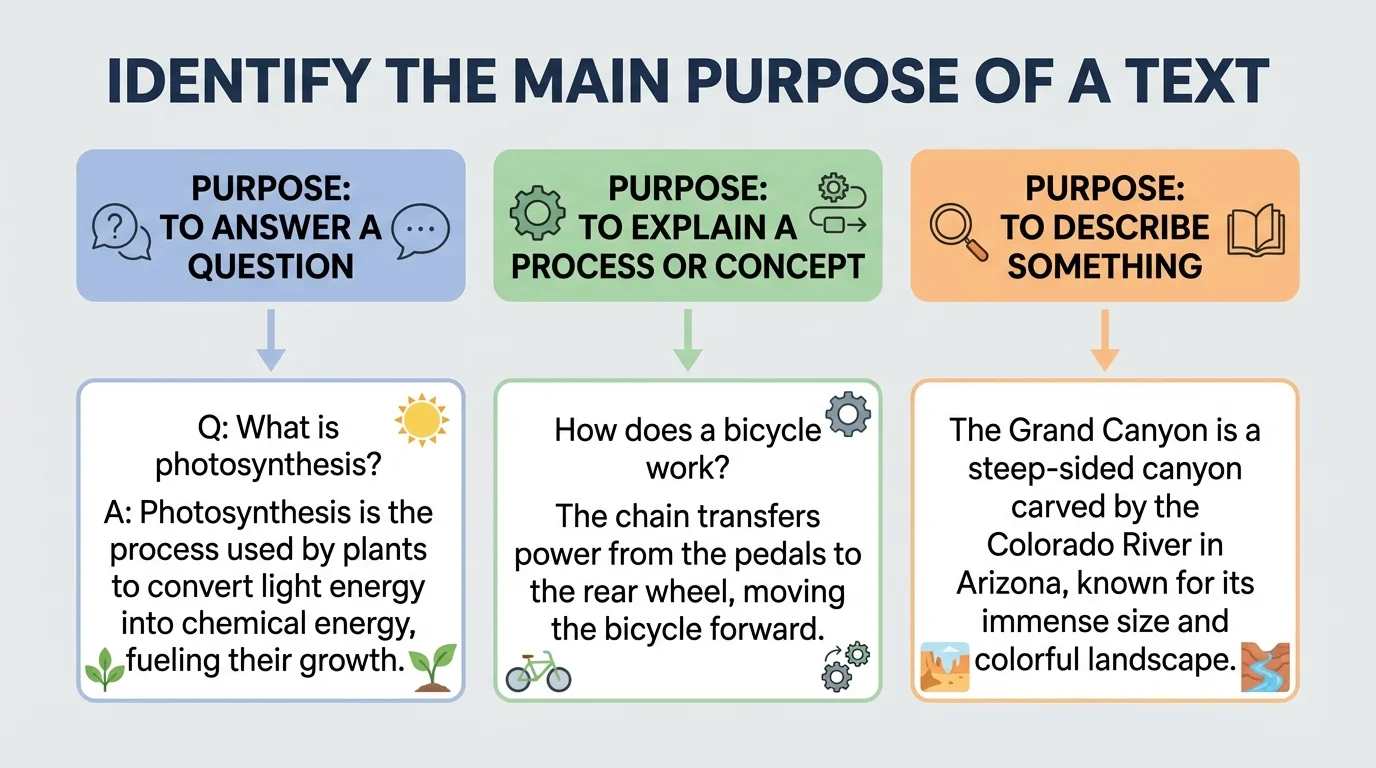
To describe means the text tells what something is like. It may tell about size, color, parts, sounds, movements, or other features. A text about polar bears might describe their thick fur, big paws, and icy home. The reader learns to picture the topic clearly.
Sometimes these purposes can sound close to each other, but they are not exactly the same. If a text says, "A giraffe has a very long neck, spotted fur, and long legs," it is mostly describing. If it says, "A giraffe's long neck helps it reach leaves high in trees," it is explaining how a body part helps the animal survive. If it begins with, "Why do giraffes have long necks?" and then gives facts to respond, it is answering a question.
Example: Looking at purpose
Step 1: Read this idea: "Why do owls hunt at night? Owls have large eyes that help them see in low light."
Step 2: Notice that the text begins with a question.
Step 3: The facts respond to that question.
The main purpose is to answer.
Now look at this idea: "Owls turn their heads far to the side because their eyes do not move much in their sockets." This text is helping the reader understand why something happens, so the purpose is to explain.
And this idea: "Owls have soft feathers, sharp talons, and round faces." This one tells what owls are like, so the purpose is to describe.
Readers do not have to guess wildly. The text gives clues, and [Figure 2] shows some of the most helpful ones. You can look at the title, headings, pictures, captions, and repeated words to learn what the author wants to do.
The heading of a section can help a lot. A heading such as How Bees Make Honey suggests the text may explain a process. A heading such as What Do Bees Eat? suggests the text may answer a question. A heading such as Parts of a Bee may describe the bee's body.
Repeated ideas matter too. If the text keeps giving reasons, causes, or steps, the author is probably explaining. If the text keeps giving traits or details, the author is probably describing. If the text keeps returning to one question, the author is probably answering.
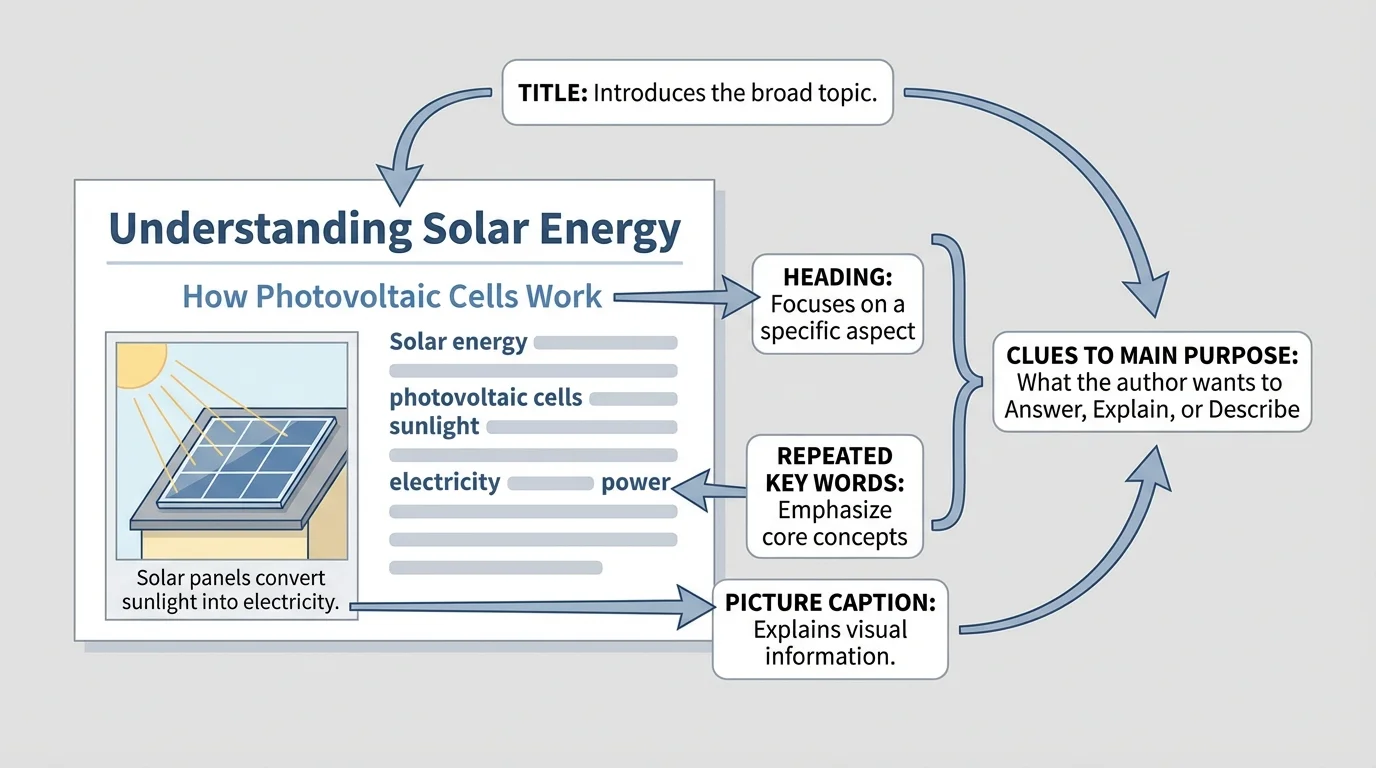
Pictures and captions can help, but readers should not use pictures alone. The words in the text are the strongest clue. For example, a picture of a volcano might appear in a text that describes what a volcano looks like, or in a text that explains how it erupts. The picture is the same topic, but the purpose is different.
Remember that informational texts teach about the real world. They often include text features such as titles, headings, captions, labels, and diagrams to help readers understand.
Another clue is the way the text starts. If the first lines ask something like "How do fish breathe underwater?" the author may be getting ready to answer. If the first lines say, "Fish use gills to take oxygen from water," the author may be explaining. If the first lines say, "Fish have fins, scales, and gills," the author may be describing.
A strong reader thinks while reading. You can stop and ask yourself a few simple questions. These questions help you find the author's purpose.
Ask, "Is the author trying to answer something?" If yes, what is the question? Ask, "Is the author helping me understand how or why?" That points to explain. Ask, "Is the author telling me what something is like?" That points to describe.
A good way to think about purpose
The author's main purpose is like the text's biggest job. Every fact in the text should help with that job. If most facts work together to answer, explain, or describe, that tells you the main purpose.
Here are some sentence starters you can think in your head while reading: "This text mostly answers...," "This text mostly explains...," or "This text mostly describes...." When you finish the sentence, you are already close to naming the main purpose.
You do not need to choose based on one sentence only. Read enough of the text to notice the whole pattern. The pattern across the text matters most.
The same topic can be written about in different ways, as [Figure 3] illustrates. A text about rain does not always have the same purpose. The topic stays the same, but the author's job changes.
Text A might say, "Why does rain fall from clouds? When tiny drops of water in clouds join together and grow heavy, they fall to the ground." This text answers a question.
Text B might say, "Rain forms when water rises into the air, cools, and turns into tiny drops. The drops gather in clouds and then fall." This text explains a process.
Text C might say, "Rain can feel cool on your skin. It makes soft tapping sounds on windows and leaves shiny puddles on the ground." This text describes what rain is like.
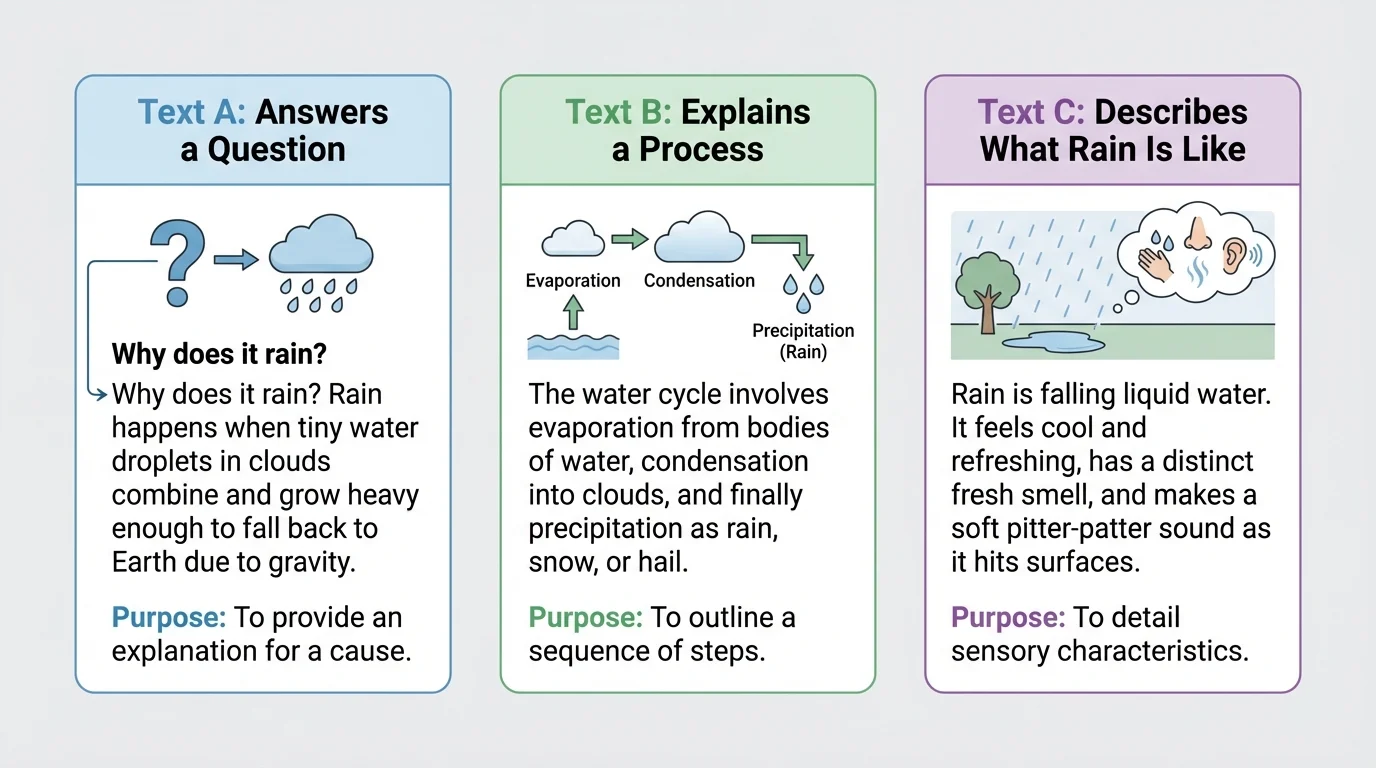
This idea is important: topic and purpose are not the same. The topic is what the text is about. The main purpose is what the author wants to do with that topic. Two books can both be about frogs, but one may describe frogs while the other explains how frogs grow.
Many nonfiction books in libraries use the same topic in different ways. One book about space may describe planets, while another answers questions about astronauts, and another explains how rockets launch.
When you compare texts on the same topic, the difference becomes easier to see. That is why readers should pay attention not just to the subject, but to what the author is doing with the subject.
Sometimes a text does more than one thing. A text about butterflies may describe their wings and also explain how they change from caterpillars into butterflies. That is normal. Authors often mix purposes.
But one purpose is usually the main one. To figure that out, ask which job is the biggest. Which job gets the most space? Which job do most of the details support? If most details tell stages and changes, the main purpose is probably to explain. If most details paint a picture of the butterfly's body, the main purpose is probably to describe.
This is where earlier clues help again. The title, headings, and repeated ideas guide you. As you saw with the three-purpose chart in [Figure 1], texts can contain similar facts, but the way those facts are used changes the main purpose.
After reading, it helps to say the purpose clearly. You can use sentence frames like these:
"The author's main purpose is to answer the question ________."
"The author's main purpose is to explain how or why ________."
"The author's main purpose is to describe ________."
Suppose you read a text called How a Turtle's Shell Helps It. If the text tells how the shell protects the turtle from danger, you might say, "The author's main purpose is to explain how a turtle's shell helps it stay safe."
If you read a text called What Is a Desert Like?, you might say, "The author's main purpose is to describe a desert." If the text is called Why Do Camels Have Humps?, you might say, "The author's main purpose is to answer why camels have humps."
Example: Saying the purpose in your own words
Step 1: Look at the title: How Do Ants Find Food?
Step 2: Notice the text tells that ants leave scent trails and other ants follow them.
Step 3: Ask what the author mostly wants readers to learn.
You can say: The author's main purpose is to answer how ants find food.
When readers can name the main purpose, they understand the text more deeply. They know what the author wants them to notice most. That makes reading clearer, more thoughtful, and more meaningful.
And when you study other texts later, these same clues still help. A science page, a magazine article, and a book about animals all give signals. Titles and headings, like the labeled page in [Figure 2], still point you toward the author's purpose. Comparing passages on one topic, like the rain examples in [Figure 3], helps you see the difference between answering, explaining, and describing.
