Have you ever read two texts about the same animal and noticed that one told you something new? Good readers pay attention to what stays the same and what changes. When you read two texts on the same topic, you can learn more because each text may give you different information.
Sometimes one text tells a lot about where an animal lives, and another text tells more about what it eats. Both texts help you understand the topic. When readers compare and contrast, they put ideas side by side. This helps them think carefully and understand better.
If two texts are about rain, plants, dogs, or space, a reader can ask, "What do both texts say?" and "What does only one text say?" These questions help you notice the most important ideas, not just random little facts.
Compare means to tell how things are alike.
Contrast means to tell how things are different.
Topic is what the text is mostly about.
Important points are the big ideas and key details that help explain the topic.
When you compare and contrast, you are not just saying anything you remember. You are choosing ideas that matter. Strong readers think about what the author really wants them to learn.
The first step is to make sure both texts are about the same thing. A topic is the subject of the text. For example, one text might be about frogs, and another text might also be about frogs. Then the two texts share the same topic.
Sometimes two texts seem close, but they are not exactly on the same topic. A text about pets and a text about dogs are related, but they are not exactly the same. To compare well, it helps when both texts are truly about one shared subject.
Remember that informational texts teach about real things. They often include facts, headings, labels, and details that explain a topic.
You can often find the topic by looking at the title, pictures, headings, and repeated words. If both texts keep talking about butterflies, then butterflies are the shared topic.
After you know the shared topic, the next step is to look for the important points. Important points are the big ideas and strong details that help explain the topic. Tiny facts that do not matter much are not the best points to use.
Suppose two texts are about bears. One important point might be that bears need food before winter. Another important point might be that some bears sleep for a long time in winter. These ideas help the reader understand bears.
A small detail like "one bear in the picture is near a rock" is probably not an important point. Good readers learn to tell the difference between a key idea and a small extra detail.
Main idea and key details work together. The main idea tells what a whole text or part of a text is mostly about. Key details support that main idea. When comparing two texts, readers often compare the main ideas and the key details that matter most.
Ask yourself questions such as: "What is this text teaching me?" "What facts show the big idea?" and "Would this point help me explain the topic to someone else?" These questions help you choose better evidence.
Two texts on the same topic can be alike in many ways. They may teach the same fact. They may have the same main idea. They may both explain how something works. They may even use some of the same words.
For example, if two texts are about seeds, both may say that seeds need water to grow. That is a similarity. If both texts say that plants start small and grow bigger, that is also a similarity.
Sometimes the texts are alike even when the words are different. One text may say, "Bees help flowers grow fruit." Another may say, "Bees carry pollen from flower to flower." The wording is different, but both texts give related information about how bees help plants.
Readers often learn more from two short texts together than from only one text, because each author may choose different facts to teach the same topic.
When you compare, you can use words like both, same, also, and too. These words help show likeness.
Two texts can also be different in important ways. One text may teach one part of the topic, while the other text teaches another part. One text may give more details. One text may use a photo while another uses a drawing. One author may focus on the life cycle, and another may focus on habitat.
For example, if two texts are about turtles, one text may tell where turtles live, while the other tells how baby turtles hatch from eggs. Both texts are about turtles, but they do not focus on exactly the same points.
Sometimes one text gives a fact that the other text does not mention at all. That difference matters. It shows that each text adds something special.
When you contrast, you can use words like but, different, however, and only one text. These words help show differences.
[Figure 1] A comparison chart helps readers organize ideas. One side is for ideas from Text A. The other side is for ideas from Text B. The middle is for ideas that belong to both texts.
This kind of chart helps you keep your thinking organized. Instead of mixing all the facts together, you can place each idea where it belongs. Shared ideas go in the middle. Ideas from only one text go on the correct side.
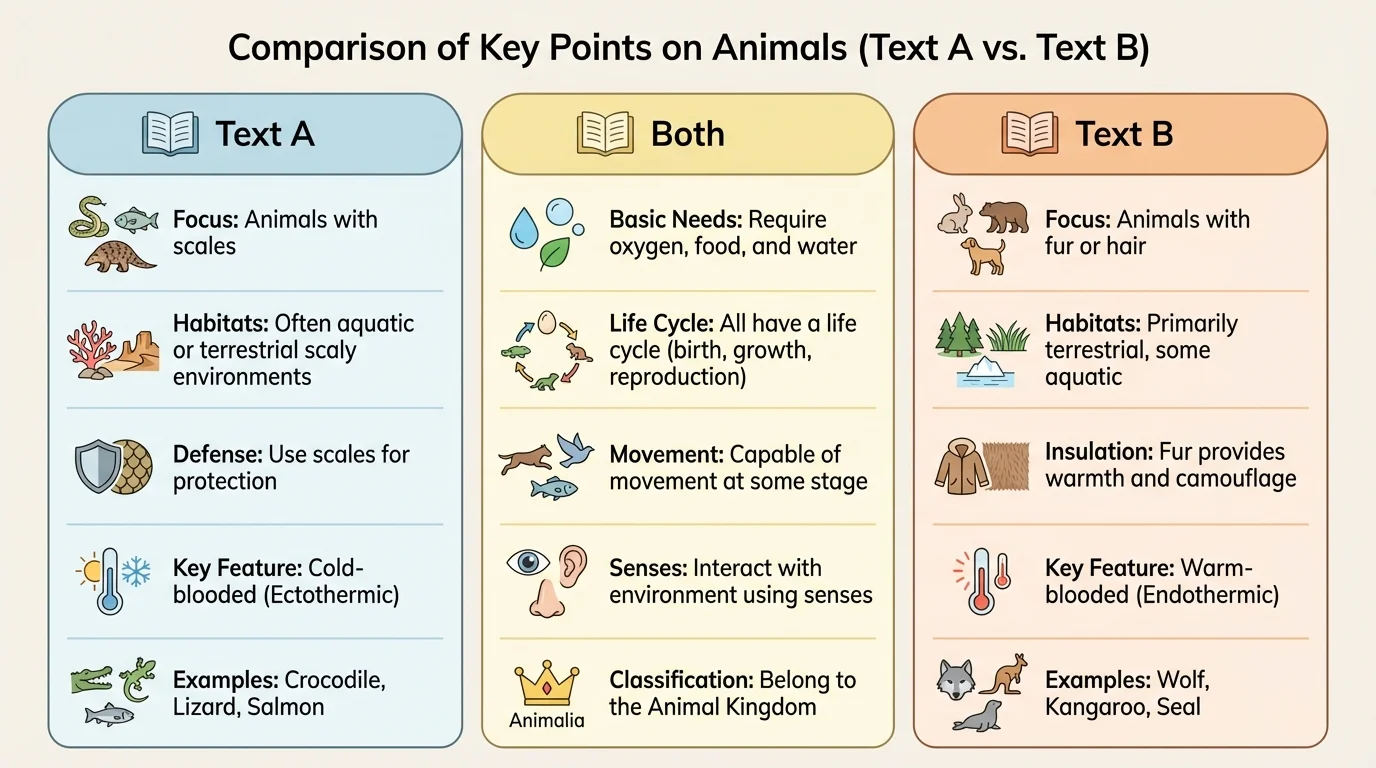
You do not need many words in a chart. Short notes are enough. Later, you can turn the chart into sentences. A chart is a tool to help your brain sort information.
| Text A | Both Texts | Text B |
|---|---|---|
| Talks about where ducks live | About ducks | Talks about what ducks eat |
| Mentions ponds | Ducks have feathers | Mentions plants and bugs |
Table 1. A simple comparison chart showing ideas only from Text A, ideas from both texts, and ideas only from Text B.
Later, when you explain your thinking, the chart in [Figure 1] still helps because it reminds you to include information from both texts, not just one.
After you compare and contrast, you need to say your ideas clearly. Good readers use words that show which text they mean. They do not speak in a confusing way.
You might say, "Both texts are about spiders." You might also say, "The first text tells how spiders make webs, but the second text tells what spiders eat." These sentences are clear because they name the shared topic and the difference.
Helpful sentence starters include: "Both texts say...," "One difference is...," "The first text..., but the second text...," and "Both authors explain...." These starters can help you speak and write in an organized way.
Sentence models
Step 1: Name the shared topic.
"Both texts are about whales."
Step 2: Tell a similarity.
"Both texts say whales live in the ocean."
Step 3: Tell a difference.
"The first text explains whale songs, but the second text explains what whales eat."
Notice that each sentence uses information from the texts. It is not just a guess. It is based on what the reader learned.
[Figure 2] Let us look at an example. Suppose Text A and Text B are both about butterflies. That means the topic is the same.
Text A says butterflies begin as caterpillars. It explains that they change inside a chrysalis. It also says many butterflies drink nectar from flowers.
Text B says butterflies have colorful wings. It explains that butterflies visit flowers. It also says a butterfly starts life as an egg and changes as it grows.
Now we can compare. Both texts are about butterflies. Both texts explain that butterflies change as they grow. Both texts mention flowers. Those are similarities.
Now we can contrast. Text A talks about caterpillars and a chrysalis. Text B talks about colorful wings and begins with the egg stage. Those are differences. Each text gives some information the other text does not.
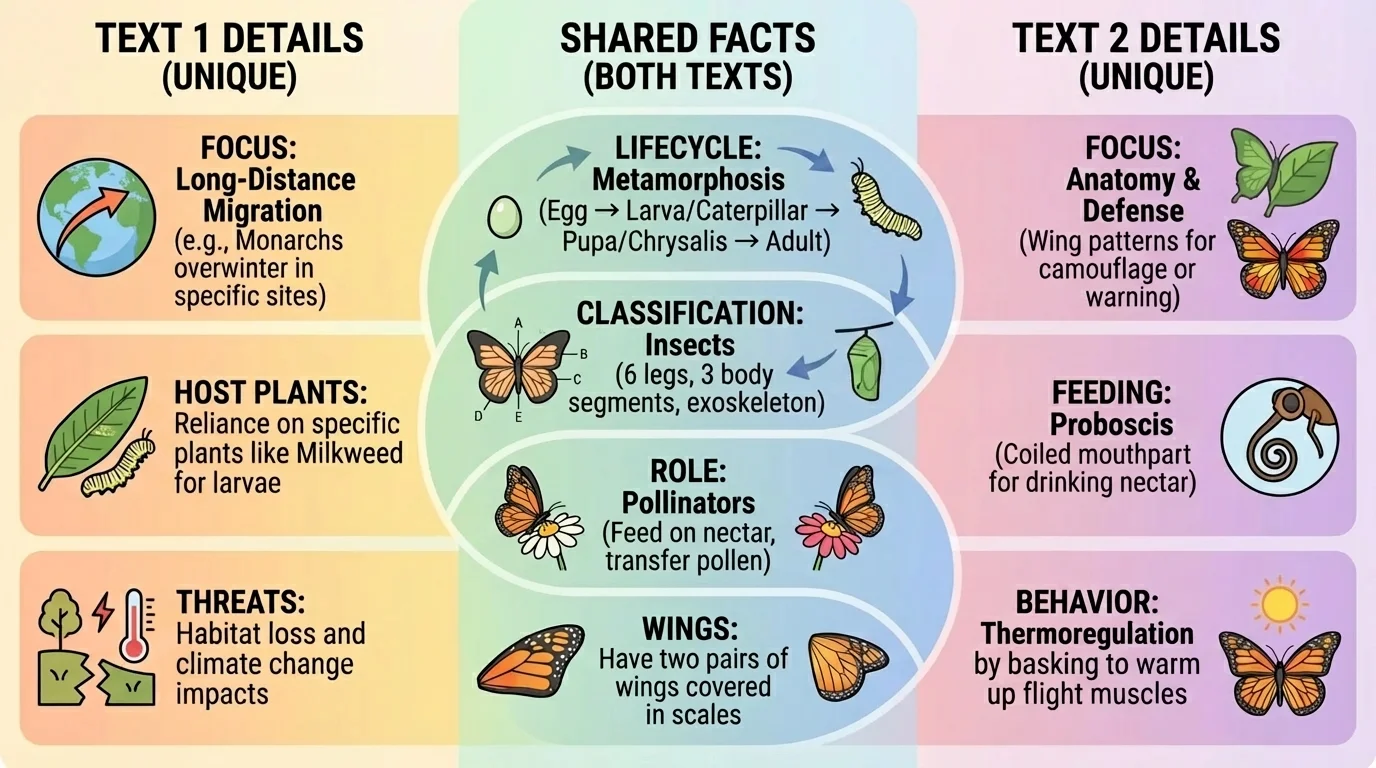
Butterfly comparison
Step 1: Find the shared topic.
Both texts are about butterflies.
Step 2: Find ideas in both texts.
Both texts explain butterfly growth and mention flowers.
Step 3: Find ideas from only one text.
Text A mentions caterpillars and a chrysalis. Text B mentions colorful wings and the egg stage.
A reader could say, "Both texts are about butterflies. Both texts teach that butterflies change as they grow. The first text focuses more on caterpillars and the chrysalis stage, but the second text focuses more on wings and eggs." That is a strong compare-and-contrast answer.
If you look back at the organizer in [Figure 2], you can see how shared ideas stay together while different ideas are separated. That makes it easier to explain your thinking in complete sentences.
One common mistake is naming details that are too small. If the detail does not help explain the topic, it may not be an important point. Try to choose facts that really teach something meaningful.
Another mistake is talking about only one text. To compare and contrast, you must use evidence from both texts. If you only tell about Text A, you are not really comparing.
A third mistake is mixing up topic and detail. "Butterflies" is a topic. "Butterflies drink nectar" is a detail about the topic. Knowing the difference helps you stay organized.
"Good readers do not just collect facts. They connect facts."
It is also important to be accurate. Do not add something that the text never said. Your ideas should come from reading carefully.
Comparing and contrasting texts helps in many school subjects. In science, you may read two texts about weather. In social studies, you may read two texts about communities. In health, you may read two texts about eating healthy foods.
This skill also helps in everyday life. You might read two short articles about caring for a pet. One may explain food, and another may explain exercise. Comparing them helps you understand the full topic better.
When readers compare texts, they become stronger thinkers. They notice patterns, ask smart questions, and build bigger understanding. That is why this reading skill is so powerful.
