Have you ever dropped your ice cream, heard a loud storm, or felt nervous before your turn in class? Big moments can make people act in different ways. Story characters do that too. When something important happens in a story, readers pay attention to what the characters do next. That helps us understand the story better.
When we read literary texts such as stories, folktales, and fairy tales, we do more than follow the plot. We also think about the people in the story. We ask, "What happened?" and "How did the character react?" A character might feel afraid, brave, upset, excited, or confused. A character might run, hide, help, shout, laugh, or make a plan.
A major event is an important thing that happens in the story. It is not a tiny detail. It is a part that matters a lot. For example, a big wind blows down a bird's nest. A child loses a backpack. A family moves to a new home. These events can change what happens next.
A challenge is a problem, hard moment, or obstacle. A challenge gives the character something to face. In a story, a challenge might be crossing a creek, making a new friend, fixing a mistake, or finding the way home before dark.
Character means a person or animal in a story. Major event means an important happening in the story. Response means how a character acts, speaks, thinks, or feels after something happens.
Sometimes a major event is also a challenge. For example, if a puppy runs away, that is an important event. It is also a challenge because the character must decide what to do. Good readers notice both the event and the response.
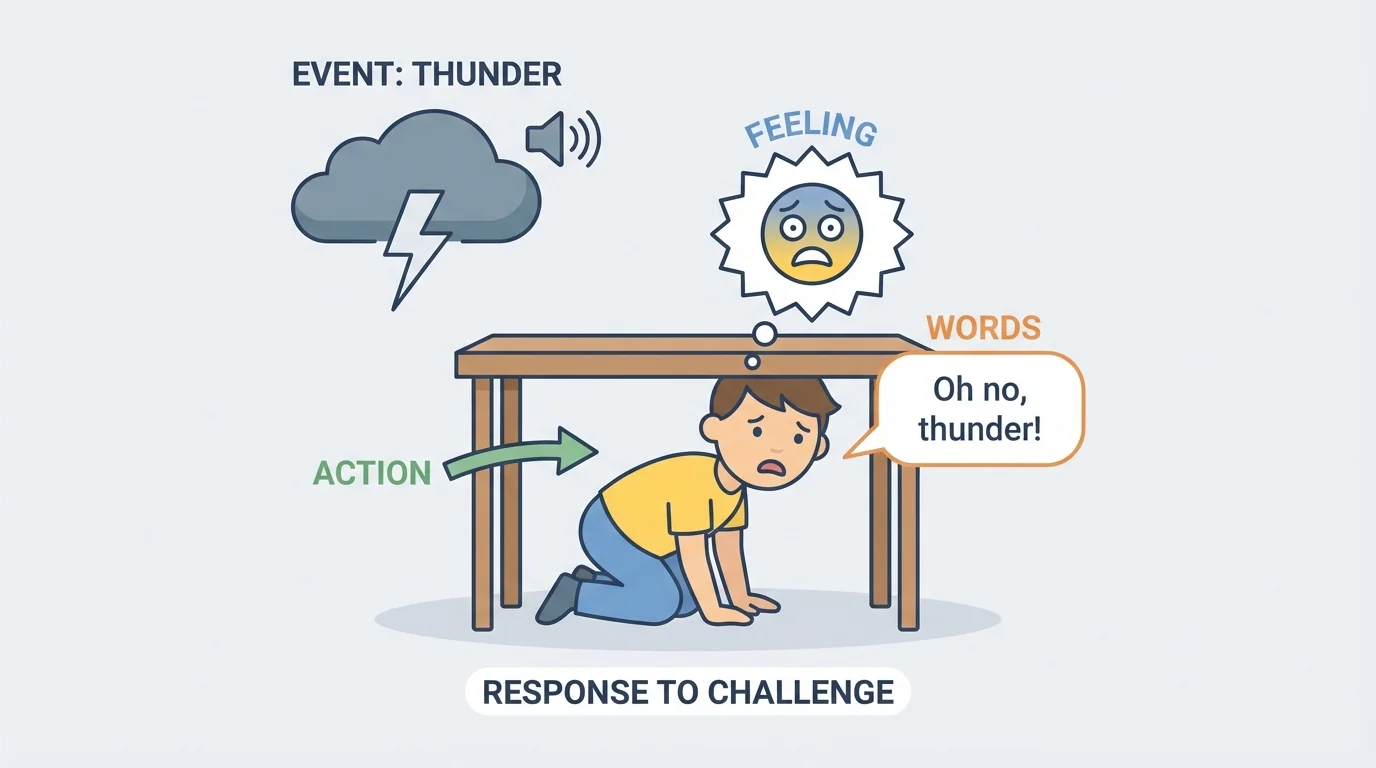
A character's response can be understood in several ways, as [Figure 1] shows. We can watch the character's actions, listen to the character's words, and think about the character's feelings and thoughts. All of these are clues.
Suppose a story says, "Mila heard thunder. She pulled the blanket over her head and whispered, 'I hope the storm ends soon.'" We can tell that Mila feels scared. How do we know? We know this because of what she does and says.
Readers often ask simple questions: What did the character do? What did the character say? How did the character feel? Why did the character act that way? These questions help us understand the character, not just the event.
Here is another example. In a story, Ben sees that his little sister cannot reach her kite in a tree. Ben gets a stool, asks a grown-up for help, and stays calm. Ben's response shows that he is helpful and thoughtful. He does not ignore the problem. He tries to solve it carefully.
Sometimes a response is on the outside, like running or laughing. Sometimes it is on the inside, like worrying or hoping. Readers learn about inside feelings from clues in the words and pictures.
How to notice a response
When something important happens in a story, stop and look for clues right away. The next sentences often tell how the character responds. Look for feeling words, action words, and dialogue. If the story has pictures, the character's face and body can give clues too.
If a rabbit in a story drops a basket of apples and then smiles and starts picking them up, the rabbit may feel surprised at first but then decides to fix the problem. One event can lead to more than one response over time.
Strong readers use evidence from the story. Evidence means details that help prove an idea. If you say, "The boy was worried," you should be able to point to details. Maybe the story says his hands shook. Maybe he asked the same question again and again. Maybe the picture shows wide eyes and a frown.
We should not guess wildly. We should think, "Which words in the story help me know this?" If a character stamps a foot and says, "That is not fair!" the evidence shows anger or frustration. If a character hugs a friend and says, "I'm glad you're here," the evidence shows caring or relief.
Using evidence from a story
Story detail: "Lena looked at the tall diving board. She took a step back, held her dad's hand, and said, 'Maybe I'll try the small one first.'"
Step 1: Notice the major event or challenge.
Lena is facing the tall diving board.
Step 2: Find the character's response.
She steps back, holds her dad's hand, and chooses the small diving board first.
Step 3: Use the clues to understand the feeling.
These details show that Lena feels nervous, but she still tries in a smaller, safer way.
This response tells us that Lena is cautious and brave at the same time.
Pictures can help too, especially in stories for young readers. A picture may show tears, a smile, crossed arms, or a helping hand. But we still connect the picture to the words in the story.
The same event does not make every character react in the same way, as [Figure 2] illustrates. One character may rush forward. Another may freeze. One may laugh. Another may cry. Different responses make stories interesting.
Think about a story where a class pet gets loose. One student might gently try to catch it. Another might call for the teacher. Another might feel too scared to move. All of them are responding to the same event, but each response is different.
Why are the responses different? Characters may have different personalities, feelings, experiences, or ideas. A careful character may stop and think first. A bold character may act quickly. A younger character may need help from an older character.
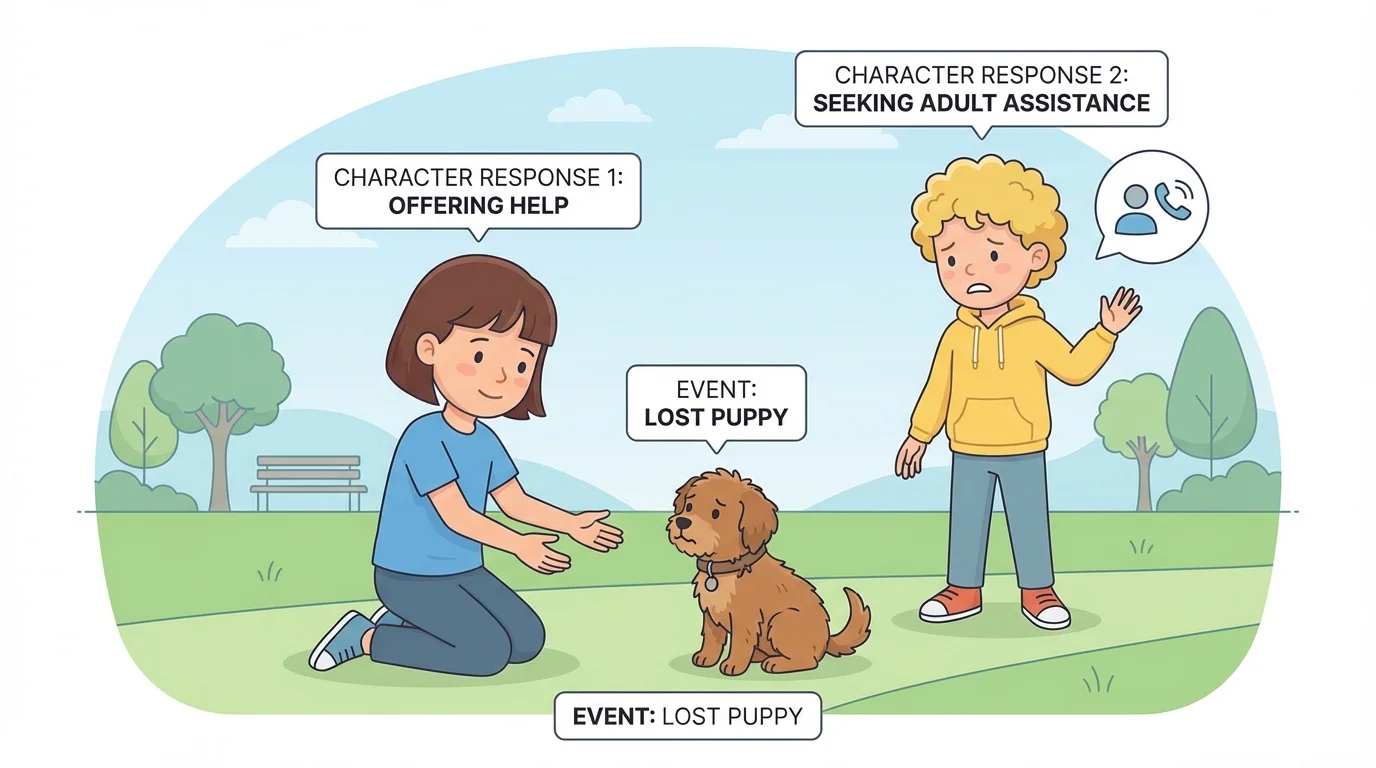
Comparing responses helps us understand characters better. If one sister loses a game and smiles, saying, "Good job," she may be a good sport. If the other sister stomps away, she may be upset or have trouble handling disappointment.
Later in the story, these different responses can lead to different results. The calm character may solve the problem faster. The worried character may ask for help. The careless character may make the challenge bigger. When we remember the different reactions from [Figure 2], it becomes easier to compare characters clearly.
Stories often show the same problem through more than one character. This helps readers see that there can be many ways to handle a challenge.
Sometimes there is not just one "right" response. A character who asks for help is not weak. A character who pauses before acting is not always afraid. Readers look at the details before deciding what a response means.
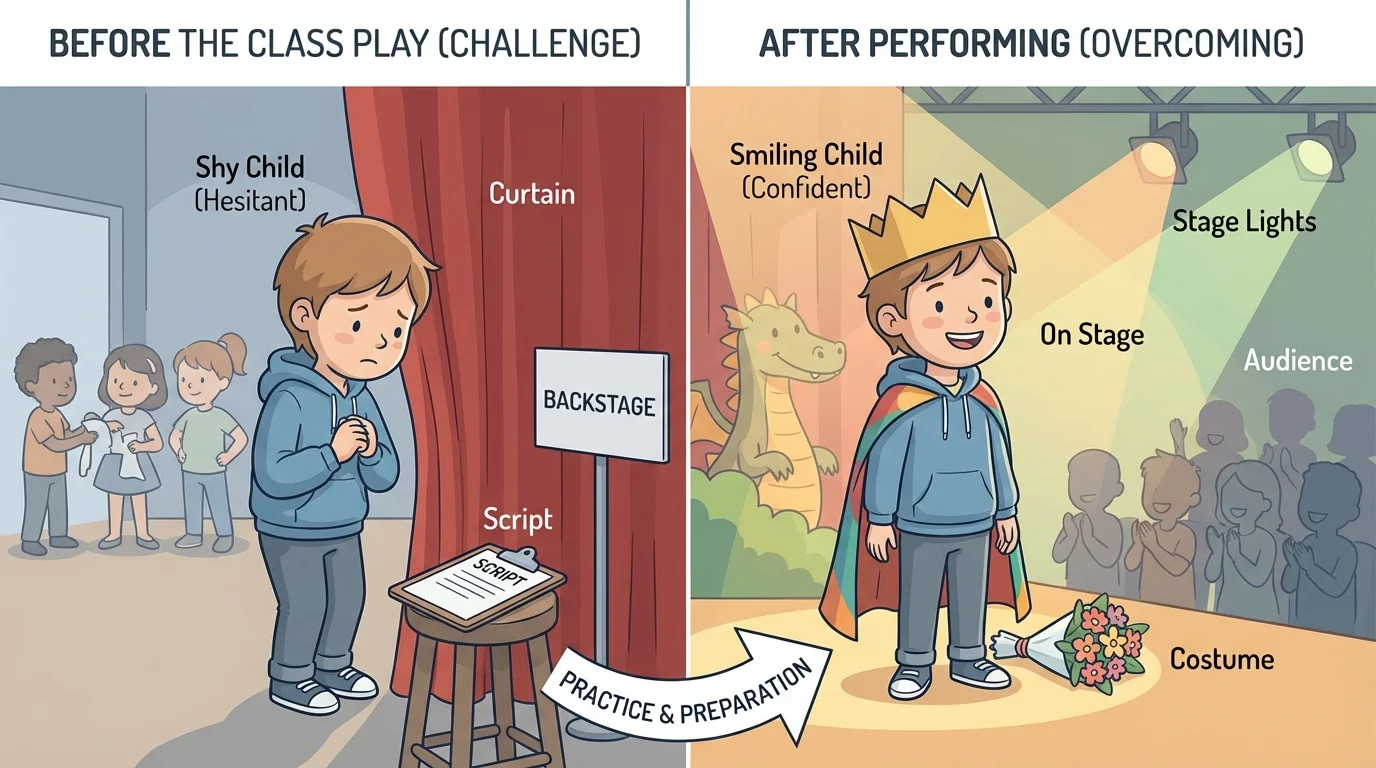
Important events can change a character over time, as [Figure 3] shows with a before-and-after view. At the start of a story, a character may be shy, impatient, afraid, or selfish. After facing a challenge, that character may become braver, kinder, more patient, or more confident.
For example, a child in a story may be afraid to speak in front of the class. Then the child practices, gets encouragement, and finally shares a poem aloud. The response to that challenge shows growth. The child may still feel nervous, but now the child acts with courage.
Not all change is fast. Sometimes a character changes little by little. The first response may be fear. The next response may be trying. The final response may be success. Watching those changes helps readers understand the character's journey.
We can ask, How was the character at the beginning? What happened? How did the character respond at the end? These questions help us see growth. The change in [Figure 3] reminds us that challenges often reveal new strengths.
Character change in a story
At first, Omar does not want to ride his bike without training wheels. He says, "I can't do it." Later, he falls, gets back up, and tries again. At the end, he rides across the yard and shouts, "I did it!"
Step 1: Identify the challenge.
Omar is learning to ride without training wheels.
Step 2: Notice the early response.
At first, he feels unsure and says he cannot do it.
Step 3: Notice the later response.
He keeps trying after falling and finally succeeds.
Omar changes from doubtful to confident.
Sometimes a character does not change in a good way. A character might become more selfish after winning a prize, or more stubborn after being corrected. Readers still pay attention to how major events affect that character.
When you explain a character's response, it helps to say the event first and the response next. You can use sentence patterns like these: The character responded by... When ___ happened, the character felt... I know this because the story says...
Here are some clear examples. "When the bridge broke, the goats stopped and looked for another way across." "After Ana lost her library book, she felt worried and asked the librarian for help." "When the dragon heard the baby cry, it gently carried the baby home." Each sentence names the event and tells the response.
You can also use story details to support your idea. Instead of saying only, "Kai was sad," you can say, "Kai was sad because he sat alone, stared at the ground, and did not answer his friend." That sounds stronger because it includes evidence.
Readers already know how to retell what happens first, next, and last in a story. Now they use that same skill to notice how a character reacts during those parts of the story.
As you read, keep thinking about cause and effect in a simple way. Cause: something important happens. Effect: the character responds. If the lantern blows out, the campers huddle together. If the lost duckling peeps loudly, the mother duck searches faster. If a friend shares crayons, the child smiles and says thank you.
Good readers do not only notice the challenge. They also notice the heart of the story: what the character does when the challenge comes. That is how we learn who the character really is.
