Have you ever heard two people tell the same story in two different ways? One person might say, "That was exciting!" while another says, "That was scary!" Stories work like that too. In a story, characters do not always think the same thing. Learning to notice those differences helps you understand the story better and makes reading aloud more fun.
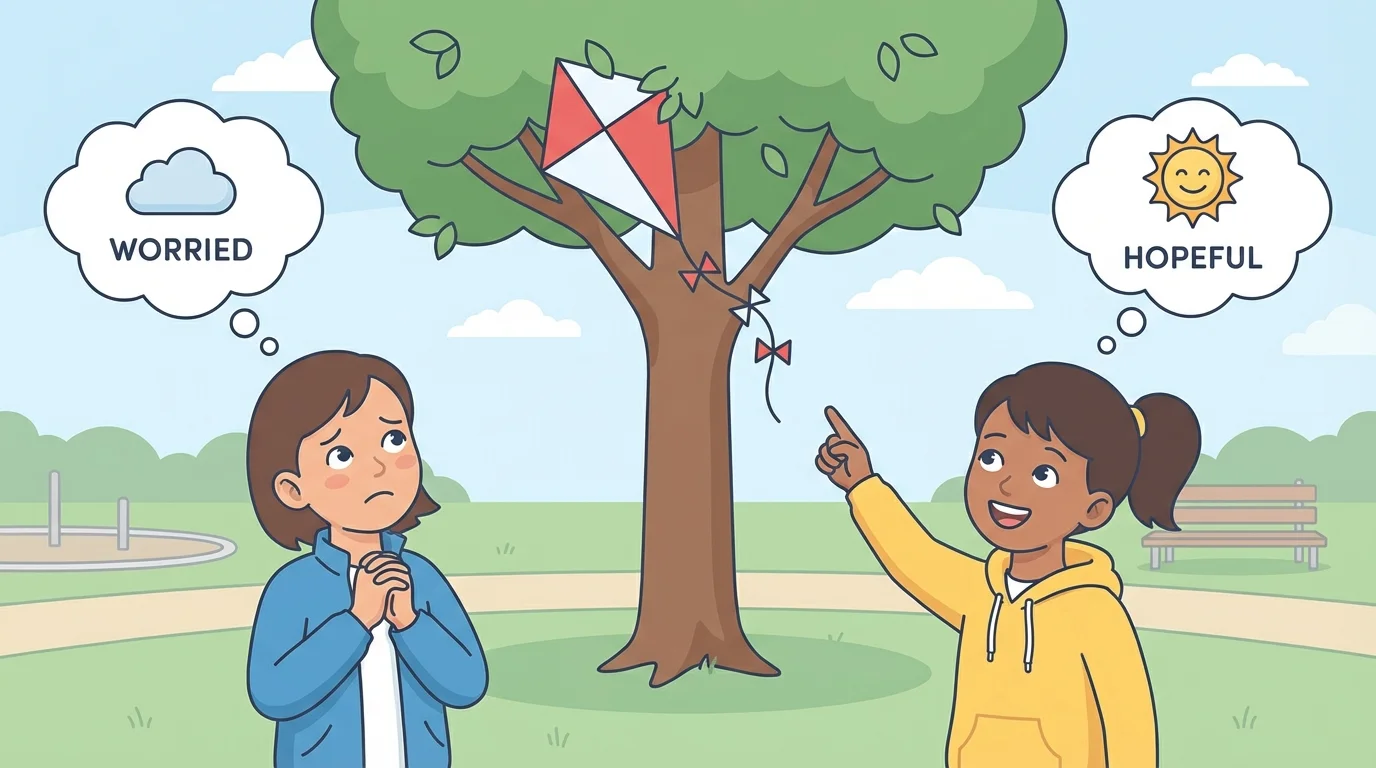
In reading, a point of view is the way a character thinks, feels, or sees what is happening. Two characters can be in the same place at the same time, but they may have very different ideas about what is going on. As [Figure 1] shows, the same event can feel upsetting to one character and exciting to another.
Point of view is the way a character sees, thinks about, or feels about something in a story.
For example, a kite gets stuck in a tree. One child might feel sad because the kite is gone. Another child might feel hopeful because an adult can help get it down. The event is the same, but the characters' thoughts and feelings are different. That is the difference in their point of view.
Readers pay attention to these differences because they help explain why characters act the way they do. A nervous character may hide. A brave character may climb. A patient character may wait for help. Their choices connect to their point of view.
Authors give readers clues. A character may show a point of view through actions, facial expressions, and words. If a character stomps, crosses arms, and says, "This is the worst day ever," that character probably feels upset. If another character smiles and says, "We can still have fun," that character probably feels cheerful or calm.
Sometimes the clue is in dialogue, which is the words characters say. Dialogue helps readers hear what a character thinks. Listen to these lines from a made-up story:
Ben said, "Oh no! Rain ruined our picnic." Maya said, "Great! Now we can splash in puddles."
Ben and Maya are talking about the same rainstorm, but Ben feels disappointed while Maya feels excited. Their words tell us their points of view.
Using clues from a story
Readers learn about a character's point of view by noticing what the character says, does, and feels. We can also look at what the narrator tells us and how other characters react. When several clues match, the character's point of view becomes clear.
Sometimes a character's point of view changes. At first, a child may be afraid of a new dog. Later, after the dog licks the child's hand and wags its tail, the child may feel safe. Good readers notice when a character changes from one feeling to another.
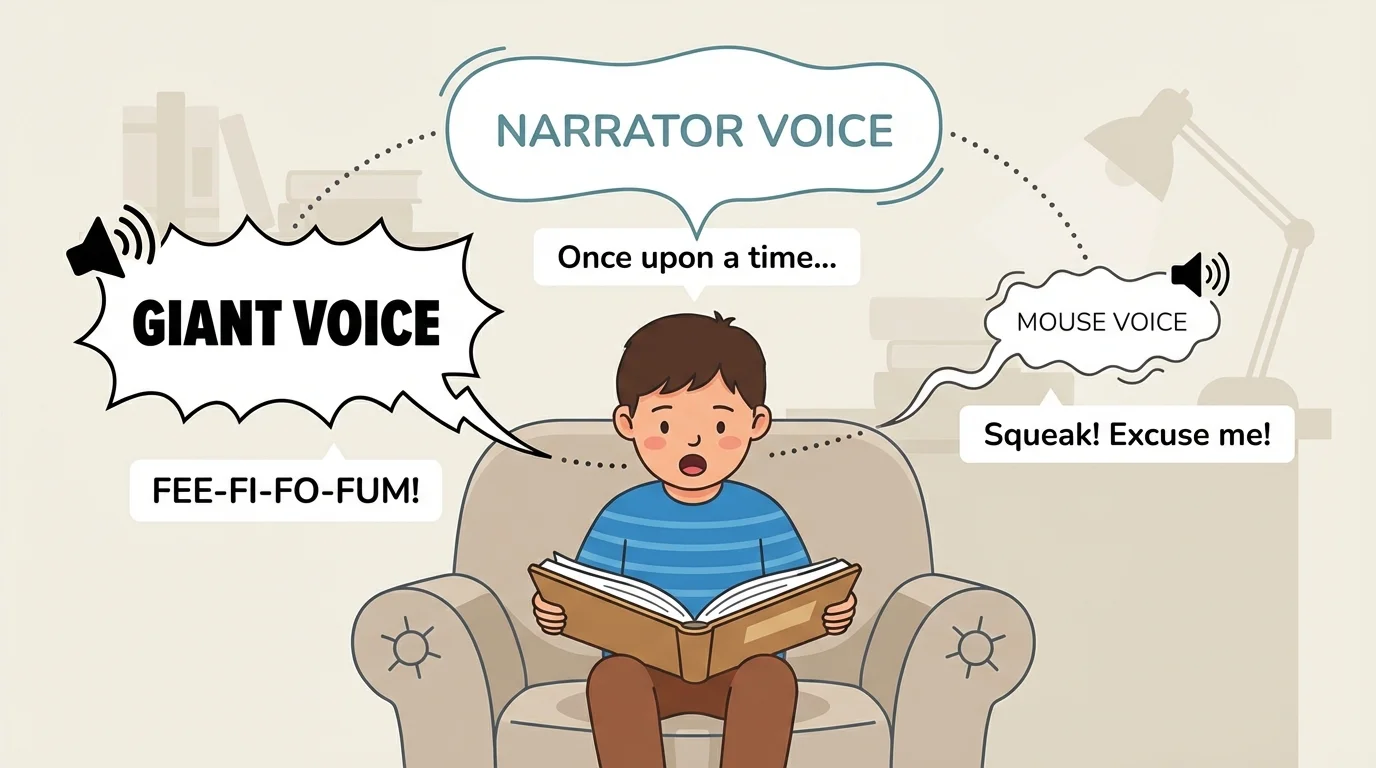
When you read dialogue aloud, you can help listeners understand the story by using a different voice for each speaker. This does not mean you need a silly or dramatic performance. It means your voice should match the character's feelings and personality. As [Figure 2] illustrates, a calm narrator, a booming giant, and a squeaky mouse do not sound the same.
A dialogue line can sound angry, excited, shy, proud, or worried. If a little mouse says, "Please don't step on my tail," you might use a soft, tiny voice. If a giant says, "Who is in my cave?" you might use a louder, deeper voice. If the narrator says, "The wind blew through the dark trees," you might return to a steady, clear reading voice.
Different voices help show who is speaking. They also help show each character's point of view. A brave knight might sound strong and ready. A frightened child might sound shaky and quiet. A grumpy bear might sound low and rough.
Example: Matching the voice to the character
Read these lines and think about how each speaker feels.
Step 1: Look at the words
"I knew we could do it!" says Ana. These words sound proud and happy.
Step 2: Match the feeling
A proud, happy voice might sound bright and strong.
Step 3: Compare with another speaker
"I wasn't sure at all," says Luis. These words sound worried or unsure, so the voice might be softer and slower.
Using different voices helps listeners hear the difference between Ana's and Luis's points of view.
You can also use punctuation to help. A question mark often tells you the character may sound curious or confused. An exclamation point may show excitement, surprise, or strong feeling. The words and punctuation work together.
As we saw earlier in [Figure 1], different feelings can grow from the same event. Reading voices should match those feelings so the story makes sense to listeners.
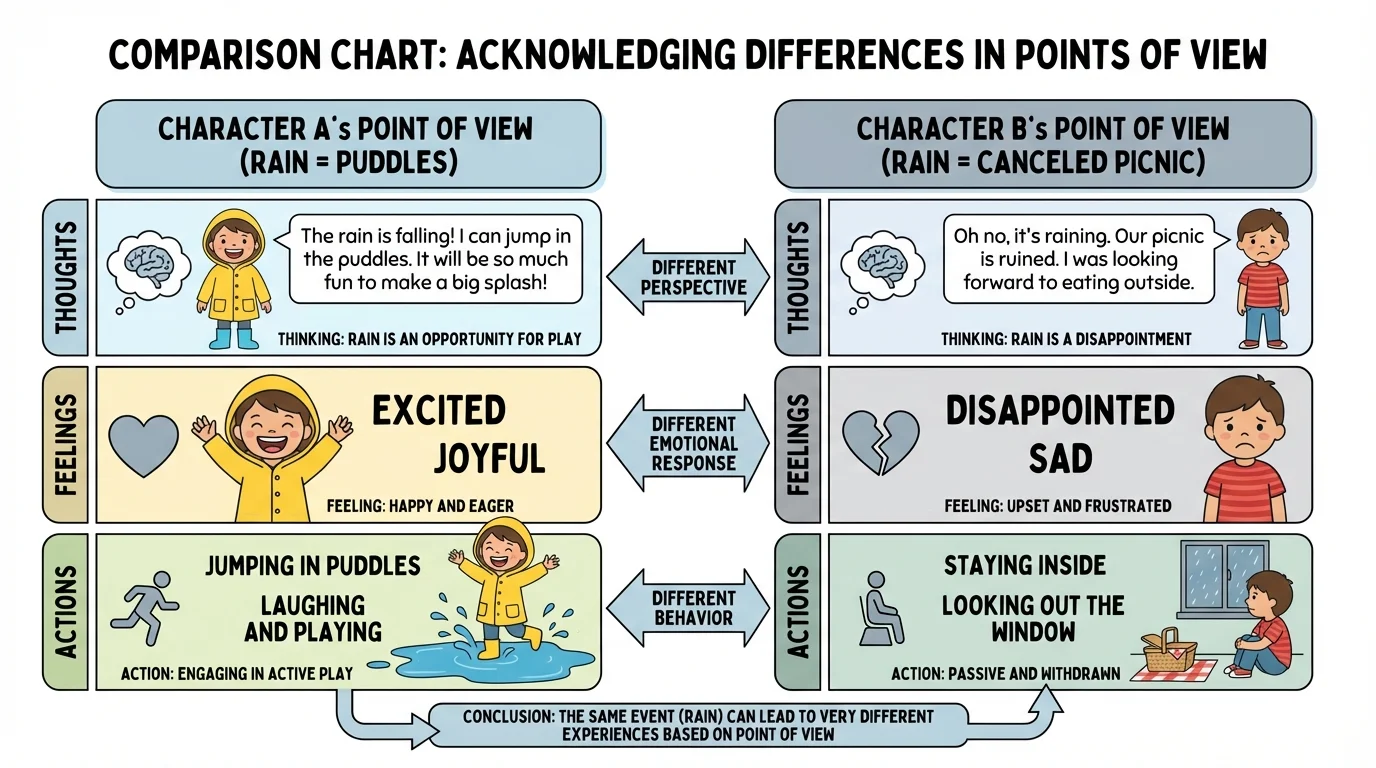
One helpful reading skill is to compare characters. In many stories, two characters look at the same problem in different ways. As [Figure 3] shows, one rainy day can be wonderful to one character and disappointing to another.
Suppose a class trip is planned for the park, and then it rains. A child who loves puddles may grin and say, "Best day ever!" A child who packed a soccer ball may groan and say, "Everything is ruined." These are different points of view about one event.
| Character | What happens? | How the character feels | Clue from the story |
|---|---|---|---|
| Lila | It starts to rain | Happy | "I can wear my boots and jump in puddles!" |
| Owen | It starts to rain | Upset | "Now our picnic is canceled." |
Table 1. A comparison of two characters with different points of view about the same rainy day.
When readers compare characters, they ask simple questions. What does each character want? What does each character fear? What words does each one use? The answers help us understand their different points of view.
Readers are like detectives. They look for clues and put them together. A clue in a story can come from speech, action, or description. If a character whispers, hides behind a chair, and says, "Did you hear that noise?" the character is probably scared. If another character laughs and runs toward the sound, that character may feel curious or brave.
It also helps to notice the narrator. The narrator tells the story, but the narrator is not always a character. The narrator may explain what a character is thinking, such as, "Jada missed her grandmother and felt lonely." That sentence gives a strong clue about Jada's point of view.
Sometimes readers should stop and ask, "Who is speaking? How does this character feel? What words show that feeling?" These questions make understanding stronger.
Actors use voice changes for the same reason readers do: a different sound helps the audience understand who is speaking and how that person feels.
You can even notice point of view in familiar stories. In The Three Little Pigs, the pigs and the wolf do not see the same events in the same way. The pigs feel danger. The wolf may feel hungry or determined. Their actions make more sense when you notice those differences.
Understanding different points of view helps readers do more than follow the plot. It helps them understand people. In stories, just as in real life, people can disagree, worry, celebrate, or hope for different reasons. Seeing those differences makes reading richer and more meaningful.
Different points of view also make stories interesting. If every character felt the same way, stories would be flat. But when one character is hopeful and another is doubtful, the story has tension and feeling. Readers want to know what each character will do next.
Later, when you read aloud and use different voices, you show those differences clearly. A gentle voice, a bold voice, or a worried voice can help listeners understand the characters better, just as the comparison in [Figure 3] helps us see how two characters react differently to one event.
Strong readers listen closely to the words, notice clues, and think about each character's feelings. Then they let those ideas guide the way they read dialogue aloud.
