Have you ever heard someone say something and thought, "Wait... what does that mean?" That tiny moment of confusion is actually a powerful moment for learning. Good listeners do not just stay quiet when they are confused. They ask questions. Good speakers do not give just any answer. They answer clearly, kindly, and with details. When people ask and answer questions together, everyone understands more.
When someone is speaking, we can learn a lot by listening closely. But listening does not always mean understanding everything right away. Sometimes a word is new. Sometimes the idea is tricky. Sometimes we want to know more than the speaker has said. Asking questions helps in three big ways: it helps us clarify meaning, gather more information, and deepen our understanding.
If a classmate says, "My plant drooped because it did not get enough sunlight," you might understand part of that sentence but not all of it. You could ask, "What does drooped mean?" That question helps you understand the speaker's words. You could also ask, "How many days was the plant away from sunlight?" That question gathers more information. Then you might ask, "Why do plants need sunlight to stay strong?" That question helps you think more deeply about the topic.
Clarify means to make something easier to understand. Additional information means more facts or details. Deepen understanding means to think beyond the first answer and learn more about why or how something happens.
These kinds of questions turn a simple talk into real learning. They help us in school, at home, on teams, and with friends.
[Figure 1] Sometimes a speaker says something that is not clear right away. A careful listener notices confusion and asks for help. Clarifying questions are often short and direct. They help us understand a word, an idea, or a direction before we make a mistake.
Here are some clarifying questions: "What do you mean by that?" "Can you say that again?" "Do you mean we should cut the paper first?" "What does that word mean?" "Can you show me?" These questions are not rude. They are smart and helpful.
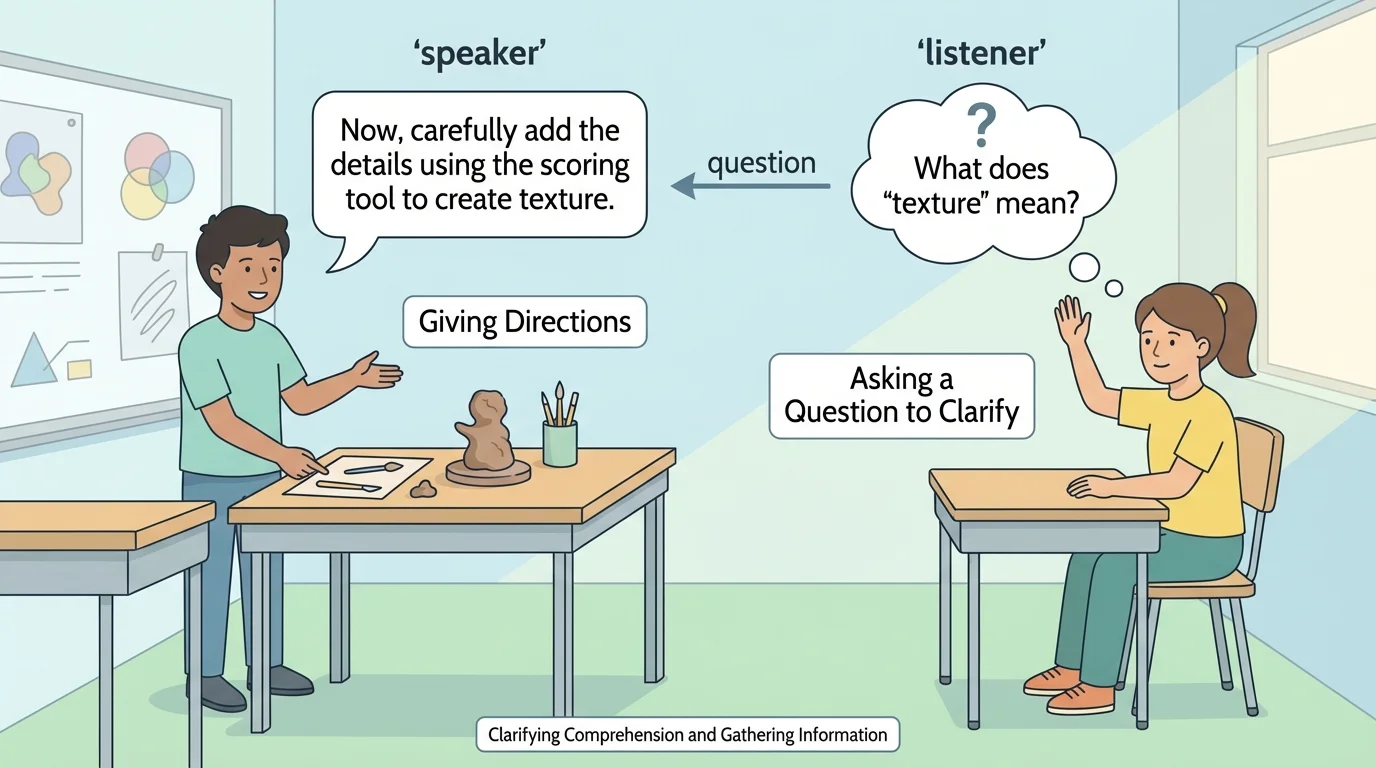
Suppose a teacher says, "Put your paper on the edge of your desk." A student might not know what edge means. Instead of guessing, the student can ask, "Do you mean the side of the desk?" Now the student is clarifying meaning. That means the student is making sure the message is understood correctly.
Clarifying can also happen when the speaker talks too fast or skips an important detail. If a friend says, "Meet me over there after lunch," you might ask, "Where is there?" Without that question, you may not know where to go.
Strong readers and strong listeners both ask questions in their minds. Good learners often stop and think, "Does this make sense?"
Asking for clarification shows that you are paying attention. It is much better to ask than to pretend you understand when you do not.
[Figure 2] Not all questions are about confusion. Sometimes we understand the speaker, but we want more details. Question words help us learn different kinds of information.
Who asks about a person. What asks about a thing, action, or idea. When asks about time. Where asks about place. Why asks for a reason. How asks about the way something happens or is done.
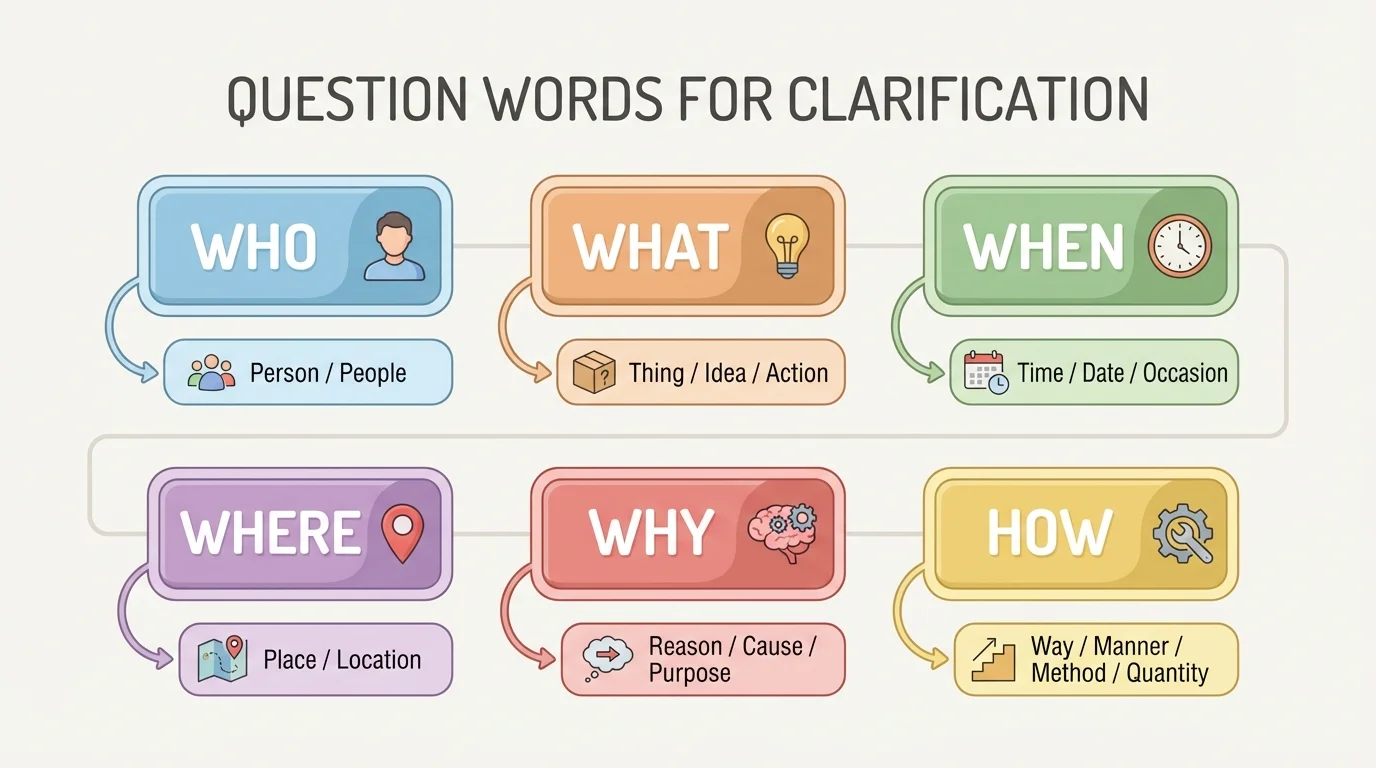
If a speaker says, "We visited a farm and learned how cheese is made," you might ask, "Who showed you how to make it?" "What tools did you use?" "When did you visit?" "Where was the farm?" "Why does milk change into cheese?" and "How long did it take?" Each question helps gather additional information.
These questions are useful when listening to stories, science talks, class discussions, or directions. They help you build a fuller picture in your mind. Later in a conversation, those same question words can also help you check details you may have missed.
Some questions go beyond simple facts. They help us think about ideas, feelings, choices, and problems. These are deeper questions. They often begin with "why do you think," "how do you know," or "what might happen if."
If a classmate says, "The main character gave away her lunch," a shallow question might be, "What did she give away?" A deeper question might be, "Why do you think she chose to share?" or "How did giving away her lunch change the story?" These questions help us understand feelings, causes, and results.
We can also deepen understanding of an issue. An issue is a topic or problem people may think about or discuss. If students are talking about playground litter, one question could be, "Where is the trash?" A deeper question could be, "Why do you think litter keeps happening?" Another could be, "How can our class help solve the problem?"
Questions can grow thinking. A simple question helps you get a fact. A deeper question helps you connect ideas, explain reasons, and think about solutions. Both kinds matter.
When we ask deeper questions, we do more than collect words. We learn how ideas fit together.
[Figure 3] To ask good questions, you first need active listening. Active listening means listening in a way that shows care, attention, and thoughtfulness. It is not just hearing sound. It is focusing on the speaker's words and meaning.
Active listeners face the speaker, keep a quiet body, watch for important details, and wait for the right time to speak. They do not interrupt. They think about what the speaker is saying. They may nod, look interested, or hold their question until the speaker finishes.
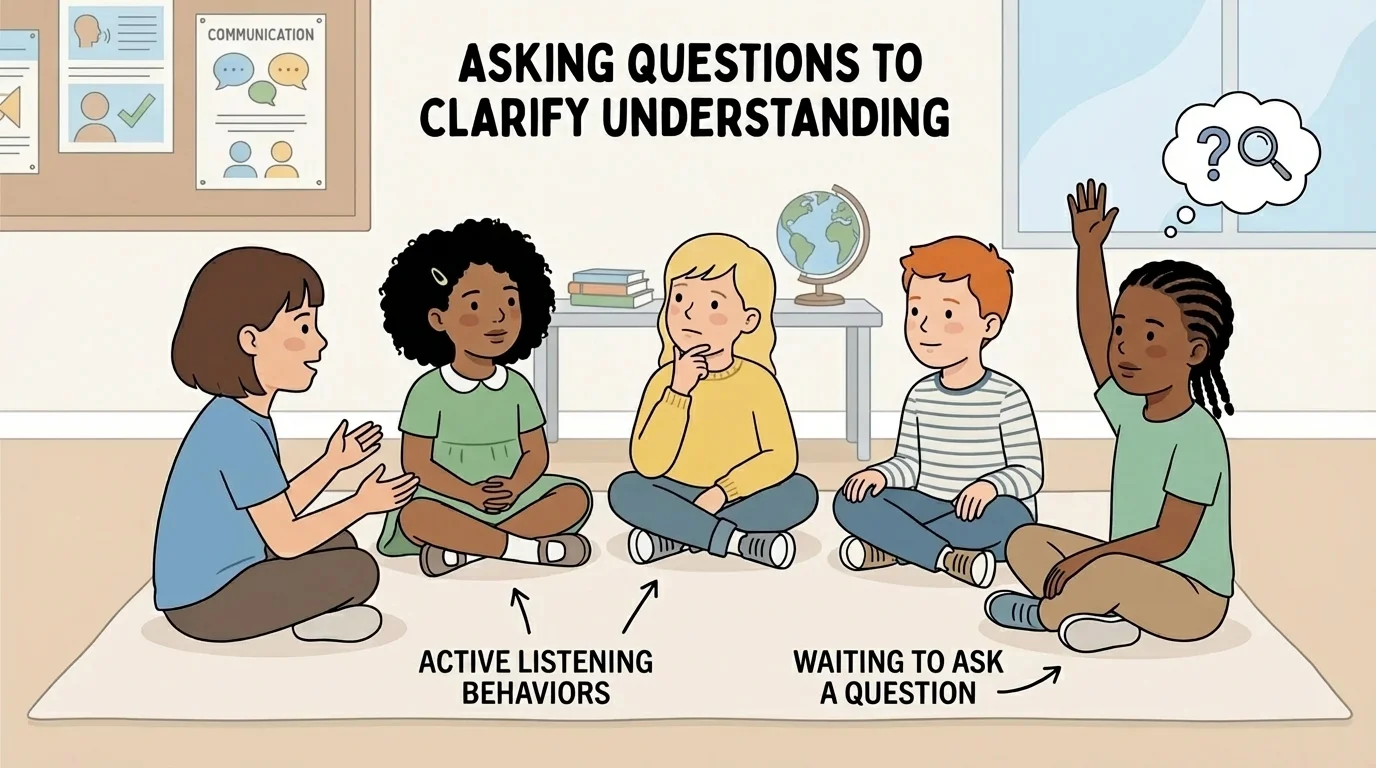
Listening with your whole body also means listening with your mind. You can silently ask yourself: "What is the big idea?" "What part do I understand?" "What part is confusing?" "What do I want to know more about?" These private questions help you get ready for the spoken question you may ask next.
When students use the listening habits shown in [Figure 3], conversations become smoother and more respectful. The speaker feels heard, and the listener understands more.
You already know how to take turns in a conversation. This skill still matters here: one person speaks, the other listens, then the listener responds with a question or answer.
Good listening makes good questioning possible.
Answering well is just as important as asking well. A helpful answer stays on the topic and gives enough information. If someone asks, "Why did the ice melt?" a weak answer is "Because it did." A stronger answer is "It melted because the sun warmed it up."
Helpful answers often use complete sentences. You can also use part of the question in the answer. For example, if someone asks, "How did you build the tower?" you can answer, "I built the tower by putting the biggest blocks on the bottom first." That answer is clearer than saying only, "With blocks."
Sometimes a speaker does not know the answer. That is okay. The speaker can say, "I'm not sure," "I need to check," or "Can you ask me that again?" Honest answers help keep communication clear.
Conversation example
A student says, "Our class made a chart about birds in the schoolyard."
Step 1: Ask to clarify.
"What do you mean by a chart?"
Step 2: Ask for more information.
"What kinds of birds did you see?"
Step 3: Ask to deepen understanding.
"Why do you think some birds came more often than others?"
Each question has a different job, and together they build stronger understanding.
A strong answer can also include examples. If someone asks, "What birds did you see?" a clear answer might be, "We saw sparrows, crows, and a robin." Details help the listener learn more.
Here are some ways this skill works in everyday school talk. If a partner says, "We need to sort the shapes by sides," you might ask, "What does sort mean?" That is clarification. Then you might ask, "How many sides does this shape have?" That gathers information. Later you might ask, "Why do shapes with the same number of sides belong together?" That deepens understanding.
During a story discussion, a student might say, "The boy felt nervous before the race." You can ask, "What made him feel nervous?" You can also ask, "How do you know he was nervous?" Those questions invite the speaker to use clues from the story.
In science, if a classmate says, "The ice changed into water," you might ask, "When did it start melting?" "What made it melt?" and "How is melting different from freezing?" Good questions open the door to stronger learning.
| Purpose | Question Example | What It Does |
|---|---|---|
| Clarify | "What does that word mean?" | Helps you understand the message clearly |
| Gather information | "Where did it happen?" | Adds facts and details |
| Deepen understanding | "Why do you think that happened?" | Helps you think about reasons and ideas |
Table 1. Three main purposes for asking questions during listening and dialogue.
Dialogue means a conversation where people share ideas by speaking and listening. In respectful dialogue, people take turns, listen carefully, and respond politely. Even when they do not agree, they treat each other kindly.
Polite question starters can help. You might say, "Can you explain that?" "I heard you say ___; did you mean ___?" "I have a question about that part." "Can you tell me more?" "Why do you think that?" These sentence starters make conversations friendly and clear.
Respect also means not changing the topic too quickly. If the class is talking about recycling, a question about pets may not fit. Stay connected to what the speaker is saying. This shows that you are listening and thinking.
"Good questions are a sign of a curious mind."
Sometimes you can build on another person's idea. If one student says, "I think the character was brave," another student might ask, "What did the character do that was brave?" Then a third student might add, "Do you think that choice was easy or hard?" That is how a thoughtful dialogue grows.
Asking and answering questions is more than a school skill. It is a way to learn from other people. When you listen closely, ask clearly, and answer helpfully, you become a stronger learner and a stronger speaker.
