Have you ever answered a question with just one word, and then someone said, "Can you tell me more?" That happens because listeners need enough information to understand us. When we speak in school, especially during presentations and class discussions, our words should be clear, complete, and helpful. A short answer like "Park" or "Yesterday" may not tell enough. A complete sentence gives the listener a full idea.
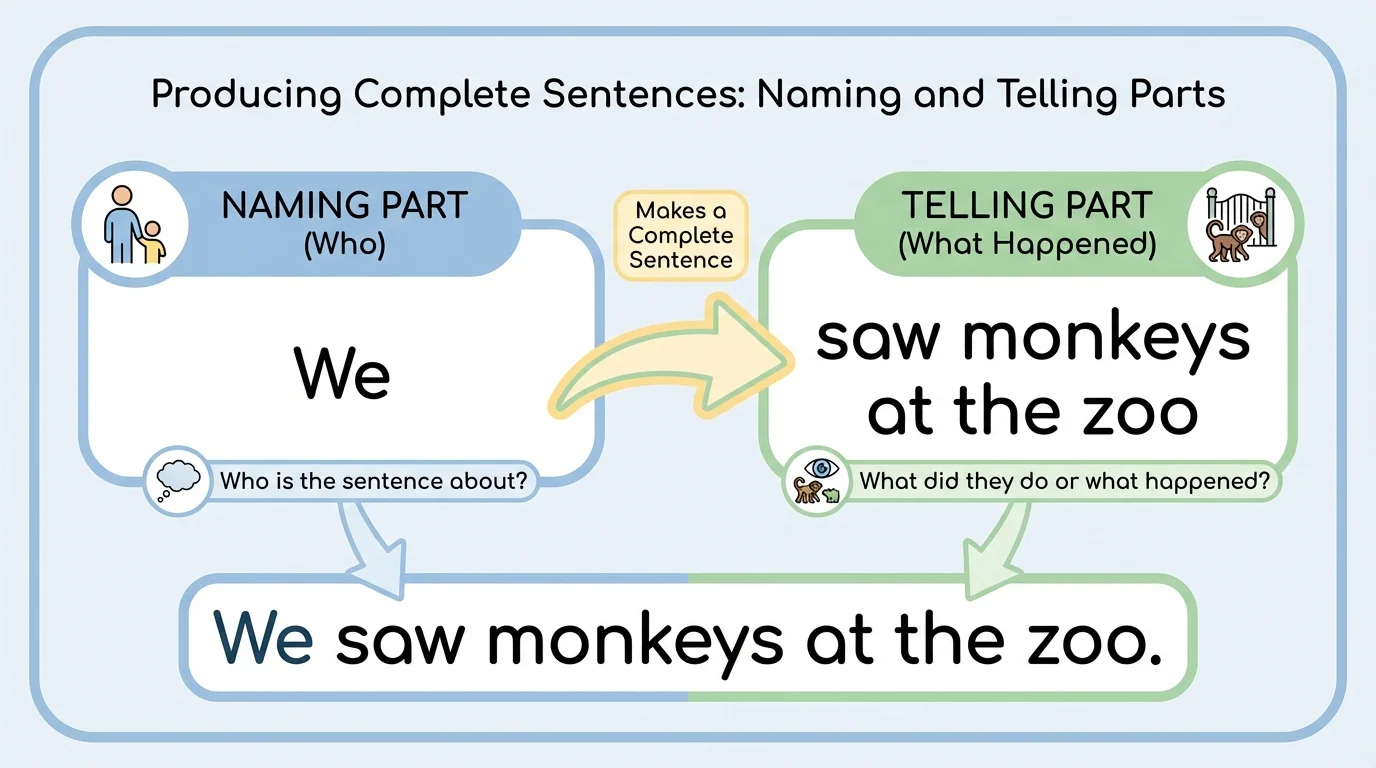
Speaking in complete sentences is an important way to share information. It helps when you are telling about a book, explaining your thinking, answering a teacher's question, or giving more detail after someone asks you to clarify. Clear speaking shows respect for your listeners because it helps them follow your ideas, as shown in [Figure 1].
A complete sentence shares a whole idea. It has the parts a listener needs to understand your meaning. Often, a complete sentence has a naming part, which tells who or what the sentence is about, and a telling part, which tells what is happening.
Listen to this fragment: "At the zoo." That is not a complete sentence because it does not tell the whole idea. Now listen to this: "We saw monkeys at the zoo." That is a complete sentence because it tells who and what happened.
Here are more examples:
Complete sentence means a group of words that tells a whole idea. When you say a complete sentence, your listener can understand what you mean without guessing.
Sometimes a very short sentence can still be complete. "Birds fly." is short, but it gives a whole idea. The goal is not always to make your sentence long. The goal is to make it complete and useful for the task.
When people listen, they cannot reread your words the way they can with a book. They hear your sentence once, so it needs to be clear. A complete sentence helps the listener know exactly what you mean. It also helps you sound prepared and thoughtful.
This matters during class talks and presentations. If you are sharing facts about butterflies and someone asks, "What do caterpillars eat?" a one-word answer like "Leaves" may be too brief. A clearer answer is, "Caterpillars eat leaves from the plants where they live." That sentence gives more information right away.
Clear speaking also helps when you want to stay on topic. If the class is discussing weather, your answer should connect to weather. A complete sentence makes it easier to keep your words focused on the subject.
Listeners often understand and remember ideas better when speakers use full, clear sentences instead of tiny answer fragments. That is one reason teachers ask students to "answer in a complete sentence."
As we saw in [Figure 1], a complete sentence gives both the subject and the action or information. That simple structure helps your ideas sound strong and easy to follow.
A task is the job you are trying to do with your words. A situation is the setting or moment when you are speaking. You may be answering a teacher, talking to a partner, presenting to the class, or explaining something to a small group. Good speakers match their sentence to the moment.
If the teacher says, "Tell us about your science picture," you might say, "My picture shows the life cycle of a frog." If the teacher asks for more, you can add, "First, the frog begins as an egg in water, and later it grows legs." That answer fits the task because it explains the picture.
If a friend asks, "Where are you going?" you might simply say, "I am going to the library." That is complete and clear. But if you are presenting to the class, you would probably need more detail: "I went to the library after school to find a book about sharks."
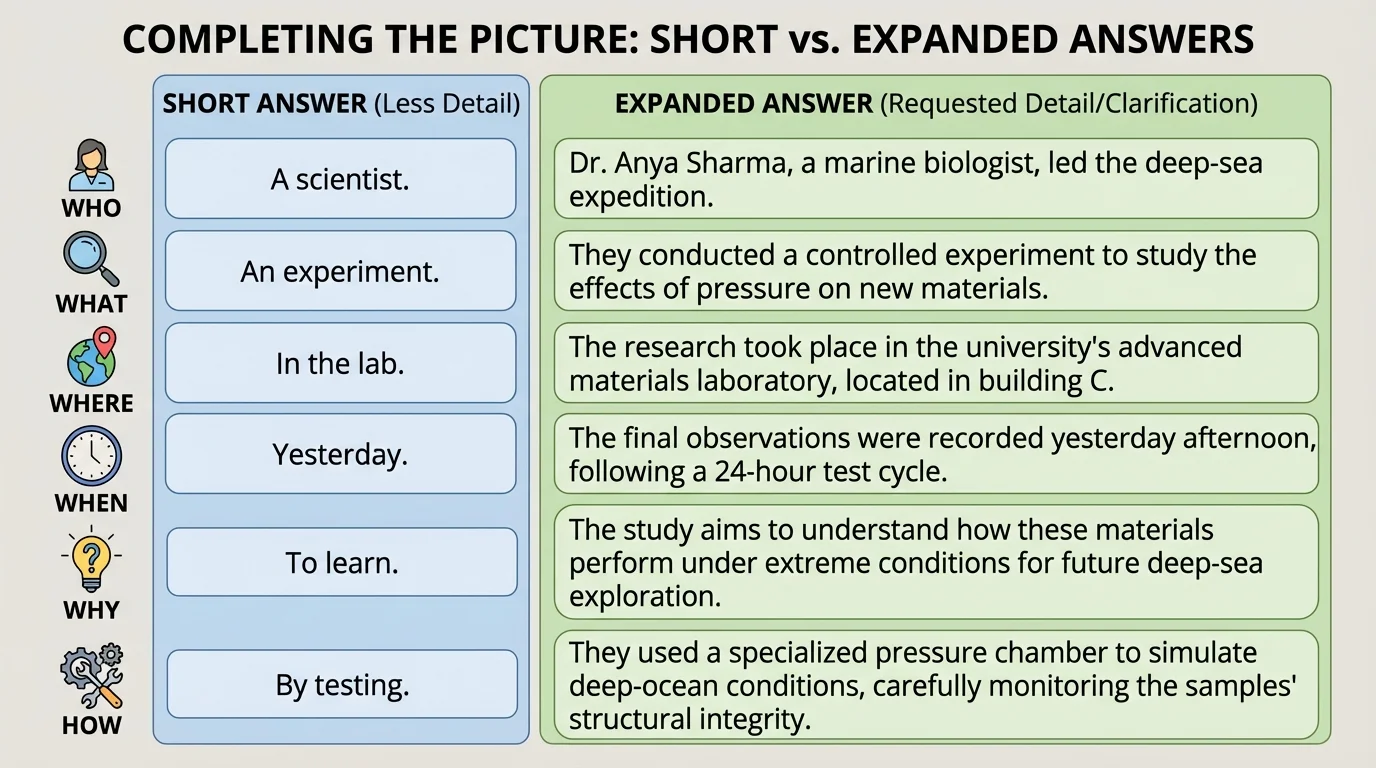
The same idea can be said in different ways depending on what your listeners need. Strong speakers think, "How much detail does this person need?" Then they answer in a sentence that fits, as shown in [Figure 2].
Sometimes your first answer is complete, but the listener needs more. Question words help speakers add the details listeners need. These question words are who, what, where, when, why, and how.
If someone asks, "What did you do after school?" and you answer, "I played," your sentence is on the right track, but it is not detailed enough. A better answer is, "I played soccer with my brother at the park after school." Now the listener knows what you did, with whom, and where.
Look at how details make speech stronger:
| Short answer | Better answer with detail |
|---|---|
| "I read." | "I read a book about penguins before bed." |
| "She helped." | "My sister helped me clean my room on Saturday." |
| "We went there." | "We went to the museum with our class in the morning." |
Table 1. Examples of changing short answers into complete sentences with more detail.
Adding detail does not mean adding every single fact you know. It means adding the information your listener asked for. If the question is "Where did you go?" the place is most important. If the question is "Why did you choose that book?" the reason is most important.
Adding detail to an answer
A teacher asks, "Why did you like the story?"
Step 1: Start with a complete thought.
"I liked the story."
Step 2: Add the reason the listener asked for.
"I liked the story because the main character was brave."
Step 3: Add one more helpful detail.
"I liked the story because the main character was brave and helped her family."
The last answer gives clear detail without wandering off topic.
When you use question words wisely, your speaking becomes fuller and easier to understand. The pattern in [Figure 2] shows that one short answer can grow into a strong sentence when you add the right detail.
Clarify means to make your meaning clearer. Sometimes a listener looks puzzled, asks, "What do you mean?" or says, "Can you explain that?" Good speakers do not get upset. They calmly say the idea again in a clearer way, as illustrated in [Figure 3].
You can clarify by adding details, using different words, or breaking your idea into smaller parts. For example, if you say, "The project was hard," and someone asks, "Why?" you can clarify by saying, "The project was hard because I had to build it, paint it, and finish it on time."
Helpful sentence starters for clarification include:
Clarifying is not repeating the exact same words. If a listener is confused, saying the same sentence in the same way may not help. Clarifying means changing your words or adding the missing detail so the other person understands better.
Here is an example. A student says, "It was exciting." A classmate asks, "What was exciting?" The speaker can clarify: "The field trip was exciting because we got to see dinosaur bones up close." Now the listener understands exactly what was exciting and why.
Classroom speaking often includes sharing ideas aloud and then answering questions. Presentations often include questions and answers. When you present, complete sentences help your audience follow your topic from beginning to end.
If you are presenting about bats, you might say, "Bats are mammals that can fly." That is a complete sentence on topic. If a classmate asks, "Where do bats sleep?" a strong answer is, "Many bats sleep in caves, trees, or other dark places during the day."
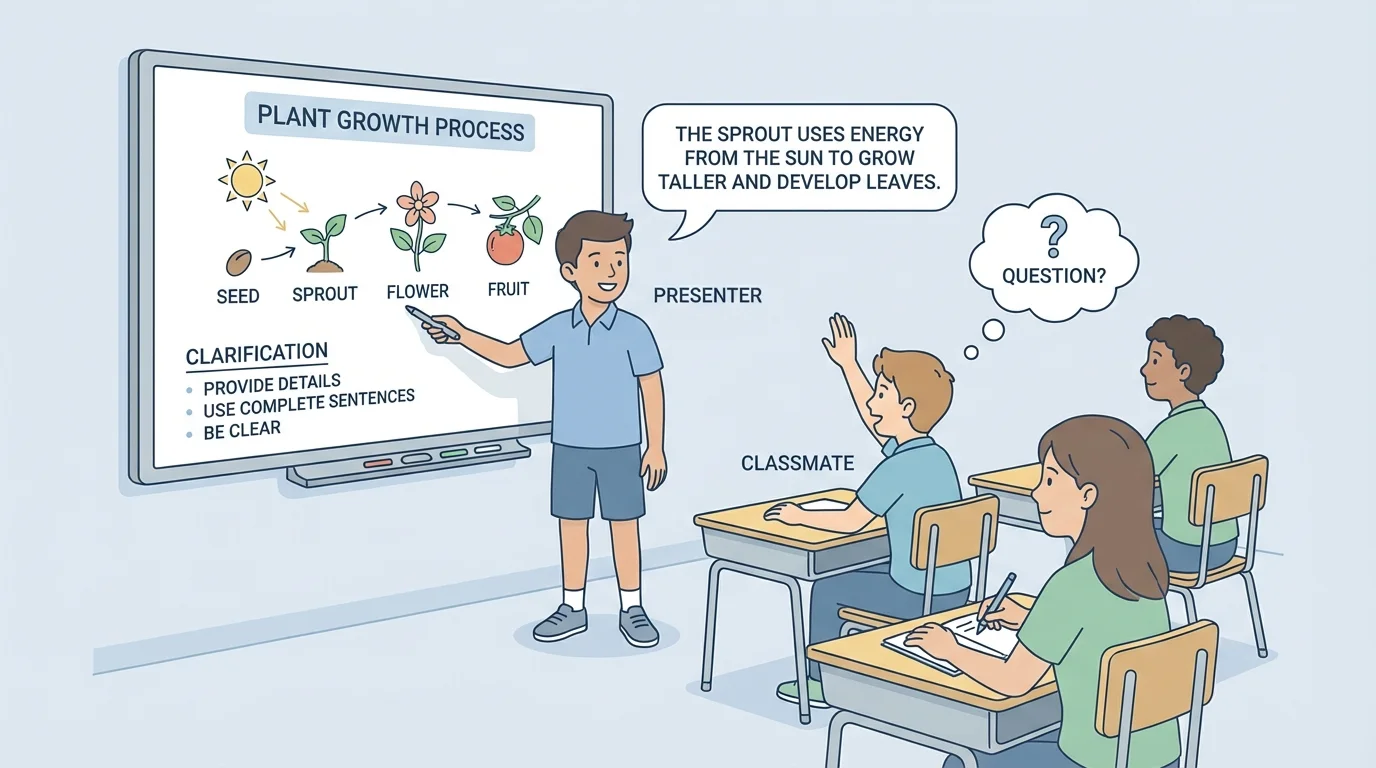
Being ready to discuss means being ready to answer follow-up questions. A follow-up question asks for more information after your first answer. If someone says, "How do you know?" or "Can you tell us more?" you can use complete sentences to explain your thinking.
Staying on topic is important too. If your presentation is about your pet rabbit, do not suddenly begin talking about a movie unless it truly connects. A complete sentence should not only be complete in grammar. It should also fit the topic and the situation.
Good listeners and good speakers work together. First listen to the question carefully. Then answer the question you heard, not a different one.
Later in a discussion, the scene in [Figure 3] still matters because speakers must do two jobs at once: stay focused on the subject and answer clearly enough for the class to understand.
One common mistake is giving a fragment instead of a sentence. Another mistake is giving a sentence that is complete but too vague. A third mistake is giving an answer that does not match the question.
Compare these responses:
Notice that the better answers do more than sound nicer. They actually help the listener learn something. That is the real purpose of complete sentences in speaking.
Listener means the person who hears your words. Strong speakers think about their listeners. They pay attention to what the listener needs to know.
Before you answer, listen all the way to the end of the question. If the question is "When did you finish your drawing?" and you answer, "I used crayons," your answer may be a full sentence, but it does not fit the question. The listener asked about time, not tools.
Good listening helps you choose the right details. If the question asks "where," answer with a place. If it asks "why," answer with a reason. If it asks "how," explain the steps or method. Listening and speaking are a team.
"Say the whole idea, and say the part your listener needs most."
When students listen carefully and speak in complete sentences, class discussions become clearer and more interesting. Everyone can understand the ideas better.
Every time you answer with a complete sentence, you are building a strong speaking habit. You are learning to share information clearly, explain your thinking, and respond to questions with care.
These skills help in many places: during show-and-tell, in partner talk, in reading groups, in science sharing, and at home when telling about your day. Clear speakers help others understand, and they are often more confident because they know how to say what they mean.
You do not need fancy words to be a strong speaker. You need clear, complete ideas. When the task changes, adjust your details. When someone is confused, clarify. When you present, stay on topic. When you listen closely, your answers become stronger.
