Have you ever spoken one way to a teacher and another way to your best friend? Most people do that every day. English can sound careful and polite, or it can sound friendly and relaxed. Learning how to compare these ways of speaking and writing helps you become a strong reader, writer, and speaker.
We do not use exactly the same words in every situation. At school, you might say, "Good morning, Mrs. Lee." On the playground, you might say, "Hi, Sam!" Both are English, but they are used for different reasons.
When we choose words, we think about our audience. The audience is the person or group we are speaking or writing to. We also think about our purpose. Purpose means why we are speaking or writing. Are we asking for help? Are we talking to a friend? Are we writing a note to the principal?
Formal English is careful, polite English that is often used at school, in important writing, or when speaking to adults we do not know well.
Informal English is relaxed, friendly English that is often used with family and friends.
Neither kind is "better" all the time. The important thing is to match your words to the situation. A soccer coach, a grandparent, a classmate, and a librarian may all hear different word choices from the same child.
Formal English uses polite words, clear sentences, and a respectful tone. Formal English is often used when talking to a principal, writing a thank-you letter, asking a teacher a question, or speaking in front of a class.
[Figure 1] Formal English often includes complete greetings and polite words such as "please," "thank you," "excuse me," and "may I." Instead of saying, "Gimme that book," a student using formal English might say, "May I please have that book?"
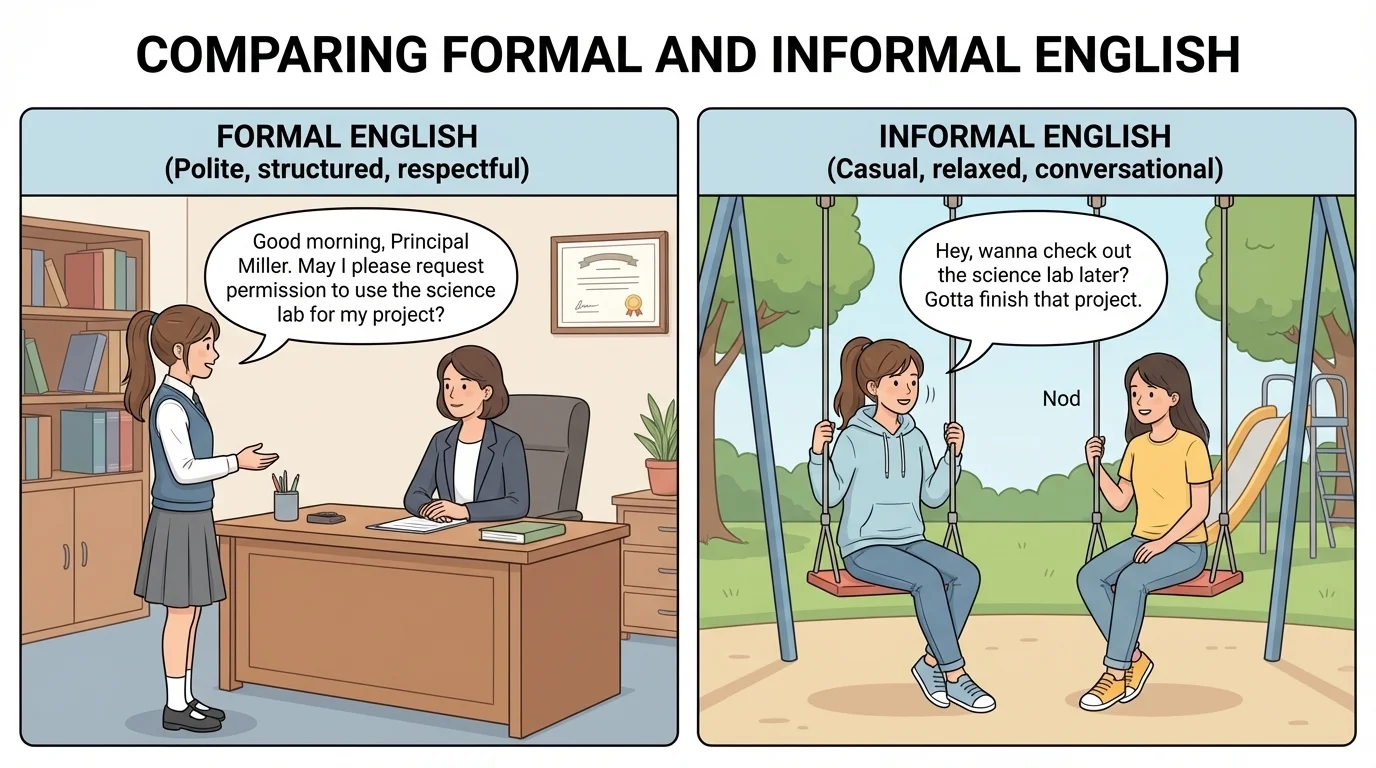
Formal English also avoids words that sound too casual. A child might say to a teacher, "I am sorry I am late," instead of, "Oops, I got here late." The formal version sounds more careful and respectful.
In writing, formal English often uses standard spelling and unshortened words. For example, "I cannot attend the meeting" is more formal than "I can't come." Both make sense, but one sounds more official.
Formal English helps people understand you clearly. When words are complete and polite, the listener or reader can tell that the message is important. Formal English is especially useful in school writing, speeches, letters, and conversations with adults you do not know well.
Later, when you compare examples again, you can return to the school scenes in [Figure 1] and notice that the formal speaker uses longer, more careful sentences.
Informal English is the kind of English people often use with friends, brothers, sisters, and other people they know well. It sounds relaxed and natural.
Informal English may include shorter greetings such as "Hi," "Hey," or "See ya." It may also include contractions like "I'm," "don't," and "can't." A child might say to a friend, "Can you help me?" instead of, "Could you please assist me?"
Informal English is not rude by itself. It is simply less official. Saying "Thanks!" to a friend is kind and friendly. But in a letter to the principal, "Thank you very much for your help" may fit better.
Sometimes informal English includes words that are very common in speaking but not as common in careful school writing. For example, "kids" is more informal, while "children" sounds more formal. "Help" is everyday and friendly, while "assist" sounds more formal.
Some words are short and simple in informal English, while formal English may use longer words with extra word parts. Readers can use those word parts to unlock meaning.
Informal English is useful because it helps people sound warm and friendly. When you are chatting at lunch or telling a story to a cousin, informal English often feels just right.
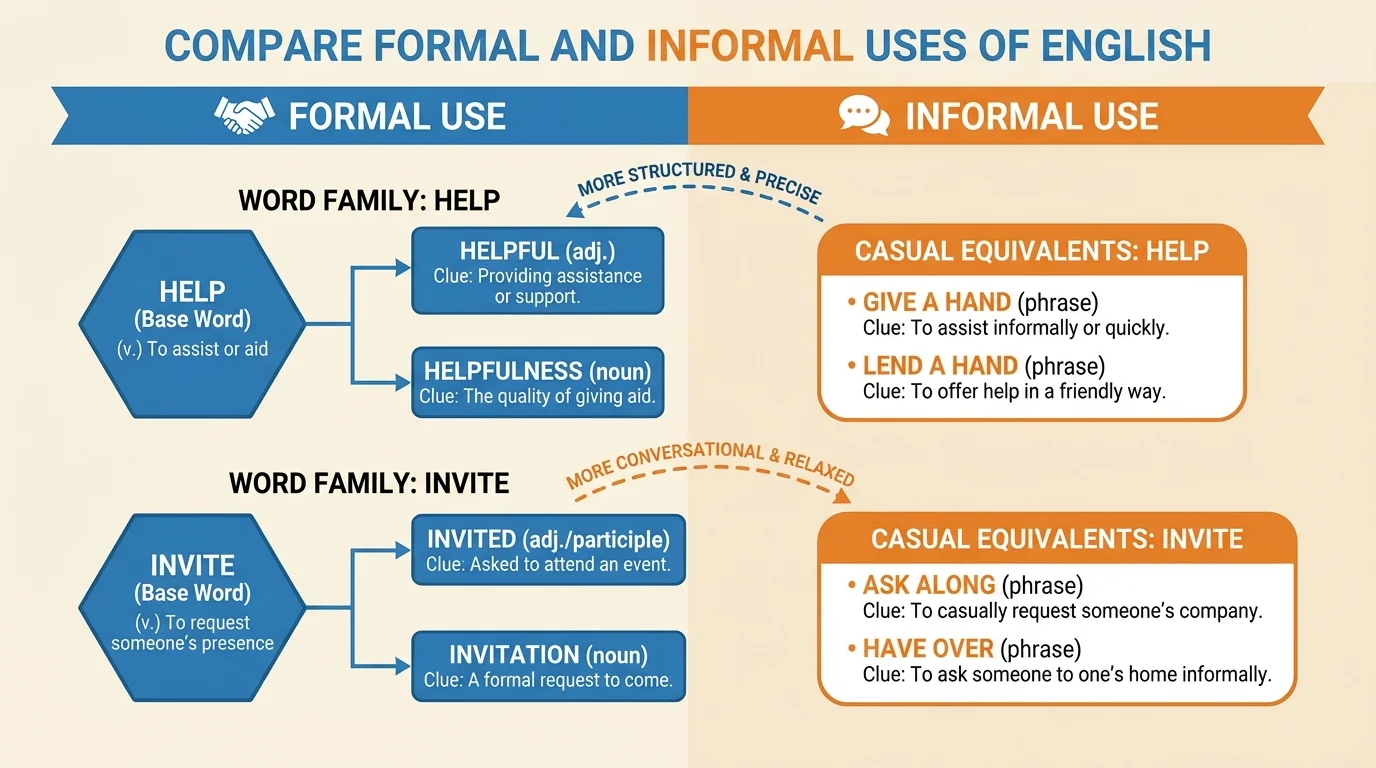
Good readers pay attention to spelling patterns and word parts. This means using knowledge of orthography and morphology. Orthography means the way words are spelled. Morphology means the parts of words and how those parts change meaning. These clues help us read both formal and informal words, as [Figure 2] explains with word families.
Look at the word invite. If you know that adding -ation can make a new noun, you can read invitation and understand that it means something connected to inviting. The shorter word may sound more everyday, while the longer word may sound more formal.
Word families can help too. If you know help, then helpful and helpfulness are easier to read. The longer form often appears in more formal writing. The same thing happens with care, careful, and carefully.
Spelling matters in both kinds of English. In formal writing, correct spelling is especially important because it helps the writing look clear and serious. If a student writes "thx" in a note to a friend, that may work in a casual message. But in a school letter, "thank you" is the better spelling choice.
Sometimes formal words are longer because they have prefixes or suffixes. A suffix is a word part added to the end. In kindness, the suffix -ness changes kind into a noun. In hopeful, the suffix -ful changes hope into an adjective. These patterns help readers decode words with accuracy.
You already know that words are made of letters and sounds. Now you are building on that knowledge by noticing chunks inside words. Those chunks can tell you both how a word is read and what it means.
As you grow as a reader, you will notice that formal English sometimes uses more complex words, but those words are not impossible. Their spelling patterns and word parts give you helpful clues, just as the word-family chart in [Figure 2] shows.
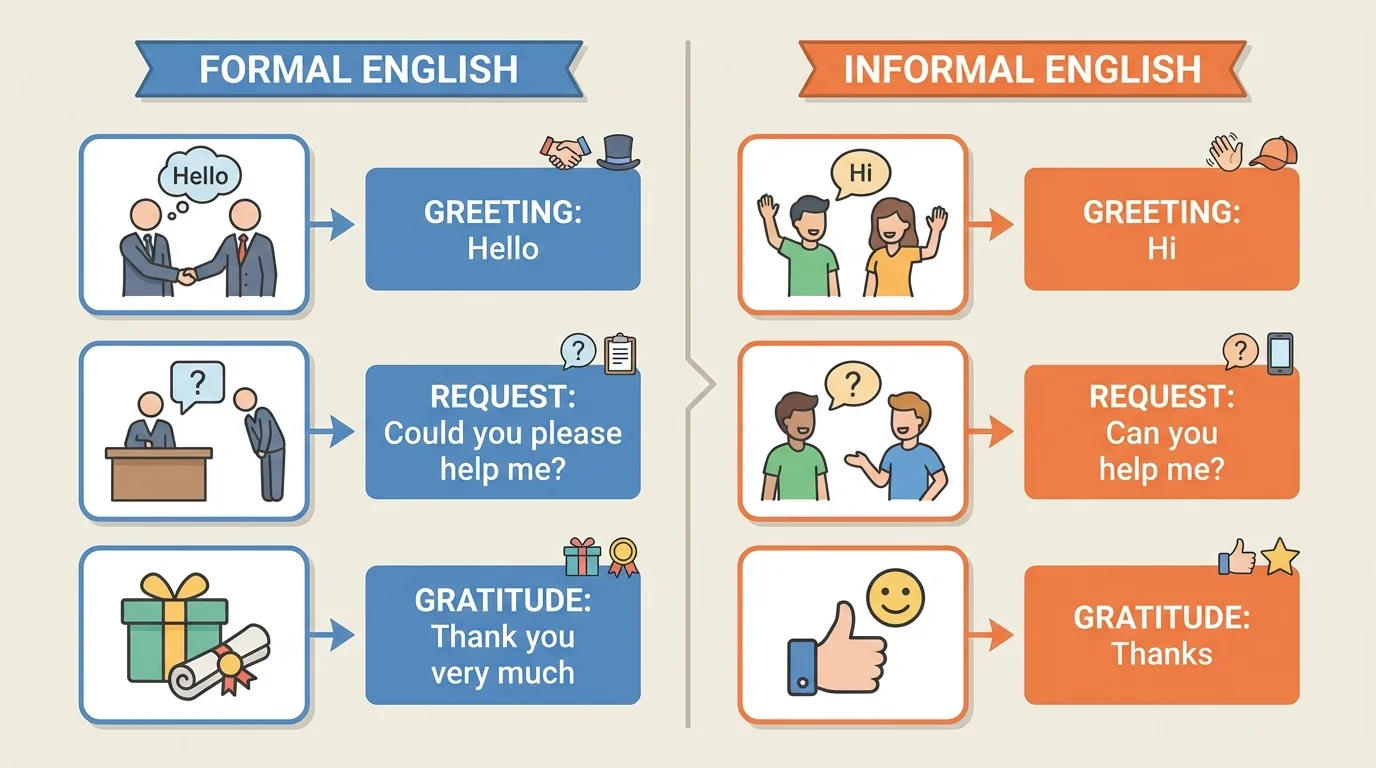
It is easier to compare the two kinds of English when you see them side by side, and [Figure 3] displays several pairs you can study closely. Notice how the meaning often stays similar, but the tone changes.
| Situation | Formal English | Informal English |
|---|---|---|
| Greeting a teacher | Good morning, Mr. Diaz. | Hi! |
| Asking for help | Could you please help me? | Can you help me? |
| Thanking someone | Thank you very much. | Thanks! |
| Saying sorry | I am sorry. | Oops, sorry. |
| Inviting someone | Would you like to come? | Wanna come? |
Table 1. Examples of formal and informal English used in common situations.
Formal English often sounds longer because it includes extra polite words. Informal English often sounds shorter because people are speaking quickly and comfortably.
Here are more pairs to compare:
Formal: "I would like some water, please."
Informal: "Can I have some water?"
Formal: "I cannot come today."
Informal: "I can't come today."
Formal: "Children should line up quietly."
Informal: "Kids should line up quietly."
Looking at one message in two ways
A student wants to ask for more time to finish homework.
Step 1: Informal version
"I need more time for my homework."
Step 2: Formal version
"May I please have more time to finish my homework?"
Step 3: Compare them
Both sentences ask for extra time, but the formal one sounds more polite and is a better choice for speaking to a teacher.
When you look back at the pairs in [Figure 3], you can see a pattern: formal English often adds polite phrases, while informal English keeps the message short and friendly.
A strong communicator knows how to make a good choice. If you are talking to a friend at recess, informal English is usually fine. If you are writing to the principal or speaking to a guest in class, formal English is a better choice.
Think about these questions: Who is listening? Why am I speaking? Is this school writing, a speech, a friendly chat, or a note to an adult? Your answers help you choose the right words.
At school, formal English is often expected in reports, letters, presentations, and polite requests. Informal English is more common in friendly conversations, quick notes to people you know well, and casual talk during play.
"The right words fit the right time."
Even when you are using informal English, you should still be kind and clear. Informal does not mean careless or mean. Formal does not mean stiff or unfriendly. Good language matches the moment.
Sometimes both formal and informal English are correct because both are real English. The difference is not about right versus wrong. The difference is about what fits best.
For example, "Hello" and "Hi" are both correct greetings. "Thank you" and "Thanks" are both correct too. But if you are welcoming a visitor to your classroom, "Hello" or "Good morning" may sound more respectful.
As a reader, you can also learn about a character by noticing whether the words sound formal or informal. A story may use informal speech to show friendship. A letter in a story may use formal language to show respect.
As a writer, you can choose the style that matches your goal. If your goal is to sound warm and natural, informal English may work best. If your goal is to sound polite and careful, formal English may work best.
