Have you ever read a birthday card, a game rule, and a storybook all in the same day? They all use words, but you do not read them in exactly the same way. A strong reader knows that every reading task has a purpose. Sometimes the purpose is to enjoy a story. Sometimes the purpose is to learn facts. Sometimes the purpose is to follow directions. When you know your purpose as a reader, you pay attention in the right way and understand more.
[Figure 1] When we read with purpose, we know why we are reading. A reader may read for enjoyment, to learn, to answer a question, to find one important fact, or to do something correctly. Readers change how they read depending on the purpose because reading a story, a sign, and directions each asks the brain to pay attention in a slightly different way.
If you read a story about a lost puppy, you might think about the characters, the problem, and the ending. If you read directions for planting a seed, you might look carefully for the order of the steps. If you read a short article about frogs, you might search for facts such as where frogs live or what they eat. Good readers do not just say the words. They think about what the words are doing.
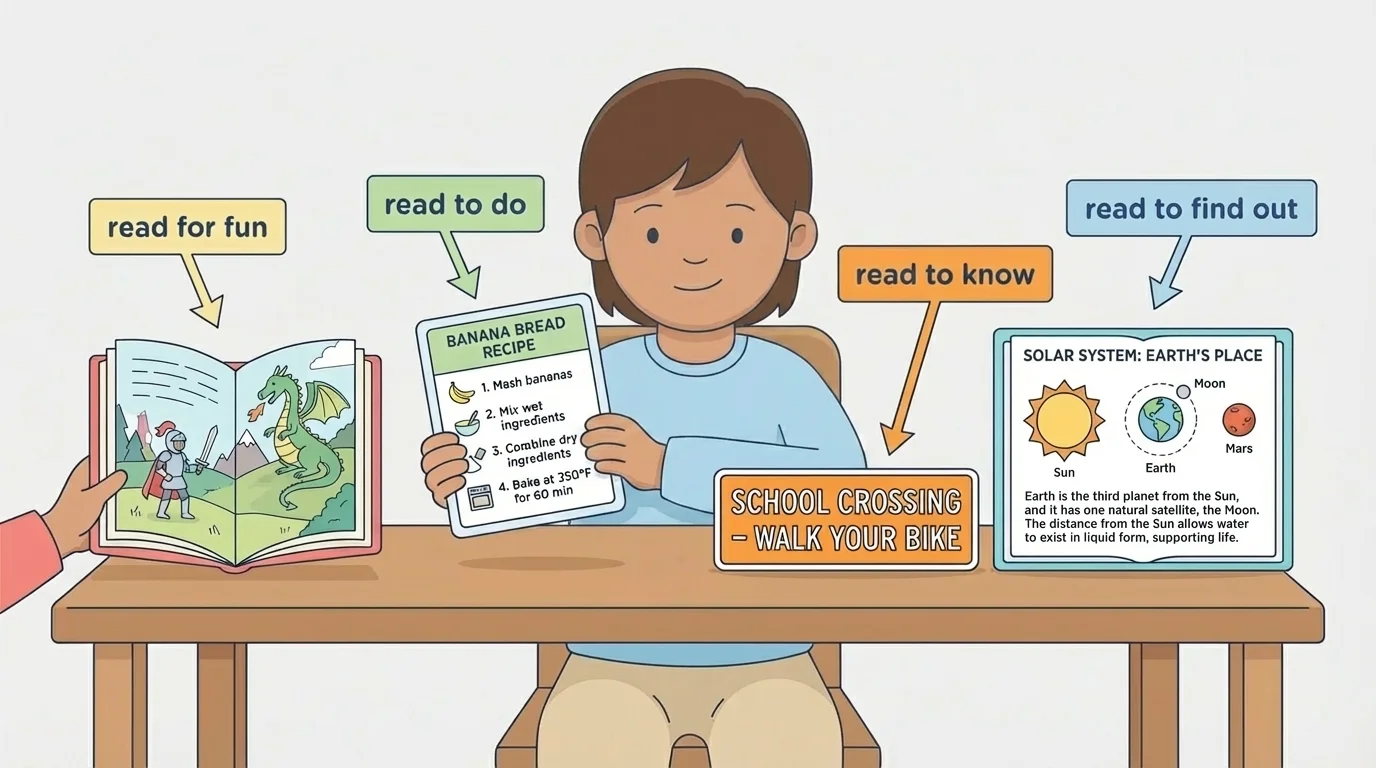
Before reading, it helps to ask, "What am I trying to understand?" That small question can make a big difference. It gets your mind ready. It is like putting on the right shoes before an activity. You would not wear swim fins to run a race, and you do not read every text in exactly the same way.
You already know that reading involves looking at words and saying them. Now you are growing into a reader who also thinks carefully about meaning while reading.
Knowing your purpose also helps you choose what matters most. In a story, the setting and feelings might matter a lot. In a science paragraph, the main facts and special words may matter most. In directions, every step matters because doing them in the wrong order can cause a mistake.
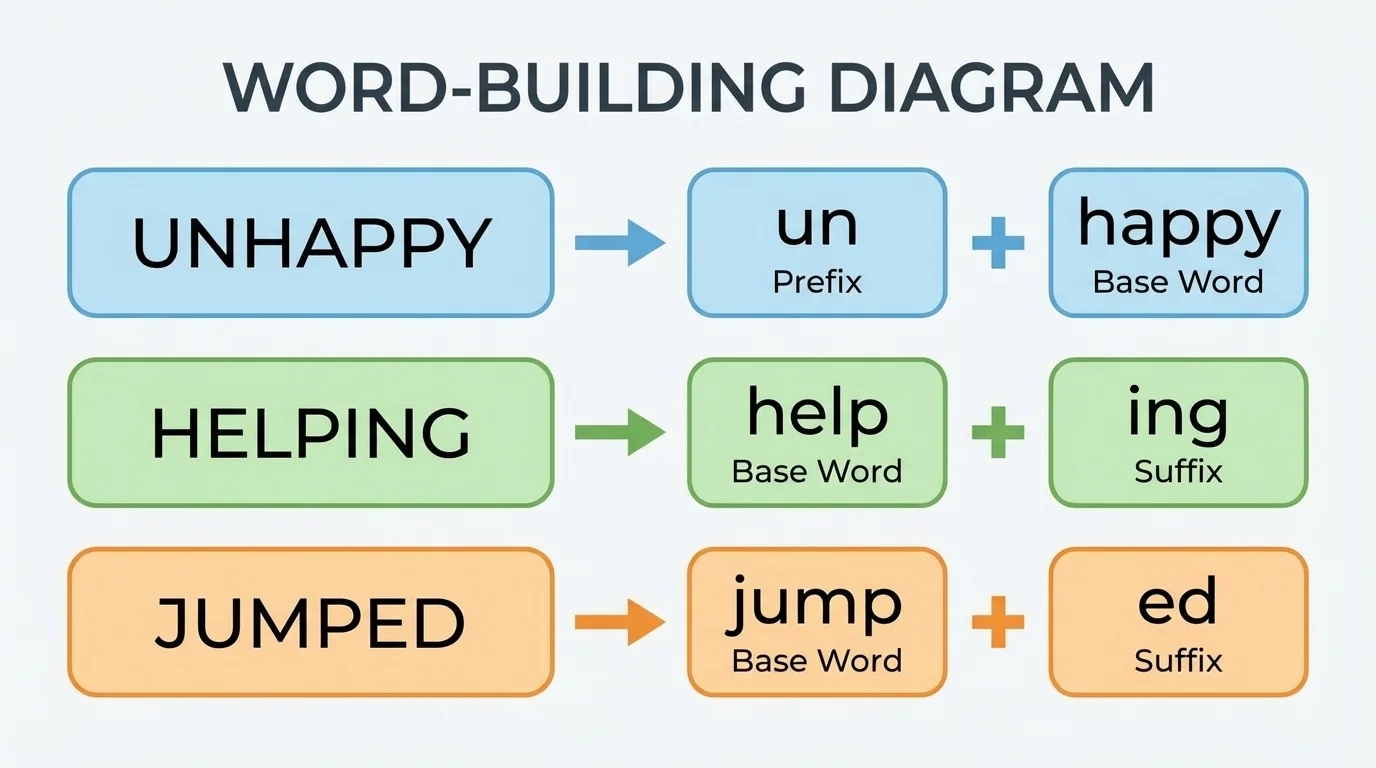
Sometimes a reader meets a long or tricky word. Instead of giving up, a smart reader looks for clues inside the word. Words often have parts that can help. These parts include a base word, a prefix at the beginning, and a suffix at the end.
Base word means the main part of a word. A prefix is a word part added to the beginning, and a suffix is a word part added to the end. These parts can change a word's meaning or job in a sentence.
Look at the word jumped. You may know the base word jump. The ending -ed shows that the action already happened. In helping, the base word is help and the ending -ing shows that the action is happening now. In unhappy, the beginning un- changes the meaning to "not happy."
[Figure 2] Readers also use spelling patterns. A spelling pattern is a group of letters that often works the same way in many words. For example, if you can read light, that can help you read night and bright. If you know train, you may be able to read paint because both have the vowel pattern ai. If you know snow, you may quickly read grow because both have the pattern ow.
Looking for chunks can make a big word feel smaller. For example, the word sunshine can be read as sun and shine. The word basketball can be read as basket and ball. Even when a word is new, its parts can give useful clues. Later, when you meet longer words in school books, this habit becomes even more powerful.
Word meaning matters too. If you read the sentence "The farmer is helpful," the word helpful may remind you of help. That helps you understand that a helpful farmer is a farmer who gives help. Decoding and meaning work together. Reading the word correctly helps you understand the sentence, and the sentence meaning can also help confirm the word.
Accuracy means reading the words correctly. Accurate readers notice all the letters in a word. They do not rush so much that they change from into for, or house into horse. A tiny mistake can change the meaning of a whole sentence.
Suppose a sentence says, "The cat hid under the bed." If someone reads hid as hit, the sentence no longer makes sense in the same way. Accurate reading means checking the letters, the sounds, and the way the word fits the sentence. Good readers use their eyes, their knowledge of sounds, and their understanding together.
Accuracy supports understanding. When readers say the right words, their minds can build the correct meaning. If many words are read incorrectly, the meaning can become confusing or even wrong.
Accuracy does not mean being afraid of hard words. It means trying carefully. Readers may slow down for a tricky word, look again, read it in parts, and then keep going. That is what strong readers do.
As we saw earlier in [Figure 2], looking at parts such as a base word and suffix can help accuracy. A reader who sees jumped as jump plus -ed is less likely to skip or guess.
[Figure 3] Fluency means reading smoothly, correctly, and with expression. A fluent reader does not read in a slow, bumpy, word-by-word manner. Instead, the reading sounds more like natural speech.
Fluency has a few important parts. One part is accuracy, because fluent readers still need to read the right words. Another part is rate, or speed that is not too slow and not too fast. A third part is expression, sometimes called phrasing. This means the voice goes up for a question, pauses at commas and periods, and sounds excited, serious, or calm when the text gives those clues.
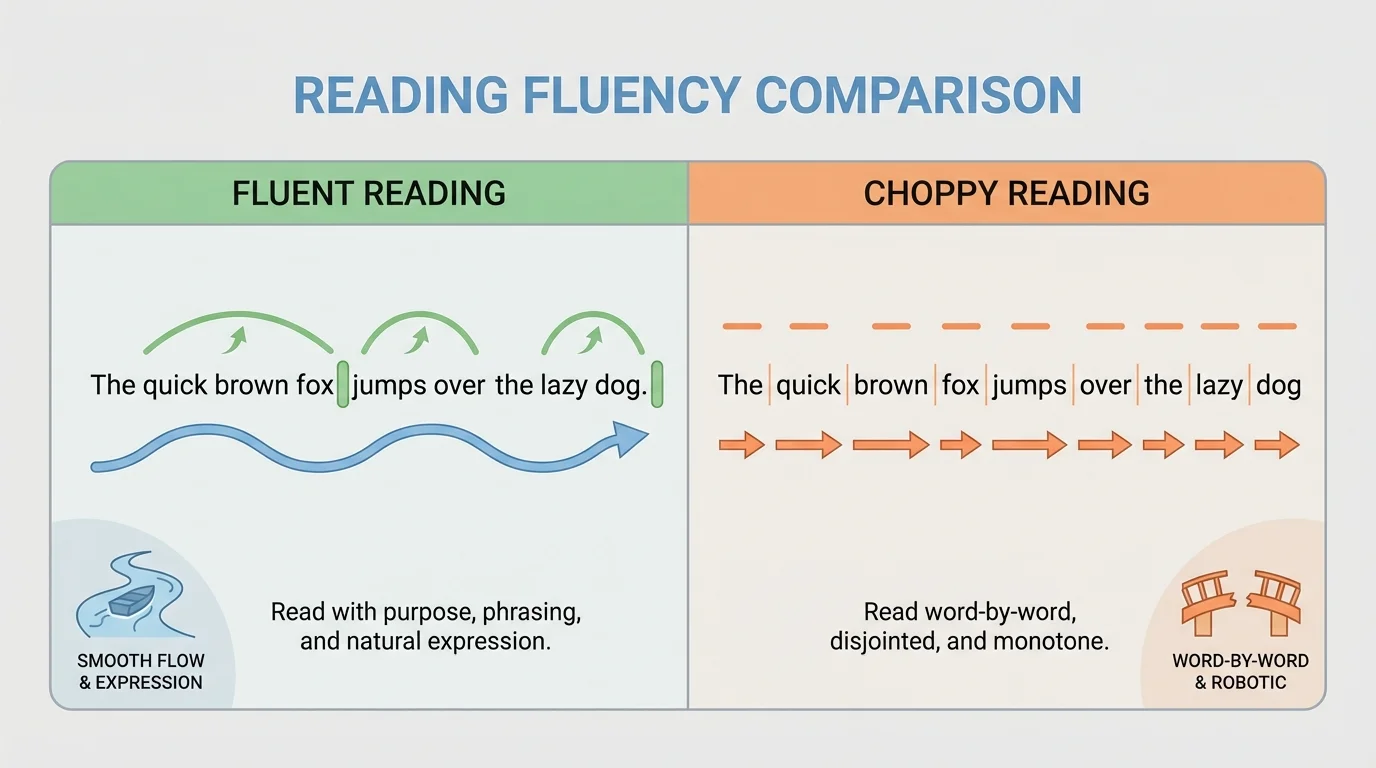
Why does fluency matter? When reading is very choppy, the brain works so hard on each word that it has less energy left for meaning. But when many words are read smoothly, the brain can pay more attention to ideas. That is why fluency helps comprehension, or understanding what is read.
Your voice can help your brain understand a sentence. When you pause at punctuation and read with expression, you are showing the structure and meaning of the text.
Listen to these two ways of reading: "The... dog... ran... fast..." and "The dog ran fast!" The second one is smoother and easier to understand. It sounds like the sentence means something, not like four separate words.
Fluency is not racing. Reading too fast can hurt understanding just as much as reading too slowly. The goal is smooth reading that matches the text. A poem may need careful rhythm. Directions may need slower, more exact reading. A simple sentence in a familiar story may be read a bit more quickly.
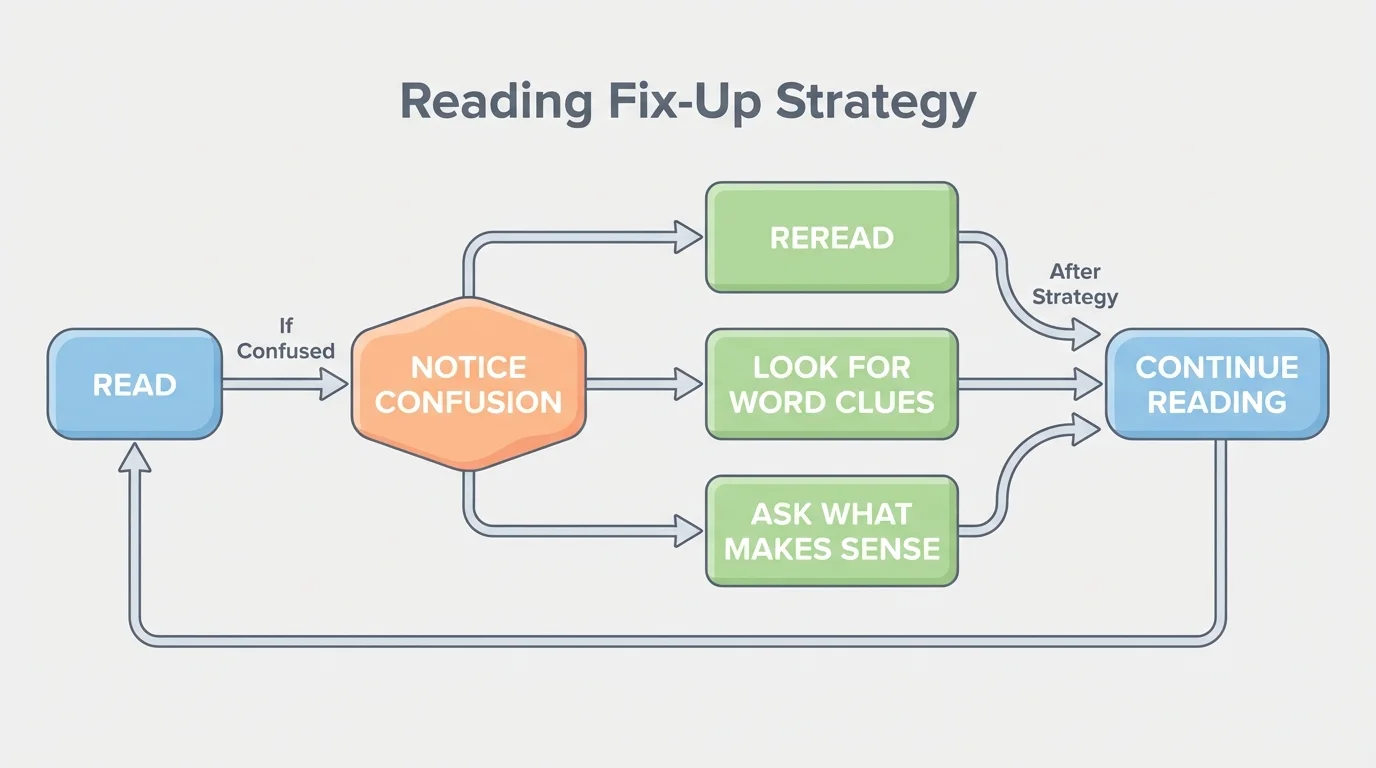
[Figure 4] Strong readers think while they read. They notice when something makes sense and when something does not. If a sentence sounds confusing, a reader does not just keep going without thinking. The reader stops and tries to repair understanding.
One way to repair understanding is to reread. Another way is to look for clues in the words around the hard part. A reader can also ask, "What is happening here?" or "What would make sense?" If the sentence says, "The ice began to melt in the sun," the word melt makes sense because heat from the sun changes ice.
Readers also think about the main idea. In a story, they may ask, "What is the big event?" In an information book, they may ask, "What is this mostly about?" Paying attention to the big idea keeps the reading connected.
Context matters too. Context means the words and ideas around a word or sentence. If you meet the word bark, the context tells whether it means the sound a dog makes or the outside part of a tree. In "The dog began to bark at the mail carrier," the context points to the sound. In "The rough bark covered the tree trunk," the context points to the tree covering.
Using context and word parts together
Read this sentence: "Mina felt fearless when she walked onto the stage."
Step 1: Look at the word parts.
The word fearless has the base word fear and the suffix -less.
Step 2: Think about meaning.
The suffix -less often means "without." So fearless means "without fear."
Step 3: Check the sentence.
If Mina walks onto the stage without fear, the sentence makes sense.
Word parts and context work together to help understanding.
Later, when a text becomes more challenging, the fix-up process in [Figure 4] still helps. Good readers are not readers who never get confused. They are readers who notice confusion and do something about it.
A storybook, a science page, a poster, and a set of directions all ask readers to think in different ways. When reading a story, readers may pay close attention to characters, setting, and problem. They may predict what happens next and notice how a character feels.
When reading informational text, readers often look for facts, details, and important topic words. They may ask, "What am I learning?" and "Which detail supports the main idea?" In a page about bees, a reader may learn that bees collect nectar and help pollinate flowers. The purpose is to understand information clearly.
When reading directions, order matters. Words like first, next, then, and last are important signals. If you skip one, the task may not work. That is why careful, accurate reading matters so much for directions.
Poems and songs may use rhythm, repeated sounds, and strong feelings. A reader may read them more slowly to enjoy the sound and picture-making words. Even though the purpose may be enjoyment, understanding still matters.
| Type of text | What readers often focus on | Possible purpose |
|---|---|---|
| Story | Characters, problem, events, ending | Enjoy and understand what happens |
| Information text | Facts, main idea, details, topic words | Learn something new |
| Directions | Steps, order words, exact actions | Do something correctly |
| Poem or song | Rhythm, repeated words, feelings, images | Enjoy language and understand the message |
Table 1. Different kinds of text and the reading focus that helps each one make sense.
The everyday purposes in [Figure 1] connect to these text types. Readers stay flexible. They ask what kind of text this is and what kind of understanding the text needs.
Readers grow stronger when they pay attention to words and meaning at the same time. They notice spelling patterns, use word parts, read accurately, and build fluency. Then they use all of that power to understand the text.
Strong reading is a little like building with blocks. One block is decoding words. Another block is reading smoothly. Another block is thinking about meaning. When the blocks work together, reading becomes easier and more enjoyable.
Sometimes you may need to slow down. Sometimes you may read a familiar part more smoothly. Sometimes you may reread. All of these are signs of smart reading. The goal is not just to finish. The goal is to understand.
"Good readers do more than say the words. They make the words mean something."
Every time you read with a clear purpose, use clues in words, and think about meaning, you are training your brain to become even stronger. Bit by bit, sentence by sentence, page by page, you become a reader who understands.
