Sometimes one tricky word can make a whole sentence feel puzzling. But good readers have a smart trick: they look around the word for clues. The other words in the sentence are like little helpers. They can tell you what an unknown word or phrase probably means.
When you read, you will not know every word right away. That is normal. Strong readers do not always stop at once. First, they look at the sentence and ask, "What is happening here?" Then they use the nearby words to make a good guess.
If you read, "Lena wore a raincoat because rain was pouring from the clouds," the word raincoat may already be familiar. But even if it were not, the words "rain was pouring" would help you know it is something used in rainy weather.
This reading skill is called using context clues. A context clue is a hint from the words around an unknown word. Today we are focusing on clues from the same sentence.
Sentence-level context means the words and ideas in the same sentence that help explain an unknown word or phrase.
Unknown word means a word you do not know yet.
Phrase means a group of words that work together to share an idea.
You do not need to know every word before you begin reading. Sometimes the sentence itself teaches you. That makes reading feel more powerful, because the sentence can help you unlock meaning.
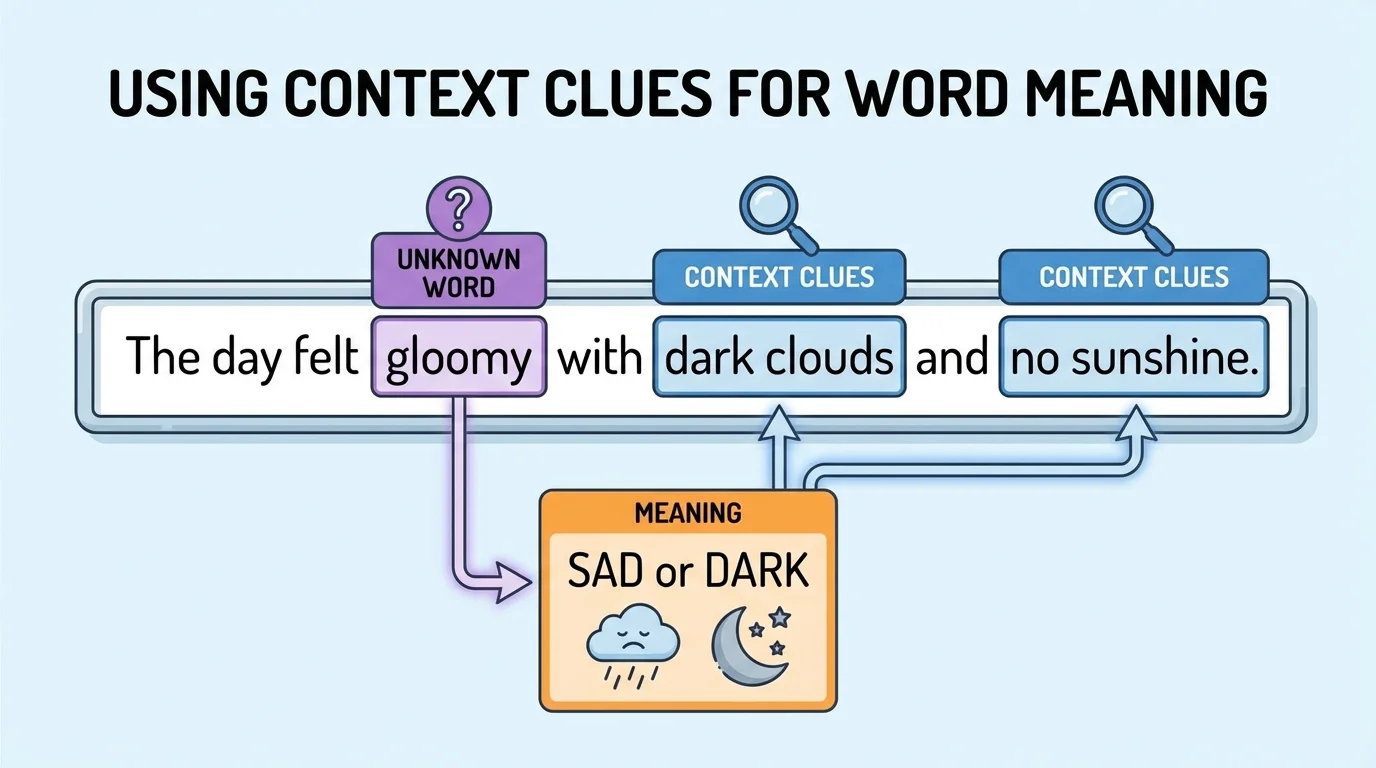
[Figure 1] shows how the words before and after a hard word can act like clues. If a sentence says, "The day was gloomy, with dark clouds and no sunshine," you can use "dark clouds" and "no sunshine" to figure out that gloomy means dark, dreary, or sad-looking.
Notice that the sentence does not always tell the meaning in one perfect dictionary sentence. Instead, it gives you hints. Your job is to put the hints together.
Here is another example: "After running three laps, Marco was exhausted and dropped onto the grass." The action "dropped onto the grass" helps you infer that exhausted means very tired.
Sometimes a phrase can be understood this way too. In the sentence "The baby chick was safe and sound after the storm," the phrase means the chick was okay and not hurt. The words around the phrase help explain it.
Your brain is always making smart guesses while you read. Good readers use those guesses, then check the sentence again to see if the guess fits.
As you continue reading, the clues may become even clearer. That is why rereading the full sentence is so helpful.
[Figure 2] organizes some of the most helpful kinds of context clues. You may see an example, a word with a similar meaning, a word with an opposite meaning, or an explanation in the sentence.
One kind of clue is an example. Read this sentence: "At the farm we saw poultry, such as chickens and ducks." If you do not know poultry, the examples "chickens and ducks" help you understand that poultry means birds raised on a farm.
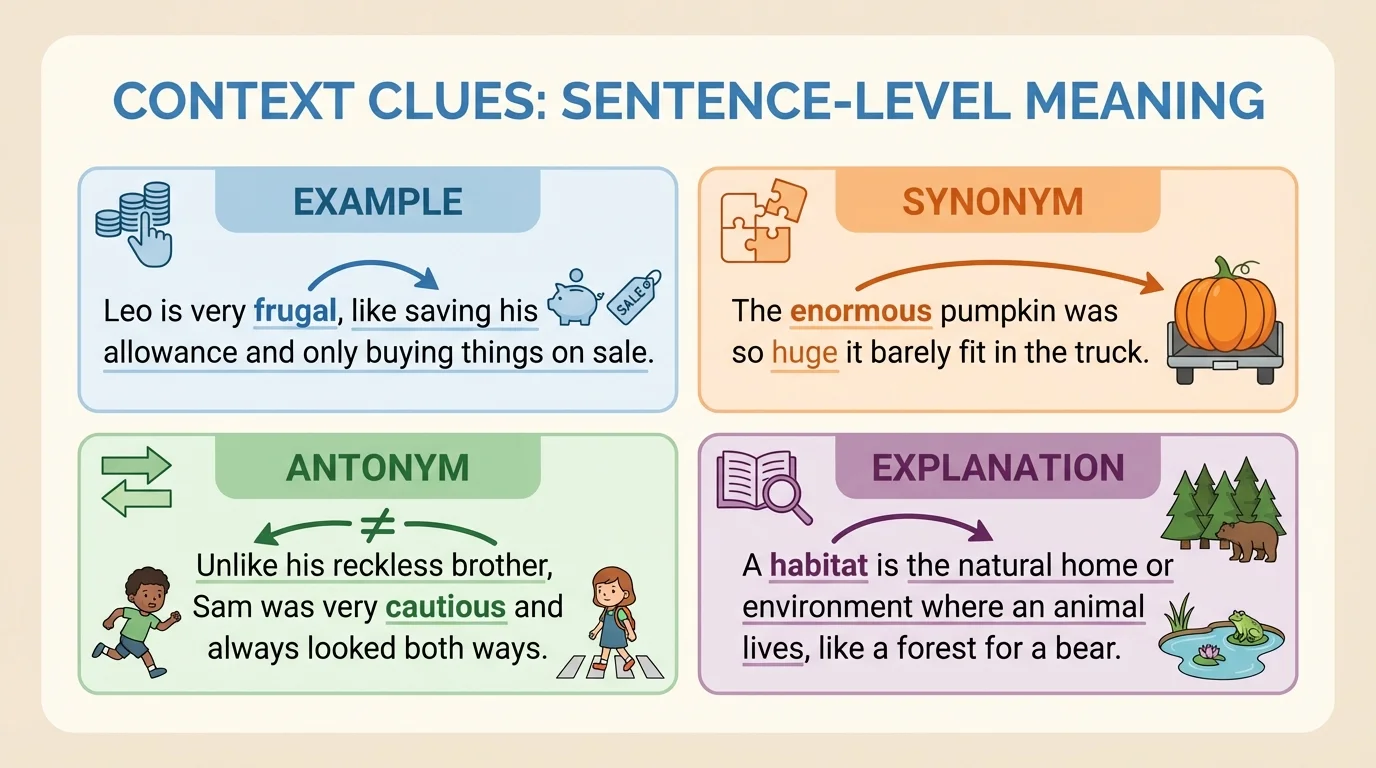
Another kind of clue is a word with a similar meaning. In "The tiny ant was minuscule, or very small," the words "very small" tell you what minuscule means.
A third kind is an opposite clue, also called an antonym clue. In "The desert was not damp; it was dry," the word "dry" helps explain that damp means a little wet.
A fourth kind is an explanation. In "Jada whispered so softly that only her friend could hear," the explanation "only her friend could hear" tells you that softly means quietly.
Readers also use action clues and feeling clues. In "The puppy whimpered and hid under the chair during the thunder," the actions show that whimpered means making a small, sad sound.
When you meet a hard word, slow down and think. You do not need to panic. You can use a simple plan.
A simple meaning-finding plan
Look at the whole sentence. Notice what is happening, who is doing something, and how the sentence feels. Then make a smart guess about the unknown word. Last, reread the sentence and check whether your guess makes sense.
Suppose you read: "Nina peeked through the curtain before going on stage." You may not know peeked at first. But if she looked through the curtain before going on stage, you can infer that peeked means took a quick look.
Try another one in your mind: "The soup was so steaming that Dad blew on it before tasting it." The clue is what Dad does. He blows on it, so steaming must mean very hot.
Thinking through a sentence
Sentence: "The kitten was reluctant to enter the tub, so it pulled back its paws."
Step 1: Notice the action clue.
The kitten "pulled back its paws."
Step 2: Think about what that action means.
If the kitten pulls back, it does not want to go in.
Step 3: Make a meaning guess.
Reluctant probably means not wanting to do something.
Step 4: Check the sentence.
"The kitten did not want to enter the tub" makes sense.
This kind of thinking turns reading into careful detective work. The sentence gives hints, and you use them to build meaning.
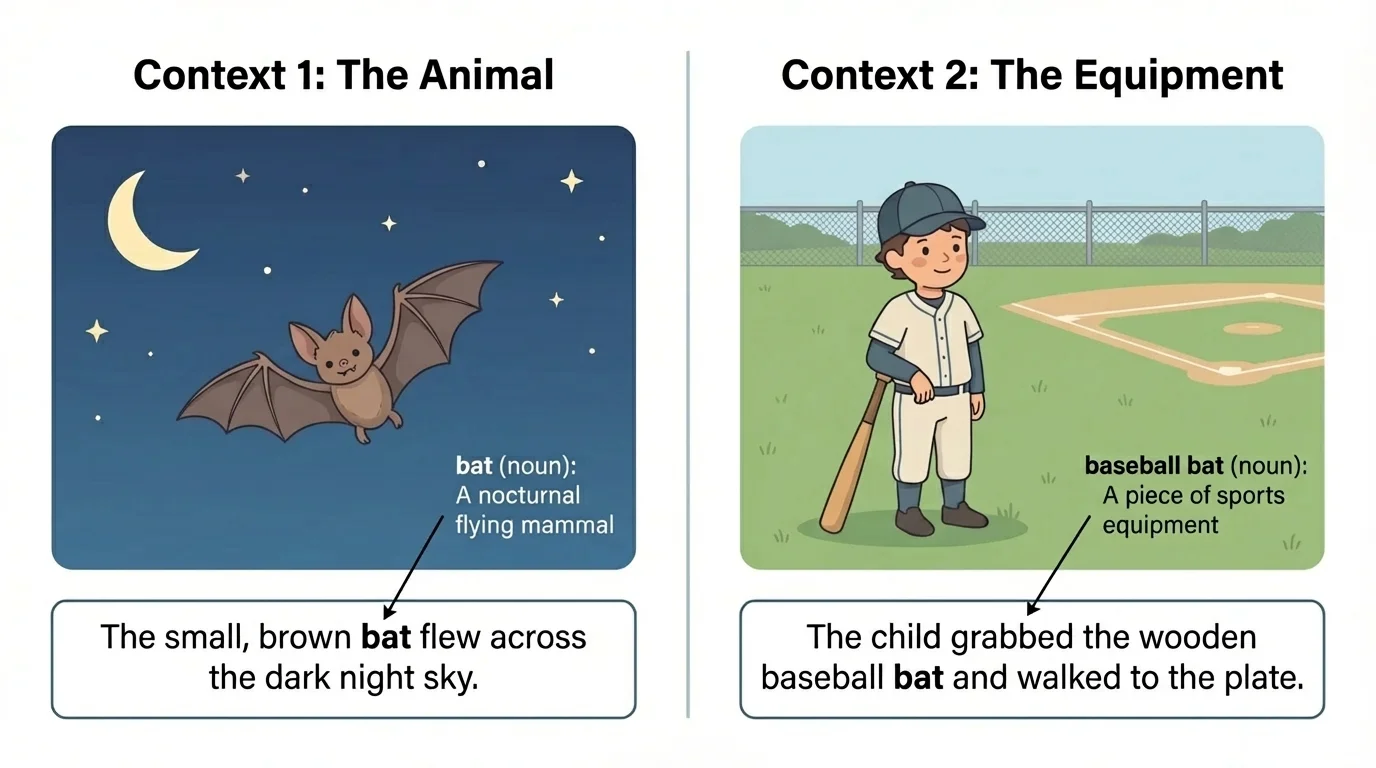
[Figure 3] shows that some words have more than one meaning. These are called multiple-meaning words. The whole sentence helps you choose the right meaning.
Look at the word bat. In "A bat flew out of the cave at dusk," bat means a flying animal. In "Mila swung the bat and hit the ball," bat means a piece of sports equipment. The sentence-level context tells you which meaning is correct.
Here is another one: bark. In "The bark on the tree felt rough," bark means the outside covering of a tree. In "We heard the dog bark at the mail carrier," bark means the sound a dog makes.
And consider park. In "We ate lunch at the park," it means a place. In "Please park the bike by the fence," it means to place something in a spot. Again, the sentence tells you the meaning.
You already know that words can mean different things in different places. When one meaning does not fit, stop and try another meaning that matches the sentence better.
Later, when you read new books, remember the two kinds of bat. One small word can carry different meanings, but the full sentence points you in the right direction.
Sentence clues are very helpful, but sometimes word parts help too. A prefix is a word part added to the beginning of a word. A suffix is added to the end. These parts can give extra hints.
For example, in "The ground became muddy after the rain," you may know the word mud. The ending -y helps show "full of" or "like," so muddy means full of mud or covered with mud. The rest of the sentence confirms that meaning.
In "Please reread the sentence," the prefix re- means again. If you know that, reread means read again. The sentence supports the meaning because it is giving a direction.
Use more than one strategy
Strong readers are flexible. They use sentence clues first, and they may also look at word parts, pictures, or what they already know. All of these can work together.
When sentence clues and word parts agree, your guess becomes stronger. If they do not agree, reread and think again.
A good guess is not just any guess. It must fit the sentence. After you decide what a word might mean, read the sentence again with your guessed meaning.
Suppose you read, "The glass vase was fragile, so Ben carried it with both hands." The clue is that Ben carried it carefully with both hands. A smart guess is that fragile means easy to break. If you put that meaning back into the sentence, it fits very well.
Now think about this sentence: "The rabbit darted into the bushes." If you guessed that darted means slept, the sentence would not make sense. In a quick-action sentence like that, darted clearly suggests fast movement. But if you guess that darted means moved quickly, the sentence works.
Checking your guess helps you avoid mistakes. The sentence is like a test: does the meaning belong there, or not?
You can use sentence-level context in stories, poems, science books, and even directions. In a story, clues may come from actions, feelings, or setting. In science, clues may come from facts and explanations. In directions, clues may come from what needs to happen next.
For example, in a science sentence such as "Seeds need moisture, or water, to begin growing," the phrase "or water" explains the word moisture. In directions like "Stir the batter gently so it does not splash," the word gently is explained by "so it does not splash."
When you listen to someone speak, you use context too. If a friend says, "Be careful, the sidewalk is slippery after the rain," the words "after the rain" help you know that slippery means hard to walk on without sliding.
The same idea from [Figure 1] applies in all kinds of reading: look nearby, gather clues, and build meaning. The rest of the sentence often gives you more information than the hard word does by itself.
"Good readers look around a hard word before they give up."
The more you read, the faster you become at noticing clues. Soon, you begin to spot examples, explanations, and opposite words almost automatically.
