Have you ever been in a group where everyone talked at once? It can sound like a flock of noisy birds, and it becomes hard to hear any one idea. A good discussion is different. It is like a team game where everyone knows the rules. When people follow the rules for talking and listening, every voice has a chance to be heard, and everyone can learn something new.
A discussion is when people talk together about a topic, a question, or a text. In second grade, discussions happen in many ways. You might talk with one partner, with a small group, or with the whole class. You might discuss a story your class read, a science observation, or a problem your class is solving together.
Discussion rules are agreed-upon ways to talk and listen so everyone can take part. These rules help people be respectful, careful, and clear.
Respectful means showing kindness and good manners to others, even when your ideas are different.
Rules matter because they make conversations fair. If one person talks all the time, other people do not get a turn. If people interrupt, speakers may forget their ideas or feel upset. If no one listens, the group cannot learn from each other. Discussion rules help people feel safe, calm, and ready to think.
Good discussion rules also help us learn better. Sometimes another person says something you did not notice before. Sometimes a classmate asks a question that helps everyone understand a text more clearly. When we listen and take turns, we gather more ideas than we could alone.
Strong listeners often become strong learners because they notice details, ask thoughtful questions, and remember what others say.
[Figure 1] Discussion rules are not just for school. People use them in families, on sports teams, in clubs, and at work. Learning these rules now helps you become a caring speaker and listener everywhere you go.
To gain the floor means to get a turn to speak. In a classroom discussion, students do this in respectful ways. One common way is to raise a hand and wait to be called on. Another way is to wait for the speaker to finish and then begin with polite words such as, "I would like to add something," or "May I share my idea?"
Sometimes the teacher chooses who speaks next. Sometimes students talk in a circle and each person has a turn. In partner talk, one person may speak first and then the other. In all of these situations, the idea is the same: wait for your turn instead of jumping in.
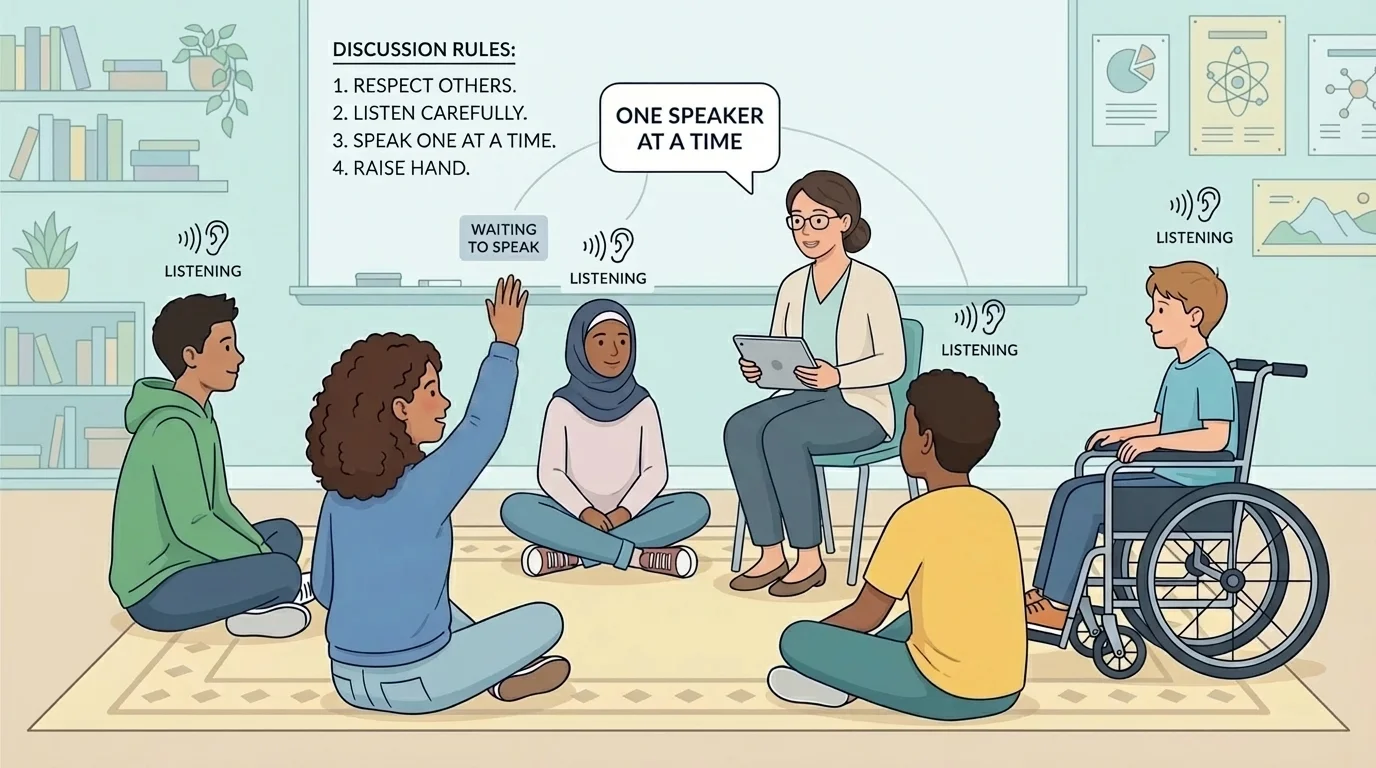
Respectful speakers use both actions and words. They do not shout across the room. They do not push into the conversation. They show patience. Patience means waiting calmly. Even if you are excited, you can hold your idea in your mind until it is your turn.
If you worry that you might forget your thought, you can quietly keep it in your head, whisper it softly to yourself, or remember a key word. Then, when it is your turn, you can speak clearly. That helps the discussion stay orderly and kind.
Example of gaining the floor respectfully
Step 1: Mia hears a question about a story character.
Step 2: She raises her hand and waits while another student finishes speaking.
Step 3: When called on, she says, "I think the character felt scared because the cave was dark."
Mia follows the discussion rules because she waits, speaks clearly, and shares an idea about the topic.
[Figure 2] Later, when your class has a group conversation again, the turn-taking we saw in [Figure 1] still matters. A peaceful group does not happen by accident. It happens because people choose to wait and speak respectfully.
Active listening means listening with your whole attention. Active listening is more than being quiet. It means your body and brain are both working. Your ears hear the speaker, your eyes look toward the speaker, and your mind thinks about the message.
When you listen with care, you do not interrupt. Interrupting means cutting in before the speaker is finished. Even if you have something important to say, you wait. This shows respect and helps you understand the full idea.
Careful listeners also notice details. They might hear a reason, an example, or a question. They may think, "That is different from my idea," or "I want to know more about that." Listening helps you prepare a better answer when your turn comes.
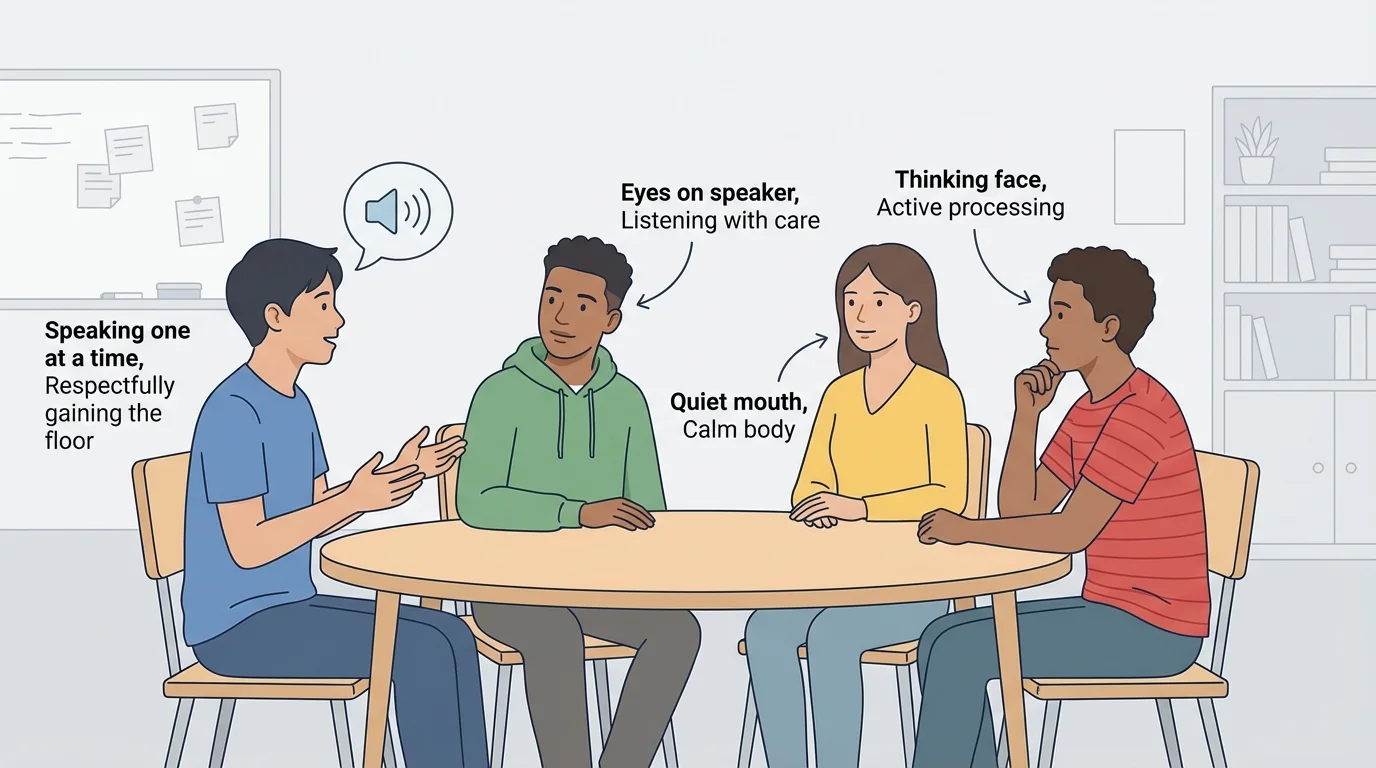
Listening with care also means not letting your mind wander too far away. If the discussion is about a book, think about the book. If the class is talking about plant growth, think about what your classmates are saying about plants. Good listeners stay connected to the conversation.
Listening helps learning grow
When students listen carefully, they collect information from many people. One classmate may remember a detail from the beginning of a story. Another may explain why a character acted in a certain way. By listening to everyone, the group understands more than any one person alone.
You can tell someone is listening by their actions. Their body is usually still. Their face shows attention. They are not busy with something else. They may nod, smile, or wait quietly. These signs help speakers feel respected and brave enough to share.
[Figure 3] Much later in a discussion, the listening habits shown in [Figure 2] still help the group. A speaker who feels heard is more likely to explain clearly, and listeners who stay focused understand more.
A strong collaborative conversation is one where people work together with their words. That means speaking one at a time and staying on the topic. The topic is what the group is talking about. Sometimes the topic comes from a class question. Sometimes it comes from a book, article, or read-aloud text.
Speaking one at a time helps everyone hear each idea. If two people talk at once, words get mixed together. Then listeners may miss both ideas. Taking turns keeps the discussion clear.
Staying on the topic means your words should match what the group is discussing. If the class is talking about why butterflies change, a comment about your favorite ice cream is off-topic. But a comment such as "The butterfly changes as it grows" is on-topic because it connects to the lesson.
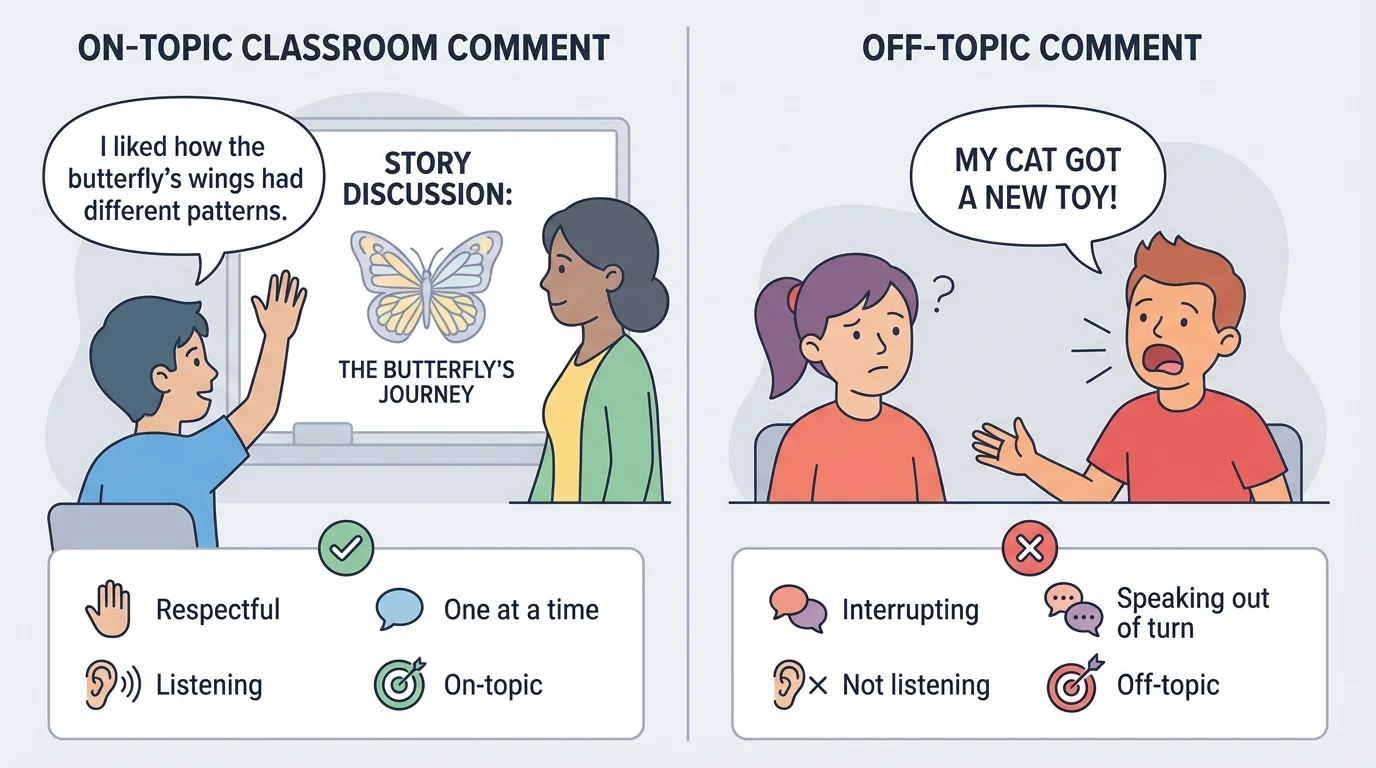
When a class discusses a text, it is helpful to use ideas from that text. You might say, "In the story, the boy shared his lunch," or "The picture shows dark clouds, so I think rain is coming." These responses connect your thinking to what the class is reading or studying.
| Type of comment | Example |
|---|---|
| On-topic | "I think the rabbit was hiding because it heard a sound." |
| On-topic | "The book says the seeds need water to grow." |
| Off-topic | "My cousin has a red bike." |
| Off-topic | "I want pizza for dinner." |
Table 1. Examples comparing comments that match the discussion topic with comments that do not.
If you notice that your words are drifting away from the topic, you can stop and try again. You might say, "Let me go back to the book," or "My idea is about the question." That helps keep the conversation useful for everyone.
The difference shown in [Figure 3] reminds us that not every thought belongs in every discussion. Good speakers choose ideas that fit the group's topic and help everyone learn.
Respectful talk does not mean everyone has the same idea. People can think differently and still be kind. The important part is how they speak. Polite words help listeners feel valued.
Helpful sentence starters
To add an idea: "I want to add that ..."
To agree: "I agree because ..."
To disagree kindly: "I think a little differently ..."
To ask a question: "Can you explain more?"
To connect to a text: "In the story, I noticed ..."
These sentence starters are useful because they make speaking smoother and kinder. They also help students explain their thinking instead of giving only a short answer. For example, "I agree because the fox looked tired in the picture" tells more than just "I agree."
Asking questions is part of respectful discussion too. Questions show that you are listening and thinking. A question like "Why do you think that?" invites another person to explain. A question like "Where did you find that in the book?" connects the talk back to the text.
"Take turns, listen carefully, and let every voice be heard."
Kind disagreement is important. Sometimes you may not think the same thing as a classmate. Instead of saying, "You are wrong," you can say, "I think something different because ..." This keeps the conversation respectful and focused on ideas rather than hurt feelings.
Even careful groups sometimes have problems. Someone may interrupt. Two people may begin at once. A speaker may forget the topic. A listener may stop paying attention. Good discussion rules help fix these problems.
If you interrupt by mistake, you can stop and say, "Sorry, you can finish." If two people talk at once, one person can politely say, "You go first." If the group gets off-topic, someone can help by saying, "Let's go back to the question." These are simple ways to repair the conversation.
You already know how to be kind on the playground, in line, and during partner work. Discussion rules use those same kindness skills with talking and listening.
Sometimes people feel nervous when they speak in a group. A respectful class makes that easier. When students listen, wait, and respond kindly, more people feel comfortable sharing their ideas. That means the discussion becomes richer and more interesting.
There may also be times when adults join the discussion. The same rules still matter. Listen carefully, take turns, and speak respectfully. Whether you talk with a classmate, a teacher, or another adult, good discussion habits stay the same.
At school, discussion rules help during read-alouds, science talks, math sharing, morning meetings, and group projects. When students talk about a text, they learn to use details and evidence from what they read or heard. When students talk about classroom ideas, they learn from different points of view.
At home, these rules matter too. If your family is deciding what game to play or where to go, taking turns helps everyone share ideas. Listening carefully helps you understand what others want. Staying on the topic helps the family make a good choice.
Real-life discussion example
A class reads a story about a lost puppy. The teacher asks, "How do you think the puppy felt?" One student says, "I think the puppy felt scared." Another student listens and adds, "I agree because the picture shows the puppy alone in the rain." A third student asks, "Do you think the puppy also felt cold?"
This discussion works well because the students take turns, listen, stay on the topic, and use details from the text.
When people follow agreed-upon rules, discussions become places where learning grows. Students do not only share their own thoughts. They also discover new ideas by listening to others with care.
