A tiny comma can do a big job. Without it, a letter can look unfinished. With it, your writing looks neat, clear, and ready to read. When you write a letter to a friend, a grandparent, or a teacher, commas help show where the greeting ends and where the closing ends.
When we talk, our voices pause in places that make our words easy to understand. In writing, punctuation marks help readers know how the words fit together. A comma is one of those helpful marks.
Letters have special parts. Two important parts are the beginning and the ending. The beginning is the greeting. The ending is the closing. Each of these parts follows a rule. We put a comma after the greeting, and we put a comma after the closing.
Greeting is the part at the beginning of a letter where you say hello to the person you are writing to.
Closing is the part near the end of a letter where you finish your message.
Comma is a punctuation mark that looks like this: ,
These rules help your letter look correct. They also help the reader quickly see the parts of your writing. A letter with the right commas looks careful and respectful.
A friendly letter has several parts, as [Figure 1] shows. It usually has a date, a greeting, the body of the letter, a closing, and a signature. The greeting comes near the top. The body tells your message. The closing comes near the end, just before your name.
It helps to think of a letter like a sandwich. The greeting is the top piece of bread because it starts the letter. The closing is the bottom piece because it finishes the letter. The message goes in the middle.
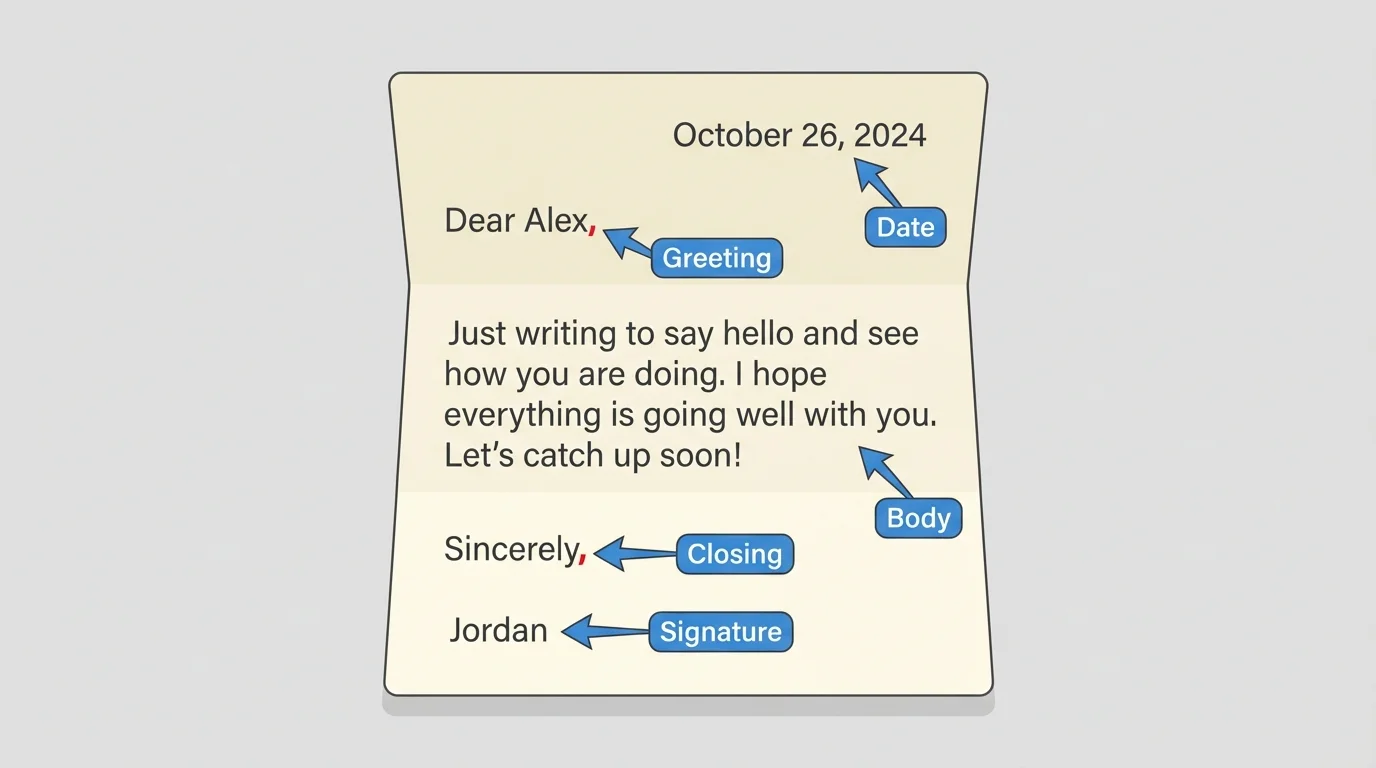
When you know the parts of a letter, it becomes easier to know where commas belong. The comma is not placed just anywhere. It belongs in a special spot in the greeting and in a special spot in the closing.
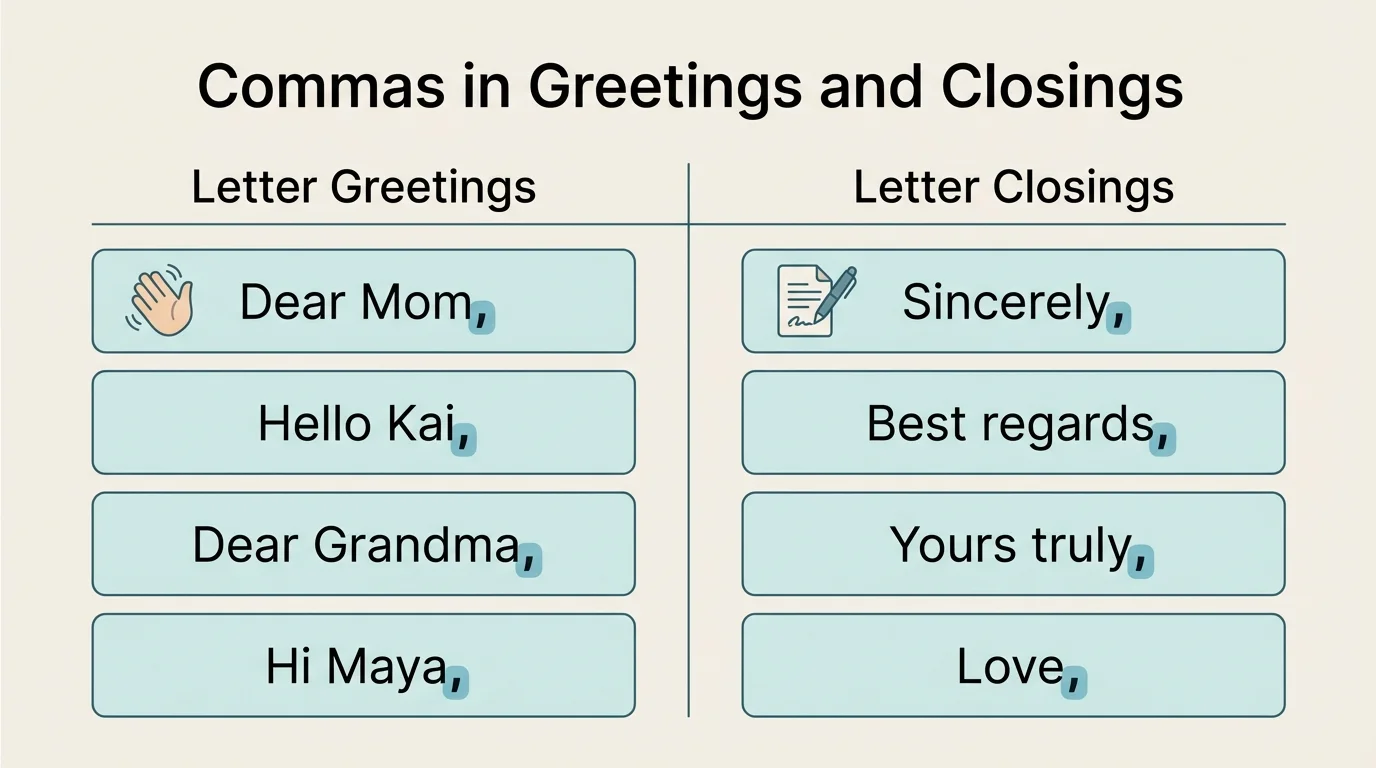
The rule for a friendly letter greeting is simple: write the greeting first, then put a comma at the end of the greeting. The comma comes after the name or word you use to greet the person.
Look at these examples:
Dear Mom,
Hello Kai,
Dear Grandma,
Hi Maya,
In each greeting, the comma comes at the end. It does not go in the middle. It does not go before the name. It comes after the whole greeting.
Here are some incorrect examples:
Dear, Mom
Hello, Kai
Dear Grandma.
These are incorrect because the comma is in the wrong place or a period is used instead of a comma. In a greeting, the comma belongs at the end of the greeting line.
Example of a correct greeting
Step 1: Start with a word that greets the reader.
You might write Dear or Hello.
Step 2: Add the person's name.
For example: Dear Ana
Step 3: Put a comma at the end.
The complete greeting is Dear Ana,
If you write to more than one person, the same idea still works. You still place the comma at the end of the greeting.
Dear Mom and Dad,
For this lesson's letter style, Hello, friends is not correct because the comma comes too early. The correct form is Hello friends,
The rule for closings is also simple: write the closing word or phrase, then place a comma after it. Your name goes on the next line.
Look at these examples:
Love,
Your friend,
From,
Sincerely,
After the closing, you write your name below it, like this:
Love,
Lena
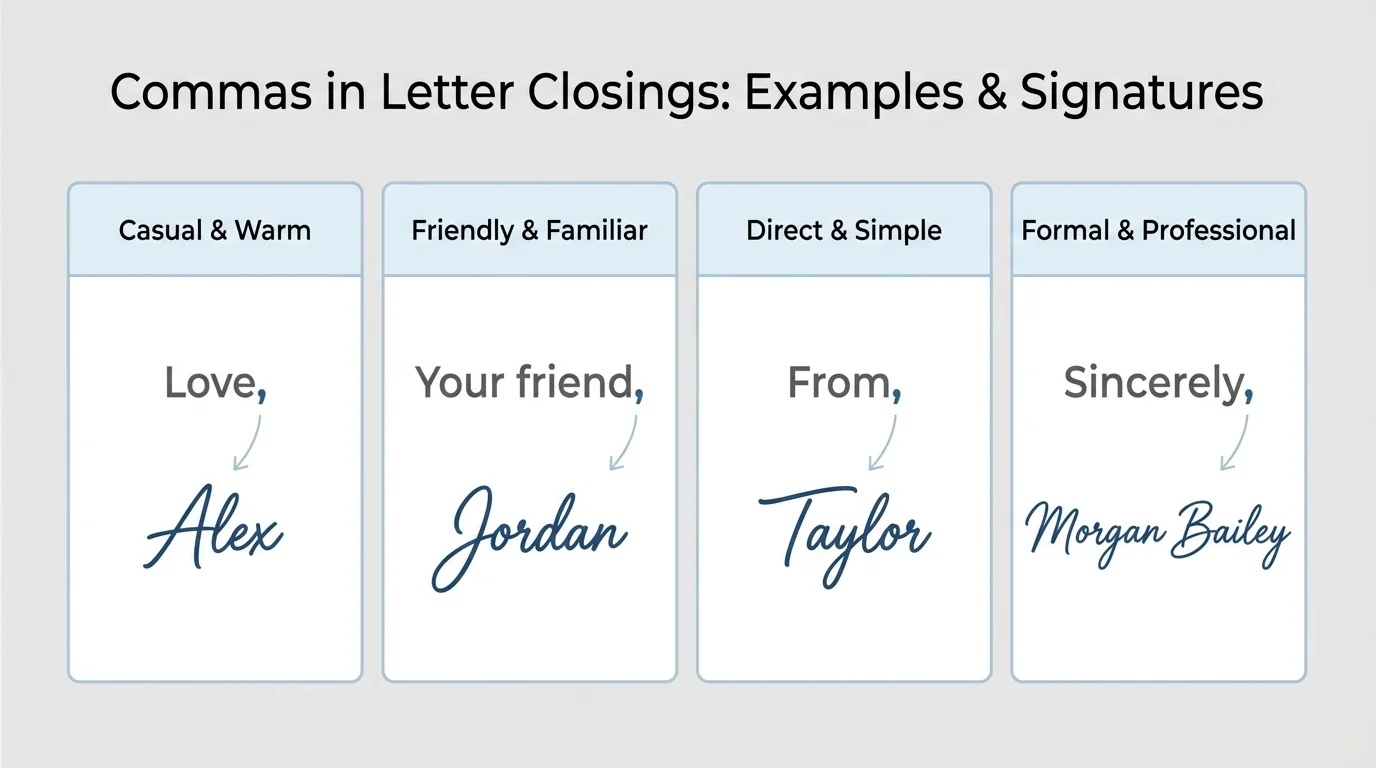
The comma belongs after the closing words, not after your name in this part of the letter. The closing and the signature are separate lines.
Here are some incorrect closings:
Love
Your friend.
Sincerely Ben,
These are incorrect because they are missing the comma, using the wrong punctuation mark, or placing the name on the same line in the wrong way for this letter format.
Example of a correct closing
Step 1: Choose a closing phrase.
Example: Your friend
Step 2: Add a comma after the phrase.
It becomes Your friend,
Step 3: Write your name on the next line.
Your friend,
Owen
Later, when you read full letters again, [Figure 1] still helps you remember where the closing belongs in the whole letter. It is near the end, just before the signature.
Letters use more than commas. They also use capitalization. That means using capital letters in the right places.
In greetings, the first word begins with a capital letter.
Dear Uncle Jay,
Hello Nora,
In closings, the first word also begins with a capital letter.
Love,
Your friend,
Notice that not every word in a closing must have a capital letter. In Your friend, the word Your starts with a capital letter because it is the first word. The word friend stays lowercase.
Commas and capitals as a team
A letter looks polished when you use both kinds of rules together. The capital letter shows the start of the greeting or closing, and the comma shows where that part ends.
If a student writes dear Maya, the comma is correct, but the capital letter is missing. If a student writes Love without a comma, the capital letter is correct, but the punctuation is missing. Good letter writing uses both.
One common mistake is leaving out the comma. For example, Dear Sam is missing the comma. It should be Dear Sam,
Another mistake is putting the comma in the wrong place. The examples in [Figure 2] remind us that the comma goes at the end of the whole greeting, not right after the first word. So Dear, Sam is incorrect.
A third mistake is using a period instead of a comma. For example, Love. is not the usual punctuation for a letter closing. It should be Love, as shown earlier in [Figure 3].
Some writers also forget to leave the name on the next line after the closing. A clean letter format helps the reader see where the closing ends and where the signature begins.
Many cards, thank-you notes, and handwritten letters use the same comma rules as friendly letters. The rule stays useful even outside school.
When you edit your letter, check the beginning and the ending carefully. Those are small parts, but they make a big difference.
You can choose different greetings depending on whom you are writing to. Some sound warm and casual. Some sound a little more formal.
Examples of greetings include Dear Dad, Hello Ava, Hi Luis, and Dear Teacher,. Each one ends with a comma.
Examples of closings include Love, Your friend, From, and Sincerely,. Each one also ends with a comma.
| Part of the Letter | Examples | What Goes at the End? |
|---|---|---|
| Greeting | Dear Mom, Hello Zoe, Hi Ben, | Comma |
| Closing | Love, From, Your friend, | Comma |
Table 1. Examples of greetings and closings that end with commas.
If you write to a teacher or principal, you might choose a greeting like Dear Mrs. Lee, and a closing like Sincerely, The comma rule stays the same.
Now let's look at a full letter. Notice how the greeting and closing each use a comma.
Dear Cousin Mia,
Thank you for my birthday gift. I loved the book you sent. I started reading it last night.
Love,
Noah
This letter begins with a greeting that ends in a comma. It ends with a closing that also ends in a comma. The reader can easily see how the letter starts and ends.
Here is another example:
Hello Mr. Reed,
Thank you for visiting our class. I liked learning about birds. My favorite part was seeing the feathers.
Sincerely,
Aria
This example uses a different greeting and a different closing, but the punctuation rule does not change. The comma still comes after the greeting and after the closing.
When you revise and edit, reread your writing slowly. Check spelling, capitalization, and punctuation one part at a time. Looking just at the greeting and closing can help you catch small mistakes.
Good writers know that details matter. A comma in the right place helps your letter look kind, organized, and correct. Whether you write Dear Grandma, or Hello Eli, the greeting ends with a comma. Whether you close with Love, or Your friend, the closing ends with a comma too.
