Have you ever noticed that one tiny word part can change a word's meaning? The word happy feels cheerful, but add un- and suddenly unhappy means not happy. Add re- to tell, and retell means tell again. Small parts can do big jobs in reading.
A prefix is a word part added to the beginning of another word. It changes the meaning of the word that comes after it. Readers can often figure out a new word by looking at the prefix and the word it joins, as shown in [Figure 1].
Prefix means a word part added to the front of a word. Base word means the word that can stand by itself and holds the main meaning.
Look at the word happy. It is a word we know. Now add un- to the front: unhappy. The new word still keeps the idea of happy, but the prefix changes it to mean not happy.
Prefixes are helpful because they are clues. When you see a new word, you do not always have to guess. You can take the word apart into smaller meaningful parts and think about what each part tells you.
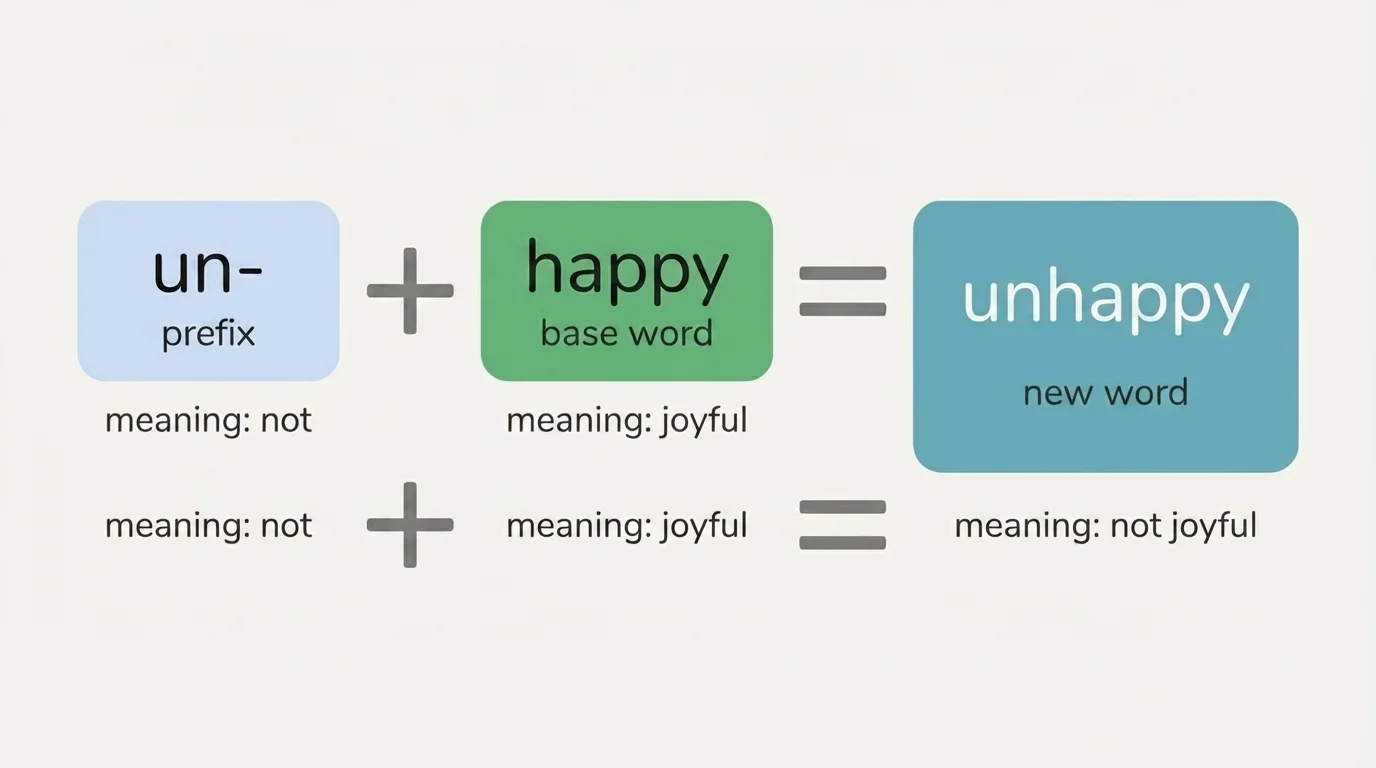
The base word is the word that gives the main idea. In retell, the base word is tell. In preview, the base word is view. In dislike, the base word is like.
When you read a word with a prefix, it helps to find the base word first. Ask yourself, "What does this word mean by itself?" Then ask, "What does the prefix add to that meaning?"
For example, if you know heat, then preheat is easier to understand. The base word heat means to make something warm or hot. The prefix pre- means before. So preheat means to heat before.
Readers do this thinking very quickly. The more you practice, the more natural it becomes.
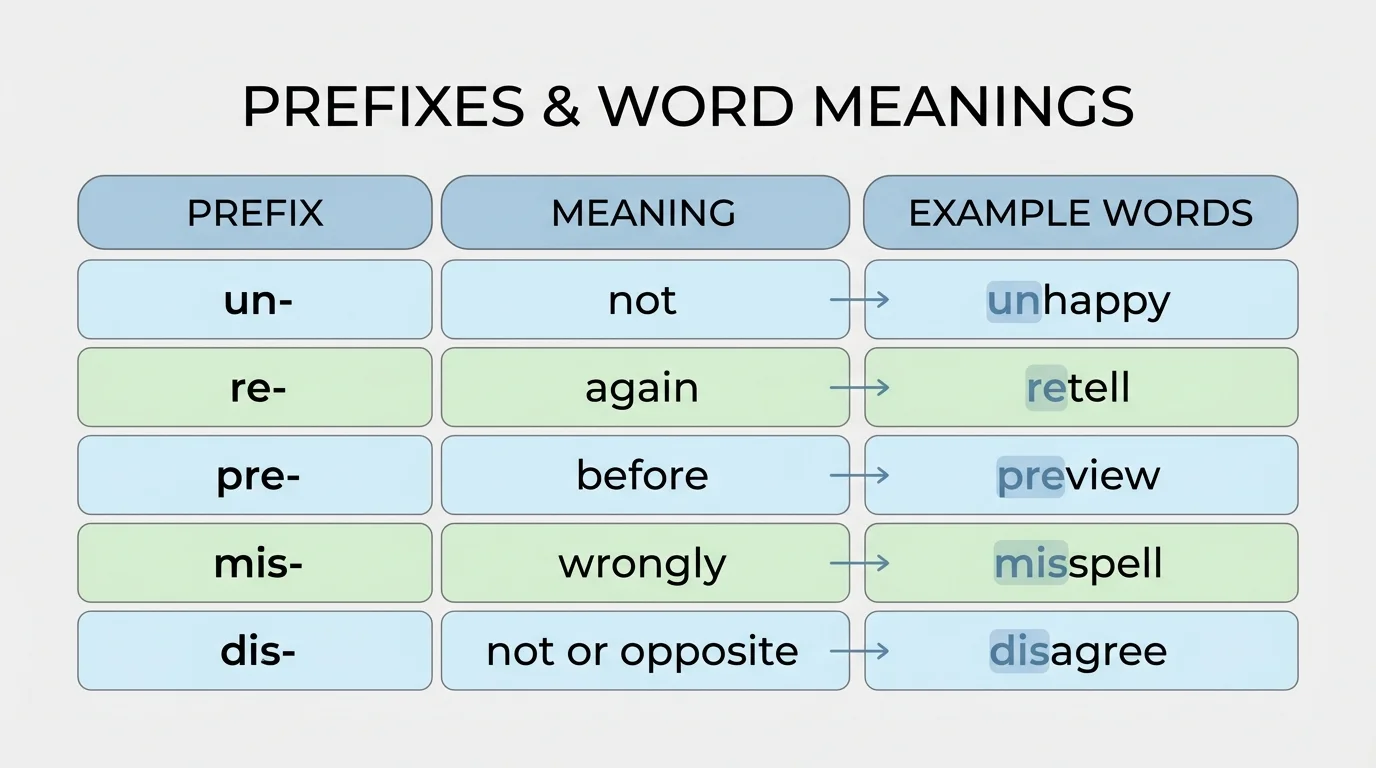
Readers can learn a small group of common prefixes and use them again and again, as [Figure 2] shows. When you know these prefixes, many new words become easier to understand.
One common prefix is un-. It often means not. Unkind means not kind. Unsafe means not safe. Untie means to loosen what was tied.
Another common prefix is re-. It often means again. Reread means read again. Replay means play again. Repaint means paint again.
The prefix pre- often means before. Preview means to view before. Prewash means wash before. Preschool means school before kindergarten.
The prefix mis- often means wrongly or badly. Misread means read something the wrong way. Miscount means count the wrong way. Misplace means put something in the wrong place.
The prefix dis- can mean not or the opposite of. Dislike means not like. Disappear means to go away from sight. Disconnect means to take apart what was connected.
Notice something important: one prefix can appear in many words. If you know that re- means again, you can use that idea in retell, redo, recheck, and rewrite. This is one reason word parts are so powerful for readers.
Some books, games, and classroom directions use prefix words all the time. Words like redo, untie, preview, and disconnect may look long, but their meanings become clearer when you notice the prefix.
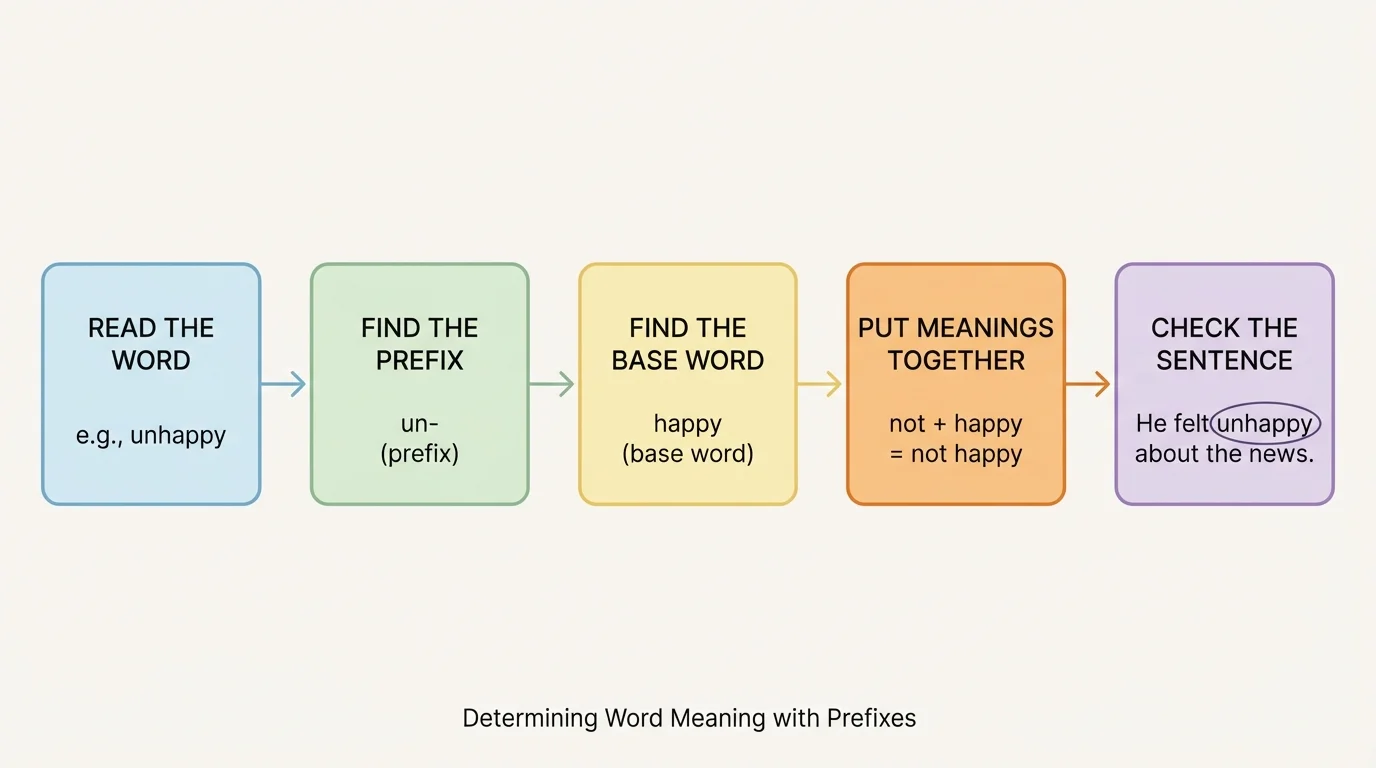
When you meet a new word with a prefix, you can follow a simple strategy, as shown in [Figure 3]. Good readers do not just sound out the word. They also think about what it means.
Here is a helpful way to figure it out. First, look for the prefix at the beginning. Next, find the base word you know. Then, put the meanings together. Last, read the whole sentence and ask if your idea makes sense.
Example: retell
Step 1: Find the prefix.
The prefix is re-, which means again.
Step 2: Find the base word.
The base word is tell, which means to say or share a story.
Step 3: Put the meanings together.
Retell means to tell again.
Step 4: Check the sentence.
In the sentence "Please retell the story to your partner," the meaning "tell again" fits perfectly.
This same strategy works for many words. Unpack means to remove things from a package or container. Precook means cook before. Miscount means count the wrong way. As we saw earlier in [Figure 1], the new word keeps the base word's main idea, but the prefix changes it.
Reading the whole sentence helps you make sure your meaning is correct. Sometimes a word part gives you a strong clue, but the sentence helps you confirm it.
Read this sentence: "After we finished the book, I decided to reread my favorite page." The word reread has the prefix re-, so it means read again. The rest of the sentence supports that meaning.
Now read: "Please untie the ribbon before opening the box." If you know tie and the prefix un-, you can figure out that untie means to loosen or open what was tied.
Context matters too. In "We will preview the movie tomorrow," preview means to view before. In "The class did a preview of the play," the word still carries the idea of seeing something before the whole performance. The sentence helps you understand exactly how it is used.
When you are not sure, do both jobs: use the prefix and base word, then use the sentence around the word.
Most of the time, a prefix is simply added to the front of a word. That makes it easier to spot the base word. In unhappy, you can still see happy. In retell, you can still see tell. In dislike, you can still see like.
Sometimes the new word may look longer or a little tricky at first, but the base word is still there. In rewrite, the base word is write. In preheat, the base word is heat. In misprint, the base word is print.
That is good news for readers. You do not need to learn each long word as if it were brand new. You can use what you already know about the base word and the prefix.
You already know many base words from speaking, listening, and reading. Prefixes let you build on that knowledge instead of starting over with every new word.
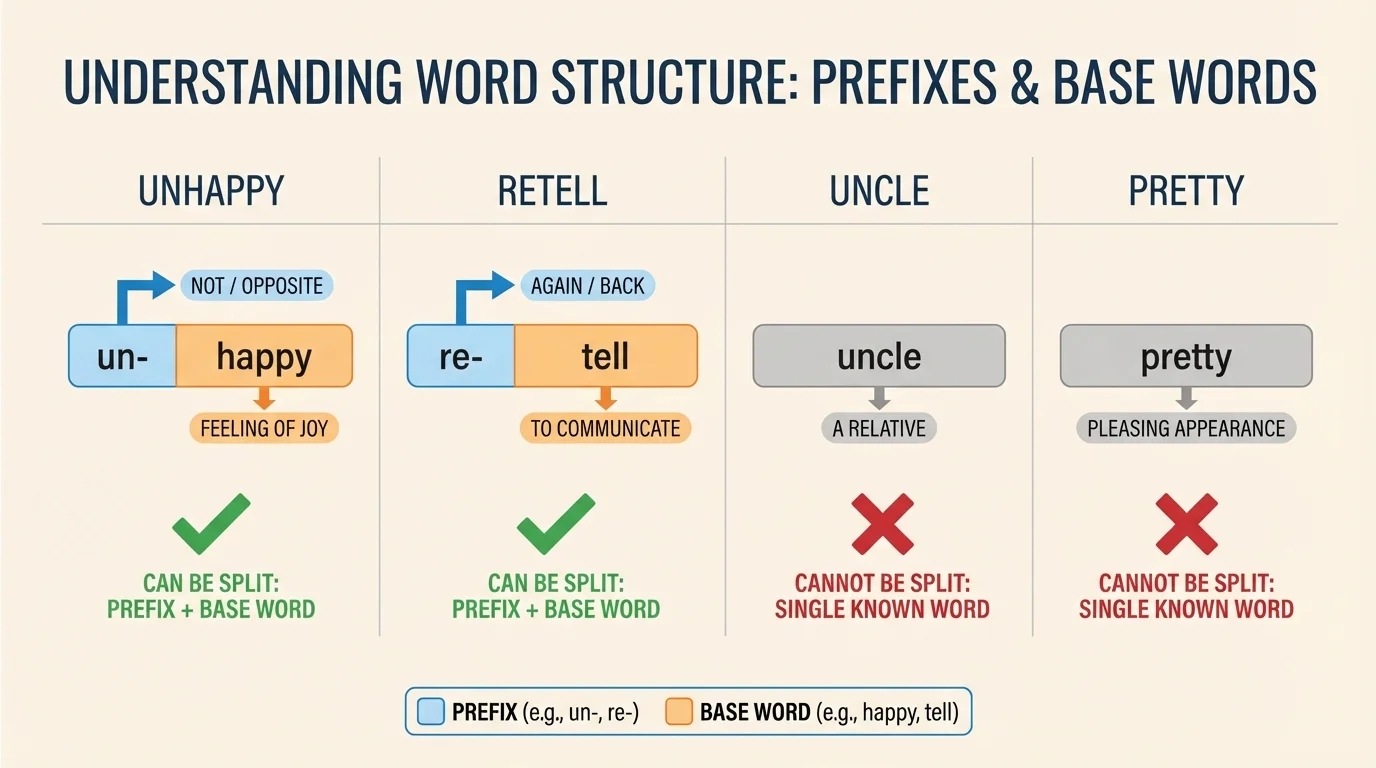
Some words only look like they begin with a prefix. Good readers check whether the rest of the word is really a known base word. The examples in [Figure 4] show this clearly.
For example, in uncle, the letters un- appear at the beginning, but cle is not a base word you know. So uncle is not a word you should split into un- and cle. In pretty, the letters pre- appear at the front, but tty is not a base word. So pretty does not contain the prefix pre-.
This is why it helps to ask, "Do I know the base word?" If the rest of the word is not a real word I know, I should be careful. The word may simply start with those letters.
Later, when you read harder books, this careful thinking will help even more. This comparison reminds us that not every word beginning is a meaningful prefix.
Knowing prefixes helps in two big ways. First, it helps you decode words, which means to read them accurately. Second, it helps you understand what those words mean.
Suppose you read the sentence, "Please disconnect the headphones before packing the tablet." Even if disconnect is new to you, you may know connect. The prefix dis- helps you understand that the word means to take apart what was connected.
Prefixes also help you as a writer. If you want to say that someone will do something again, re- may help. If you want to show that something is not true or not safe, un- may help. Word parts give writers more choices.
As readers grow, they learn that words are built in meaningful ways. The flow of steps in [Figure 3] is useful not only for one word but for many words across stories, science books, directions, and classroom talk.
When you know a prefix and a base word, you hold two clues at once. Put those clues together, and many new words become much less mysterious.
