Have you ever noticed that two words can seem like twins, but they are not exactly alike? If you toss a ball to a friend, that feels different from when you hurl it across a field. Both words refer to throwing, but they paint different pictures in your mind. Good readers and writers pay attention to these tiny differences because they help us understand stories better and choose just the right word.
Some words are closely related. That means they share a similar meaning. But each word can have its own small difference. This small difference is called a shade of meaning. A shade of meaning is like a different shade of a color. Light blue and dark blue are both blue, but they do not look exactly the same. Words work that way too.
When readers notice shades of meaning, they understand more. They can tell whether an action is gentle or rough, quick or slow, kind or unkind. They can also tell whether a describing word sounds positive, negative, or neutral. These details make reading richer and writing clearer.
Shade of meaning means a small difference in the meaning of words that are closely related.
Verb means an action word, such as run, grab, or throw.
Adjective means a word that describes a noun, such as small, bright, or slender.
Sometimes the difference is about strength. Sometimes it is about speed. Sometimes it is about how something looks or feels. Sometimes it is about the feeling the word gives to the reader. That feeling is called tone. A word can sound friendly, fancy, rude, or serious.
A verb tells about an action. [Figure 1] shows that many verbs can describe almost the same action, especially words for sending something through the air. But the exact word matters. The words toss, throw, and hurl all involve making something move from one place to another. Still, each word gives a different picture.
Toss usually means to throw something gently or lightly. You might toss a beanbag into a basket. Throw is a more general word. It can mean many kinds of throwing. You might throw a ball in gym class. Hurl usually means to throw with great force. If a giant hurls a rock, it sounds strong and powerful.
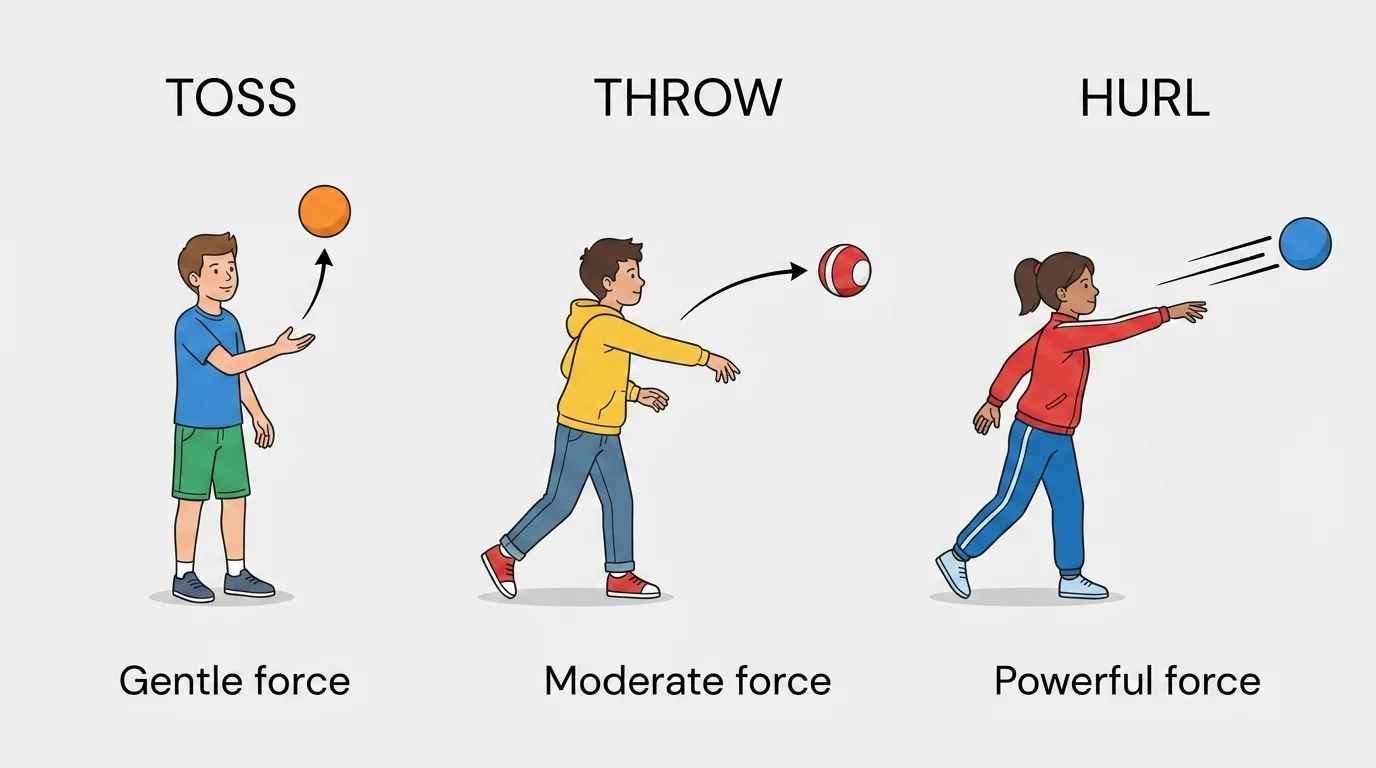
Look at how the meaning changes in these sentences. "Mia tossed the pillow onto the bed" sounds soft and easy. "Mia threw the pillow onto the bed" is plain and general. "Mia hurled the pillow onto the bed" sounds much stronger, maybe even angry, even though a pillow is light.
Here are more related verbs: drop, place, and slam. All three can mean moving something down. But if you place a book on a desk, you do it carefully. If you drop a book, it may slip from your hands. If you slam a book down, you do it with force. The action changes because the word changes.
Verb shades of meaning
Step 1: Read the action idea.
A child moves a snowball to a friend.
Step 2: Compare the verbs.
If the child moves it gently, toss fits best. If the child sends it in an ordinary way, throw fits. If the child sends it hard and fast, hurl fits best.
Step 3: Notice the picture in your mind.
Each word creates a different picture, even though all three are related.
Writers choose these words on purpose. If a story says, "The boy hurled his backpack onto the floor," you can guess he may be upset. If it says, "The boy placed his backpack by the door," he sounds calm and careful. The word choice gives clues about the character.
We can compare some verbs in a table.
| Verb | What it means | How it feels |
|---|---|---|
| toss | throw lightly | gentle or easy |
| throw | send through the air | general |
| hurl | throw very hard | strong or angry |
| place | set down carefully | careful |
| drop | let fall | accidental or quick |
| slam | put down with force | loud or angry |
Table 1. Comparison of closely related verbs and the feelings they suggest.
When you read, stop and ask, "Why did the author choose this verb and not a different one?" That question helps you understand the story more deeply. As we saw in [Figure 1], even words for the same basic action can show very different amounts of force.
An adjective describes a person, place, thing, or idea. Some adjectives also have shades of meaning. [Figure 2] shows that the words thin, slender, skinny, and scrawny all describe someone or something that is not wide or thick, but they do not sound the same at all.
Thin is often a general word. A thin line is not wide. A thin slice of apple is cut in a narrow way. Slender often sounds graceful or elegant. A slender tree branch sounds long and delicate. Skinny can sound less kind when talking about a person. Scrawny usually means very thin in a weak or bony way, and it often sounds negative.
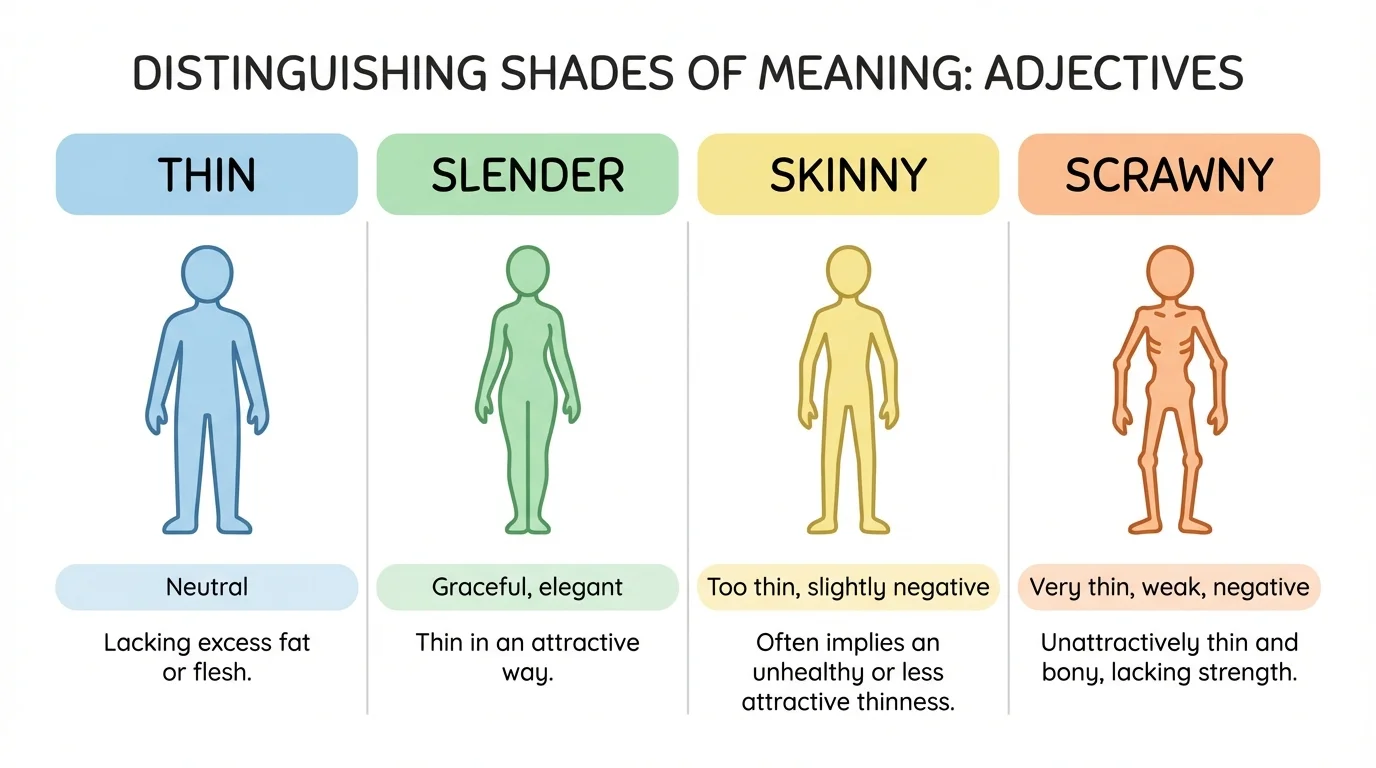
Listen to the feeling in these examples. "The cat has a thin tail" sounds neutral. "The dancer has a slender shape" sounds positive. "The boy has skinny legs" may sound a little rude. "The scrawny chicken looked weak" sounds clearly negative. The meaning is close, but the feeling changes.
This is important because readers should notice whether a word sounds kind or unkind. Writers should also choose words that match what they really mean. If you want to describe a flower stem in a pretty way, slender works well. If you are describing a weak little puppy in a story, scrawny may fit better.
Words carry feelings
Some related words give information, and they also carry a feeling. A word may sound positive, negative, or neutral. Learning these feelings helps you understand a character, setting, or object more clearly.
Here is another set of closely related adjectives: big, large, huge, and gigantic. They all tell about size, but each one grows stronger. A large pumpkin may sound bigger than a big pumpkin, and a gigantic pumpkin sounds enormous. Readers use these word clues to build the right picture.
Later, when you meet the words skinny and scrawny in a story, think back to [Figure 2]. The figure reminds you that not all "thin" words are equally kind, equally strong, or equally useful in every sentence.
Context means the words and ideas around a word. Context helps readers figure out the best meaning. A word can change a little depending on the sentence it is in.
Read these two examples: "Lena tossed the salad" and "Lena tossed the ball." In both sentences, tossed means to move something lightly. But the first sentence is about mixing food, and the second is about playing a game. The context tells which picture to make in your mind.
Context also helps with adjectives. "A thin blanket" means not thick. "A thin excuse" does not mean the excuse is flat like paper. It means the excuse is weak or not very good. The words around it help you know which meaning fits.
One small word choice can change how a whole sentence feels. Authors often pick one exact word so readers can feel calm, excited, worried, or amused.
When you come to a word you know, but the sentence seems unusual, slow down. Ask what the sentence is about. Ask what feeling the author wants to create. That is how context helps you become a stronger reader.
Sometimes a word means exactly what it says. That is called a literal meaning. Other times a word is used in a creative or non-literal way. That is called figurative language. [Figure 3] illustrates that related verbs and adjectives can be used in both ways.
If you read, "Jamal hurled the ball," that is probably literal. A real ball is flying through the air. But if you read, "Jamal hurled an insult," no object is flying. The word hurled means he said something mean in a forceful way. The word still carries the idea of strong force, but now it is figurative.
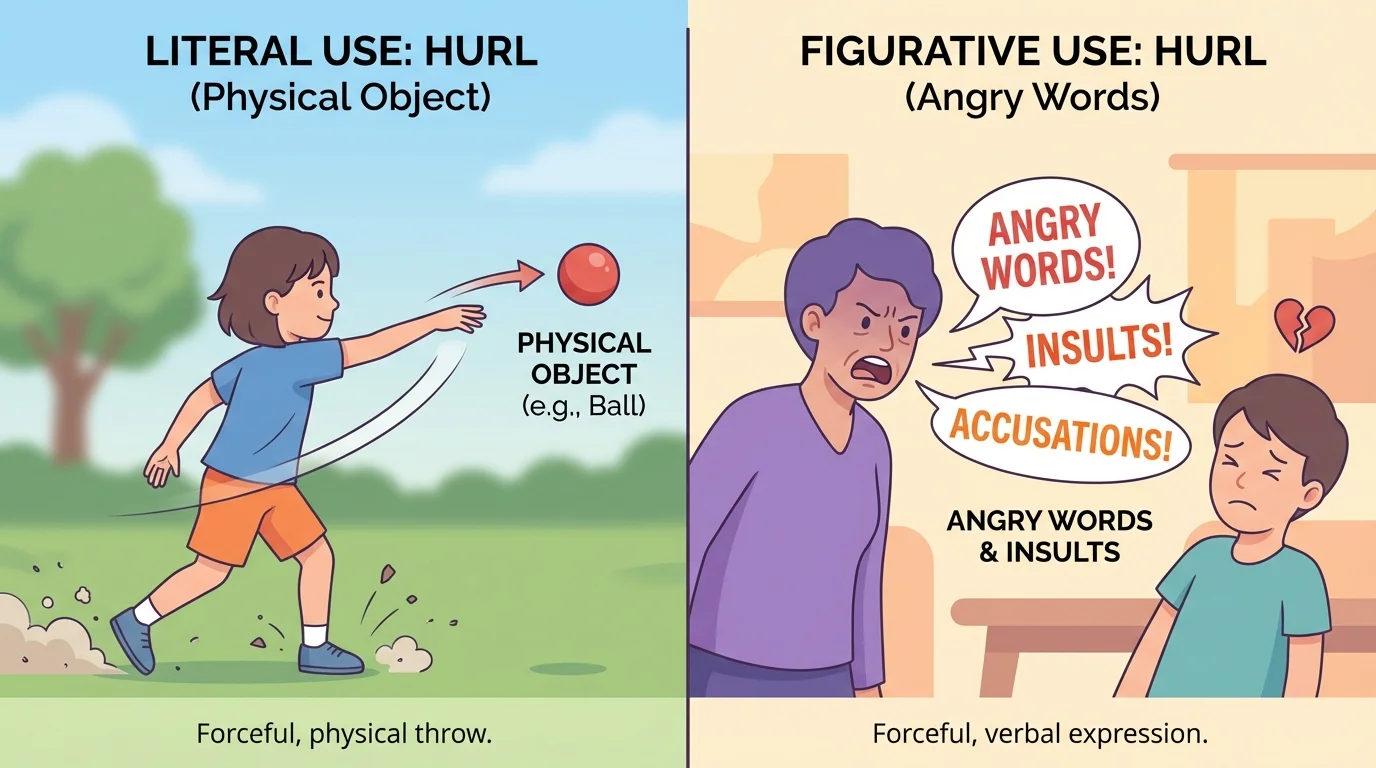
Adjectives can work this way too. "A thin rope" is literal because the rope is really narrow. "A thin excuse" is figurative because an excuse cannot be skinny like a person. Instead, it means weak or not believable.
Figurative language makes writing lively. It also depends on shades of meaning. The author chooses a powerful word because of the feeling it brings. Thinking back to [Figure 3], you can see how the same verb keeps its strong feeling even when the meaning changes from a real throw to spoken words.
Strong readers notice exact words. Strong writers choose exact words. If you are reading a story, pay attention to action words and describing words. Ask yourself what picture each word creates. Ask whether the word sounds gentle, rough, kind, fancy, silly, or serious.
If you are writing, do not just pick the first word that comes to mind. Think about what you really want to show. A character who tiptoes is different from one who walks or stomps. A room that is messy is different from one that is filthy. These differences help your reader see exactly what you mean.
Choosing a stronger word
Step 1: Start with a simple sentence.
"The girl threw the snowball."
Step 2: Think about the action.
Was it gentle, ordinary, or forceful?
Step 3: Choose the best verb.
If it was gentle, write "The girl tossed the snowball." If it was forceful, write "The girl hurled the snowball."
Step 4: Notice how the sentence changes.
The new verb gives a clearer picture of what happened.
Shades of meaning matter in school, in books, and in everyday life. When someone says, "Please place your shoes by the door," that sounds careful and polite. If someone says, "Don't slam your shoes there," you know a different kind of action is being talked about. The words guide your understanding.
Learning these small differences helps you grow as a reader. It also helps you become more thoughtful with language. The more you notice word choices, the more meaning you can find in every sentence.
