Have you ever heard someone read a story out loud in a way that made the story sound alive? The words seemed to flow, the voice matched the meaning, and it was easy to understand. That kind of reading is called fluent reading. When readers become more fluent, they do not just sound better. They also understand the text better.
When we read out loud well, we use three important parts of fluency, as shown in [Figure 1]: accuracy, rate, and expression. Accuracy means reading the words correctly. Rate means reading at a speed that sounds natural, not rushed and not painfully slow. Expression means using your voice to match the meaning of the words.
Strong readers use all three parts together. If a reader says many words wrong, the meaning can get lost. If a reader races too fast, the story may sound confusing. If a reader reads in a flat, robot-like voice, the important feelings and ideas may disappear. Fluent reading helps the listener and the reader understand the text.
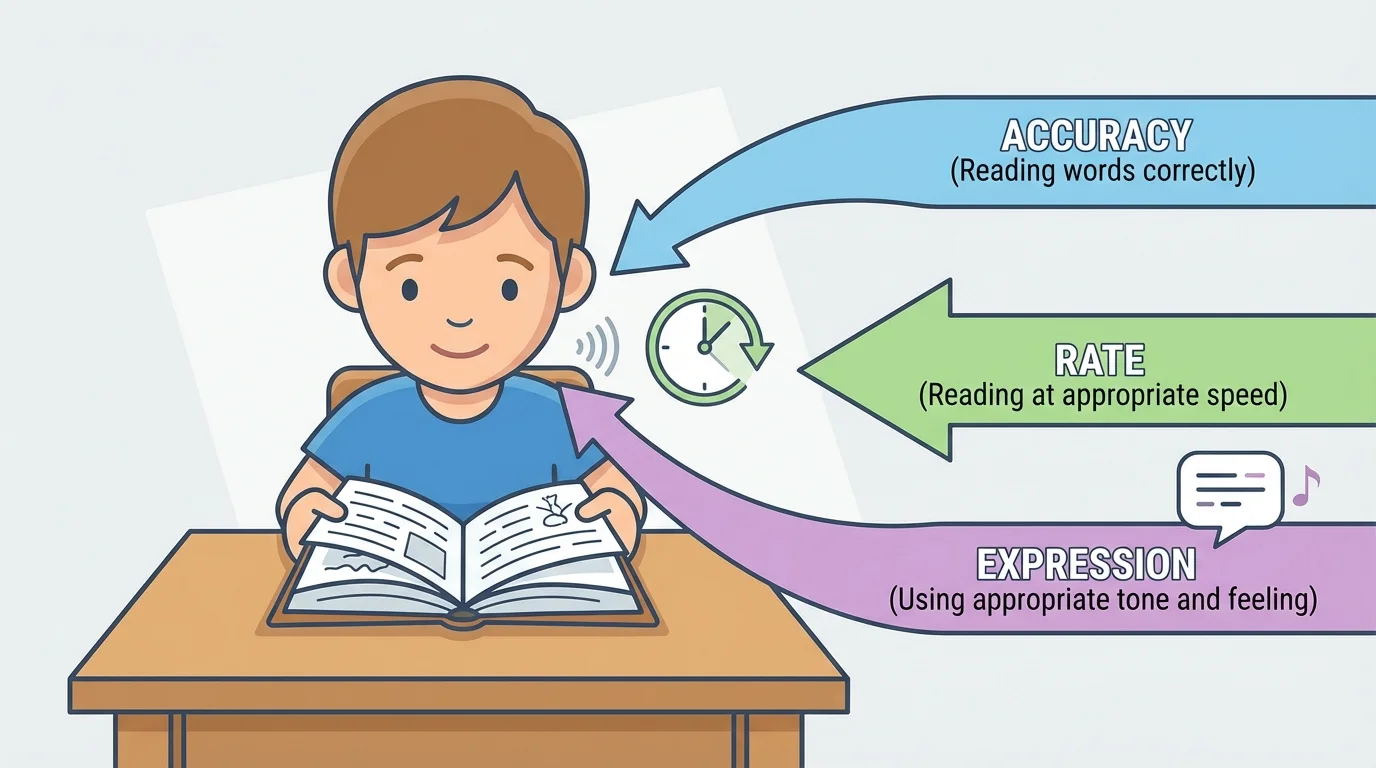
Accuracy is reading words correctly. Rate is how fast or slow someone reads. Expression is the way a reader uses voice, pauses, and feeling to match the meaning of the text. Successive readings mean reading the same text more than once to improve.
Reading fluently does not mean reading perfectly the first time. Even good readers sometimes pause, fix a mistake, or reread a sentence. Fluent reading grows over time as readers practice and pay attention to the words and their meaning.
Decoding helps readers say written words correctly. When students decode, they use letters, spelling patterns, and word parts to figure out words. Accurate reading begins with looking carefully at the whole word, not guessing from just the first letter or from a picture.
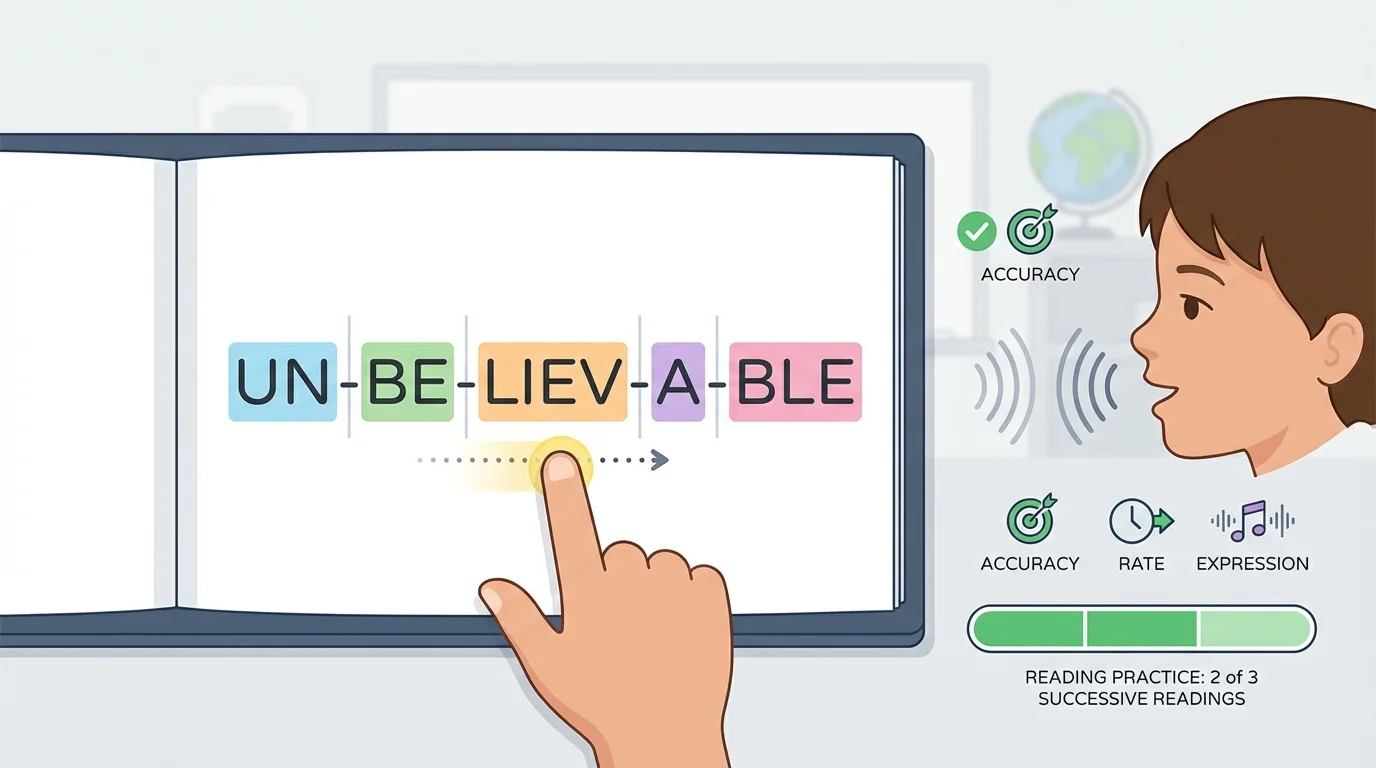
Many words can be read by noticing familiar parts. For example, in the word sunlight, a reader can see sun and light. In the word jumping, a reader may notice the base word jump and the ending -ing. In careless, the reader can see care and -less. Looking for chunks makes long words easier to read.
Readers also use orthography, or spelling patterns, to help with accuracy, as shown in [Figure 2]. A word like train has the vowel pattern ai. A word like night has the pattern igh. Knowing these common patterns helps readers read words correctly instead of sounding out every single letter one at a time.
Another helpful tool is morphology, which means understanding meaningful word parts. Prefixes, base words, and suffixes all give clues. If a reader knows that re- can mean "again," then replay makes more sense. If a reader knows that -ful can mean "full of," then helpful is easier to understand and read.
Accurate readers also notice when something does not sound right. Suppose a sentence says, "The rabbit hopped across the grass," but a reader says, "The rabbit hoped across the grass." The reader can stop, look again, and fix the word. Self-correcting is an important reading habit because it shows the reader is paying attention to meaning.
When you learned letter sounds, blends, digraphs, and word endings, you built tools for fluent reading. Those tools still matter. Fluent readers keep using phonics, spelling patterns, and word parts every time they read.
Accuracy is important because every word carries meaning. If too many words are read incorrectly, the story or information becomes hard to understand. When readers decode accurately, comprehension becomes stronger.
Rate is the speed of reading. A good reading rate sounds like calm, clear speech. It is not a race. Reading too fast can cause missed words, skipped punctuation, and confusion. Reading too slowly can make the text sound choppy and can make it harder to remember the meaning of the sentence by the time it ends.
An appropriate rate changes a little depending on the text. A funny dialogue in a story may move more quickly. A page with new information may need a slower, careful reading. Readers adjust their pace so the words make sense.
Think about how you would read these two sentences: "Run!" and "The turtle slowly crossed the garden path." The first sentence is very short and quick. The second sentence should be read more steadily. Readers match their pace to the text.
Skilled readers do not all sound exactly the same. One reader may pause a little more, and another may read a little faster, but both can still have a good rate if the reading is smooth and easy to understand.
Rate works best when it supports meaning. If a sentence is exciting, the voice may move a bit faster. If a sentence is packed with new ideas, the reader may slow down enough to think. Reading well means staying in control of the pace.
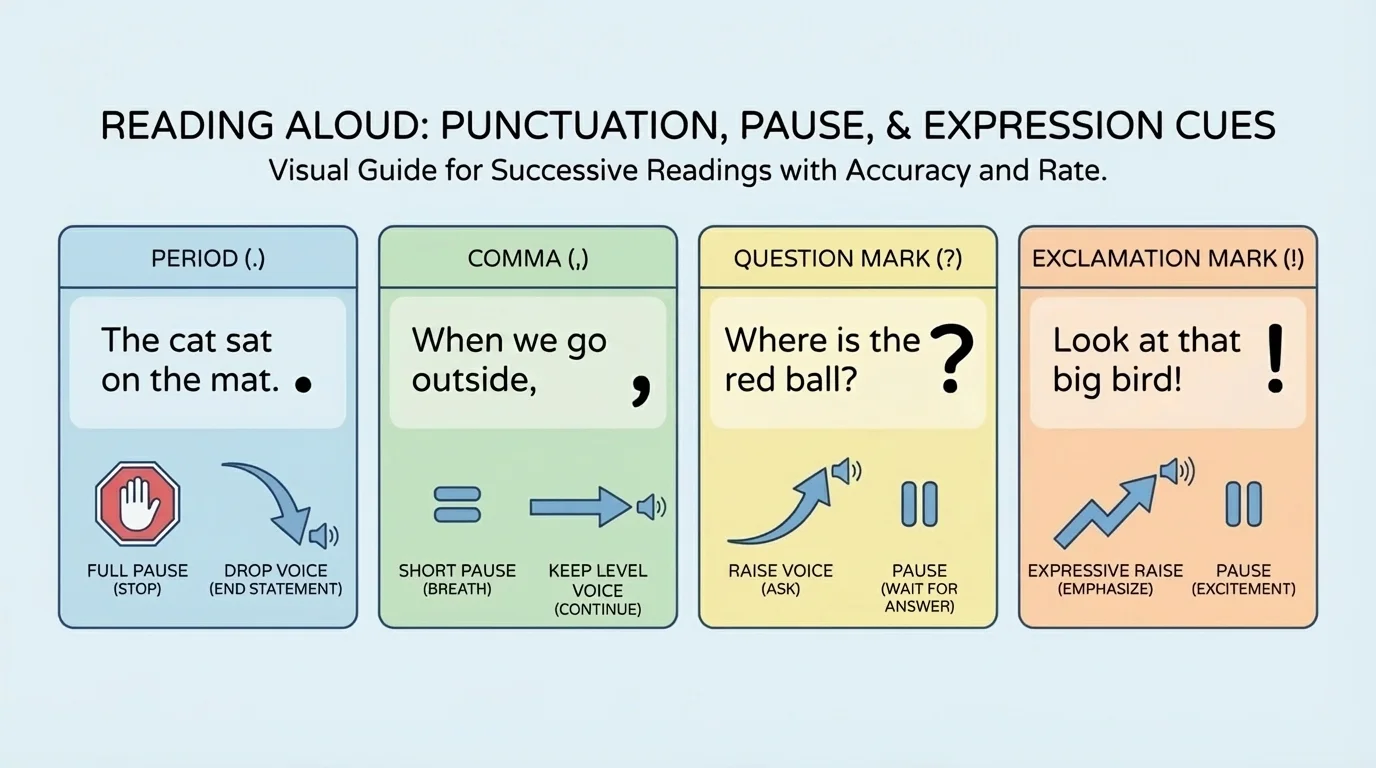
Expression makes reading sound meaningful, and [Figure 3] shows how punctuation helps guide the voice. When readers use expression, they pay attention to punctuation, the kind of sentence, and the feeling of the words. A question should be read with a questioning tone. An exciting line should sound excited. A calm description should sound smooth and thoughtful.
Punctuation gives clues for expression. A period tells the reader to stop. A comma often signals a short pause. A question mark signals that the voice should sound like a question. An exclamation mark tells the voice to sound strong or surprised. Quotation marks can show that a character is speaking.
Listen to how expression changes meaning. "We won the game." can sound calm and proud. "We won the game!" sounds more excited. "We won the game?" sounds surprised, like the speaker can hardly believe it. The words are almost the same, but the voice changes the meaning.
Readers also group words into meaningful parts, called phrasing. Instead of reading one word at a time, they read in word groups. For example, "The little brown bird / landed on the fence" sounds smoother than reading each word separately. Phrasing helps the listener understand the sentence more easily.
Example of expression in action
Read these sentences with voices that match the meaning:
Step 1: Notice the punctuation.
"Where is my backpack?" ends with a question mark, so the voice should sound like a question.
Step 2: Notice the feeling words.
"I cannot wait for the field trip!" has excited meaning, so the voice should sound eager.
Step 3: Group words smoothly.
"After lunch, / we planted seeds / in the garden." The pauses help the sentence sound natural.
Expression helps the words sound the way they are meant to sound.
Expression is not acting in a silly way. It is reading so that the meaning can be heard clearly. As readers improve, their voices begin to sound more natural and confident, just as we saw earlier with the parts of fluency in [Figure 1].
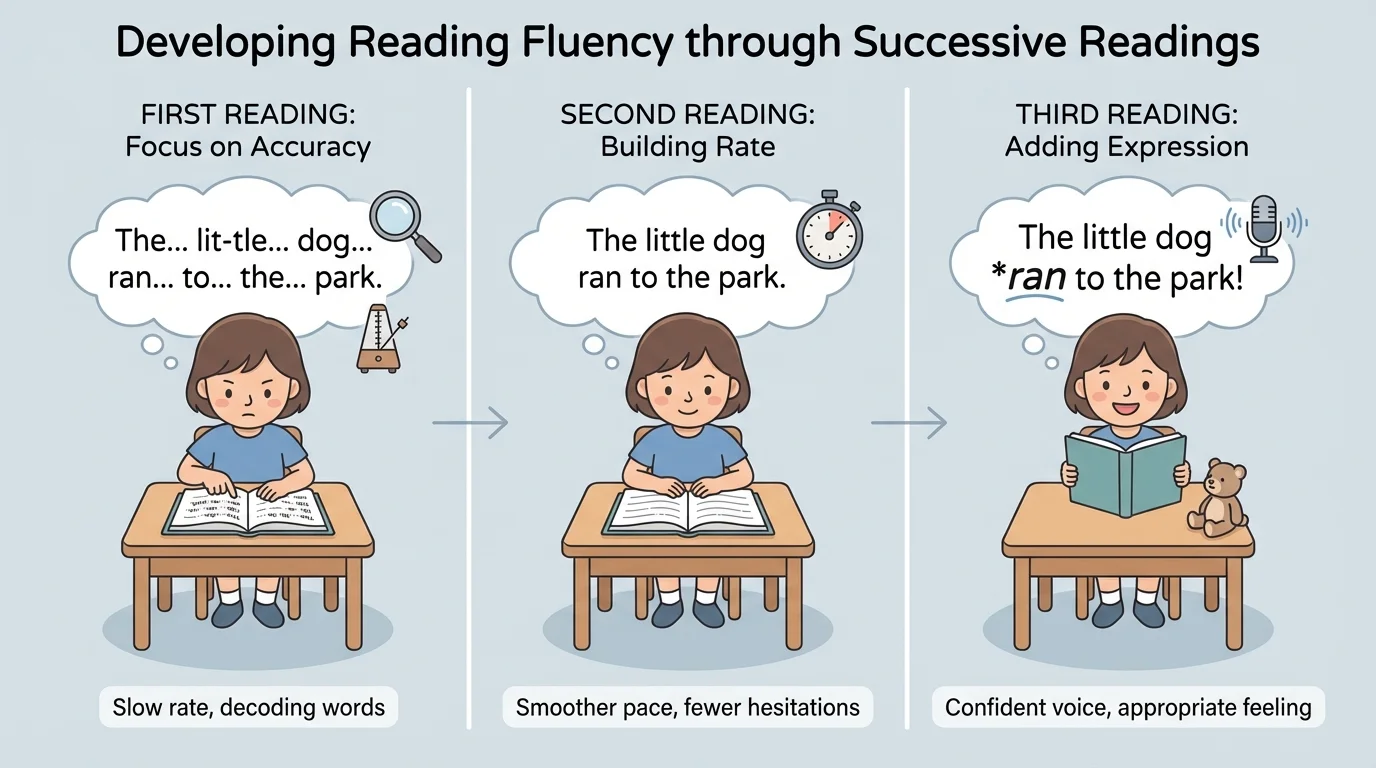
Successive readings means reading the same text more than once, and [Figure 4] illustrates how each reading can sound smoother than the one before. The first reading may include some slow spots or mistakes. During the second reading, the words begin to feel more familiar. By the third reading, the reader often sounds smoother, more accurate, and more expressive.
This happens because the brain has already done some of the hard work. The reader has seen the words, noticed the tricky parts, and started to understand the meaning. That leaves more attention for smooth reading and expression.
Successive readings are especially helpful with on-level text. On-level text is reading that is a good match for a student's grade and learning stage. It should be challenging enough to grow skills, but not so hard that every sentence feels impossible.
Rereading also builds comprehension, which means understanding what is read. When a student is no longer stuck on many words, the mind can focus on the characters, ideas, facts, and details. That is why fluency and comprehension work together.
Why rereading improves understanding
At first, a reader may spend a lot of energy solving words. On later readings, less energy is needed for word solving, so more attention can go to meaning. The reader starts to notice tone, important details, and connections in the text.
Suppose a student reads a short paragraph about penguins. The first reading may sound slow because of words like feathers or slippery. The second reading may be smoother. The third reading may sound more confident, and the student is more likely to remember that penguins use their feathers to stay warm.
When readers work on fluency, they bring several skills together at once. They look carefully at words, use spelling patterns and meaningful parts, pay attention to punctuation, and keep the reading smooth. This combination helps oral reading sound clear and supports understanding.
Think about a sentence such as, "At sunset, the orange sky shimmered over the lake." A fluent reader reads each word correctly, pauses a little at the comma, keeps a steady pace, and lets the voice show that the sentence paints a peaceful picture. The reading is not flat or rushed. It matches the meaning.
These same skills help in many real situations. Students use fluent reading when sharing a poem with the class, reading directions in a science activity, performing lines in a play, or reading a story to a younger child. In each case, accurate words, a good pace, and expression make the reading easier to understand.
"Good reading sounds like the words mean something."
As readers grow stronger, they often become more confident. Words that once felt hard become familiar. Sentences begin to flow. Voices begin to match the text. The improvement shown through rereading, like the progress in [Figure 4], reminds us that fluent reading is built step by step.
