Have you ever seen a long word and thought, "Wait, part of that word looks familiar"? That is a big clue. Readers do not have to know every word right away. Sometimes one small, known part of a word can unlock the meaning of a bigger, new word. If you know the word add, you already have a clue for words like addition and additional. That is a powerful reading skill.
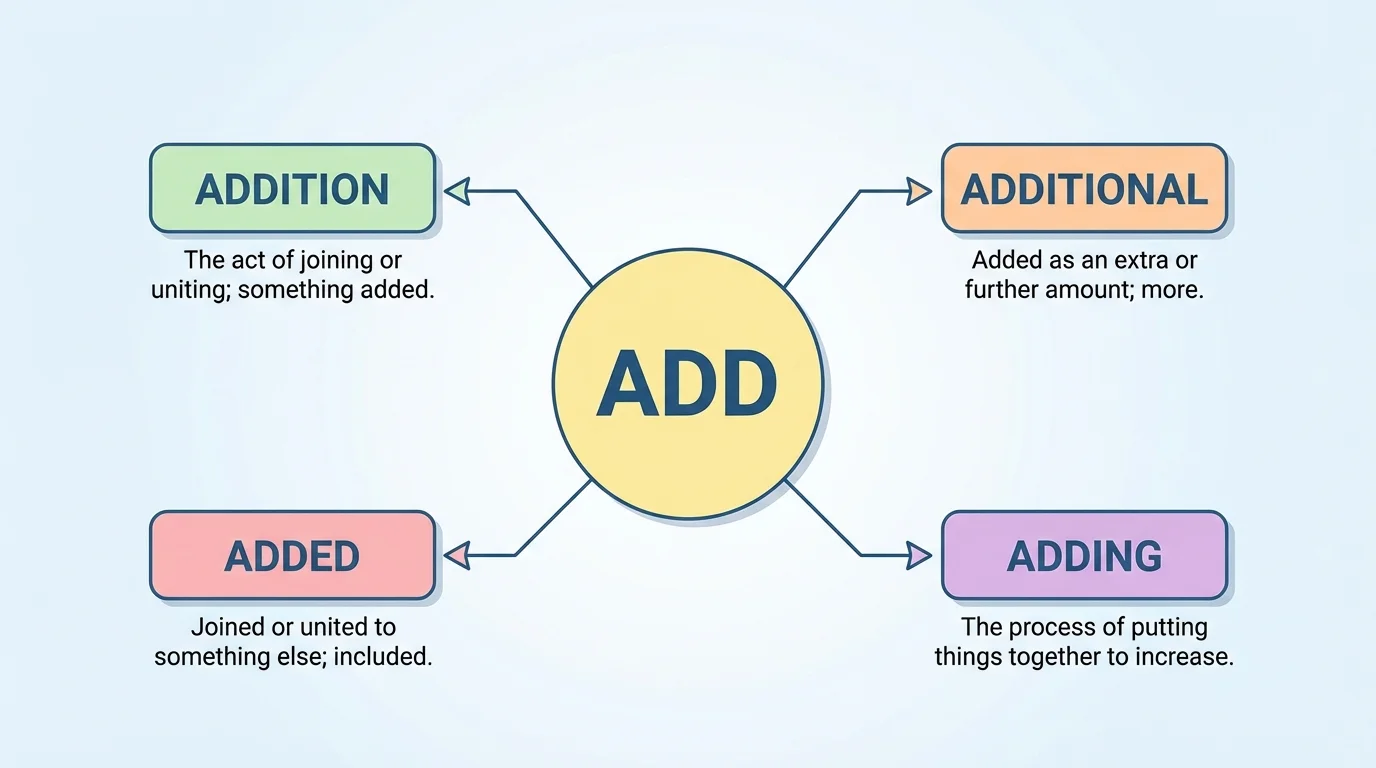
Many words belong to the same family. They are related because they grow from the same root word. A root is the main part of a word that carries the basic meaning. When readers notice that familiar part, as shown in [Figure 1], they can make a smart guess about a new word.
Think of a root word like the trunk of a tree. New words are like branches growing from it. The branches may look a little different, but they are still connected to the same trunk. If the trunk is help, then words like helpful and helpless are connected to that same meaning.
Root word means the basic word part that gives a word its main meaning. Words in the same family often share the same root.
Word family means a group of words that are related in spelling and meaning because they share a root.
When you read, spotting a word family can help you decode a word and understand it. You may not know the whole word yet, but you can start with the part you know.
A root word can often stand on its own as a word you already know. For example, play, jump, care, and fear are root words. Other words can be built from them: playing, jumped, careful, and fearful.
If you know that care means to look after something or someone, then careful probably has something to do with acting in a way that shows care. If you know that fear means being scared, then fearful probably means full of fear or feeling scared.
Sometimes the spelling changes a little when a new word is formed, but the root still gives a strong clue. Readers do not have to be perfect the first time. They can make a guess, then check whether the sentence makes sense.
You already know that good readers use clues. They look at the letters in the word, think about what makes sense, and reread if needed. Using a root word is one more clue to add to your reading toolbox.
This strategy works especially well when a new word looks longer but contains a smaller word you already know inside it.
Words often change when we add parts to the beginning or end. These parts can change the meaning, but the root still helps. The root help stays the same while endings change what the whole word means.
Endings added to words are often called suffixes. A suffix is a word part added to the end of a root word. For second-grade readers, it is helpful to notice common endings like -ful, -less, -ing, and -ed.
In [Figure 2], look at these examples:
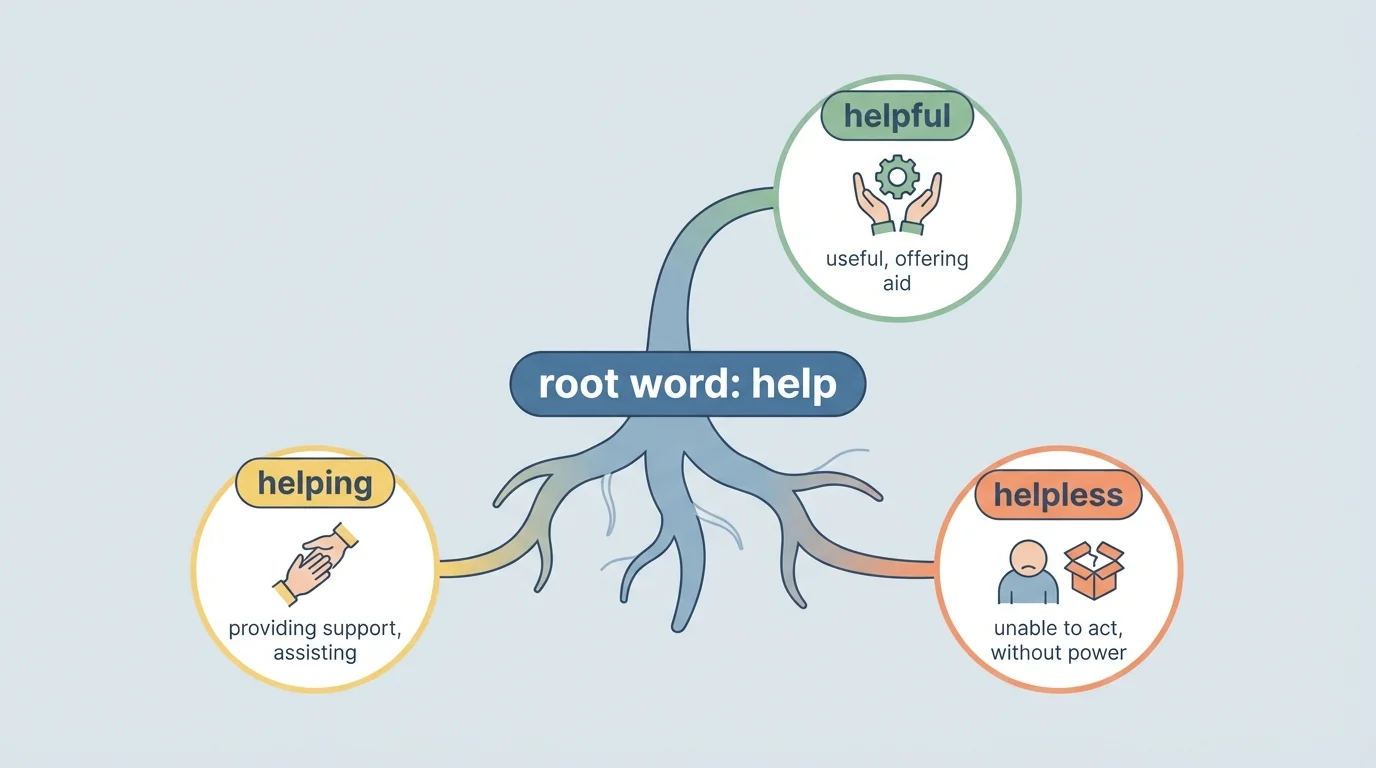
Notice that the root tells the main idea. The ending adds more information. If you know the root, you already know an important part of the word's meaning.
Beginnings can help too. For example, in the word unhappy, the root is happy. The beginning un- changes the meaning. Even so, knowing the root happy still gives a strong clue.
How word parts work together
The root gives the main meaning. Added parts such as endings or beginnings change that meaning a little or add details. Readers can think, "What does the root mean?" and then, "What do the extra parts tell me?"
This is why long words are not just random letters. They are often built from smaller meaning parts.
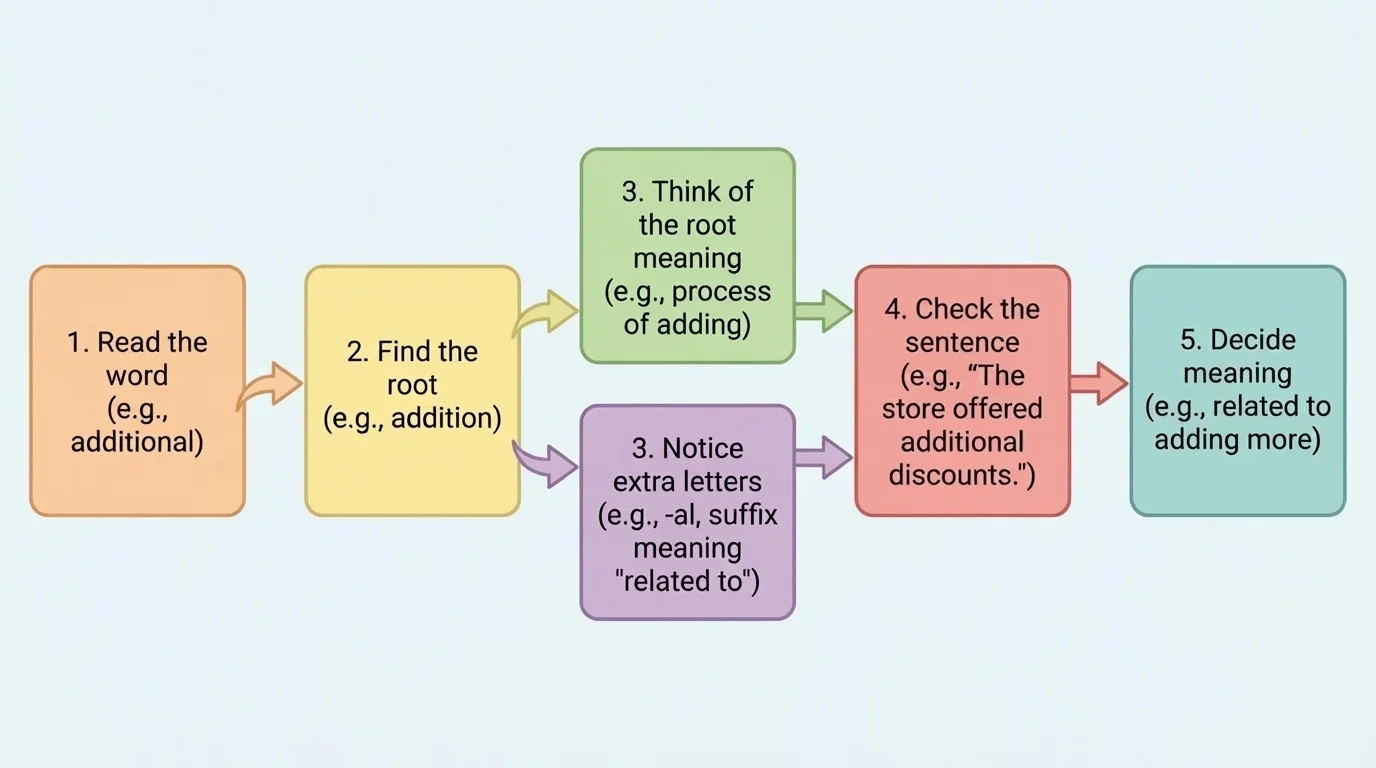
Readers can follow a simple clue-finding process, and [Figure 3] lays out those steps clearly. First, look for a part you know. Next, think about what that part means. Then notice any extra letters or word parts. Finally, read the whole sentence and ask, "Does my idea make sense here?"
This strategy is called making an inference about meaning. You use what you know to figure out what you do not know yet.
Suppose you read this sentence: We need additional chairs for the class party. If you know the word add, you know it means to put more with something. The word additional has the same root. So additional probably means more added or extra. That makes sense in the sentence, because more chairs are needed.
Example: figuring out a new word from a known root
Sentence: The puppy was playful in the yard.
Step 1: Find the part you know.
The familiar root is play.
Step 2: Think about the root meaning.
Play means to have fun or join in a game.
Step 3: Look at the whole word.
Playful probably means full of play or ready to play.
Step 4: Check the sentence.
A puppy in a yard can run and have fun, so playful makes sense.
The word playful means acting in a fun or lively way.
Good readers do this quickly in their minds. They do not always stop to explain every step, but those steps are still happening.
Some roots appear in many words you see in stories and informational books. Learning a few common roots can help you with many new words.
If you know add, then words in that family become easier to understand. As we saw earlier in [Figure 1], the root carries the basic idea of putting more with something.
add means to put something more with something else.
addition means something that has been added, or the act of adding.
additional means extra or more.
Here is another family:
care means to look after something or someone, or to give close attention.
careful means showing care.
careless means not showing care.
And another:
joy means happiness.
joyful means full of joy.
enjoy means to feel joy from something.
| Root Word | Known Meaning | Related Word | Meaning Clue |
|---|---|---|---|
| add | put more with | additional | more, extra |
| care | look after; be cautious | careful | showing care |
| care | look after; be cautious | careless | without care |
| help | give support | helpful | giving help |
| fear | being scared | fearful | full of fear |
| joy | happiness | joyful | full of joy |
Table 1. Examples of root words and related words that share meaning.
When you study these families, you begin to notice a pattern: the root stays important even when the whole word changes.
Many long words are easier to understand than they first appear. Once you spot a familiar root, the word often stops feeling so mysterious.
This is one reason vocabulary can grow so quickly. One word you know can help you learn several more.
Root words are powerful, but readers should also use the rest of the sentence. A word's meaning becomes clearer when you mix the root clue with context clues. Context clues are hints from the other words and sentences around it.
Read this sentence: Mia felt fearless when she stood on the stage and sang. The root fear tells you the word is about being scared. The ending helps too. The sentence says Mia stood on the stage and sang with confidence. So fearless means without fear or not scared.
Read this one: Dad made a careful turn on the icy road. The root care gives the idea of being cautious. The sentence about an icy road supports that meaning. So careful means acting with care.
Using both kinds of clues is smart reading. If one clue is not enough, another clue can help.
Example: using the root and the sentence together
Sentence: The extra backpack was an additional item for the trip.
Step 1: Spot the familiar root.
The root is add.
Step 2: Recall the root meaning.
Add means to put more with something.
Step 3: Think about the sentence.
The sentence talks about an extra backpack.
Step 4: Decide on the meaning.
Additional means extra or added on.
The root clue and the sentence clue match, so the meaning is clear.
When both clues point to the same idea, you can feel more sure about your answer.
Most of the time, using a known root helps a lot. But readers should still check the whole sentence to make sure the meaning fits. Sometimes a guess can be a little off.
For example, if you know play, you can guess that player is someone who plays. That works well. But some words may be trickier, so it is important to reread and think carefully.
A good reader asks, "Does this meaning make sense here?" If the answer is no, try again. Look at the sentence, the picture, or the sentences around it. Root words are a strong clue, but they are not the only clue.
The process in [Figure 3] reminds readers to check the sentence at the end, not just stop after finding the root. That final check helps make sure the meaning is right.
"Look for the part you know."
— A strong strategy for readers
This short reminder can help when a word looks long or tricky.
You use this skill in many kinds of reading. In stories, it helps you understand characters and actions. In science or social studies books, it helps you learn new topic words. In directions, signs, and messages, it helps you read more independently.
When you notice a familiar root, you are doing the work of a word detective. You are not guessing wildly. You are using what you know about spelling, word parts, and meaning.
For example, if you know wonder, then wonderful may suggest something very full of wonder or very good. If you know hope, then hopeful may suggest feeling hope. If you know rest, then restless may suggest not resting or unable to rest.
Every time you connect a new word to a known root, your reading grows stronger. You begin to understand more words, and books become easier to read and enjoy.
