Have you ever read a sentence and said a word that sounded fine at first, but then the whole sentence turned silly? That happens to readers of all ages. Strong readers are not readers who never make mistakes. Strong readers are readers who notice mistakes and fix them. They use clues from the sentence and story to make sure the words they read match the meaning.
Reading is more than saying words out loud. Reading is thinking about what the words mean. Sometimes a reader sees a word and makes a quick guess. That guess might be close, but it may not be correct. Good readers slow down for a moment and check.
They ask themselves whether context helps confirm that the word is right. If the sentence says, "The fish swam in the pond," a reader would know that "fish" makes sense, but "dish" does not. The words around the unknown word help the reader decide.
Context is the words, pictures, and ideas around a word that help a reader understand it. Self-correct means to notice a mistake and fix it by yourself. Reread means to read again so the text becomes clearer.
When readers check themselves, they become more accurate. When they are more accurate, they understand more. This also helps reading sound smoother instead of choppy or confusing.
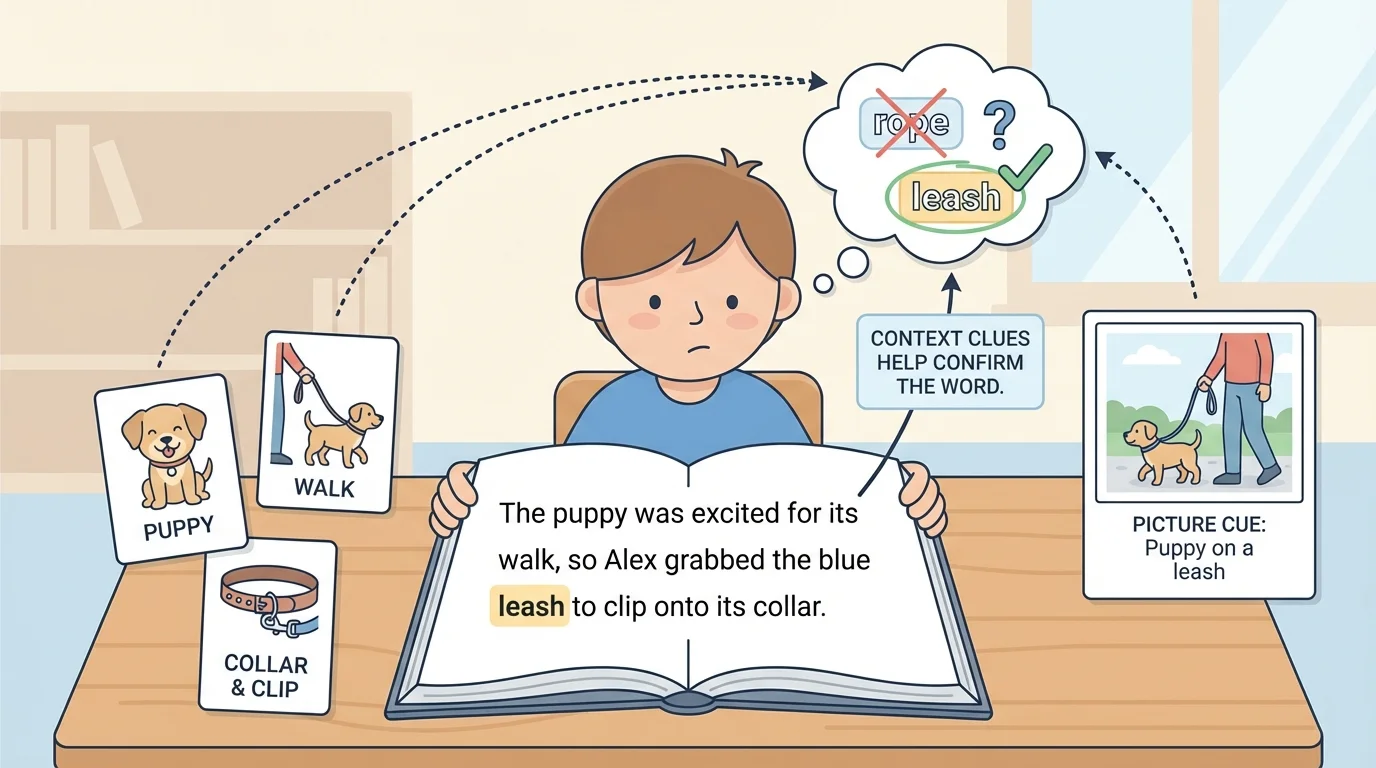
The words around a tricky word give important clues, as [Figure 1] shows. A sentence, a paragraph, or even a picture on the page can help a reader decide what word fits and what the text means.
Read this sentence: "Mila clipped the dog's leash before the walk." Suppose a reader first says "leaf" instead of "leash." The word "leaf" may start with the same sound, but it does not make sense here. The clue words "dog" and "walk" help the reader know the correct word should be "leash."
Context can help with meaning too. In the sentence "The bat flew out of the cave at night," the word "bat" means an animal. In the sentence "He swung the bat at the ball," the word "bat" means a piece of sports equipment. The same word can have different meanings, so readers use the rest of the sentence to understand it.
Pictures can also support context in many books for young readers. A picture of a rainy playground may help confirm the word "umbrella." But readers should not use pictures alone. They should also look closely at the letters in the word.
Even grown-up readers sometimes reread a sentence when a word does not make sense the first time. Fixing mistakes is part of real reading.
This means context is a helper, not a replacement for careful reading. Readers use both the print on the page and the meaning of the text together.
Many readers use a simple self-check, and [Figure 2] illustrates it clearly: Does it look right? Does it sound right? Does it make sense? These three questions help readers confirm a word or fix it.
If a child reads, "The boy rode his house to school," the sentence does not make sense. The word might need to be corrected to "horse," depending on the letters. A reader goes back and checks the word carefully.
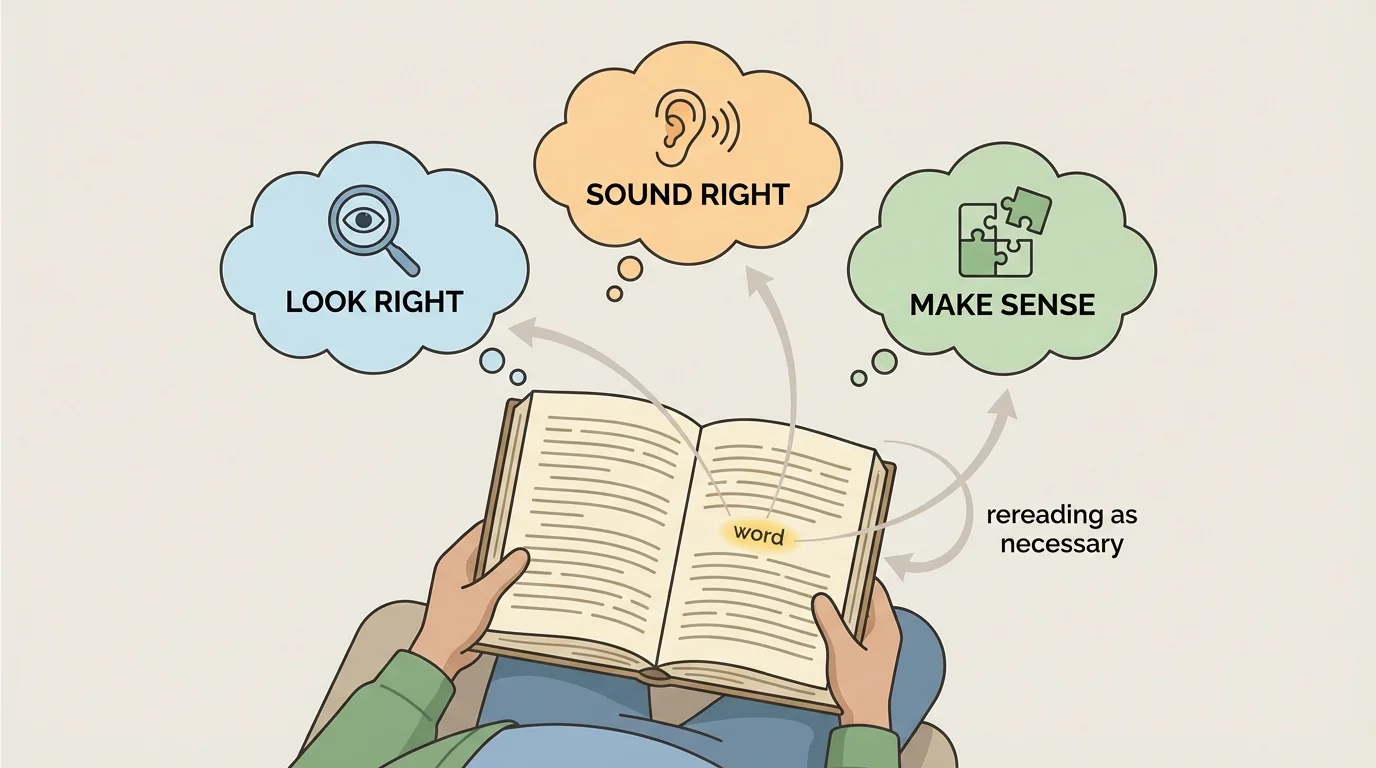
Does it look right? This means the letters and spelling pattern should match the word the reader says. If the printed word is "train," the reader should not say "truck." Those words do not look alike.
Does it sound right? This means the sentence should sound like real language. If a reader says, "She is eating a apple," it does not sound right. "An apple" sounds right in English.
Does it make sense? This means the idea should fit the story or information. If a sentence says, "The snow was hot," a reader should stop and think, unless the story is pretending something unusual on purpose.
Strong readers often use all three questions together. A word may look a little right but still not make sense. Or it may make sense in the sentence, but the letters may not match. Readers check all the clues.
Readers also pay attention to orthography, which means spelling patterns in words, and to morphology, which means meaningful word parts. These help readers decode words and then use context to confirm them.
For example, if a reader sees the word "jumping," the beginning part "jump" is familiar, and the ending "-ing" tells that the action is happening now. In the sentence "The frog is jumping into the pond," the sentence meaning confirms the word.
Readers can notice chunks such as sh, ch, th, igh, and endings like -ed, -ing, and -s. If a child reads "played" as "play," the word is close, but the ending matters. The sentence "Yesterday we played outside" tells the action already happened, so "played" fits better than "play."
Word parts help meaning
Some parts of words carry meaning. The ending -s can show more than one, as in "cats." The ending -ed often shows something already happened, as in "jumped." The ending -ing often shows an action happening now, as in "jumping." Readers look at these parts and then check whether the whole sentence makes sense.
Beginning letters matter too. If the sentence says, "The chick hatched from an egg," and the reader says "chased," the beginning looks a bit similar, but the whole word does not fit the sentence. The middle and ending parts help show the correct word is "hatched."
As readers grow, they learn to use word parts and context together. They do not guess wildly. They look carefully, think carefully, and then confirm.
Sometimes a sentence suddenly feels confusing, and that is a sign to stop, as [Figure 3] shows in a step-by-step way. A reader may notice, "I said all the words, but I do not know what this part means." That is the moment to go back and reread.
Rereading is not starting over because you failed. Rereading is a smart reading move. It gives the brain another chance to put the words and ideas together.
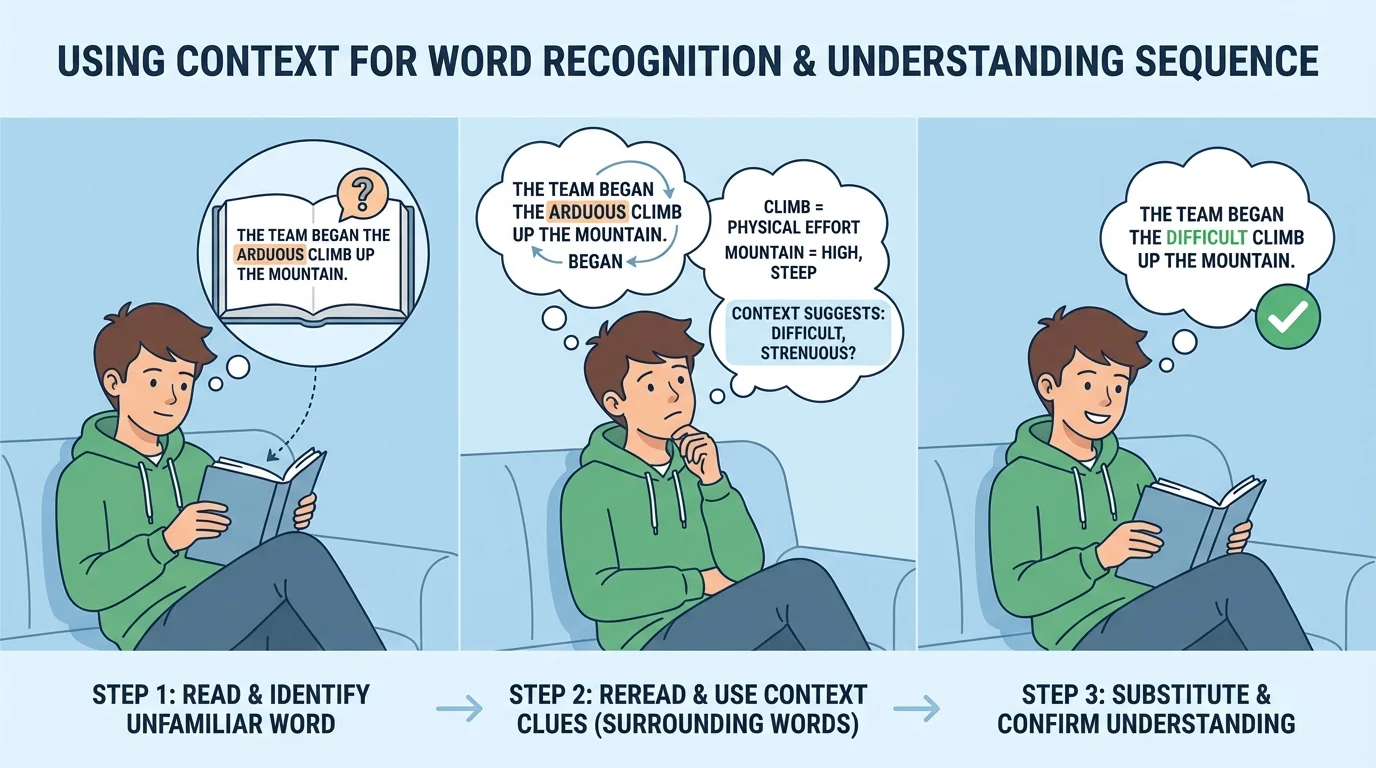
Readers may need to reread when they skip a word, mix up two words, change an ending, or lose the meaning of the sentence. For example, if a reader says, "The farmer milked the house," the sentence should send up a warning right away. Going back to the print may show that the reader misread an important word and needs to try it again.
A helpful way to reread is to return to the beginning of the sentence, or even the sentence before it. Often, the earlier words give the clue that was missing. Later, when we think again about the three-question check in [Figure 2], we can see how rereading gives a reader time to ask those questions again.
How a reader self-corrects
Sentence: "The rabbit hid under the bush." A reader first says, "The rabbit hid under the bed."
Step 1: Check the letters.
The printed word starts with b-u, so "bed" does not look right.
Step 2: Check the meaning.
In an outdoor animal sentence, "bush" makes more sense than "bed."
Step 3: Reread the whole sentence.
"The rabbit hid under the bush." Now the sentence sounds right and makes sense.
Each time readers self-correct, they strengthen their reading habits. They learn to trust clues, not quick guesses.
Readers use context in stories and in books that teach facts. In a story, the plot, characters, and setting give clues. In an information book, the topic, headings, pictures, and facts give clues.
In a story sentence such as "The princess climbed the tower stairs," a reader who says "tiger" for "tower" should notice that the sentence no longer makes sense. The story context helps fix the word.
In an information sentence such as "Beavers build dams in rivers," the topic is animals and habitats. If a reader says "dances" instead of "dams," the letters and meaning do not match. The facts around the word help confirm the correct reading.
Context can also help with words that are new. If a child reads, "A cactus stores water in its thick stem," the surrounding words teach something about a cactus even if the reader has never studied that plant before. The sentence helps build understanding.
Readers already know how to sound out many words, notice letter patterns, and blend sounds together. This lesson adds another powerful step: after decoding, always check whether the word fits the sentence and the meaning.
That is why good reading is both decoding and thinking. Saying the word is important, but understanding the idea is the real goal.
Fluency means reading smoothly, accurately, and with understanding. Fluency grows when readers practice reading words correctly and fixing mistakes when they happen.
Self-correcting may briefly slow a reader down, but it actually helps reading become stronger. A reader who rushes and keeps mistakes will understand less. A reader who notices and fixes errors builds better understanding and stronger habits.
As we saw earlier with the sentence clues in [Figure 1], context helps readers choose words that fit the meaning. Over time, this checking becomes faster and more natural. Readers begin to catch small mistakes almost right away.
Fluent readers listen to themselves as they read. They notice when something sounds odd. They notice when the sentence stops making sense. They go back, reread, and fix it. This helps them enjoy stories more and learn more from books.
Every time you read, your brain can do three important jobs together: look at the letters, think about the word parts, and use the meaning of the sentence. When all three work together, reading becomes more accurate, more confident, and more meaningful.
