Have you ever heard someone say something and thought, "Wait... what?" That happens to everyone. Good learners do not just stay confused. They ask questions. When you ask for help understanding, you are using an important speaking and listening skill. This skill helps you learn new ideas, understand stories and information, and take part in classroom conversations.
Listening is not only about being quiet. Listening also means paying attention, thinking about the words you hear, and noticing when something does not make sense yet. A strong listener is an active listener. An active listener looks at the speaker, listens for key ideas, and asks a question when something is unclear.
Sometimes students think asking a question means they were not listening. That is not true. Asking a good question often shows that you were listening carefully. You noticed something important and you want to understand it better. That is a smart way to learn.
Clarification means getting help so something becomes clearer and easier to understand.
Further explanation means hearing more details or a new way of explaining an idea.
When you ask for clarification, you are saying, "Please help me understand this better." When you ask for further explanation, you are saying, "I understand a little, but I need more information." These two actions help you become a stronger speaker, listener, reader, and thinker.
Sometimes a speaker uses a word you do not know. Sometimes a direction has many steps. Sometimes a story has a part that feels confusing. In each case, asking a question can help. You do not have to pretend you understand when you do not. It is better to ask.
For example, if a teacher says, "We will compare the two characters," a student might not know what compare means. The student can ask, "What does compare mean?" Then the teacher might explain, "Compare means tell how two things are alike and different." Now the student can follow the lesson better.
A student might also need more details. If a classmate says, "The problem happened because the weather changed," another student could ask, "Can you explain more about how the weather changed the problem?" That question asks for further explanation, not just one short answer.
Many times, when one student asks a question, other students are wondering the same thing. One brave question can help the whole class understand better.
Asking questions helps in many parts of the school day. It helps during read-aloud time, partner talks, science discussions, social studies lessons, and when adults give directions. It even helps on the playground when you are learning the rules of a new game.
You may need to ask for clarification when you hear a new word, miss part of what someone said, or do not understand the main idea. You may also need to ask when a speaker talks too softly, too fast, or without enough details.
Here are some common times to ask:
Suppose your class is talking about a story, and someone says, "The character was frustrated." If you do not know that word, you can ask, "What does frustrated mean?" If you know the word a little but still need help, you might ask, "Can you give an example of when the character felt frustrated?"
Suppose your teacher says, "First underline the title, next circle the verbs, and then write a sentence." If you only heard the last part, you can ask, "Could you please say the directions again?" That is asking for clarification so you can do the task correctly.
There are many respectful ways to ask for help understanding. [Figure 1] shows that polite question starters help conversations feel kind and safe. They show that you are interested and respectful, even when you are confused.
You can use a calm voice, look at the speaker, and wait for the right time to speak. If someone else is talking, do not interrupt in the middle unless it is necessary. When it is your turn, use clear and friendly words.
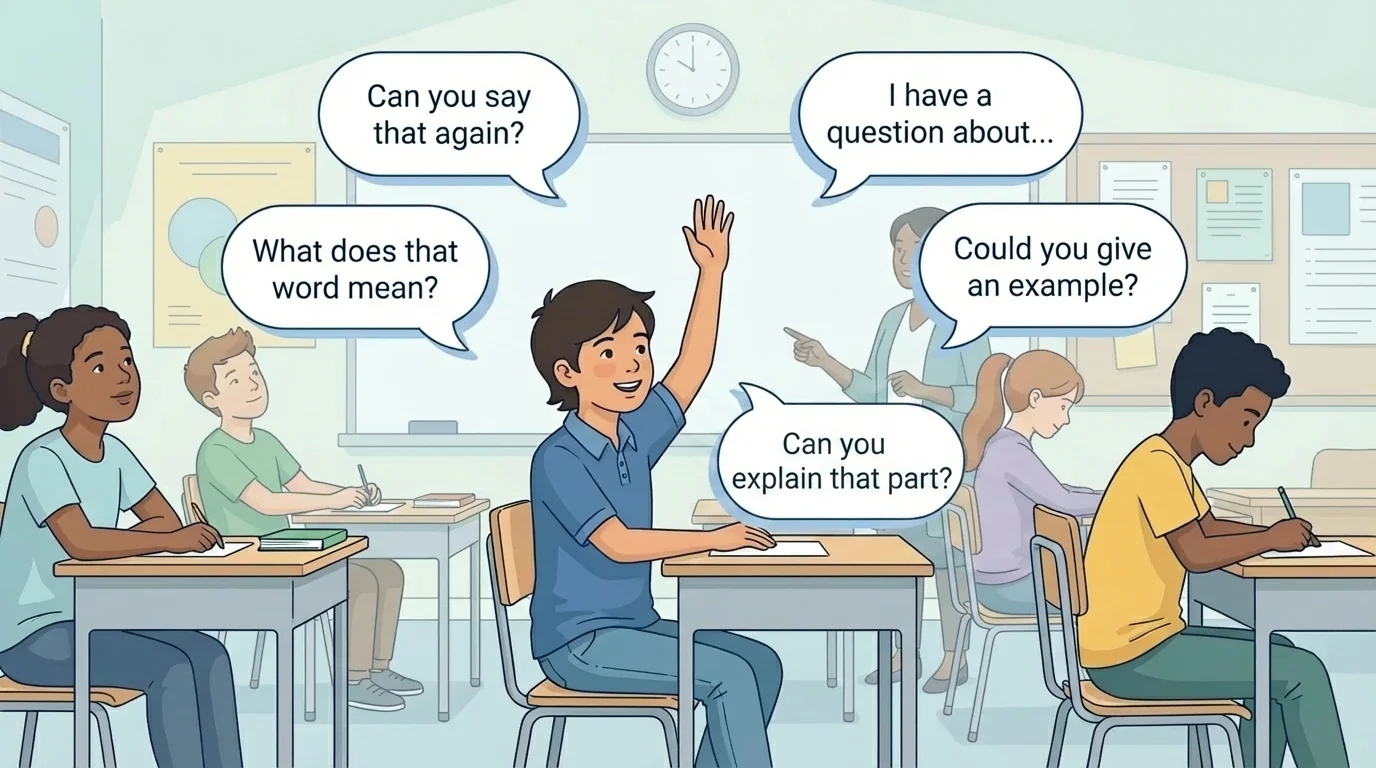
Here are some helpful sentence starters:
These question starters are useful because they are specific. Instead of only saying, "I don't get it," you can say exactly what you need. A specific question helps the speaker give a helpful answer.
Classroom example
Teacher: "The rabbit is a prey animal."
Step 1: The student notices an unknown word.
The student hears prey and realizes the meaning is not clear.
Step 2: The student asks politely.
"What does prey mean?"
Step 3: The student listens to the answer.
The teacher explains, "Prey is an animal that another animal hunts for food."
Step 4: The student checks understanding.
"So the rabbit is hunted by other animals?"
This kind of question-and-answer helps the student understand the topic better.
Polite words matter. Saying "please" and "thank you" shows respect. Your face and voice matter too. A friendly tone helps everyone feel comfortable talking and learning together.
Students often discuss a topic or a text in class. A topic is the subject you are learning or talking about. A text is spoken or written language, such as a story, article, poem, or directions. During these discussions, you may need help understanding a character, event, fact, or big idea.
When talking about a story, you might ask, "Why did the character leave?" or "Can you explain what happened at the end?" When talking about an information book, you might ask, "What does this part teach us about insects?" or "Can you explain how the plant grows?"
Questions about texts can focus on different things:
Sometimes you can ask a question to make sure you heard correctly. For example, "Did you say the caterpillar turns into a butterfly?" That helps you check your understanding.
Questions help meaning grow. When you ask about a text, you are not stopping the learning. You are building it. Each answer adds more meaning. Sometimes a short question helps you understand one sentence. Sometimes a follow-up question helps you understand the whole story or topic.
If a classmate shares an idea about a book, you can ask for more explanation in a respectful way. You might say, "Can you tell me why you think that?" or "What part of the story makes you think that?" Those questions help everyone talk about the text more deeply.
Asking a question is only one part of the skill. The next part is listening carefully to the answer. After you ask, keep your body still, look at the speaker, and think about the response. Do not talk over the answer.
Sometimes one answer is enough. Other times you may still be unsure. Then you can ask a follow-up question. A follow-up question is a new question you ask after hearing an answer because you still need more help.
For example, if an adult says, "A habitat is a place where an animal lives," you may understand. But if you still wonder about it, you can ask, "Can you give an example of a habitat?" The adult might answer, "A pond is a frog's habitat." Now the idea is even clearer.
You can also repeat back what you heard to check your understanding. You might say, "So you mean the seed needs water and sunlight to grow?" This gives the speaker a chance to say yes or fix any misunderstanding.
You already know how to take turns in a conversation. Asking for clarification uses that same skill. You listen, wait, speak clearly, and then listen again.
Listening after you ask shows respect. It also helps you decide whether you understand now or need one more explanation. Good learners do both: they ask and they listen.
In a collaborative conversation, people work together by talking and listening. [Figure 2] shows that no one person does all the talking. Everyone has a chance to share ideas, ask questions, and respond to others.
Small groups and whole-class talks both need good conversation habits. Students face the speaker, listen without interrupting, and stay on the same subject. If something is confusing, they ask a question that helps the group keep learning.
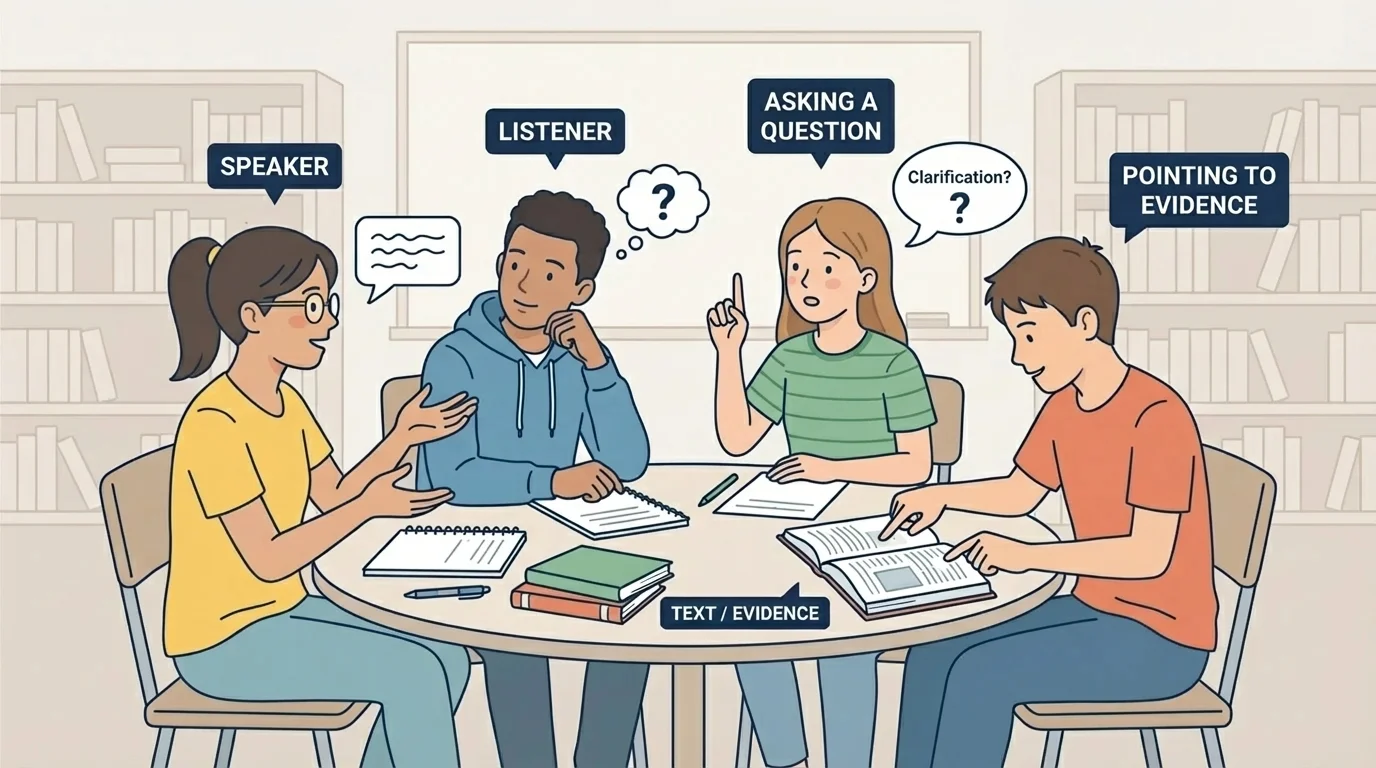
Here are some ways to help a conversation go well:
For example, if one student says, "I think the fox was sneaky," another student might respond, "Can you explain why you think that?" That keeps the conversation going. It also helps the speaker give evidence from the story.
Later in the same discussion, students may return to these habits by listening, asking one question at a time, and giving thoughtful answers. These habits help the group learn new information together.
During a science talk, a student hears, "Plants absorb water through their roots." The student asks, "What does absorb mean?" That question helps the student understand a key science word.
During reading time, a classmate says, "The author gave us a clue." Another student asks, "Which part was the clue?" This question asks for more explanation about the text.
During math directions, a teacher says, "Solve the first three problems and then color the shape with the largest number." A student who missed the first part asks, "Can you repeat the directions, please?" That helps the student complete the task the right way.
During social studies, a student says, "People moved because they wanted better land." Another student asks, "Can you explain what better land means?" That question asks for more detail about the topic.
Partner-talk example
Student A: "I think the boy in the story was responsible."
Step 1: Student B listens and thinks.
Student B understands the idea but wants more support.
Step 2: Student B asks for further explanation.
"Can you tell me what the boy did that was responsible?"
Step 3: Student A answers with details.
"He fed the dog, cleaned up, and remembered the rules."
Step 4: Student B responds.
"Oh, now I see why you think that."
The question helps both students talk more clearly about the story.
These examples show that questions can be short, polite, and powerful. They help conversations become clearer and more meaningful.
Sometimes students feel shy about asking questions. They may worry that others already understand. But every learner needs help sometimes. Asking for clarification is a strong choice, not a weak one.
You do not have to know everything right away. Learning often happens in steps. First you hear an idea. Then you think about it. Then you ask a question. Then the idea becomes clearer. That is how understanding grows.
When you ask thoughtful questions, you help yourself and others. You show that the class is a place where it is okay to learn, wonder, and ask for help. The polite question starters from [Figure 1] are useful tools you can use again and again in any subject.
As you join conversations with classmates and adults, remember that good communication is a team effort. Speakers try to be clear. Listeners try to understand. When something is confusing, a good question can open the door to better learning.
