Have you ever known how to spell a new word because it looked like a word you already knew? That is one of the smart things strong writers do. They do not guess randomly. They look for patterns. If you can spell cage, you can use that pattern to help spell badge. If you know boy, you can think about why boil is spelled differently. Spelling is not just about memory. It is also about noticing what words do.
When you write, you want your ideas to be easy to read. Correct spelling helps your reader understand your message. Spelling patterns are groups of letters that often work the same way in many words. When you learn a pattern once, you can use it again and again.
Writers use spelling patterns during revising and editing. Revising means making your writing better. Editing means checking for correct spelling, capitalization, grammar, and punctuation. If a word does not look right, you can ask yourself, "Do I know another word with a pattern like this?"
Spelling pattern means a group of letters that appears in words in a regular way. Generalize means to use something you learned in one word to help with another word. Edit means to check writing carefully for mistakes.
For example, if you know light, that can help you spell night. If you know train, that can help you spell brain. The pattern does not make every word easy, but it gives you a strong clue.
To generalize a spelling pattern means you take what you already know and apply it to a new word. You are like a word detective. You look for familiar parts. Maybe the beginning changes. Maybe the ending stays the same. Maybe the middle vowel team changes the sound.
If you know the word cake, you may be able to spell bake, make, and lake. You learned the -ake pattern once, and then you used it many times. That is generalizing.
This skill is helpful because writers cannot stop every minute to ask someone how to spell a word. Strong writers use what they know. Then they reread their work and fix words that need attention.
Many English words belong to word families. When you learn one family, you unlock many more words.
Word families are groups of words that share a spelling pattern. Some examples are -at in cat, hat, and flat, or -ight in light, night, and bright. These families help your brain notice what stays the same.
Some patterns involve a final silent e, and some involve letters that can make different sounds. A writer can use a known word to help with a new word, as [Figure 1] shows with cage and badge. In both words, the letters age are important, but the whole word changes when extra letters are added.
In cage, the letter g says its soft sound, like /j/. The final e helps make that sound. In badge, the letters dge work together to spell the /j/ sound after a short vowel. Even though cage and badge are not spelled exactly the same, seeing the ending sound can help you think carefully instead of guessing.
Here is an important idea: some words that sound alike at the end are built in different ways. Cage ends with ge. Badge ends with dge. Writers learn to notice these chunks. When a short vowel comes before the /j/ sound, dge is common, as in badge, edge, and bridge. When the vowel sound is longer, ge may appear, as in cage and huge.
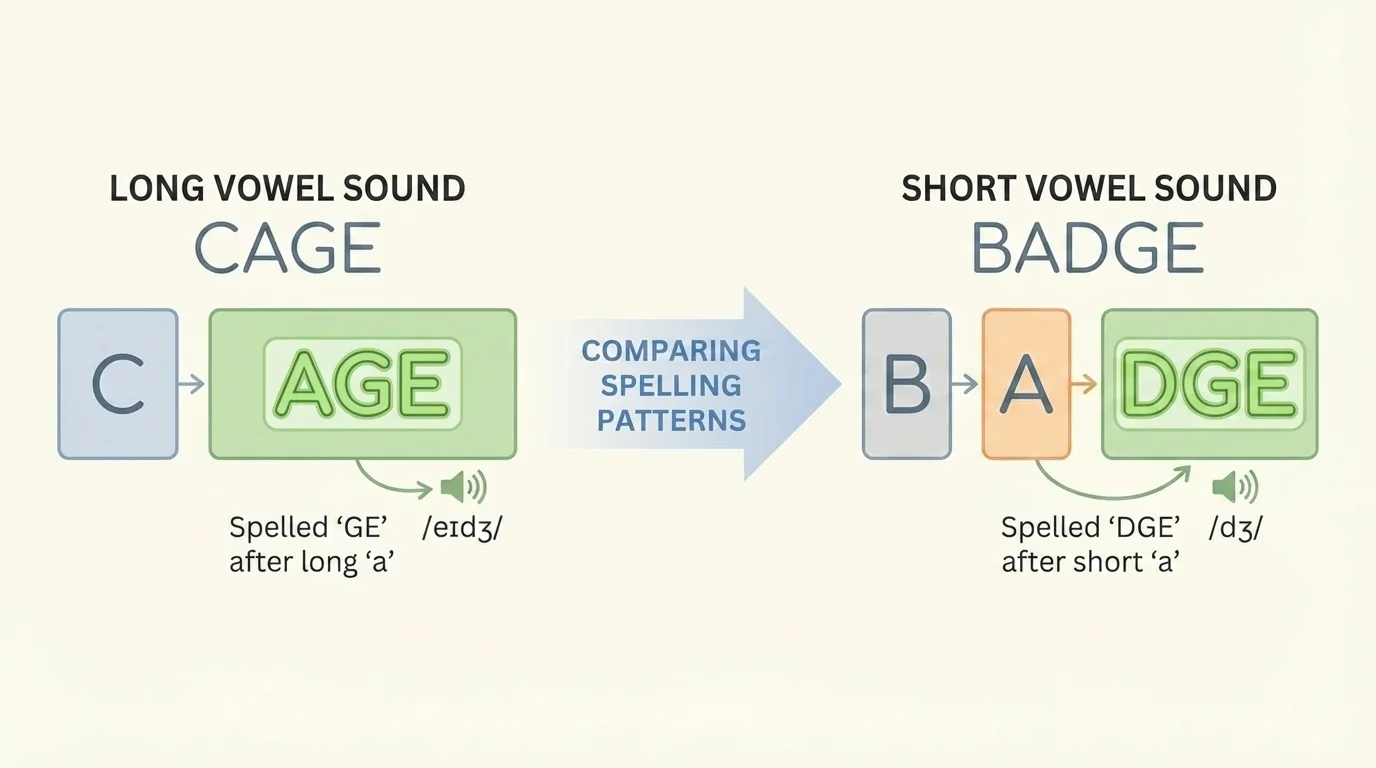
You can also compare other words with similar endings. Look at these pairs: rage and badge, page and edge. They do not all follow one exact rule, but they teach you to watch the vowel and the ending together.
Later, when you edit a sentence, you can think back to [Figure 1] and ask whether your word needs ge or dge. That is a smart editing move because you are using a pattern, not only your memory.
Using a known pattern
A student wants to write: "I wore my badge." The student knows how to spell cage and hears the /j/ sound at the end.
Step 1: Listen to the vowel sound.
In badge, the vowel is short: ba.
Step 2: Think about the ending sound.
The word ends with /j/.
Step 3: Use the pattern.
After a short vowel, the /j/ sound is often spelled dge, so badge is the correct spelling.
Not every word follows every pattern, but patterns still help most of the time. Good spellers stay flexible and notice what looks right in real words they have read.
Another useful pattern involves vowel teams. [Figure 2] A vowel team is two vowels working together in one word. When writers compare boy and boil, they learn that the same sound can be spelled in different ways. The choice depends on where the sound appears in the word.
The sound you hear in boy and boil is the same vowel sound. But the spelling changes. Usually, oi is found in the middle of a word, like boil, coin, and soil. Usually, oy is found at the end of a word or syllable, like boy, toy, and joy.
This is a useful pattern because it gives writers a clue about where the sound appears. If you hear that sound at the end of a word, try oy. If you hear it in the middle, try oi. That will not solve every word, but it will help with many.
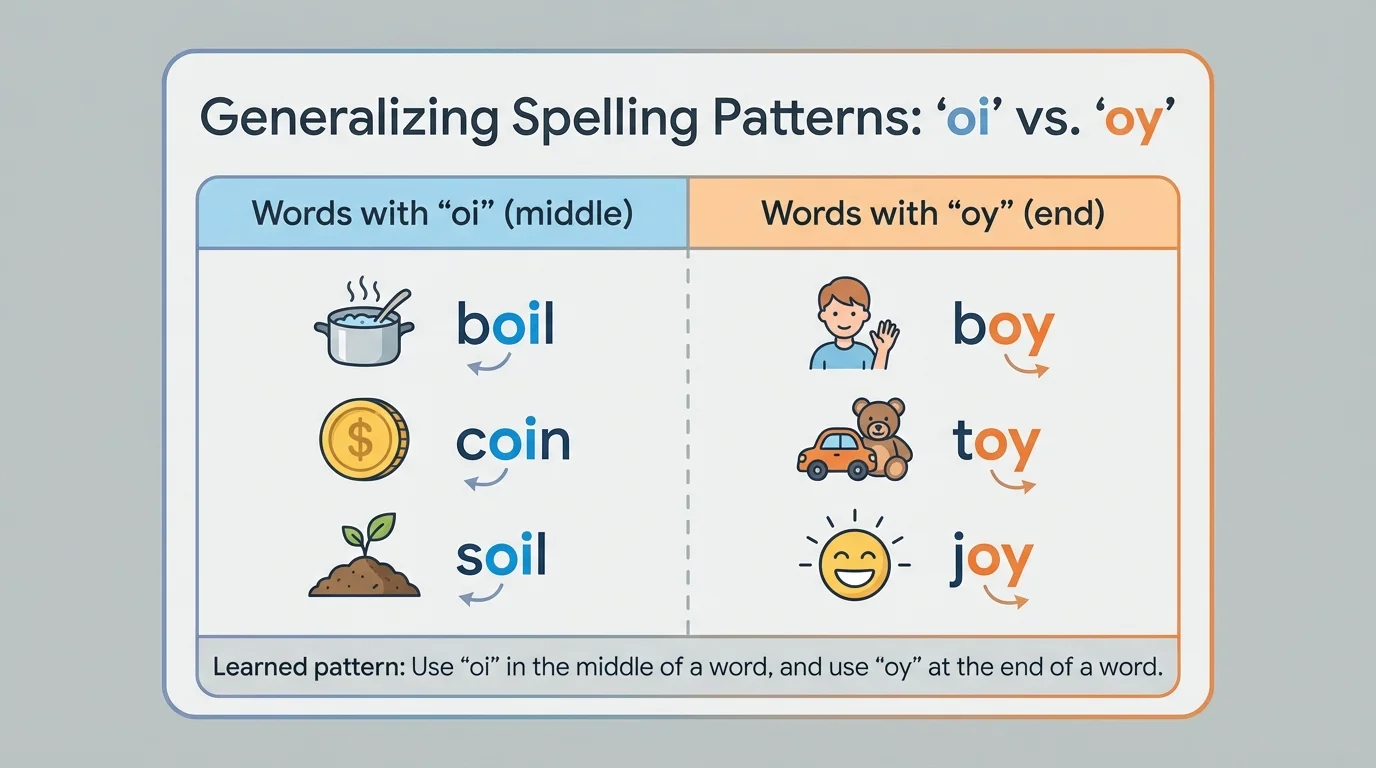
Here are more examples: point, join, and noise use oi in the middle. annoy and enjoy have oy at the end of a syllable. Writers begin to notice that position matters.
When you reread your writing, check words with this sound. If you wrote boyl, you can remember the pattern from [Figure 2]. The sound is in the middle, so oi is the better choice: boil.
Position helps spelling
Some spelling choices depend on where a sound appears in a word. That is why writers pay attention to the beginning, middle, and end of words instead of only listening to the sound.
Other vowel-team patterns work this way too. For example, ai often appears in the middle of words such as rain, while ay often comes at the end, as in play. You do not need to memorize every pattern at once. You build them little by little.
[Figure 3] Words become easier to spell when you study them in parts. You can look at the beginning sound, the middle vowel pattern, and the ending chunk. Instead of seeing one long word, you see smaller pieces that work together.
Take the word boil. You can notice b at the beginning and oil as the rest. Take the word badge. You can notice b at the beginning and adge as the ending chunk. When you break words apart, patterns stand out more clearly.
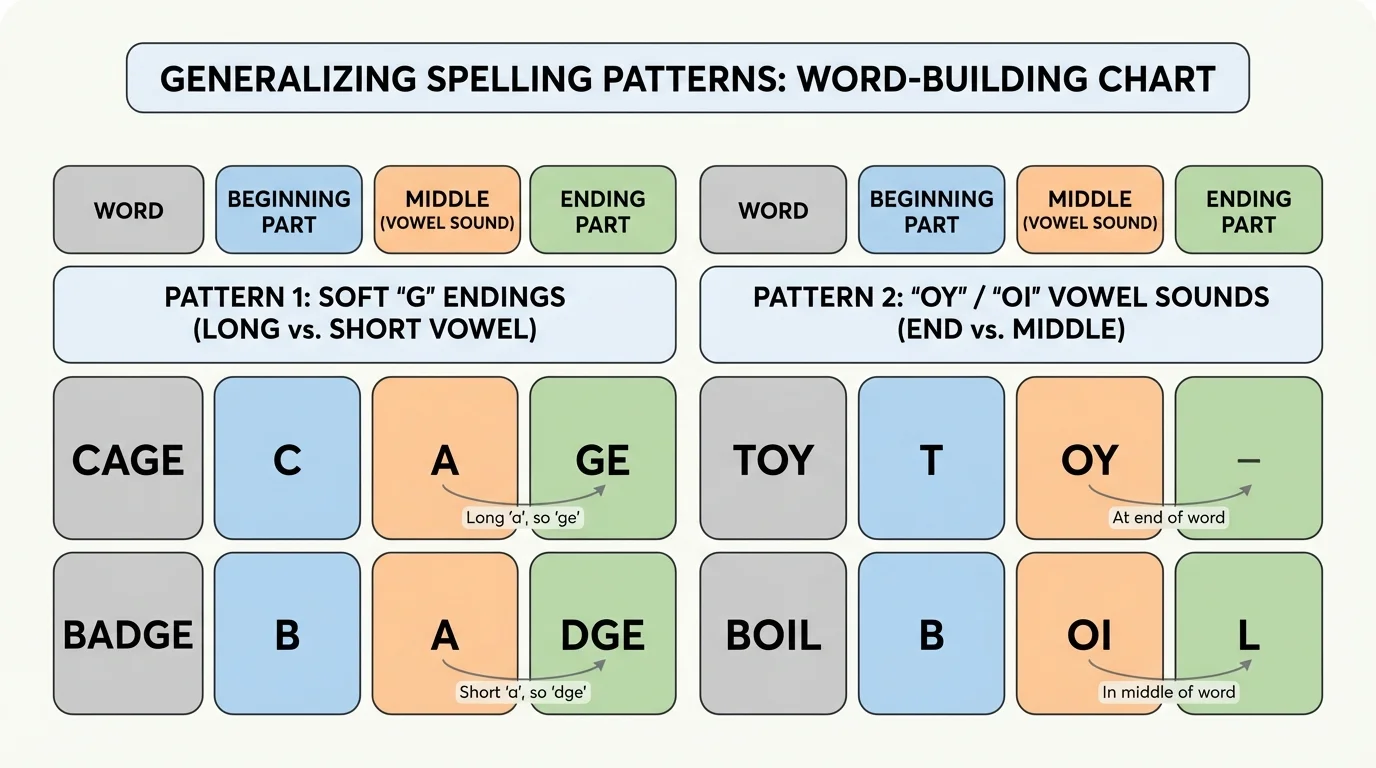
Writers also look for word families. A word family is a group of words with the same pattern. The family -oil includes boil, coil, and soil. The family -oy includes boy, toy, and joy. Knowing one family helps you write other words in that family.
Later, if you are unsure how to spell a word, think back to the parts shown in [Figure 3]. Ask yourself what chunk you already know. Maybe you know the ending but need to fix the beginning. Maybe you know the vowel team but need to check the last letters.
You already know that letters make sounds and that some groups of letters work together. This lesson adds a new idea: you can use those known groups again when you write unfamiliar words.
Looking at parts of words is especially helpful when you are writing a sentence quickly. You may not know the whole word right away, but you can still make a strong spelling choice by using the parts you know.
Spelling patterns are not only for spelling tests. They help during real writing. Suppose you write: "The boy will boil the soup." If you stop and think about the sound in boy and boil, you can choose the correct vowel team in each word.
When you revise, first make sure your ideas make sense. Then, when you edit, check for conventions of standard English. That means correct spelling, capitalization, punctuation, and grammar. If a word looks strange, compare it to a word you already know.
For example, a student may write: "i got a badg." During editing, the student can fix several things: capitalize I, add the missing e to make badge, and add punctuation: "I got a badge." Spelling works together with the other writing rules.
Editing with patterns
Sentence draft: "the boy put oyl in the pan"
Step 1: Fix capitalization.
The sentence begins with The, not the.
Step 2: Check the vowel pattern.
The sound in oil is in the middle of the word, so oi fits better than oy.
Step 3: Add punctuation.
The corrected sentence is: "The boy put oil in the pan."
Notice how the writer used what they knew about the oi and oy pattern. That is exactly what good editors do.
Sometimes writers confuse patterns because words sound similar. A few common mix-ups are boil and boyl, or badge and bage. When this happens, slow down and check three things: the vowel sound, where the sound is in the word, and the ending chunk.
You can also think about whether the word looks like other real words you know. Does boyl look like boy at the end? Yes, but the sound in boil is in the middle, so oi makes more sense. Does bage match the short vowel sound in badge? No, so dge is a better ending.
| Sound or Pattern | Often Used | Examples |
|---|---|---|
| /j/ after a short vowel | dge | badge, edge |
| /j/ in some other words | ge | cage, page |
| /oi/ in the middle | oi | boil, coin |
| /oi/ at the end | oy | boy, toy |
Table 1. Common spelling patterns that help writers choose between similar letter groups.
Another smart check is rereading your whole sentence. Sometimes a word looks wrong when you see it in writing, even if it sounded fine in your head. That is why writers reread slowly.
"Good writers do not just write words. They check them, fix them, and make them clear."
The more you read, the more these patterns begin to feel familiar. Books, signs, labels, and classroom charts all help train your eyes to notice correct spellings.
Strong spelling grows over time. Every time you read a word carefully, write a word, or fix a word, you are building a habit. You are teaching your brain to spot patterns faster.
One helpful habit is to pause during writing when a word feels tricky. Instead of guessing wildly, think of a similar word. Ask yourself: "What part do I know? Is the sound in the middle or at the end? Does this word belong to a family I already know?"
Another helpful habit is to check your work for more than one thing. You can check capitalization, punctuation, and spelling together. If you wrote a sentence about a boy with a badge, you might check that boy is not capitalized unless it starts the sentence, that badge has the correct ending, and that the sentence ends with a period.
Patterns do not replace careful thinking. They support it. Writers use patterns, read what they wrote, and make changes when needed. That is how writing becomes clear, correct, and easy for others to understand.
