Google Play badge

Use knowledge of the meaning of individual words to predict the meaning of compound words (e.g., birdhouse, lighthouse, housefly; bookshelf, notebook, bookmark).


Use Word Parts to Figure Out Compound Words

Have you ever seen a birdhouse and a housefly and wondered why they both have the word "house" in them? πŸ€” Words like these are called compound words, and they are like little puzzles made from two smaller words. When you learn how the puzzle pieces work, you can solve many new words all by yourself!

🌈 What Are Compound Words?

A compound word is a big word that is made when two smaller words are put together. Each small word has its own meaning. When they join, they make a new meaning.

Here are some examples:

Each big word is made from two real words you already know. That means your brain already has the tools to figure out what the big word might mean. πŸŽ‰

Compound Word is a word that is made by joining two smaller words, like sun and flower to make sunflower.

Knowing about compound words helps you read longer words, spell them correctly, and understand what you are reading.

🧩 Breaking Compound Words Into Two Smaller Words

You can think of a compound word as two small words holding hands, as shown in [Figure 1]. When you see a long word, you can look inside it and ask, "Do I see two little words hiding in there?"

For example:

Sometimes compound words are written as one word (like notebook), and sometimes they can be written as two words (like ice cream). In second grade, we mostly work with them as one long word, but it helps to remember there are really two little words inside.
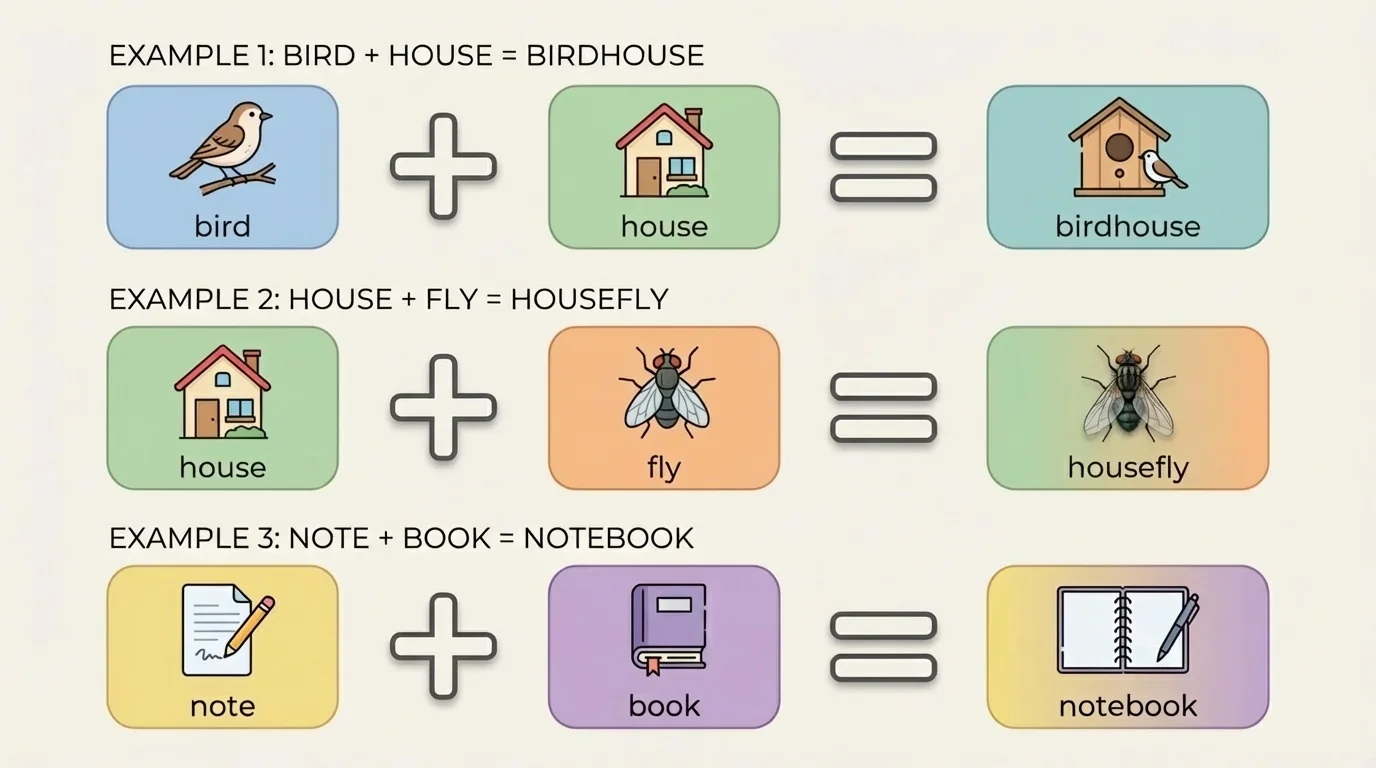
Three compound words (birdhouse, housefly, notebook), each split into two labeled boxes with arrows: bird + house, house + fly, note + book. Simple icons: a bird and a house, a house and a fly, a note and a book.
Figure 1: Three compound words (birdhouse, housefly, notebook), each split into two labeled boxes with arrows: bird + house, house + fly, note + book. Simple icons: a bird and a house, a house and a fly, a note and a book.

When you read, you can:

Once you find the two smaller words, you are ready for the next step: using their meanings! πŸ’‘

πŸ” Using Each Small Word's Meaning to Predict the Big Word's Meaning

To understand a new compound word, you can use a simple three-step plan.

Step 1: Say each small word and think about what it means.

Step 2: Put the meanings together in your mind.

Step 3: Check if your guess makes sense in the sentence you are reading.

Example: birdhouse 🐦🏠

Step 1: Split the word: bird + house.

bird = an animal that has wings and feathers.
house = a place where someone lives.

Step 2: Put the meanings together.

A birdhouse is a kind of house for a bird.

Step 3: Check the sentence.

"We hung a birdhouse in the tree." Does a little house for birds in a tree make sense? Yes! βœ…

Let's try another one.

Example: lighthouse πŸ’‘πŸ°

Step 1: Split: light + house.

light = brightness that helps you see.
house = a building.

Step 2: Put together.

A lighthouse could be a house with a big light.

Step 3: Check it.

"The ship saw the lighthouse on the cliff." A tall building with a strong light that helps ships see at night makes sense. βœ…

One more!

Example: housefly πŸͺ°

Step 1: Split: house + fly.

house = a home.
fly = a small insect that can fly.

Step 2: Put together.

A housefly is a fly that is often seen in or near a house.

Step 3: Check it.

"A housefly buzzed around the kitchen." That fits perfectly. βœ…

Notice that you did not need a grown-up or a dictionary. You used the meanings of the two smaller words to predict the big word's meaning. That is a powerful reading strategy! πŸ’ͺ

🎯 Different Kinds of Compound Word Meanings

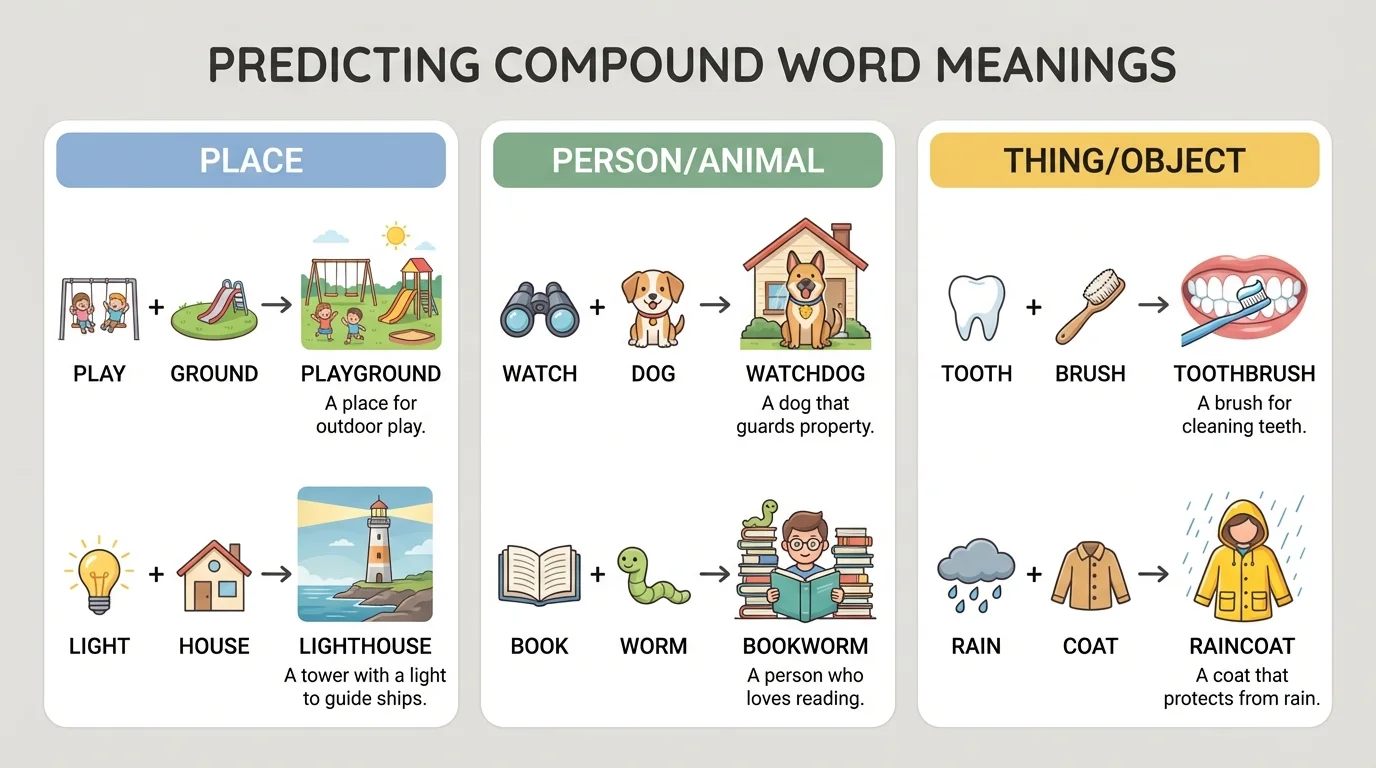
Many compound words can be sorted into groups by what they tell us, as shown in [Figure 2]. Sometimes the compound word is a place, sometimes it is a person, and sometimes it is an object used for a special job.

Illustration with three or four groups labeled "Place", "Person/Animal", "Thing/Object", each with 1–2 compound words and small icons (e.g., playground with kids, watchdog with a dog, toothbrush with teeth).
Figure 2: Illustration with three or four groups labeled "Place", "Person/Animal", "Thing/Object", each with 1–2 compound words and small icons (e.g., playground with kids, watchdog with a dog, toothbrush with teeth).

When you see a new compound word, you can ask yourself:

Thinking about these groups can help your brain guess the meaning more quickly, just like the examples in the chart above.

😲 Be Careful: Tricky Compound Words

Most of the time, a compound word's meaning is easy to guess from its two parts. But some words are tricky compound words. Their meanings are not exactly what the two words say.

Here are some fun ones:

These words started a long time ago, and people just kept saying them that way. For tricky compound words, you can still use the two smaller words to remember how to spell them, even if the meanings do not fit perfectly. πŸ“

Some compound words slowly change over time. A word that used to be written as two words, like "bed room," can become one word, "bedroom," when people use it a lot.

When a compound word seems strange, you can ask a grown-up or check a dictionary. But first, try to predict the meaning yourself using the smaller wordsβ€”you might be right!

πŸ“– Using Compound Words to Understand New Words in Reading

When you read stories and science books, you will meet many long words. If you know about compound words, you can use that knowledge to figure out what those words might mean. This is part of using context clues and word parts together.

Try this plan when you meet a new long word that might be a compound word:

Example sentence: "Tom put the shells in his backpack after playing on the beach."

You just used your knowledge of the smaller words to figure out the big word, backpack. πŸ–οΈπŸŽ’

πŸ‘‚ Listening for Compound Words

Compound words are fun to hear too! They often sound like they have two beats.

Try clapping the beats in some compound words:

Each clap is one small word. When you clap and say the words slowly, it can help you hear where to split the word when you are trying to spell it or figure it out while reading.

Sometimes, your voice is a little stronger on the first part of the word, like in rainbow or toothbrush. Listening carefully can help you notice that there are two parts hiding inside the big word.

🌟 Mini Story Time With Compound Words

Read this short story and listen for compound words:

"On Saturday morning, Mia grabbed her notebook and sat on the sunlight porch. She watched a bluebird land on the birdhouse and a tiny housefly buzz past her window. Mia wrote in her notebook about the big sunflower by the backyard gate. When the doorbell rang, her friend Max came in with a basketball and a lunchbox, ready for a fun day."

There are many compound words in that story, such as notebook, birdhouse, housefly, sunflower, backyard, doorbell, basketball, and lunchbox. For each one, you can:

Every time you do this, your brain is getting stronger at using word parts to understand and enjoy what you read. πŸ§ πŸ“š

Download Primer to continue

Type of MeaningHow to Think About ItExamples
Place where something isA location for the first wordbirdhouse, sunflower, playground
Person or animal that does somethingThe doer of an actionmailman, snowman, watchdog
Object made for somethingA tool or thing used with the first wordtoothbrush, bookshelf, bookmark