Have you ever written a great sentence and then stopped because one word did not look quite right? That happens to strong writers all the time. Good writers do not have to know every word by heart. They use tools to help them. A writer who checks spellings is being careful, thoughtful, and clear.
When words are spelled correctly, other people can read our ideas more easily. If you write a story, a note, or a report, correct spelling helps your reader understand exactly what you mean. Spelling is one part of editing, and editing helps make writing neat and clear.
Sometimes a word sounds one way but is spelled another way. Sometimes two words sound almost the same. Sometimes we just forget a letter. That is why writers use reference materials. These are tools that help us check information.
Reference materials are tools we use to find information. For spelling, reference materials can include a beginning dictionary, a picture dictionary, a classroom word wall, an alphabet chart, a personal word notebook, or a digital dictionary used with an adult.
Using a spelling tool does not mean you are bad at spelling. It means you are acting like a real writer. Authors, teachers, and even grown-ups who write for work check words when they are unsure.
A dictionary is a book or digital tool that lists words in alphabetical order and tells how they are spelled. A beginning dictionary is made for young learners. It often has big print, simple definitions, and sometimes pictures.
A picture dictionary can help when you know what something is but need to see the word. A word wall in the classroom helps you quickly check words you use often, such as because, friend, or school. An alphabet chart can help you think about letter order. A personal word notebook can hold words you want to remember.
Each tool has a job. If you need to check one word, a dictionary may help most. If the word is already posted in your classroom, the word wall may be faster. Smart writers choose the tool that fits the job.
Many dictionaries show words in ABC order so readers can find them quickly, just like books on a shelf can be organized to make searching easier.
[Figure 1] Even when you use a tool, you still need to look carefully. You are not just hunting for a word. You are checking that every letter is in the right place.
A beginning dictionary is organized in alphabetical order. That means words are placed from A to Z. To find a word, you usually start with the first letter. If two words begin with the same letter, you look at the second letter. Sometimes you keep going to the third letter or more.
For example, think about the words cake, call, and cap. They all begin with c. So you compare the next letters: a, a, and a. Those are still the same, so you look again: k, l, and p. That helps you see which word comes first, next, and last.
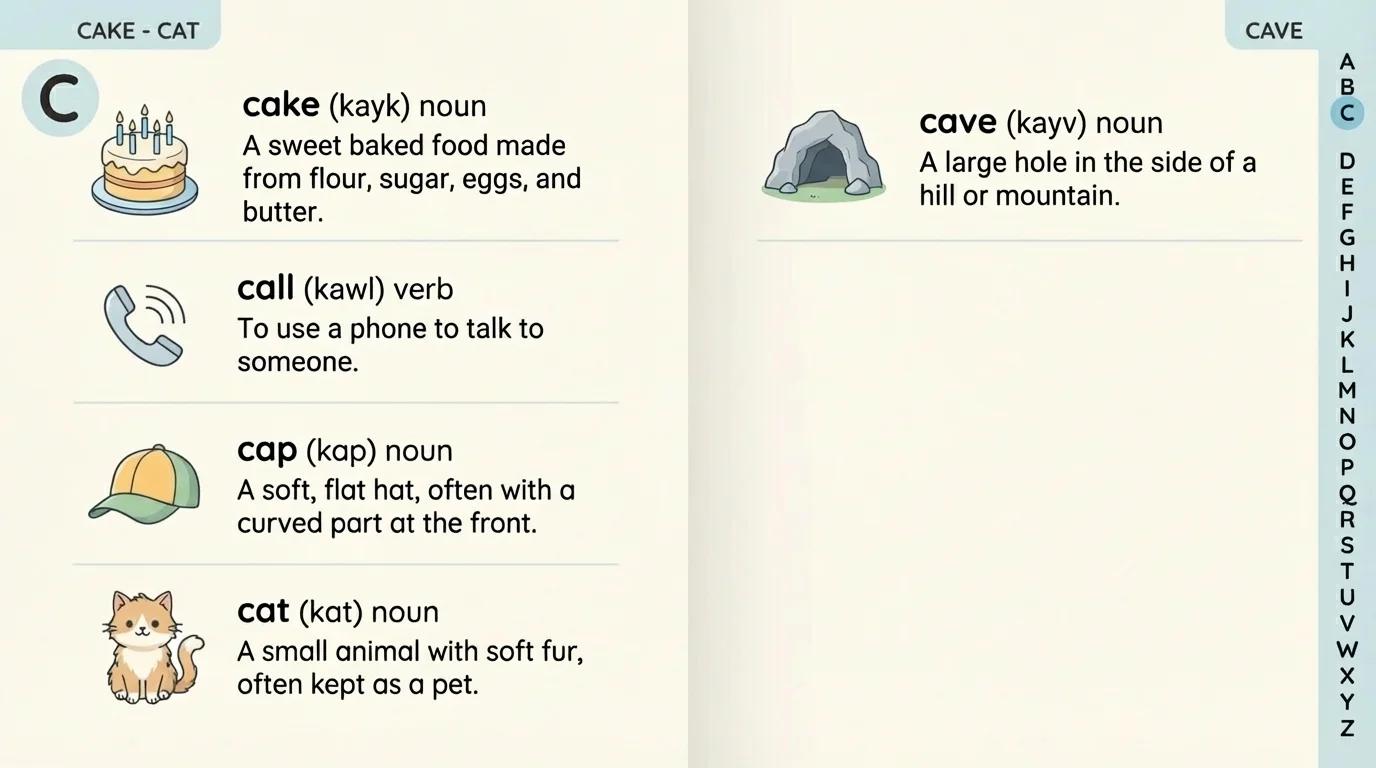
When you open a dictionary, take your time. Find the first letter. Then scan the page for the next letters. Some dictionaries have guide words at the top of a page. Guide words help you know which words come first and last on that page.
If you want to find the word rabbit, start by finding the section for r. Then look for words that begin with ra. After that, check the next letters until you find rabbit. Looking carefully matters. If you rush, you might choose the wrong word.
When you find the word, compare it to the one you wrote. Check every letter. For example, if you wrote rabit and the dictionary says rabbit, you can see that the correct word has two bs.
Later, when you check another word, remember the same idea from [Figure 1]: look at one letter at a time in ABC order until you reach the exact word.
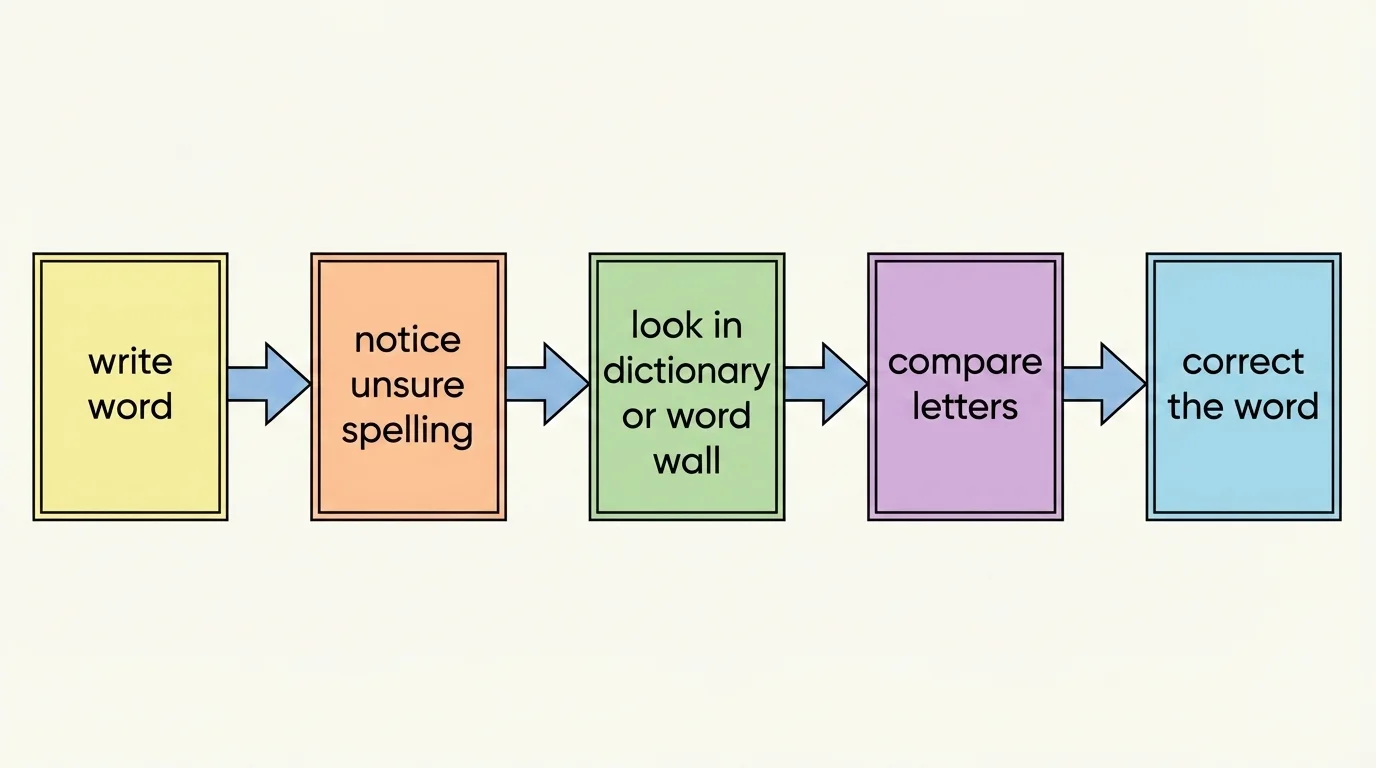
Writers can follow a simple checking path, as [Figure 2] shows. Having steps helps you stay calm and careful when a word looks wrong.
Here is a strong way to check a spelling. First, notice the word that does not look right. Next, say the word slowly and think about the sounds you hear. Then choose a reference material, such as a dictionary or word wall. After that, find the word and compare it with your writing. Last, fix the spelling in your sentence.
Checking one word step by step
You write: I lik to read. The word lik does not look right.
Step 1: Notice the tricky word.
The word is lik.
Step 2: Say the word slowly.
You hear /l/ /i/ /k/, but you also remember the word may have a silent letter pattern.
Step 3: Look in a dictionary or on a word wall.
You find the correct spelling: like.
Step 4: Compare and correct.
Change lik to like.
The corrected sentence is I like to read.
Sometimes you will check a word and discover that it was already correct. That is fine. Careful writers check because they want to be sure.
The flow in [Figure 2] is useful during stories, reports, and even short answers. The same process works in many kinds of writing.
Sometimes it is hard to find a word in a dictionary because you are not sure how it starts. In that case, use clues. Say the word slowly. Think about the beginning sound, the middle sound, and the ending sound. Then try the spelling that seems closest.
You can also think about word parts, or word parts. For example, if you know play, then playing starts with the same base word. If you know jump, then jumped keeps the word jump and adds an ending.
Use what you know first
Writers do not guess wildly. They use clues they already know, such as sounds, word parts, and words they have seen before. Then they check a reference material to make sure the spelling is right.
If you cannot find the word right away, do not give up. Try another spelling that matches the sounds. For example, if you are looking for train, you might first think of trane. When you do not find it, say the word again, think about the long a sound, and try another likely spelling.
After you check the tool, compare carefully. If your word is frend and the word wall says friend, notice that the letters ie are in the middle. Looking closely helps your brain remember the correct form for next time.
Some words are tricky because they have double letters, silent letters, or endings. A beginning dictionary can help with all of these.
Double letters can be easy to miss. Words like rabbit, happy, and letter need close checking. Silent letters can be surprising too. In write, the w is silent. In knock, the k is silent. A dictionary helps you see letters you may not hear.
Endings matter as well. If you write lookd, a reference tool can help you find looked. If you write boxs, you can check and correct it to boxes. Spelling changes sometimes happen when we add endings.
| Tricky situation | Incorrect example | Correct example | How a tool helps |
|---|---|---|---|
| Double letter | rabit | rabbit | Shows the extra letter |
| Silent letter | rite | write | Shows letters you may not hear |
| Ending added | lookd | looked | Shows the full word with ending |
| Plural form | boxs | boxes | Shows how the word changes |
Table 1. Examples of tricky spelling situations and how reference materials help correct them.
Names and places can also need checking. You may need to copy a person's name exactly from a card, book cover, or class list. Writers know that names should be spelled correctly because they belong to real people and places.
Remember that editing is different from drafting. During drafting, you get ideas down. During editing, you slow down and fix spelling, capitalization, punctuation, and grammar so your writing is easier to read.
Another tricky situation is a word that looks almost right. Maybe you wrote becus for because. That is the perfect time to use a familiar classroom tool such as a word wall, because it may be faster than searching through many pages.
[Figure 3] Writers reread their work and use tools to correct misspelled words. When you revise, you improve your ideas. When you edit, you fix the conventions of writing, like spelling, capitals, punctuation, and grammar. Reference materials are especially helpful during editing.
Suppose you wrote, My clas went to the libary. While editing, you may notice that clas and libary do not look right. You can check those words in a dictionary or on a classroom chart and correct them to class and library.
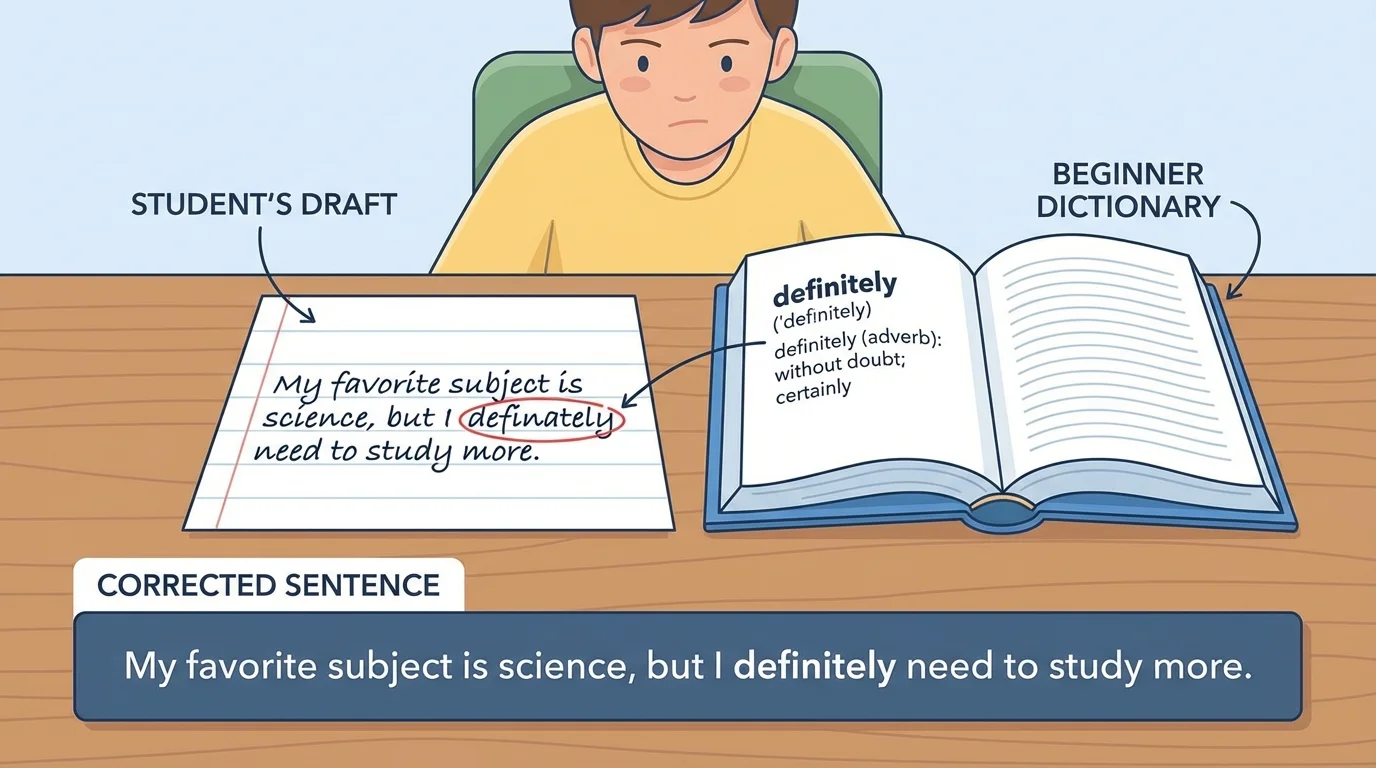
Checking spelling during editing helps your message shine. If your sentence says, The butterfly landed on the flowr, your reader may still understand it, but the corrected word flower makes your writing stronger and more polished.
Many writers use a checklist when they edit. A checklist might ask: Did I use capitals? Did I use end punctuation? Did I spell words correctly? If not, can I check a reference material? This habit helps you become more independent.
Later, when you reread a full paragraph, think back to the editing process you practiced. One careful check can improve a whole piece of writing.
Strong spelling habits grow over time. Each time you stop, check, and correct a word, you are training your brain. Soon, some words that once felt hard become easy to remember.
You do not need to stop for every single word while drafting, but you should check important words when the spelling matters for understanding. Then, during editing, go back and look closely at all the words you were unsure about.
A writer can ask questions like these: Does this word look right? Have I seen it on the word wall? Can I find it in the dictionary? Does my corrected spelling match the word exactly? These questions help you take charge of your own writing.
"Careful writers check, compare, and correct."
The more you use reference materials, the more confident you become. Spelling tools are not just for fixing mistakes. They are for learning new words, noticing patterns, and making your writing easy for others to read.
