Have you ever been reading a book and found a word that felt like a tiny mystery? Strong readers do not stop forever when they meet an unknown word. They use smart tools to solve the mystery. Two very helpful tools are a glossary and a dictionary. These tools help readers learn what words mean, check how words are spelled, and understand words better in stories and in books about science, animals, weather, and many other topics.
When you read, you will sometimes see a word you do not know. That is normal. No reader knows every word. Good readers know what to do next. They slow down, look at the word carefully, and use a word tool to help. Learning to use word tools makes reading easier and helps you become more independent.
A glossary and a dictionary both help readers understand word meanings, but they are not exactly the same. Each one has a special job. If you know how to use both, you can understand more of what you read.
Glossary means a small list of important words and their meanings, usually found at the back of a book.
Dictionary means a book or digital tool that lists many words in alphabetical order and tells what they mean.
Sometimes a book about frogs, space, or communities has special words that are important for that topic. A glossary helps you understand those words. A dictionary helps you learn many kinds of words from different types of reading.
A glossary is often found at the back of a book. It gives meanings for important words used in that book. In many books, the special words are printed in bold in the main text, and the glossary gives their meanings. If you are reading a book about insects and you see the word larva, you can turn to the glossary and find out what it means.
[Figure 1] A glossary is helpful because it focuses on the exact topic of the book. If a book is about weather, the glossary might include words such as storm, forecast, or temperature. If a book is about plants, it might include stem, roots, and petals. The glossary gives simple meanings that fit the topic you are studying.
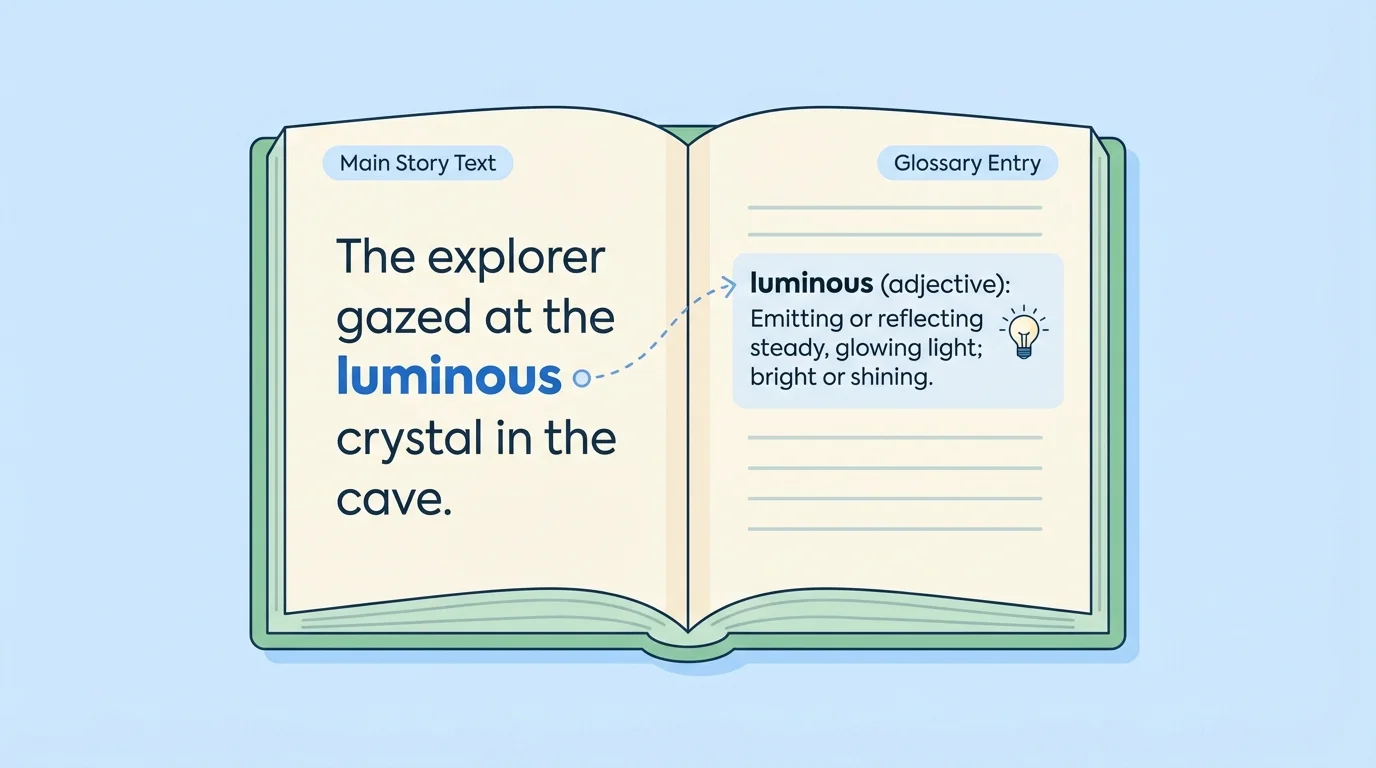
To use a glossary, first notice the special word in the book. Next, turn to the glossary pages, usually near the back. Then look for the word in alphabetical order. Read the meaning and return to the page you were reading. After that, reread the sentence to see if the meaning makes sense.
Suppose a book says, "The cactus stores water in its stem." If you do not know stores, the glossary might tell you that it means "keeps for later use." Now the sentence makes more sense. The cactus keeps water for later use in its stem.
A dictionary is a larger word tool. It includes many words, not just words from one book. Dictionaries can be printed on paper or used on a computer, tablet, or phone. Some beginning dictionaries are made just for children and use easy definitions, pictures, and simple examples.
A dictionary entry may tell you the word, what it means, how to say it, and sometimes how to use it in a sentence. Some digital dictionaries also read the word aloud. That can help when a word looks difficult or sounds unfamiliar.
Some words in English have more than one meaning. A dictionary helps readers see the different meanings so they can choose the one that matches the sentence.
For example, if you look up the word trunk, a dictionary may tell you it can mean part of a tree, a large box, or the long nose of an elephant. The dictionary gives several meanings because the same word can be used in different ways.
A print dictionary puts words in alphabetical order, and the top of each page often has guide words to help readers find where a word belongs. If you want to find the word nest, you think about the first letter, then the next letters, and look in the section for words that begin with n.
[Figure 2] Guide words are the first and last words on a dictionary page. They tell you the range of words on that page. If the guide words are nap and new, then the word nest could be on that page because it comes after nap and before new.
When you find the word you want, read the entry carefully. Look at each meaning. Some beginning dictionaries also have a small picture. That picture can help you match the meaning to the word you saw in your reading.
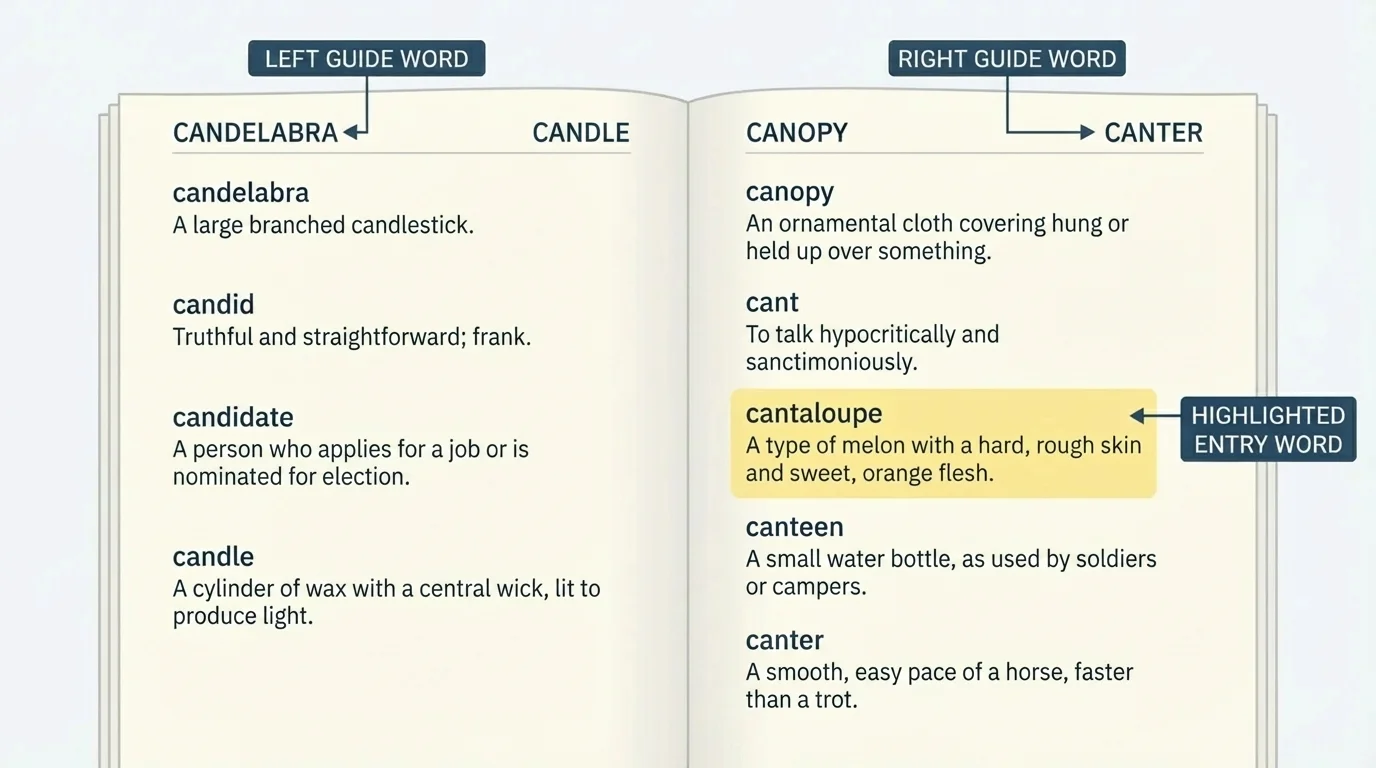
Here is a simple way to use a print dictionary. First, say the word and notice its letters. Next, look for the first letter. Then use the next letters to narrow your search. Finally, read the meanings and choose the one that fits your sentence.
Example: Finding a word in a print dictionary
You are reading: "The puppy was timid during the storm." You do not know the word timid.
Step 1: Find the first letter.
The word timid begins with t, so look in the t section.
Step 2: Use alphabetical order.
Look for words that begin with ti.
Step 3: Read the meanings.
The dictionary says timid means "shy or a little afraid."
Step 4: Check the sentence again.
"The puppy was shy or a little afraid during the storm" makes sense.
The best meaning is shy or a little afraid.
As you become a stronger reader, the dictionary becomes easier to use. The more you practice finding words, the faster you can solve word mysteries.
A digital dictionary works a little differently. Instead of turning pages, you type the word into a search box. Then the meanings appear on the screen. This can be very fast and helpful, especially when you are reading online.
When using a digital dictionary, type the word carefully. One missing letter can bring up the wrong word or no word at all. If you are not sure about the spelling, try your best, and the digital tool may offer choices that are close.
After the meanings appear, read more than one if there are several. Some digital dictionaries have a sound button so you can hear the word said aloud. Some also have pictures or sample sentences. Those extra features can help you understand the word more clearly.
If you read the sentence "The seal rested on the rock," a digital dictionary may show one meaning for a sea animal and another meaning for something used to close a container tightly. You use the sentence to pick the sea animal meaning.
Sometimes one word has two or more meanings. This is called a multiple-meaning word. A dictionary helps you see those choices.
[Figure 3] To choose the correct meaning, read the whole sentence. Think about what is happening in the story or book. Look at the pictures if there are pictures. Then choose the meaning that fits best.
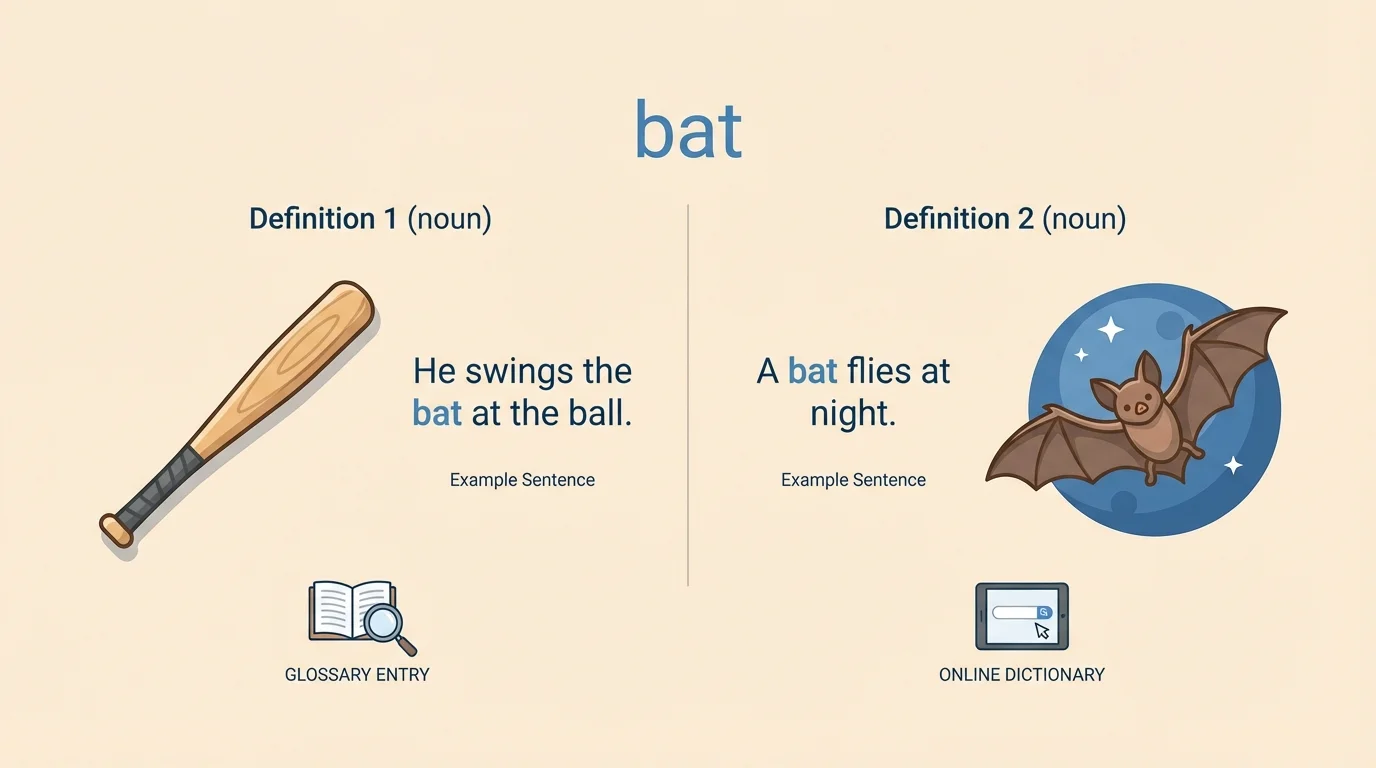
Look at the word bat. In "The bat flew out of the cave," the word means a flying animal. In "Mia swung the bat at the ball," the word means sports equipment. The letters are the same, but the meanings are different.
The same is true for words like bark, spring, and kind. Bark can be the sound a dog makes or the outside of a tree. Spring can be a season or a jump. A dictionary gives the meanings, but the sentence tells you which one belongs.
Use the sentence to guide your choice. If a dictionary gives more than one meaning, do not choose the first one too quickly. Read the sentence before and after the word. Think about the topic of the book. The right meaning is the one that makes the whole text make sense.
Later, when you meet another tricky word, remember the idea from [Figure 3]: one spelling can connect to more than one meaning. The surrounding words help you choose.
Glossaries and dictionaries are powerful tools, but readers also use other clues. You can look at the sentence, the pictures, and parts of the word. These clues work together.
For example, if you see the word entry word careless, you might notice the part care. Then you see the ending -less, which can mean "without." That helps you think the word may mean "without care" or "not careful." A dictionary can confirm whether your thinking is right.
If a nonfiction book says, "A habitat is the place where an animal lives," the sentence itself gives a clue. After noticing that clue, you can check the glossary to make sure. Smart readers do not depend on only one strategy. They use several strategies together.
You already know the alphabet and know that letters follow a certain order. That skill helps you use print dictionaries and glossaries quickly.
When a word still feels confusing, reread the sentence after you find the meaning. If the sentence sounds right and makes sense, your choice is probably correct.
Both tools help readers, but they are best for different jobs. A glossary is best when you are reading a specific book with special topic words. A dictionary is best when you need help with many kinds of words.
| Tool | Where You Find It | Best Use |
|---|---|---|
| Glossary | Usually at the back of a book | Finding meanings of important words from that book |
| Dictionary | Print book or digital tool | Finding meanings, spellings, and sometimes pronunciations of many words |
Table 1. Comparison of a glossary and a dictionary.
If you are reading a book about the moon and see the word crater, the glossary may be your fastest choice because it focuses on moon words. If you hear a new word in conversation and want to know what it means, a dictionary may be the better tool.
The glossary picture from earlier, shown in [Figure 1], reminds us that a glossary stays connected to one book. The dictionary pages in [Figure 2] remind us that dictionaries cover many words from across the language.
After you find a meaning, do one more important thing: check it. Put the meaning back into the sentence. Ask yourself, "Does this sound right? Does it fit the story or topic?" If yes, you probably found the correct meaning.
Suppose you read, "The class watched the crane lift steel high into the air." If you choose the bird meaning for crane, the sentence does not make sense. If you choose the machine meaning, it fits. Careful readers always make sure the meaning matches the sentence.
Using glossaries and beginning dictionaries, both print and digital, helps you become a stronger reader, writer, and thinker. Every new word you understand gives you more power to understand books, directions, facts, and stories.
