Have you ever heard someone tell a story and thought, "That sounded like a movie in my head"? That happens because the storyteller uses details. In a narrative, details help readers see the action, understand what a character is thinking, and feel the character's emotions. Without details, a story can sound flat. With details, a story comes alive.
When you write a real or imagined story, you are not only telling what happened. You are also helping your reader know how it happened, why it mattered, and what the character experienced. Good details make events clear and interesting from the beginning of the story to the ending.
A narrative is a story. Stories usually have characters, events, and an ending. If a writer says, "I went to the park," the reader knows one fact. But if the writer says, "I raced to the park with my kite bumping against my shoulder and the wind tugging at my hat," the reader can picture the moment much better.
Details are words that give more information. In stories, details can tell about actions, thoughts, and feelings. These details help the reader understand the character and the events.
Details do an important job in story writing. They help readers follow events in order. They also help readers care about what is happening. If readers know what a character is doing, thinking, and feeling, they understand the story more deeply.
Action details tell what a character does. These details make movement clear, as [Figure 1] shows with a simple action becoming a lively scene. Instead of using a plain verb like "went," writers can choose stronger verbs like "raced," "crept," "stomped," "twirled," or "hugged." Strong verbs help the reader picture the event.
Action details can also include how something happens. A writer might tell how fast, slow, quietly, or loudly a character moves. The writer can also tell what the character's body is doing. For example, "Mina opened the box" is clear, but "Mina tugged the ribbon loose, lifted the lid, and leaned in with wide eyes" paints a fuller picture.
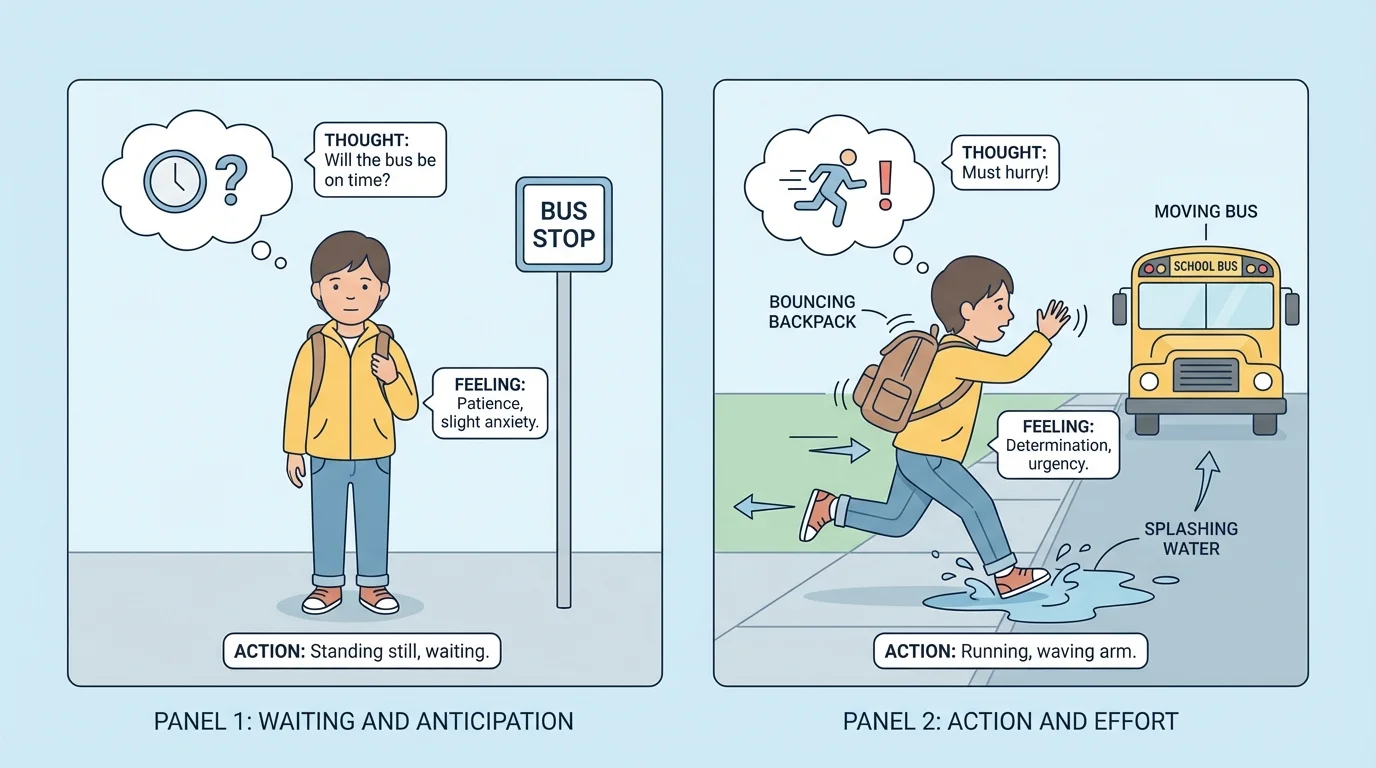
Here is how a sentence can grow stronger with action details. "The dog ran" is a basic sentence. "The dog dashed across the yard, skidded around the tree, and barked at the fluttering squirrel" gives the reader much more to see.
Sequence words also help action details make sense. Words such as first, next, then, and finally show the order of events. When events are in order, the story is easier to follow. For example: "First, Leo zipped his coat. Next, he grabbed his sled. Then, he trudged up the snowy hill. Finally, he pushed off and zoomed down."
Adding action details
Plain sentence: "Ana got on the stage."
Step 1: Choose a stronger verb.
Instead of "got on," use "stepped," "hurried," or "walked."
Step 2: Add movement details.
Tell what Ana's body is doing: "Ana stepped onto the stage and held her music folder tightly."
Step 3: Add a small extra action.
"Ana stepped onto the stage, held her music folder tightly, and took a deep breath before singing."
The new sentence helps the reader picture the moment clearly.
Later in a story, action details can also show change. A character may begin by creeping slowly, but end by running boldly. Just as in [Figure 1], movement can tell us a lot about what is happening in the scene.
Thought details tell what is happening inside a character's mind. Readers cannot see thoughts the way they can see actions, so the writer must choose words carefully. Thoughts help explain why a character makes a choice.
For example, if a story says, "Jamal stood by the diving board," the reader knows where he is. But if the story adds, "Jamal stared at the water and wondered if he was brave enough to jump," the reader understands his problem. Thoughts can show questions, plans, worries, hopes, and ideas.
You can write thoughts in simple, clear ways. Here are some examples: "I hope I remember my lines." "Maybe the kitten is hiding under the couch." "What if the answer is wrong?" These thought details make the story stronger because they help the reader know the character from the inside.
Thoughts explain choices. In stories, actions show what a character does, but thoughts often explain why the character does it. If a child hides behind a parent, the action tells what happened. If the writer adds, "She thought the big dog might jump on her," the reader understands the reason for the action.
Thoughts can also connect one event to the next. A character may think about a problem, make a plan, and then act. That helps the story move forward in a sensible way.
Feeling details tell the reader about a character's emotions. Writers can name the feeling directly, such as happy, nervous, disappointed, proud, or angry. Writers can also show a feeling through body language and reactions. A trembling hand, a huge grin, slumped shoulders, or a happy jump can all reveal emotions.
For example, "Nora was excited" names the feeling. "Nora bounced on her toes, grinned from ear to ear, and kept peeking out the window for her cousins' car" shows excitement. As [Figure 2] shows, both approaches are useful, and many strong stories use both direct naming and descriptive showing.
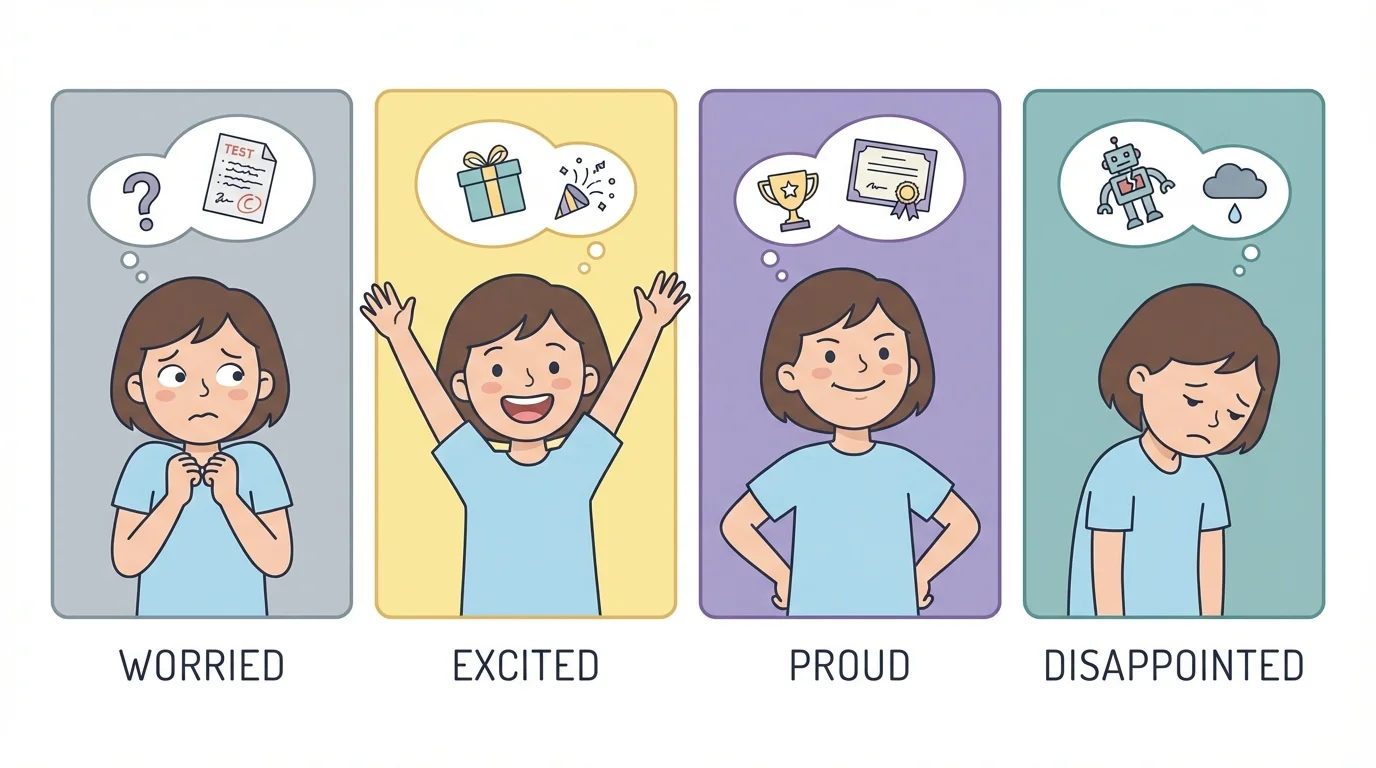
Showing feelings helps readers connect with the character. If the reader can picture the face, posture, and reaction, the emotion feels more real. A character who whispers, twists a shirt hem, and looks down probably feels nervous. A character who throws both arms into the air and laughs probably feels joyful.
Writers should choose feeling details that match the event. If a child loses a favorite toy, disappointed or sad details fit. If a child wins a race, proud or excited details fit. Good feeling details make the story believable.
Actors use facial expressions, posture, and movement to show feelings on stage. Writers do something similar with words so readers can "see" emotions in their minds.
Later in the same story, feelings can change. A character may start worried, then feel relieved. Looking back at [Figure 2], you can see how the face and body change with each emotion. Those changes help a reader understand how events affect the character.
The strongest narrative details often work together. A writer might describe what the character does, what the character thinks, and how the character feels in the same moment. This gives the reader a full picture.
Read this example: "Ben tiptoed toward the dark hallway, clutching the flashlight. He thought he heard a scratching sound behind the door, and his stomach felt tight with worry." In one short part of a story, the reader learns Ben's action, his thought, and his feeling.
Here is another example: "Sofia planted the seed carefully, patted the soil flat, and smiled. She thought about the sunflower she hoped would grow taller than the fence, and she felt proud of her tiny garden." This kind of writing helps readers understand both the event and the character.
Building one strong story sentence
Start with a plain idea: "Eli opened the test paper."
Step 1: Add action.
"Eli opened the test paper and gripped his pencil."
Step 2: Add thought.
"Eli opened the test paper, gripped his pencil, and thought, 'I studied hard for this.'"
Step 3: Add feeling.
"Eli opened the test paper, gripped his pencil, and thought, 'I studied hard for this.' His hands still felt a little shaky, but he was ready to begin."
Now the moment is much more meaningful.
When you combine these kinds of details, you do not need to make every sentence long. Short sentences can still be strong if the words are specific and clear.
A good story moves in order. It usually has a beginning, a middle, and an ending. The beginning introduces the character and situation. The middle shows what happens. The ending gives closure, which means the story feels finished.
As [Figure 3] shows, details help each part of the story. In the beginning, details can show where the story happens and what the character wants. In the middle, details can show actions, thoughts, and feelings as the events unfold. In the ending, details can show how the problem is solved or how the character has changed.
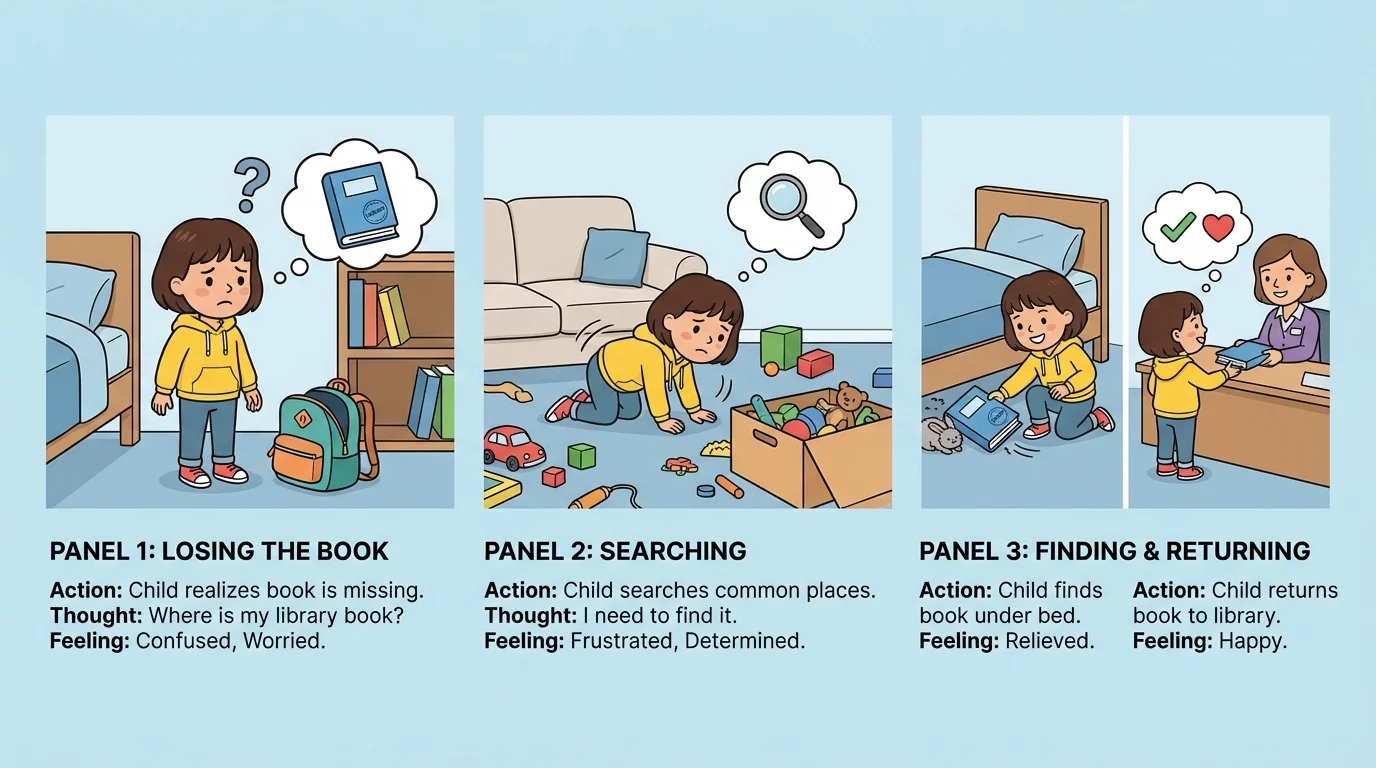
For example, a story might begin with, "On Saturday morning, Tia packed her blue backpack for the class picnic." In the middle, the writer might add, "At the park, she realized her lunch bag was missing. She searched under the bench, peeked inside the bus, and worried that she would have nothing to eat." In the ending, the writer might write, "Then her teacher lifted the extra bag from the front seat. Tia laughed with relief and thanked her." The ending feels complete because the problem is solved.
Closure does not always need a big surprise. Sometimes a quiet ending works well. A smile, a sigh of relief, a learned lesson, or a solved problem can all help the reader feel that the story is done. The sequence in [Figure 3] makes this easy to see: a problem begins, actions happen in order, and the final event completes the story.
| Part of the story | What details can do |
|---|---|
| Beginning | Introduce the character, setting, and situation |
| Middle | Show actions, thoughts, and feelings as events happen |
| Ending | Resolve the problem and help the story feel complete |
Table 1. How details help in the beginning, middle, and ending of a narrative.
Writers often start with plain sentences and then improve them. One way to strengthen writing is to ask simple questions: What did the character do? What did the character think? How did the character feel? What happened next?
Look at this plain sentence: "Kayla found her cat." The reader knows the event, but not much more. A stronger version is: "Kayla spotted her orange cat curled inside the laundry basket. She let out a happy laugh because she had been searching every room in the house." This new version adds action, feeling, and a reason.
Writers should choose details that matter. Too many extra details can make a story confusing. The best details are the ones that help the reader understand the important event, the character, and the ending.
When writing sentences, start with a capital letter and end with correct punctuation. Clear sentences make your story details easier to understand.
Specific words make details stronger. Compare these pairs: "walked" and "marched," "said" and "whispered," "happy" and "proud." The more exact word often paints a clearer picture. Good writers think carefully about word choice.
You can also listen to your own writing. If a sentence sounds too plain, add one important detail. If a story event seems confusing, add a thought or feeling that explains it. Small changes can make a big difference.
"Good stories help readers see, think, and feel along with the character."
When readers can picture the action, understand the thoughts, and feel the emotions, the story becomes more powerful. That is how details turn simple events into memorable narratives.
