Have you ever told someone about your day, but they looked confused because your story jumped all around? Maybe you said what happened at the end before you told what happened at the start. Writers have a smart way to fix that. They use special time words to guide the reader through events, one step at a time.
When we write a story, we want the reader to know what happened first, what happened after that, and how everything ended. This is called putting events in sequence. A story in sequence is easier to understand because the events are in order.
Stories can be about real things that happened or things we imagine. In both kinds of stories, event order matters. If a writer says, "I ate my cake. Then I blew out the candles. First we sang," the reader may need to stop and figure out the real order. Good writers help readers by using clear time-order words.
Temporal words and phrases are words and groups of words that tell when something happens. They help readers follow the order of events in a story.
These words are like road signs for a reader. They point to the beginning, the middle, and the end of what happens.
A temporal word can be one word, like first, next, then, or finally. A temporal phrase can be more than one word, like after that, a little later, in the morning, or at last.
These words and phrases tell the reader how one event connects to another event in time. They answer questions like: What happened first? What happened next? What happened at the end?
Temporal words do an important job in narrative writing. A narrative is a story. It can tell about a trip to the park, a lost puppy, a birthday party, or even a dragon adventure. No matter what the story is about, the reader needs to follow the events in order.
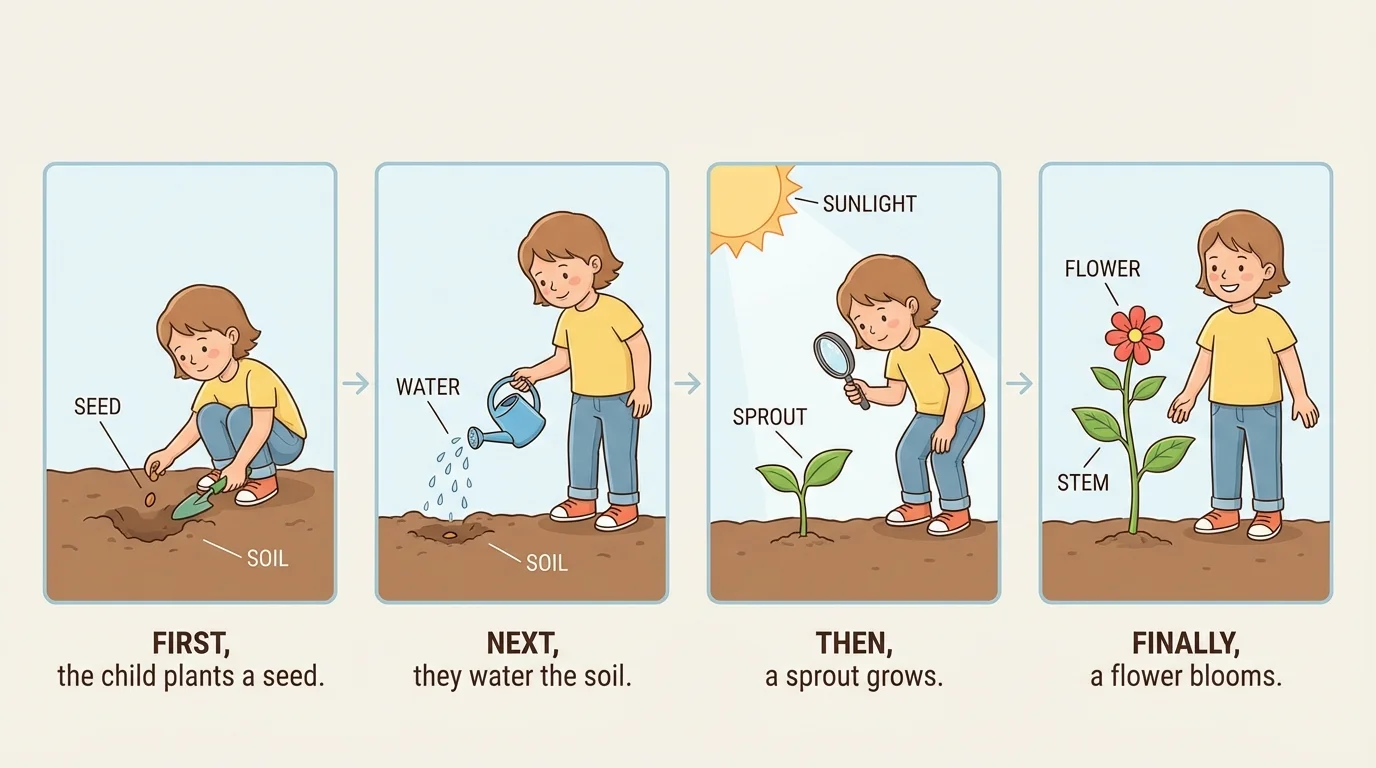
Writers use many time-order words. In a simple story, a writer might say, "First I dug a hole. Next I dropped in the seed. Then I covered it with dirt. Finally I watered the soil." That order is easy to follow in a growing plant story.
[Figure 1] Here are some common temporal words and phrases:
| Use | Temporal words and phrases |
|---|---|
| To begin | first, to begin, one day, at the start, in the morning |
| To continue | next, then, after that, soon, later, a little later |
| To end | finally, at last, in the end, last, after all that |
Table 1. Common temporal words and phrases grouped by how writers use them.
Some temporal phrases tell exact times, like before lunch or that evening. Others simply tell the order, like next or finally. Both kinds help the reader understand time in a story.
You do not need to use every temporal word in every story. You choose the ones that fit your events best. A short story might only need three or four. A longer story may need more.
Many books for young readers use time-order words again and again because they help new readers follow the action and remember what happened.
Even when a story is exciting, clear order matters. A story about a race, a storm, or a surprise party is more fun when the reader can tell exactly when each event happens.
A story often has a beginning, a middle, and an ending. Temporal words help shape each part. In the beginning, a writer may use words like one day or first. In the middle, the writer may use next, then, and after that. At the end, the writer may use finally or in the end.
Look at this short example: "One sunny day, Maya found a tiny kitten by the fence. First, she gave it some water. Next, she called her dad. Then, they made a soft bed in a box. Finally, the kitten fell asleep." The time words help the reader move through the story smoothly.
Example: A clear event sequence
Here is how a writer can build a short story in order.
Step 1: Start the story.
"One afternoon, Luis heard rain tapping on the window."
Step 2: Tell what happened next.
"First, he put on his boots. Next, he grabbed his umbrella. Then, he splashed outside."
Step 3: End the story.
"Finally, Luis came home wet and laughing."
The temporal words guide the reader from the start of the event to the end.
Notice that each event comes after the one before it. The reader does not have to guess the order.
Different temporal words do slightly different jobs. First is strong for the beginning. Next and then work well in the middle. Finally is useful when the last event happens. At last can show that someone waited a long time. Soon can show that something happened after a short time.
For example, compare these endings: "Finally, the bus came." and "At last, the bus came." Both are correct, but at last gives a stronger feeling that the person had been waiting.
Writers also use phrases such as that night, the next day, and after a while. These phrases can help the story move forward in time without sounding the same over and over.
Good writers match the time word to the event. If the event is the very first one, use a beginning word. If it happens after other actions, use a middle word. If it closes the story, use an ending word. Choosing carefully helps the story sound natural.
That is why writers do not just pick random time words. They choose words that fit the place of the event in the story.
Temporal words help, but writers should not use the same word too many times. If every sentence starts with then, the writing can sound bumpy. Instead, writers can mix words and phrases: first, next, after that, later, and finally.
Here is a choppy example: "Then I woke up. Then I got dressed. Then I ate cereal. Then I ran to the bus." It is in order, but it is not very smooth.
Here is a smoother version: "First, I woke up. Next, I got dressed. After that, I ate cereal. Finally, I ran to the bus." The meaning is the same, but the writing sounds better.
Readers need clear sentences and clear order. A strong story has both. Temporal words do not replace details, but they help the details stay organized.
Writers also add details about actions, feelings, and places. Temporal words organize the events, while details make the story interesting.
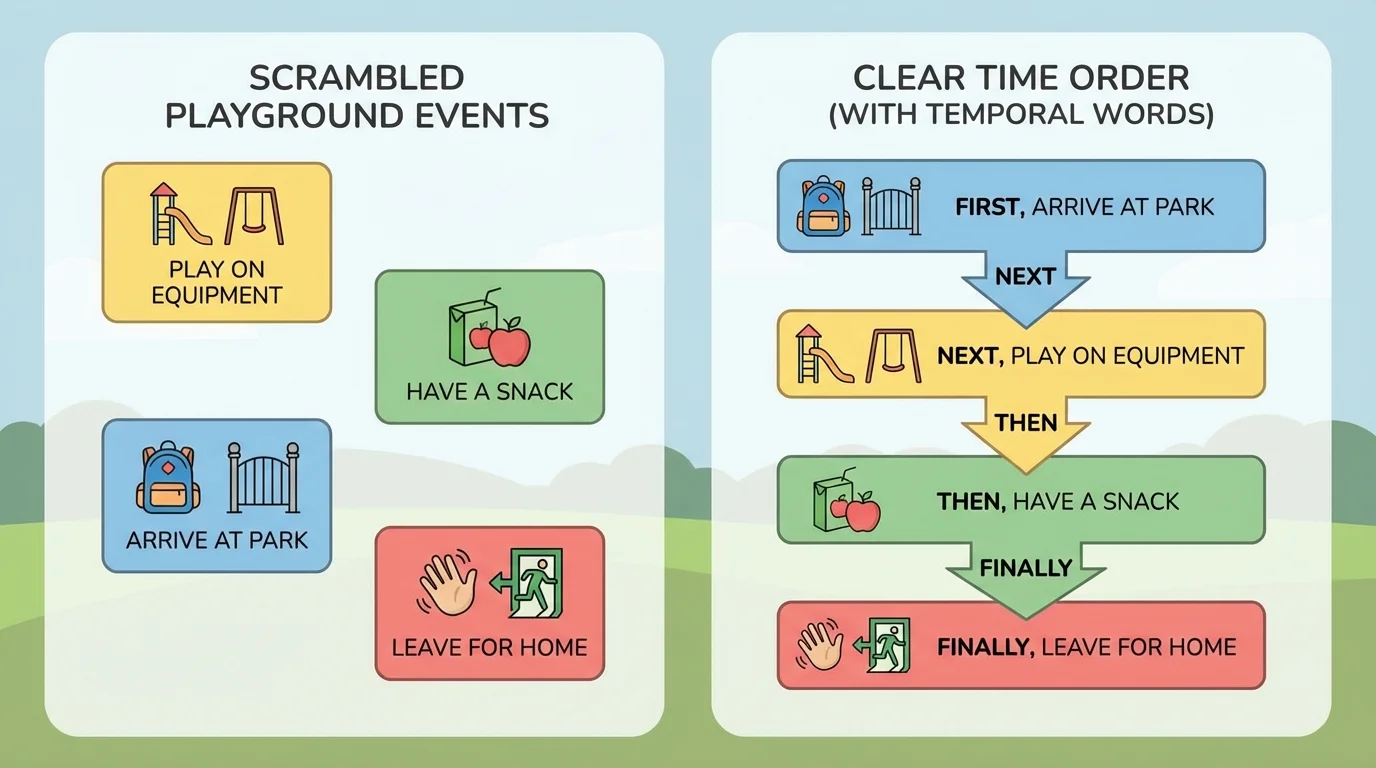
Sometimes a writer has all the right events but puts them in a confusing order. Reordering the events with temporal words makes the writing easier to understand, as [Figure 2] illustrates in a playground story.
Read these mixed-up sentences: "I went down the slide. We walked to the playground. I climbed the ladder. Mom pushed me on the swing." The reader may wonder what happened first and what happened next.
A writer can fix it like this: "First, we walked to the playground. Next, Mom pushed me on the swing. Then, I climbed the ladder. Finally, I went down the slide." Now the events are in order.
Writers often do this when they revise. To revise means to go back and improve writing. A writer may read a story and ask, "Will my reader know the order of events?" If the answer is no, adding or changing temporal words can help.
Later, when you look back at a draft, you can check whether every event is easy to follow. The kind of clear ordering shown in [Figure 2] helps readers stay inside the story instead of stopping to figure it out.
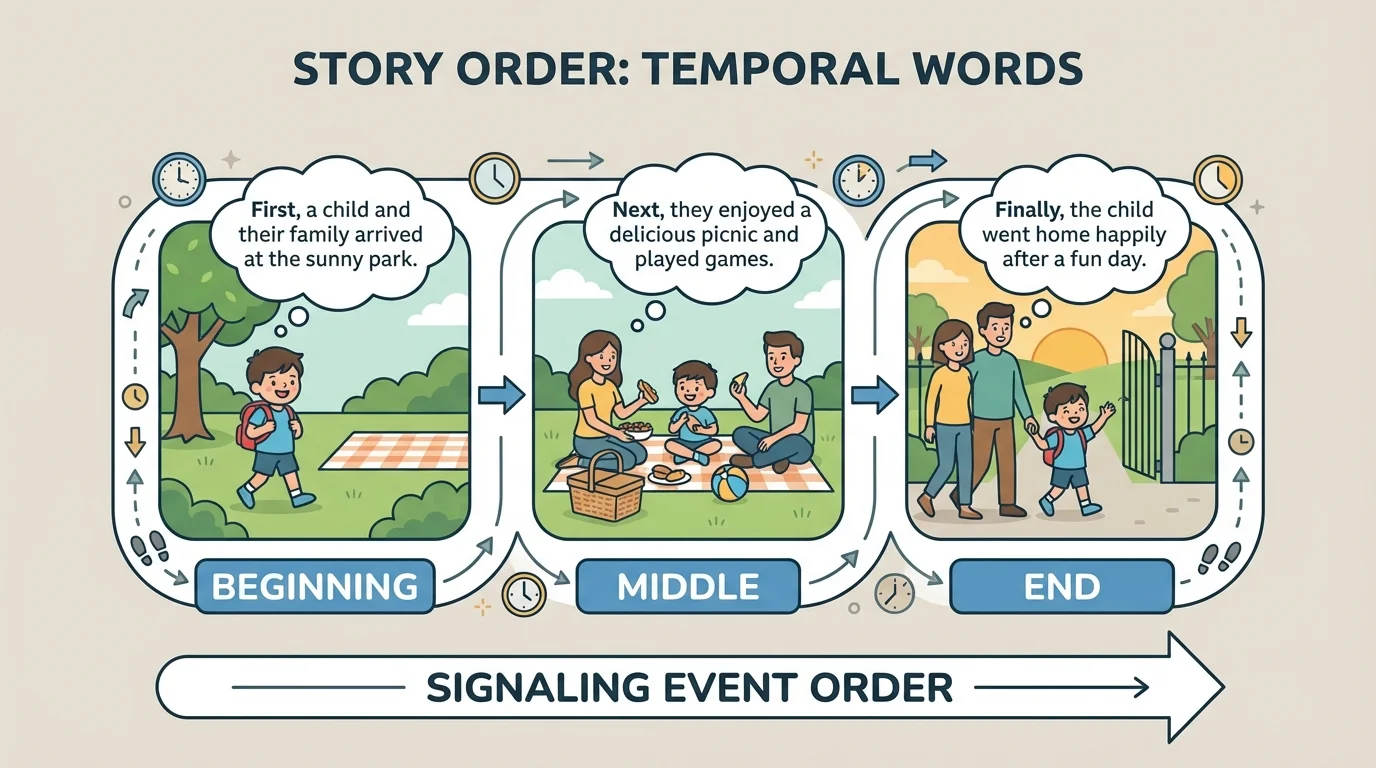
A good story does not just stop. It gives the reader a feeling that the events are finished. This feeling is called closure. Temporal words at the end of a story help create that feeling, as [Figure 3] shows with a beginning-middle-end path.
Ending words and phrases include finally, in the end, at last, and after all that. These words tell the reader, "This is the last part."
For example: "Finally, we spread our blanket under the tree and ate our picnic lunch." This sentence feels more finished than "We spread our blanket under the tree and ate our picnic lunch." Both can work, but the temporal word gives a stronger ending signal.
Closure can also come from telling what happened after the problem was solved. "In the end, Ben found his lost shoe, and everyone laughed." That ending helps the reader know the story is complete.
Example: Adding closure to an ending
Weak ending: "We got on the bus."
Stronger ending: "Finally, we got on the bus and headed home."
The second ending sounds more complete because the time word signals that the story is wrapping up.
When readers feel closure, the story seems whole. They can tell the writer has reached the end on purpose.
Temporal words are not only for made-up stories. Writers use them when they tell about real events too. A student might write, "In the morning, our class boarded the bus. Next, we visited the farm. After that, we fed the goats. Finally, we returned to school."
People also use temporal words when speaking. If you explain how to make a sandwich, tell about a soccer game, or describe a science experiment, you often use time-order words without even noticing. These words make ideas clear in everyday life.
The same idea from the plant sequence in [Figure 1] works in many kinds of writing: the reader or listener needs to know what happened first, what changed next, and how it ended.
"First things first, and one step at a time."
— A helpful writing reminder
When writers choose strong temporal words and phrases, they build stories that are easy to follow, interesting to read, and satisfying at the end.
