Have you ever heard two friends talk about pizza and one says, "Cheese pizza is the best," while the other says, "Pepperoni is the best"? They cannot both be stating a fact, but they can both be sharing ideas they believe. That is what writers do when they state an opinion. They tell what they think, feel, or believe, and then they explain why.
An opinion is what a person thinks or feels. An opinion is not something everyone has to agree on. One person may love rainy days. Another person may like sunny days better. Both are opinions.
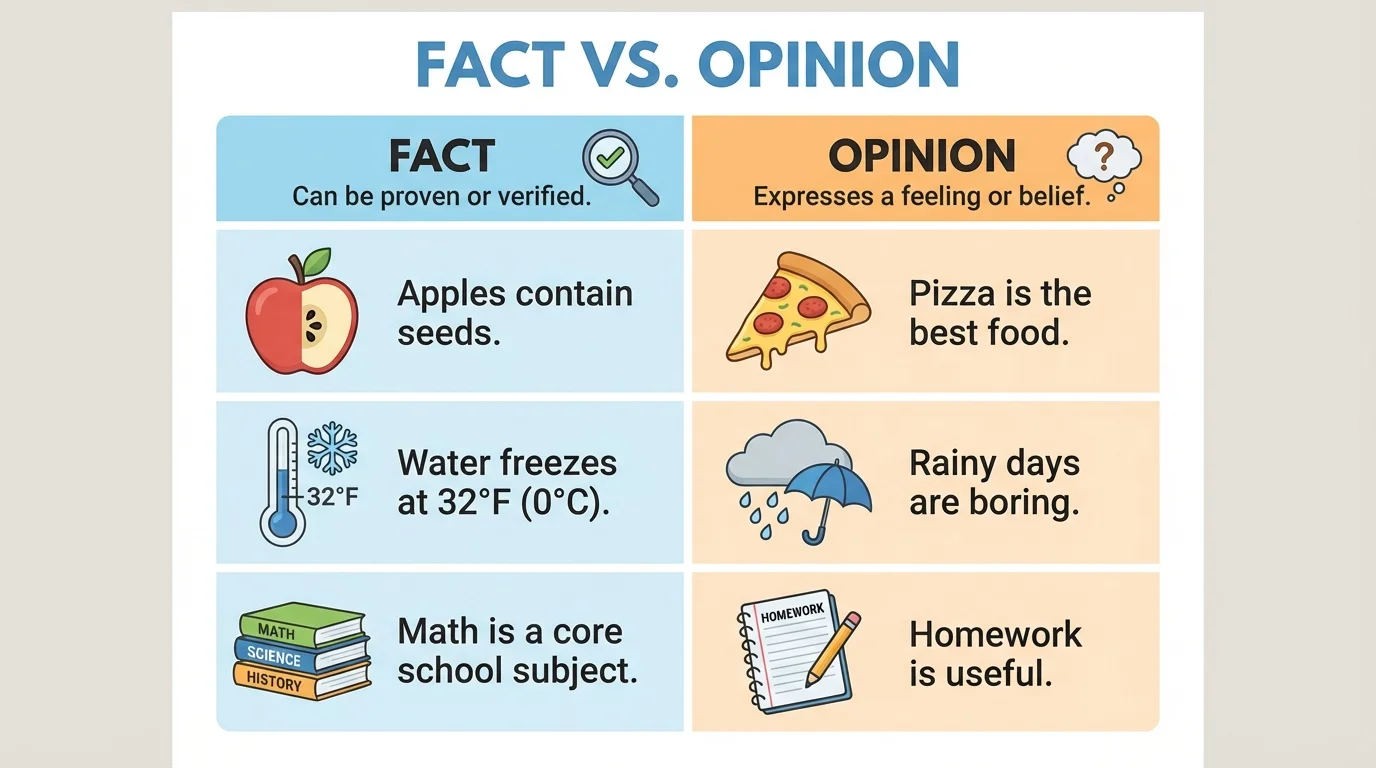
A fact is something that can be checked and proved true. Saying "A week has seven days" is a fact. Saying "Saturday is the best day of the week" is an opinion. As [Figure 1] shows, facts and opinions can be about the same topic, but they do different jobs. Facts tell what is true. Opinions tell what someone thinks.
When you write an opinion, you are not just saying random words. You are making a clear choice and sharing it with your reader. A reader should be able to tell exactly what you believe.
Opinion means what a person thinks, feels, or believes.
Fact means something that is true and can be checked.
Reason means why you think your opinion is right.
Here are some examples. "Dogs are the best pets" is an opinion. "Dogs have four legs" is a fact. "Reading is more fun than watching TV" is an opinion. "Books have words" is a fact. Writers need to know the difference because opinion writing uses opinions with reasons, and facts can help explain those reasons.
A good opinion does not stop after one sentence. If you say, "Summer is the best season," your reader may ask, "Why?" That is where a supporting reason comes in. A supporting reason helps explain your idea.
For example, a writer might say, "Summer is the best season because I can swim, play outside longer, and eat cold watermelon." Now the opinion is clearer. The reasons help the reader understand the writer's thinking.
Sometimes writers use facts to support their reasons. A writer may say, "Our class should grow plants because plants need water and sunlight, and we can watch them change each week." The opinion is that the class should grow plants. The facts about what plants need help support the reason.
Why reasons matter
Reasons make opinion writing stronger. Without reasons, the reader only knows what you think. With reasons, the reader understands why you think it. Strong reasons help your writing sound thoughtful and clear.
It is fine if another person has a different opinion. Good writers do not need everyone to agree. They simply need to explain their ideas well.
Writers often use special words to show they are sharing an opinion. These words help the reader know what kind of writing they are reading.
Some helpful opinion words and sentence starters are:
Here are a few examples: "I think the library is the best place in school because it is quiet and full of stories." "In my opinion, apples are a better snack than chips because they are juicy and crunchy." "I believe recess should be longer because children need time to move and play."
The word because is especially important. It connects your opinion to your reasons. Without it, your writing may sound unfinished.
Opinion writing is easier to follow when it has clear parts, as [Figure 2] illustrates. Even a short piece of writing should be organized so the reader can move from the main idea to the reasons and then to a strong ending.
The organization of an opinion piece can be simple:
Beginning: Tell your opinion clearly.
Middle: Give reasons that support your opinion.
Ending: Finish by restating your opinion or giving a strong final thought.
For example, a writer could begin with, "I think school gardens are a great idea." In the middle, the writer could explain, "They help students learn about plants, and they make the schoolyard beautiful." The ending could say, "That is why every school should have a garden."

This structure helps your reader stay with you from start to finish. Later, when you read a full paragraph, you can notice these parts working together. This pattern helps many writers remember what to say next.
Good sentences begin with capital letters and end with punctuation. When you write an opinion piece, you still use complete sentences, spaces between words, and neat order so your reader can understand your ideas.
Writers do not need a very long piece to share an opinion well. A short paragraph can be strong if it has a clear opinion, good reasons, and a thoughtful ending.
Strong reasons help readers understand your opinion, as [Figure 3] shows when it compares weak and strong support. A weak reason may be too short or too unclear. A strong reason tells more.
Look at this weak example: "Cats are the best pets because they are nice." The word "nice" is not very specific. It does not tell much.
Now look at a stronger example: "Cats are the best pets because they are soft, they can play indoors, and they curl up quietly when people read or rest." This reason gives the reader a clearer picture.

A stronger opinion statement
Topic: favorite school activity
Step 1: State the opinion.
"I think art is the best school activity."
Step 2: Add reasons.
"I think art is the best school activity because I can paint, draw, and make new things."
Step 3: Add a closing thought.
"Art lets me be creative, so it is my favorite part of the day."
This example is clear because the writer says the opinion, gives reasons, and ends strongly.
Examples can make reasons even better. If you write, "Reading is fun because books can teach us about animals," you can add an example such as, "I learned how penguins keep warm." Small details help the reader see what you mean.
That is why the stronger side works better. It gives enough detail for the reader to picture the idea instead of guessing.
Not everyone will think the same way you do. That is normal. One student may think soccer is the best sport. Another may think basketball is better. Good opinion writing does not need mean words or rude comments.
Respectful writers use calm language. They focus on their own reasons instead of saying unkind things about someone else's idea. Instead of writing, "Only silly people like winter," a respectful writer could say, "I like spring better than winter because flowers bloom and the weather feels warm."
When writers are respectful, readers are more willing to listen. Opinion writing is about sharing ideas clearly, not about hurting feelings.
People use opinion writing all the time. They write book reviews, tell why they like certain foods, choose class activities, and even explain which playground game should be played first.
Respect matters in speaking and writing. It shows that you can have a strong idea and still be kind.
Here is an example of a full opinion paragraph:
"I think the zoo is a great place to visit. First, people can learn about animals from many parts of the world. Next, the zoo helps visitors see animals up close in a safe way. Also, going to the zoo can make families want to protect animals and their homes. For all of these reasons, the zoo is an exciting and important place."
This paragraph works because the opinion comes first. Then the writer gives several reasons. At the end, the writer reminds the reader of the opinion in a new way.
"A strong opinion says what you think and tells why you think it."
Notice that the paragraph stays on one topic. It does not suddenly start talking about a birthday party or a math test. Good opinion writing stays focused.
Sometimes writers make simple mistakes in opinion writing. One mistake is giving an opinion without reasons. If you write only "I like bikes," your reader still wants to know why.
Another mistake is adding details that do not match the topic. If your opinion is about the best fruit, a sentence about your favorite movie does not belong. Writers should keep all their sentences connected to the main idea.
A third mistake is mixing up facts and opinions. Remember the chart in [Figure 1]. A fact can support your writing, but the opinion is the main claim you want to share.
Writers also need to make their opinions easy to understand. If a sentence is confusing, the reader may not know what the writer believes. Clear words help your message shine.
Opinion writing is not only for school. People use it in everyday life. A child might tell why a class should read one book instead of another. A family member might explain why one park is better for a picnic. A reader might write which story was most interesting and why.
When you talk about your favorite game, best lunch, nicest season, or most interesting animal, you are already practicing opinion writing. Writing simply helps you organize those thoughts.
Opinion writing also helps you become a better thinker. It teaches you to make a choice, explain it, and support it with reasons. These are important skills for school, conversations, and future writing.
Whether you are choosing a favorite book or explaining why classrooms need more plants, a strong opinion piece tells what you think, gives reasons, and stays clear from beginning to end.
