People share opinions all the time. You might say a game is fun, a book is exciting, or rainy days are the best. But if someone asks, "Why do you think that?" you need more than just your opinion. You need reasons. Reasons help your listener or reader understand your thinking.
When writers give reasons, their writing becomes stronger. Instead of only saying, "Cats are the best pets," a writer can add, "Cats are the best pets because they are gentle, they clean themselves, and they do not need to be walked." Now the opinion sounds clear and thoughtful. Good writers do not just tell what they think. They also tell why they think it.
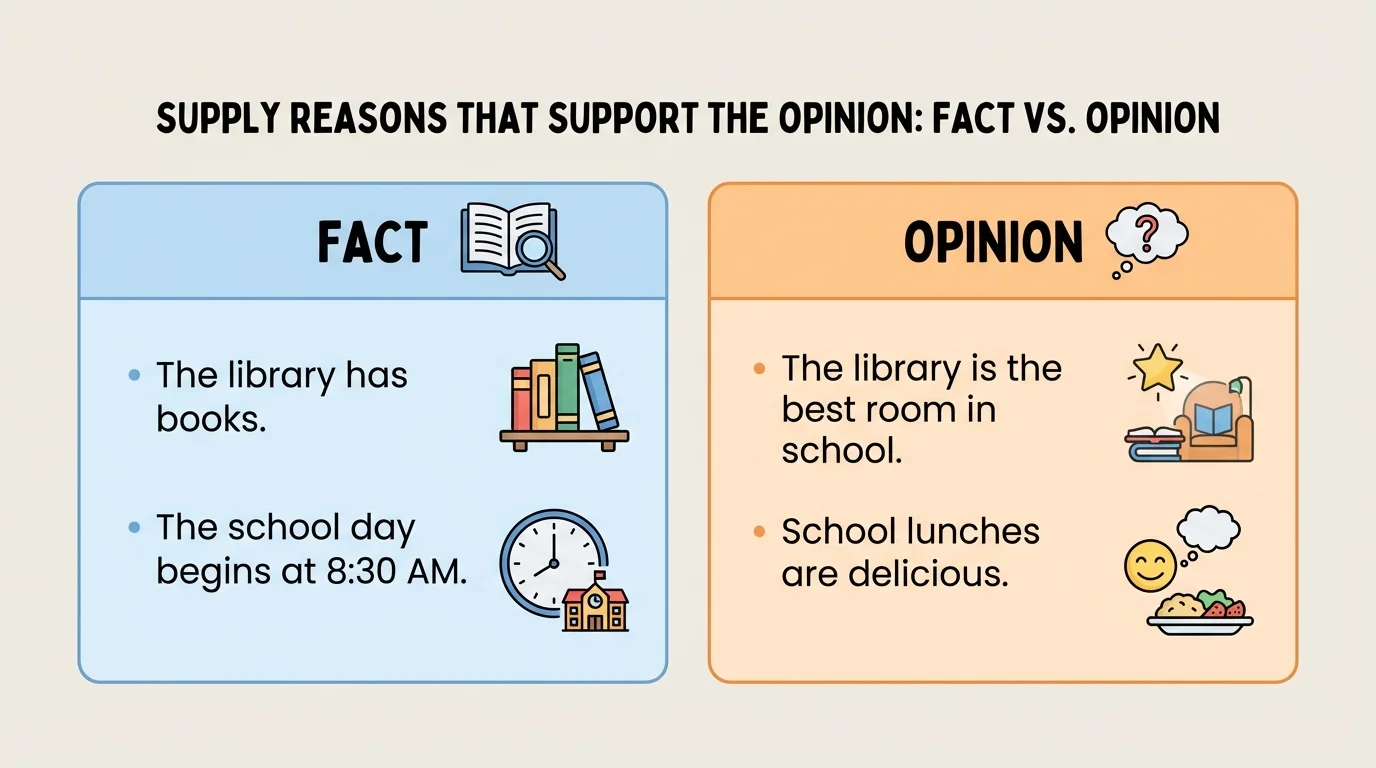
[Figure 1] An opinion is what a person thinks, feels, or believes. It is not something everyone has to agree with. One person may think chocolate ice cream is the best, while another person may like vanilla more. Both are opinions.
A fact is something that can be checked and proven. Facts and opinions are different, as the examples show. "A week has seven days" is a fact. "Saturday is the best day of the week" is an opinion. Writers need to know the difference so they can share their ideas clearly.
Opinions are important in writing because they let writers share ideas. A writer may have an opinion about a story, a food, a class rule, or a place to visit. When the writer gives reasons, the opinion becomes more powerful.
Opinion means what someone thinks or believes.
Fact means something that is true and can be checked.
Reason means why someone thinks an opinion is true or important.
If you say, "The park is the best place to play," you have shared an opinion. That is a good start. But your writing gets stronger when you explain your thinking with reasons.
A reason tells why you think something. It supports your opinion. It helps support your idea. If your opinion is "Reading before bed is a good habit," your reasons might be "it helps me feel calm" and "I learn new words from books."
Reasons should connect directly to the opinion. If your opinion is about reading before bed, then your reasons should be about bedtime reading. A reason like "My shoes are blue" does not fit. It may be true, but it does not support the opinion.
Think of an opinion as a little chair. The reasons are the legs holding it up. One leg may help, but several strong legs make the chair steady. In the same way, more than one good reason can make your writing stronger and easier to believe.
How reasons help
Reasons help the reader understand your thinking. They answer the question "Why?" and make your opinion sound complete. Without reasons, an opinion feels unfinished. With reasons, it feels clear and supported.
Writers often use reasons when they talk about favorite books, best animals, classroom choices, or rules they think are fair. Even young writers can make strong points when they choose reasons that really match the idea.
Not all reasons are equally helpful. A supporting reason is a reason that clearly helps prove or explain the opinion. A strong reason is clear, connected, and sensible. A weak reason may be confusing, repeated, or not connected enough.
Look at this opinion: "School uniforms are a good idea." A strong reason would be "they can make it easier to choose clothes in the morning." Another strong reason would be "they can help students feel like part of one school team." A weak reason would be "bananas are yellow." That reason does not connect at all.
Sometimes a reason is connected, but it is too vague. If you write, "Pizza is the best lunch because it is nice," the word nice does not tell enough. A stronger reason is "Pizza is the best lunch because it is warm, cheesy, and easy to share." Strong reasons paint a clearer picture in the reader's mind.
Good opinion writers often reread their reasons and ask, "Does this really help my opinion?" That one question can make writing much stronger.
Writers can also use facts to support an opinion, but the facts must fit. For example, if your opinion is "Our class should have more plants," a reason like "plants make the room look cheerful" is helpful. A fact like "plants need water to grow" may also help if you connect it clearly to your point.
Writers use linking words to connect opinions and reasons smoothly. Linking words help writing sound organized instead of choppy. Some useful linking words are because, also, another reason, and for example.
Here is how they work: "I think winter is the best season because I like snow." "Also, I can wear my warm boots." "Another reason is that I enjoy hot soup on cold days." These words guide the reader from one idea to the next.
Without linking words, writing can sound jumpy: "Winter is best. I like snow. I wear boots. I eat soup." The ideas are there, but they do not flow together as well. Linking words make the writing easier to follow.
[Figure 2] A short opinion piece has parts that work together. First, the writer tells the opinion. Next, the writer gives reasons. Last, the writer finishes with an ending that reminds the reader of the opinion.
The beginning should clearly state the opinion. The middle should include reasons that support it. The ending can wrap up the idea in a simple way. This structure helps the reader understand the message from start to finish.
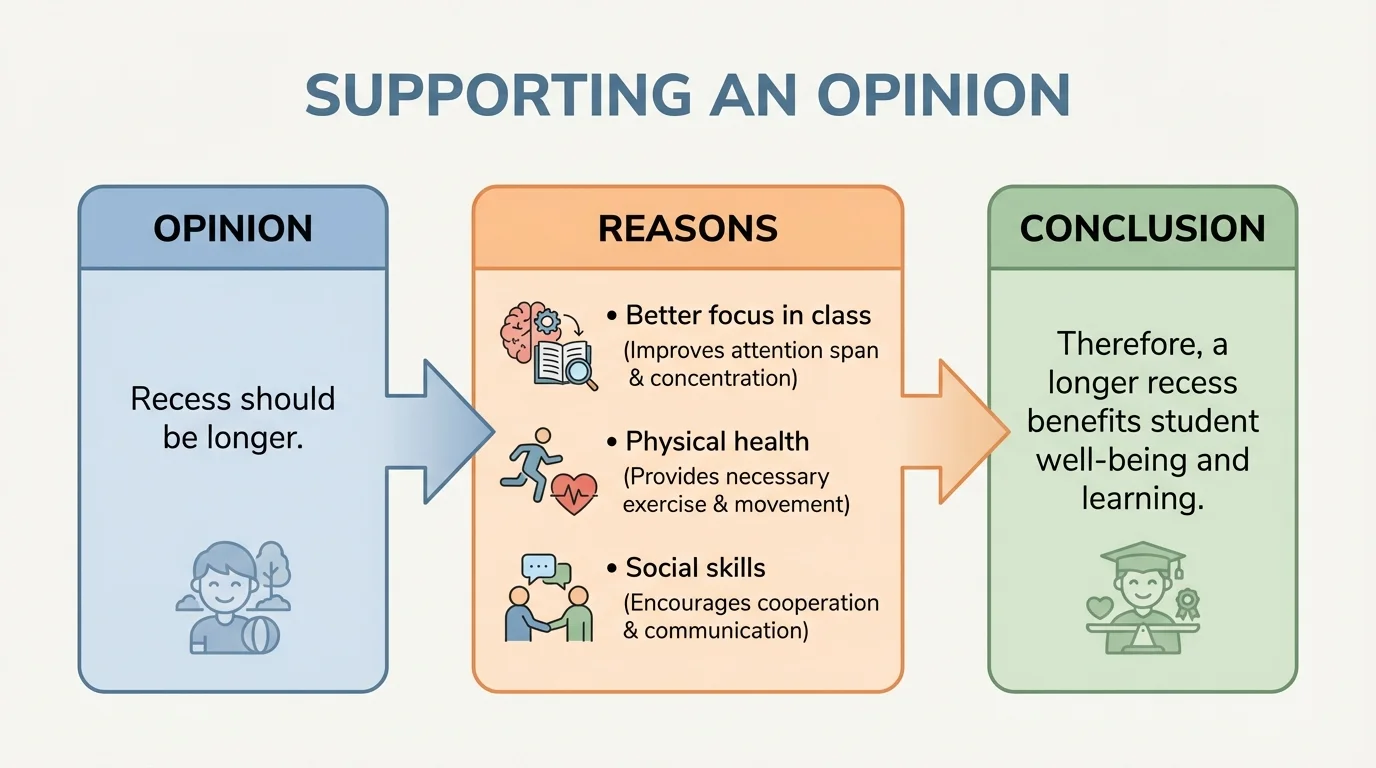
For example, a writer may begin with "I think recess should be longer." Then the writer gives reasons such as "students can get more exercise" and "students return to class ready to learn." The writer can end with "That is why I think longer recess would help students."
Example opinion piece
Step 1: State the opinion
"I think dogs make great pets."
Step 2: Add supporting reasons
"Dogs can play with families. They can help people feel less lonely. They can also help keep a home safe."
Step 3: End by restating the opinion
"For these reasons, I think dogs are wonderful pets."
This kind of writing does not need to be long to be strong. Even a few sentences can make a good opinion piece when the opinion is clear and the reasons are thoughtful.
Let's look at more examples. "Opinion piece" means a piece of writing where the writer shares an opinion and supports it with reasons. A student might write, "My favorite book is Charlotte's Web because the characters are memorable, the story is touching, and the friendship in the book feels real."
Another writer might say, "Spring is the best season because flowers bloom, the weather gets warmer, and more animals are active outside." Each reason matches the opinion and tells why the writer feels that way.
Here are more examples in a table.
| Opinion | Supporting reasons |
|---|---|
| Art class is important. | It helps students be creative, practice careful work, and share ideas with pictures. |
| The library is a great place. | It is quiet, full of books, and a good space for learning. |
| Breakfast is an important meal. | It gives energy, helps people focus, and starts the day well. |
| Having a class pet can be helpful. | Students learn responsibility, observe animals, and practice gentle care. |
Table 1. Examples of opinions paired with reasons that support them.
As you can see, the strongest examples do more than say "because it is good." They explain how or why something is good, helpful, fun, or important.
Reasons need to stay close to the main idea, as [Figure 3] shows. If your opinion is "We should read every day," your reasons should be about reading. They might include "reading builds knowledge" and "reading helps us learn new words."
If you suddenly add "my backpack has a zipper," the reader gets confused. That detail may be true, but it does not match the opinion. Writers need to check each reason and ask, "Does this support my idea?"
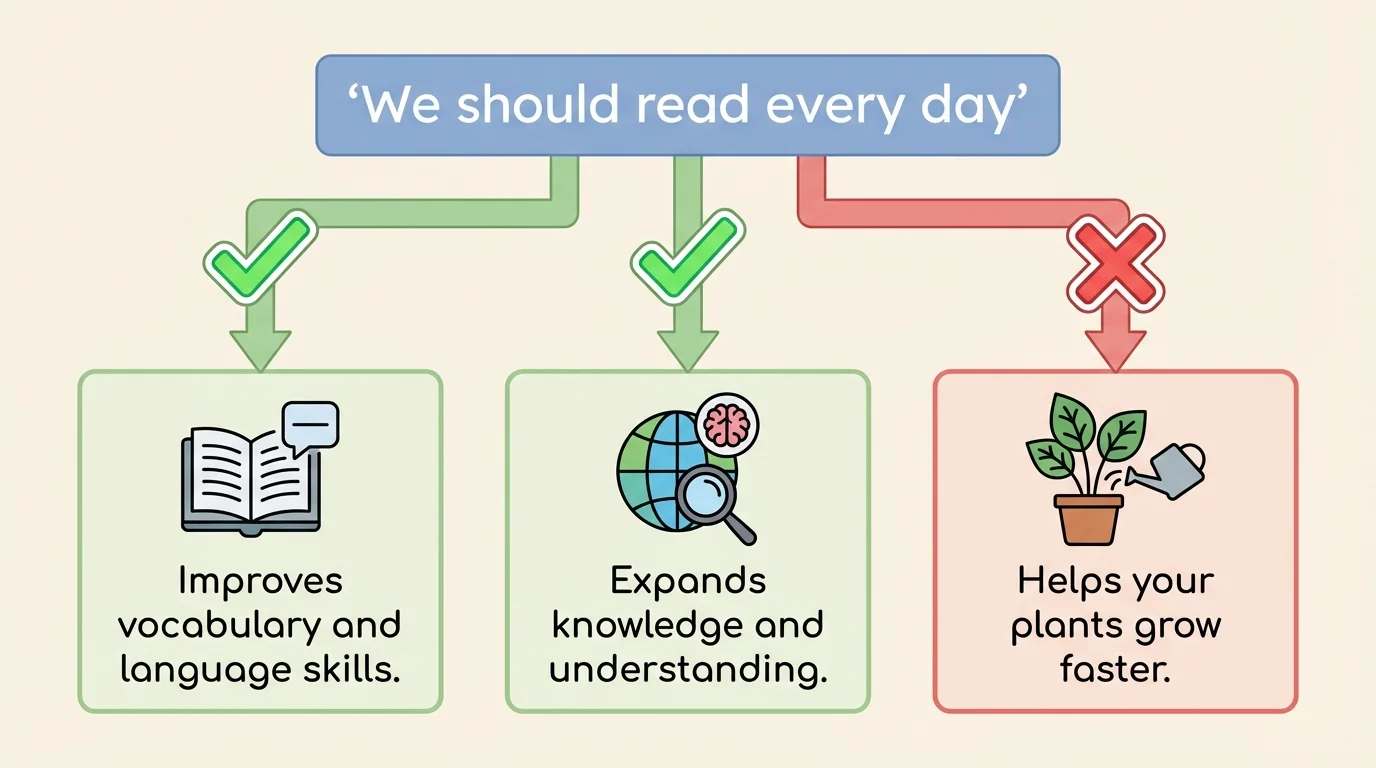
This is where careful thinking matters. Matching reasons make the writing sound clear and logical. Unrelated reasons make the writing weak. When you choose reasons that fit, your reader can follow your thinking more easily.
You already know how to stay on topic when speaking or writing. This skill helps here too. Every reason should stay on the same topic as the opinion.
Later, when you reread your work, you can use [Figure 3] in your mind: keep the reasons with check marks and remove the ones that do not belong.
Specific words make reasons stronger. Compare these two reasons for the opinion "The zoo is exciting." One says, "It is good." The other says, "It has tall giraffes, loud parrots, and animals from many places." The second reason helps the reader picture the zoo much better.
Words like good, nice, and fun are not wrong, but they are often too general. Writers can improve by adding details. Instead of "The movie was good," try "The movie was good because it had funny parts and a surprising ending."
Strong word choices help reasons sound more believable. They also make writing more interesting to read.
One common mistake is giving an opinion with no reasons. For example, "Field trips are the best." That tells the opinion, but it does not explain why. Add reasons such as "we learn in new places" and "we see things up close."
Another mistake is repeating the same reason again and again. If you write, "Soccer is fun because it is fun and fun things are fun," your writing does not grow. Try new reasons like "it keeps players active" and "it teaches teamwork."
A third mistake is using reasons that do not fit. This problem is easier to notice when you reread your work carefully. Strong writers check whether every sentence supports the opinion.
Making a weak opinion stronger
Step 1: Weak version
"Summer is the best season. It is nice."
Step 2: Add clear reasons
"Summer is the best season because there is no school, the days are sunny, and many families can swim or travel."
Step 3: Add a clear ending
"For these reasons, summer is my favorite season."
When writers fix these mistakes, their opinions become easier to understand and more convincing.
You use this skill often, even when you are not writing a big paragraph. You use it when you tell which game to play, which snack you like best, or which book should be read aloud in class. When you add reasons, other people understand you better.
At school, opinion writing can help when you respond to a story, choose a class activity, or explain a classroom rule you like. At home, you might share why a certain dinner is your favorite or why a pet needs a cozy bed. In each case, the opinion becomes stronger when it has good reasons.
As we saw earlier in [Figure 1], opinions are different from facts, but they can still be thoughtful and strong. And the structure in [Figure 2] helps writers organize those ideas clearly. Good opinion writing is not about being loud. It is about being clear, supported, and meaningful.
