Have you ever heard someone tell a story and then just stop? You might wonder, "Wait... what happened next?" A good story does not leave the reader with unanswered questions by accident. It ends in a way that feels complete. That finished feeling is called closure, and it helps readers understand that the story is over.
In narrative writing, a story tells events in order. It may be a true story from your life, or it may be a made-up story from your imagination. At the end, the writer should give the reader a sense that the important part is done. Closure is not always a long ending. Sometimes it is only one or two sentences. But those sentences should help the reader feel calm, satisfied, or sure about what happened.
Closure is the feeling that a story has reached a real ending. The reader understands what happened, how the problem changed, or how the character feels at the end.
A story with closure usually answers a question the story has been asking. If the story is about finding a missing mitten, closure shows whether the mitten was found. If the story is about a child being nervous on the first day of school, closure shows what happened at the end of the day or how the child feels after the experience.
Closure matters because readers want stories to make sense from start to finish. The ending should connect to the rest of the story. It should not feel random. It should feel earned.
A narrative has events in sequence, and each event helps the story move forward toward the ending, as [Figure 1] shows. Often, the story begins by introducing a character and a situation. Then something happens. The middle shows actions, problems, or important moments. The ending brings those events to a close.
Think of a story like walking on a path. You start in one place. You move through what happens. Then you arrive somewhere. The ending is that arrival. It shows where the character is now compared with where the character started.
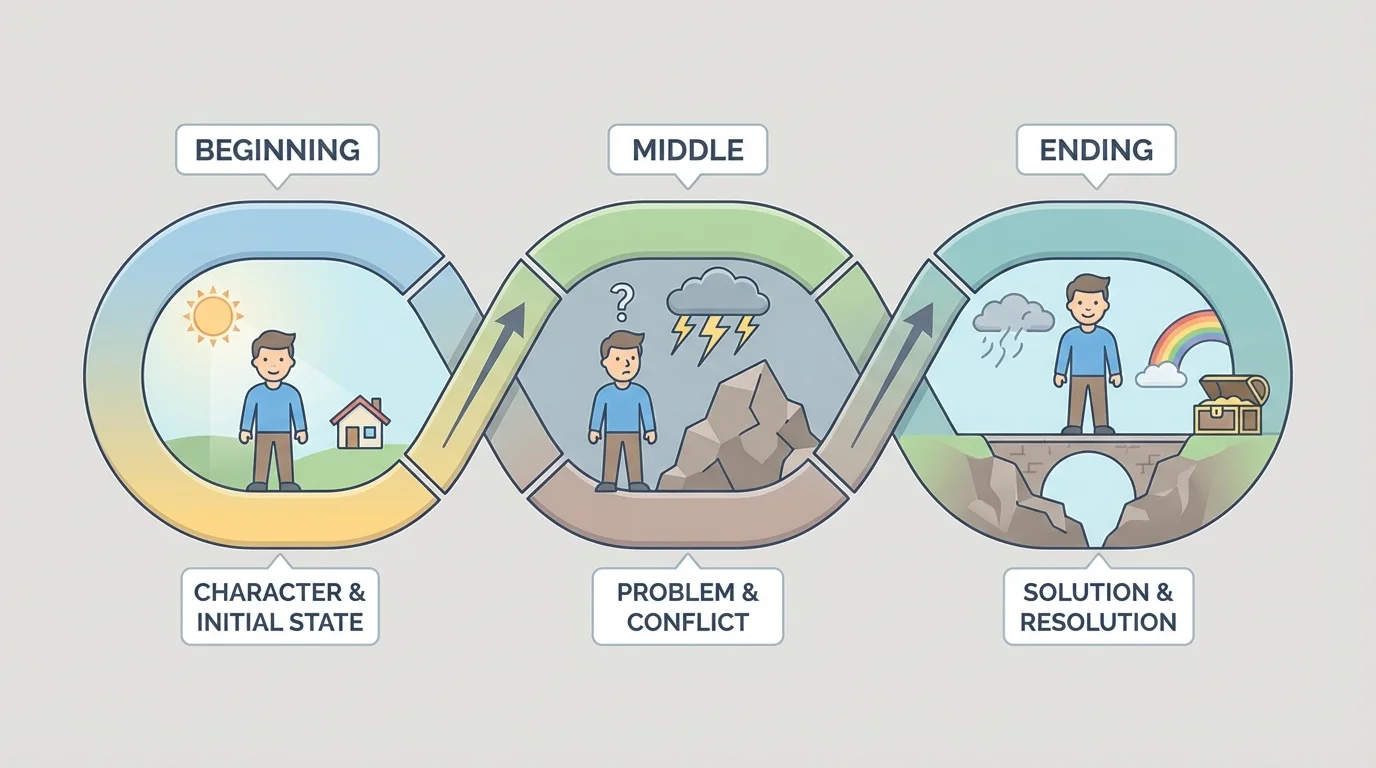
If a girl plants a seed in the beginning, waters it in the middle, and waits patiently, the ending might show a flower blooming. That ending matches the events that came before it. It feels right because the story has been building toward that moment.
If the same story suddenly ended with "Then she ate spaghetti," the reader would feel confused. That detail does not close the story. It does not connect to the main events. Good closure stays connected to the important action.
Writers often think about beginning, middle, and end. The beginning introduces, the middle develops, and the end closes. All three parts work together.
When writers plan endings, they ask simple questions: What changed? Was the problem solved? What did the character learn, do, or feel? These questions help the ending fit the story.
Writers can create endings in different ways. There is not only one correct kind of ending. What matters is that the ending matches the story and helps the reader feel that the story is complete.
[Figure 2] One way is to solve the problem. If a boy cannot find his library book, closure may come when he discovers it under the couch and returns it to school.
Another way is to show a feeling at the end. If a child is worried about singing in front of the class, the ending might say, "Mina smiled as her classmates clapped. She was glad she had been brave." The feeling helps the reader understand what the event meant to the character.
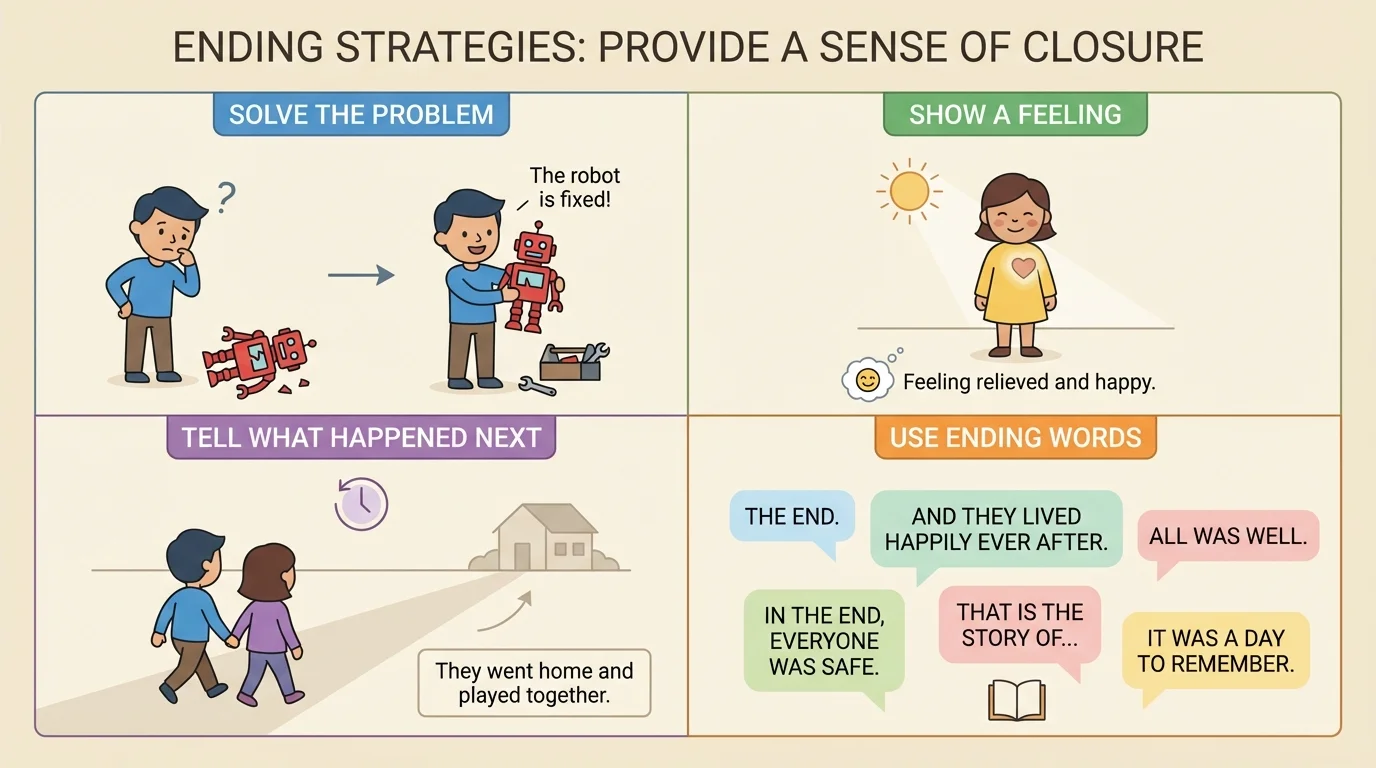
Writers may also tell what happened next. After the main action ends, one sentence can show what comes after. For example: "From that day on, Carlos checked the gate every afternoon so the puppy could not slip out again." This gives the reader a little look beyond the main event.
Sometimes writers use words that help signal closure, such as finally, at last, in the end, or after that. These words do not create closure all by themselves, but they can help guide the reader toward the ending.
Matching the ending to the story
A funny story may end with laughter. A problem-solving story may end with a solution. A personal story may end with a thought or feeling. The best ending sounds like it belongs to that story and not to a completely different one.
As we saw in [Figure 2], some endings focus on action, and some focus on emotion. Both can work well. A strong writer chooses the one that fits the story best.
Readers can feel the difference between an ending that works and one that does not. A narrative ending is strong when it makes sense, connects to the story, and feels finished. A weak ending may stop too suddenly, add something unrelated, or leave out an important result.
[Figure 3] Look at this weak ending: "Jay looked everywhere for his lost dog. He ran to the park and called her name. Then it was dinner time." This ending stops, but it does not really close the story. We still wonder about the dog.
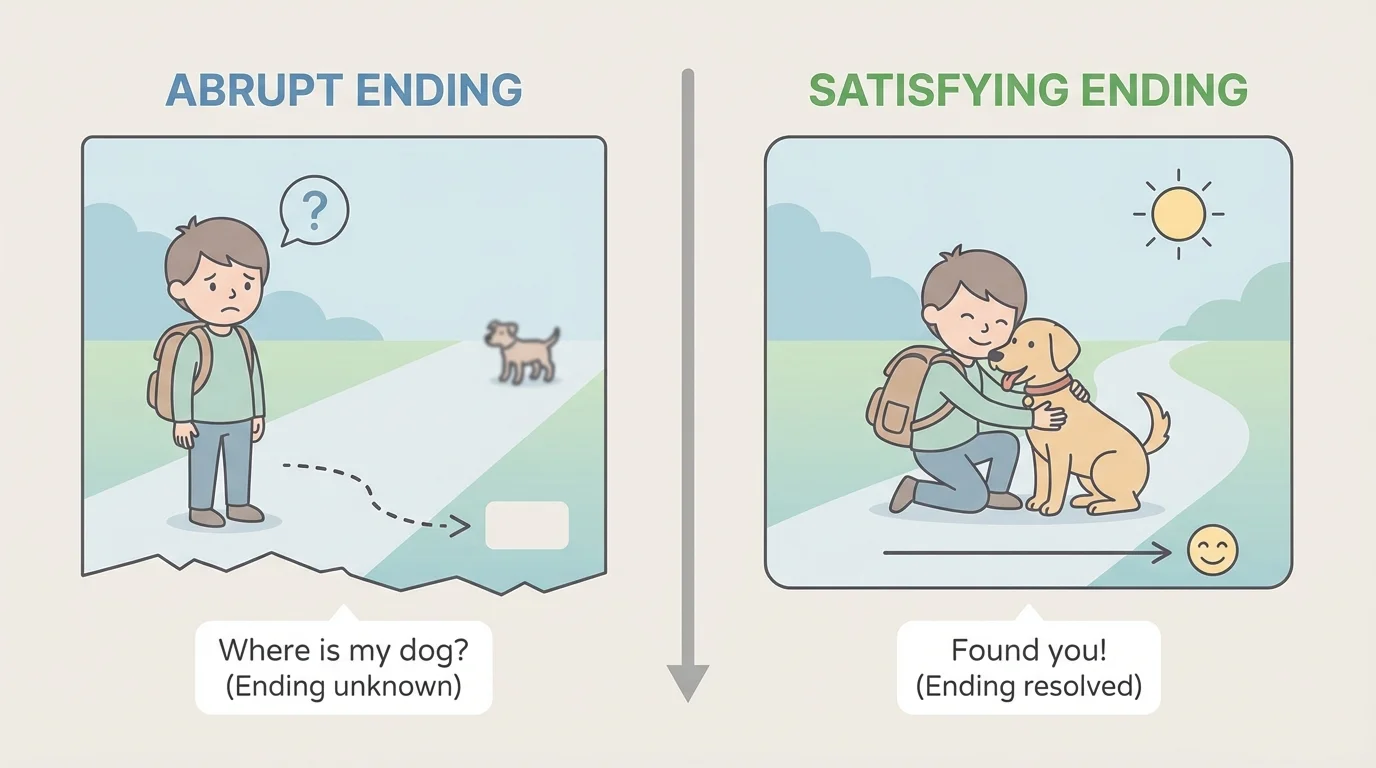
Now look at this stronger ending: "Jay looked everywhere for his lost dog. At last, he heard her bark near the swings. He hugged her tight and walked home smiling." This ending gives closure because the main problem is solved.
A strong ending does not need to tell every tiny detail. It only needs to finish the important part. In the dog story, we do not need to know what Jay ate for dinner or what color his socks were. We need to know what happened with the dog.
Later, when you check your own writing, think back to the comparison in [Figure 3]. Ask yourself whether your story truly ends or just stops.
| Type of ending | What it does | How it feels to the reader |
|---|---|---|
| Strong ending | Solves, explains, or completes the main event | Finished and satisfying |
| Weak ending | Stops suddenly or adds unrelated details | Confusing or incomplete |
Table 1. Comparison of strong and weak story endings.
Here are some examples of how closure can sound in short stories.
Example 1: A real-life narrative
Beginning: I was nervous before my first swim lesson.
Middle: I held the wall, kicked my feet, and listened to the teacher.
Ending: "By the time the lesson ended, I could float by myself. I could not wait to come back next week."
This ending shows what changed and how the writer feels.
Notice that the ending connects to the fear from the beginning. The writer started out nervous and ended up proud and excited. That change gives the story shape.
Example 2: An imagined narrative
Beginning: Luca built a tiny boat from bark and leaves.
Middle: The boat tipped over in the stream, and Luca chased it along the bank.
Ending: "Finally, the little boat spun into a shallow puddle. Luca picked it up, laughed, and decided to build an even better one."
This ending solves the problem and shows what happens next.
The word finally helps lead into the closing moment, but the real closure comes from Luca finding the boat and making a new plan.
Example 3: A classroom story
Beginning: Ana forgot her show-and-tell item at home.
Middle: She felt upset and did not know what to share.
Ending: "Then Ana told the class about her pet turtle from memory. When her teacher smiled and the class asked questions, Ana knew everything had turned out all right."
This ending shows the result and the character's feeling.
These examples are different, but each one closes the main event. That is what makes them satisfying.
When you write your own story, your closing sentence or closing sentences should sound natural. They should fit the voice of the story. A closing sentence can tell the result, show an emotion, or tell what the character learned.
Some helpful ways to think about a final sentence are: What happened at the end? How did the character feel? What changed from the beginning? What does the reader need to know before the story is finished?
For example, if your story is about building a snow fort with a friend, you might end with: "As the sun began to set, we stepped back and grinned at our snowy castle." That ending gives a picture of the last moment and the feeling of success.
Many favorite picture books have endings that feel simple, but those endings are carefully chosen. One short sentence can make the whole story feel complete.
You do not need a giant surprise at the end of every story. Quiet endings can be strong too. A story about planting a garden may end with a small green sprout. A story about making a new friend may end with two children sitting together at lunch. Small moments can give big closure.
Real stories and imagined stories can both have closure. In a true story, the ending should match what really happened. In a made-up story, the ending should still make sense with the events and characters.
Sometimes the ending is happy. Sometimes it is thoughtful. Sometimes it is funny. What matters most is that the reader understands the story is complete. The ending should respond to the story's main events, not ignore them.
If a character spends the whole story trying to fix a kite, closure might come when the kite finally flies, when the character decides to try again tomorrow, or when a friend helps with the repair. Each ending is different, but each one connects to the main event.
When you look back at the sequence from [Figure 1], you can see why closure depends on what came before. The ending grows from the beginning and the middle. It is the last step in the story path.
Good writers help readers leave the story feeling ready to say, "Now I know what happened." That is the power of closure.
