Have you ever finished reading and then someone asks, "What was it about?" Sometimes that sounds easy, but strong readers do more than name one tiny part. They figure out the big idea of the whole text and pick the details that matter most. That is like being a reading detective: you notice the biggest clue, not just every little thing.
When we read, we want to understand what the text is mostly about. In an article, that big idea is often called the main topic. In a story, it is often called the central idea. Both help us answer the question, "What is this text mostly teaching me or showing me?"
A text also has important facts, events, or ideas that help explain the big idea. These are called key details. Key details are not just any details. They are the details that help the reader understand the main topic or central idea.
Main topic is the subject of an informational text, or what the text is mostly about.
Central idea is the big idea or message a story or literary text shows.
Retell means to tell the important parts again, usually in order.
Summarize means to give a short version using only the most important ideas.
Sometimes readers think the biggest or funniest detail is the main idea. But one detail is not the same as the whole text. If a story has a funny dog in one scene, the story may not really be "about a dog joke." We have to think bigger.
In nonfiction, the main topic is the subject the author teaches about. One topic can connect to several important details, as [Figure 1] shows. If an article is about bees, the text may tell where bees live, what bees do, and why bees are important.
Read this short example: "Bees live in hives. They collect nectar from flowers. Bees help plants make seeds." The main topic is bees. The key details are that bees live in hives, collect nectar, and help plants.
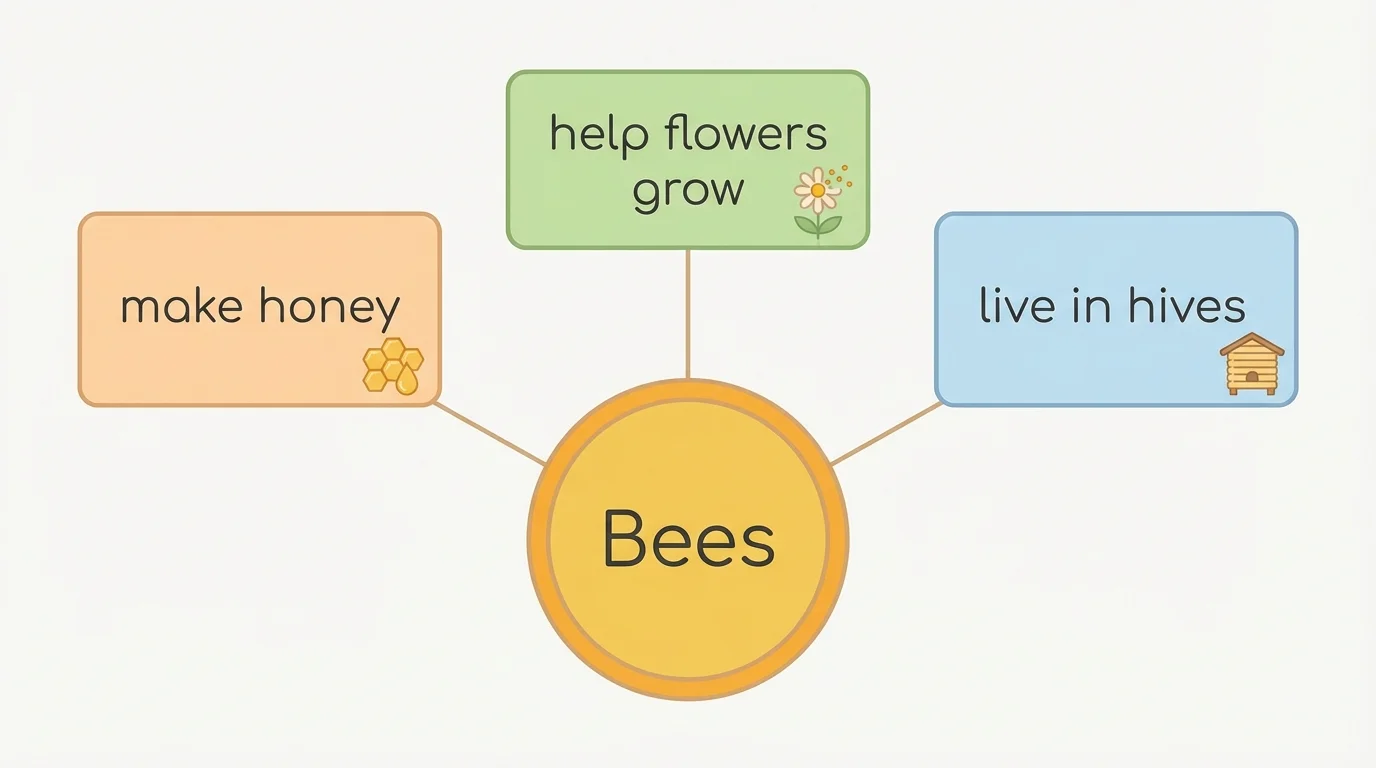
Notice that the details all fit together. They all teach us about bees. If the text also said, "One beekeeper wears red boots," that might be interesting, but it would probably not be a key detail unless the whole article was about the beekeeper.
Many informational texts are about animals, weather, places, inventions, or people from history. To find the main topic, ask, What subject keeps showing up? Then ask, Which details teach me more about that subject?
Example: Finding the main topic in an article
Text: "Penguins cannot fly. They use their wings to swim. Penguins live in cold places."
Step 1: Look for the subject that appears again and again.
The repeated subject is penguins.
Step 2: Choose details that teach about that subject.
The text tells that penguins cannot fly, use wings to swim, and live in cold places.
Step 3: State the main topic.
The main topic is penguins.
This kind of reading helps in science, social studies, and even directions for making something. We do not just collect facts. We organize them around the topic.
Stories work a little differently. As [Figure 2] illustrates, in a story, the central idea is what the story is mostly about or the big thought the events show. It is not always just the name of the character.
Think about this story: "Lena planted a seed. A storm washed it away. She planted another seed and cared for it every day. Soon a flower grew." The central idea might be not giving up or working patiently helps things grow.
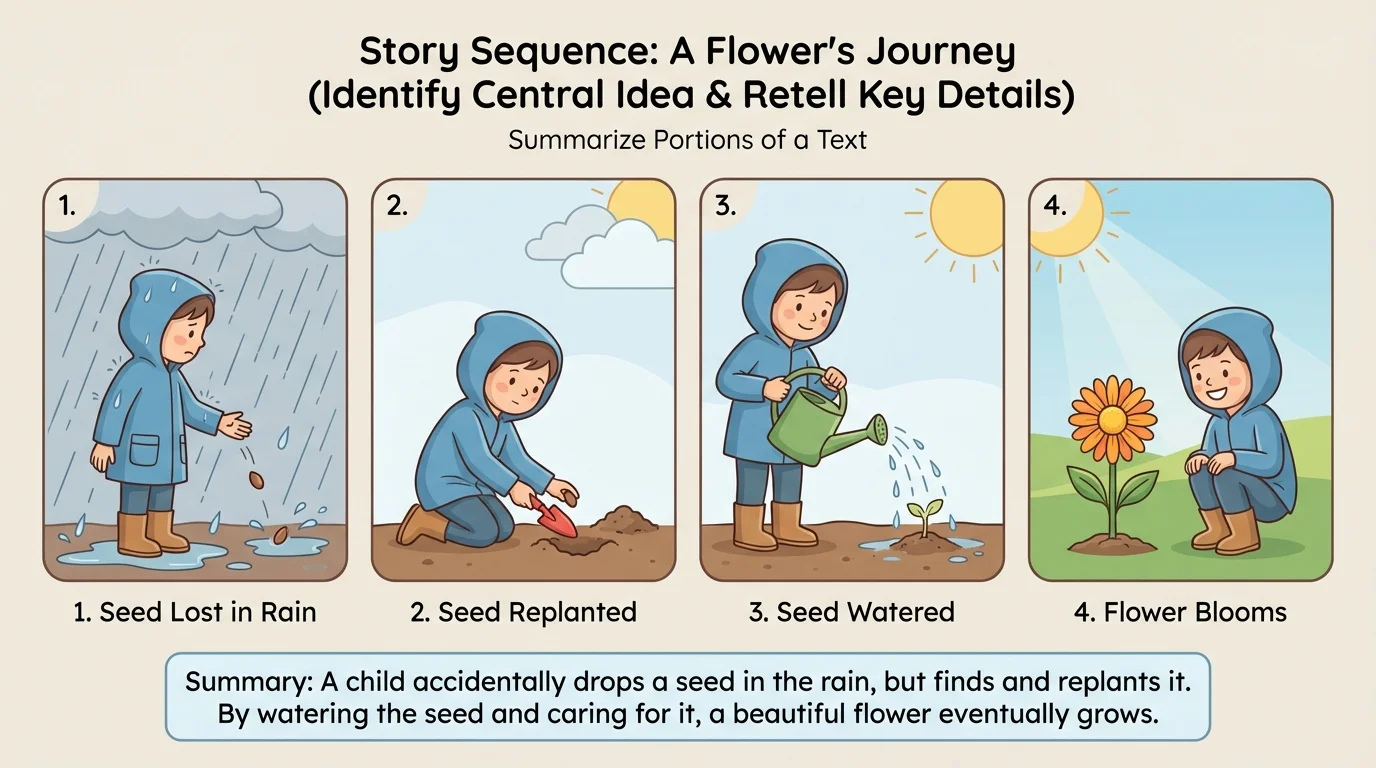
The key details are the events that support that idea: Lena planted the seed, lost it in the storm, tried again, and kept caring for the plant. Those details help us understand what the story is really showing.
In stories, the central idea can be about friendship, courage, kindness, patience, honesty, or solving a problem. We figure it out by thinking about the characters, the problem, and what happens in the end.
As we saw in [Figure 2], each event in a story can push the reader toward a bigger understanding. One event alone is not enough. The events work together.
Key details are the strongest helpers in a text. They answer questions such as who, what, where, when, why, and how. They tell facts in nonfiction and important events in stories.
Not every detail is a key detail. Some details are small. Some are interesting but not necessary. A key detail helps the reader understand the whole text better.
How to test a detail
Ask yourself, "If I leave this detail out, will I still understand what the text is mostly about?" If the answer is yes, it may be a small detail. If leaving it out makes the text much harder to understand, it is probably a key detail.
For example, in a text about frogs, "Frogs begin life as tadpoles" is likely a key detail. "One frog sat on a shiny rock" is probably not, unless the whole text is about that moment.
In the bees article from [Figure 1], details like "live in hives" and "help plants" support the whole topic. They are much stronger than a random small fact that only appears once.
When you retell, you tell back the important parts of a text. A good retell includes the main topic or central idea and the key details. In stories, a retell often goes in order: beginning, middle, end.
For an informational text, a retell might sound like this: "This article is about butterflies. It explains that butterflies start as caterpillars, change inside a chrysalis, and come out with wings." That tells the big topic and the important facts.
For a story, a retell might sound like this: "At the beginning, Max lost his library book. In the middle, he looked for it everywhere and asked for help. At the end, he found it under his bed and returned it." That is much stronger than saying, "It was about a book."
Example: Retelling a story
Story: "Nina forgot her lunch. Her friend shared with her. Nina thanked her and shared a snack the next day."
Step 1: Name what the story is mostly about.
The story is mostly about kindness and sharing.
Step 2: Tell the important events in order.
Nina forgot her lunch. Her friend shared. Nina was thankful and shared later.
Step 3: Put it together in a retell.
"Nina forgot her lunch, so her friend shared. Nina appreciated the kindness and shared a snack the next day."
A retell should not include every single tiny detail. It should include the important ones. That is how a reader shows real understanding.
Sometimes you do not summarize the whole text. You might summarize one paragraph, one page, or one part of a chapter. A summary is shorter than a retell. It keeps only the most important ideas.
If a paragraph says, "Clouds form when tiny drops of water gather in the sky. When the drops grow heavy, rain can fall," a summary could be: Clouds form from water drops, and heavy drops can fall as rain.
That summary is shorter, but it keeps the meaning. It does not copy every word. It also does not add opinions like "Rain is fun" unless the text says that.
Remember that good readers can ask, "What matters most here?" That question helps with both retelling and summarizing.
When you summarize part of a story, think about the most important event in that section. When you summarize part of an article, think about the most important fact or explanation in that section.
Readers do not guess the big idea from nowhere. They use clues from the text, as [Figure 3] shows. Titles, headings, repeated words, pictures, and captions all help us figure out what matters most.
A title gives a big clue. If the title is How Seeds Travel, the text is probably about ways seeds move from place to place. Headings can also tell what a section is about, such as "By Wind" or "By Animals."
Repeated words matter too. If a text keeps using the words habitat, forest, and animals, those words may point to the main topic. The first and last sentences in a paragraph can also be helpful because authors often place important ideas there.
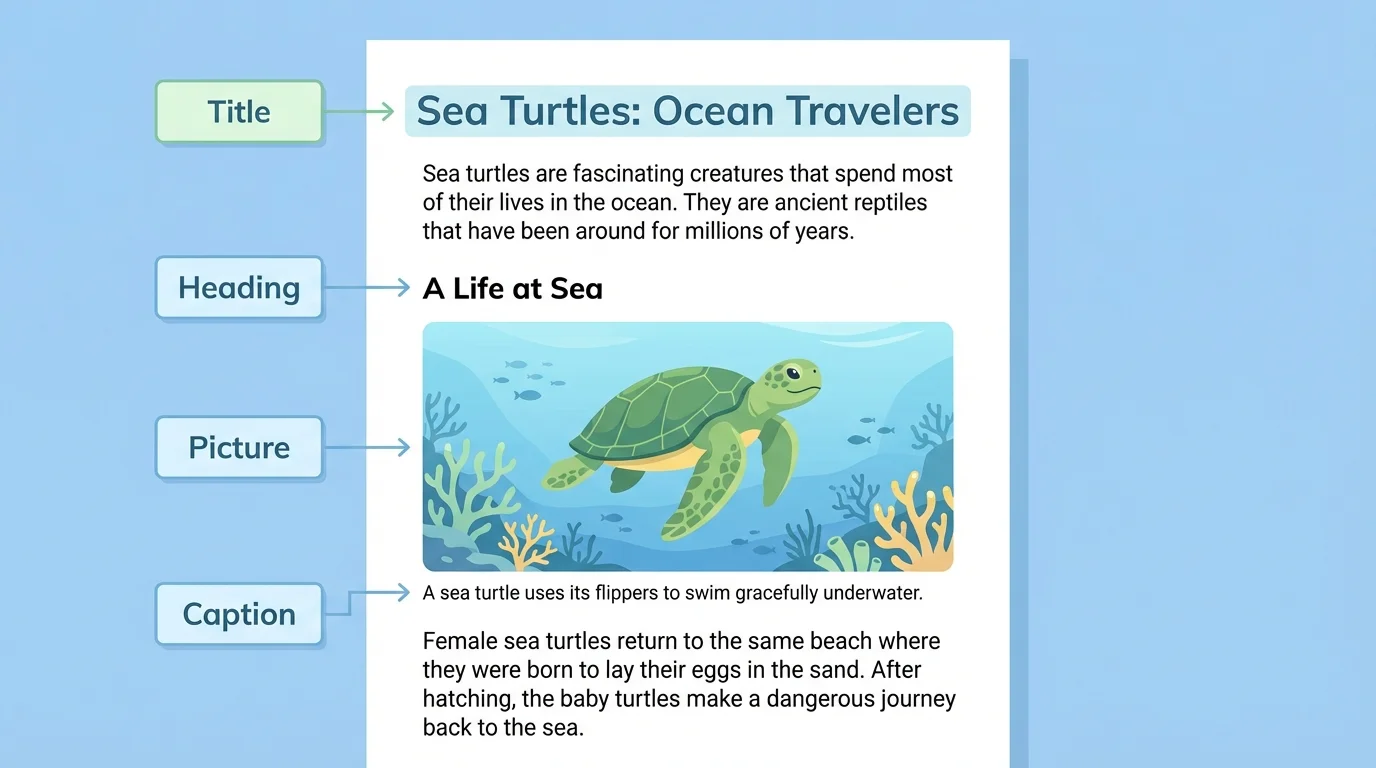
Pictures and captions are not only decorations. They can support understanding. A picture of a desert plant beside a paragraph about saving water helps the reader connect ideas. The page features work together to guide the reader toward the big idea.
| Text clue | How it helps |
|---|---|
| Title | Tells the big subject quickly |
| Heading | Shows what one section is about |
| Repeated words | Point to important ideas |
| Picture | Gives visual support for the text |
| Caption | Explains the picture and adds information |
Table 1. Common text clues that help readers find the big idea and supporting details.
Informational texts and literary texts are not exactly the same, but readers use similar thinking in both. In informational text, ask, What subject is this teaching about? In literary text, ask, What bigger idea do the characters and events show?
For example, in an article about the moon, the main topic may be facts about the moon. In a story about a child who keeps practicing the guitar, the central idea may be practice helps you improve.
Some books mix both kinds of reading. A story about an animal can entertain you, but it may also teach real facts. Strong readers can notice both the story events and the information.
That is why careful readers stay flexible. They look at what kind of text they are reading and choose the best way to find the big idea.
One common mistake is choosing a favorite detail instead of an important one. A detail can be silly, exciting, or surprising, but still not be a key detail.
Another mistake is making the topic too small or too big. If a passage is about how turtles hatch from eggs, the topic is probably not just animals, because that is too broad. It is also probably not sand on one beach, because that may be too small.
Readers should also be careful not to add their own ideas. A summary tells what the text says, not what the reader wishes it said.
Let's look at two quick examples. Nonfiction: "Bats sleep during the day. They come out at night. Many bats eat insects." The main topic is bats. The key details explain when they sleep, when they are active, and what many eat.
Story: "Omar was nervous about reading aloud. He practiced at home and tried in class. After he finished, he felt proud." The central idea is practice can build confidence. The key details are that Omar was nervous, practiced, and then felt proud after trying.
Example: From details to summary
Text: "Mia and her dad built a bird feeder. They filled it with seeds and hung it outside. Soon, small birds came to eat."
Step 1: Find what the text is mostly about.
It is mostly about making and using a bird feeder.
Step 2: Pick the key details.
Mia and her dad built the feeder, filled it with seeds, and birds came to it.
Step 3: Make a short summary.
"Mia and her dad made a bird feeder, put seeds in it, and birds visited it."
When readers can identify the big idea, tell key details, retell important parts, and summarize shorter sections, they understand texts more deeply. Those are powerful reading skills for every subject.
