Have you ever heard a song that made you tap your foot right away? Or a poem that sounded so smooth you wanted to say it again? Writers do that on purpose. They choose words that sound good together, and those sounds help tell us how a text should feel. A quiet poem may sound soft and slow. A happy song may sound bouncy and bright. The sounds of words are not just decoration. They help create meaning, as you can see in [Figure 1].
When we read a poem or hear a song, we can often hear a rhythm. Rhythm is the beat or flow of words. It is what makes some lines sound quick, slow, jumpy, gentle, or strong. In songs, the beat is very easy to hear. In poems and stories, the beat may come from how the words are arranged and how they sound when we read them aloud.
Writers can make a regular beat by using a pattern that repeats. Listen to this line: Tap, tap, tiptoe, tap. The words sound like tiny footsteps. The beat is steady. Now listen to this one: Boom! I run through the rain! This sounds louder and faster. The rhythm changes how the line feels.
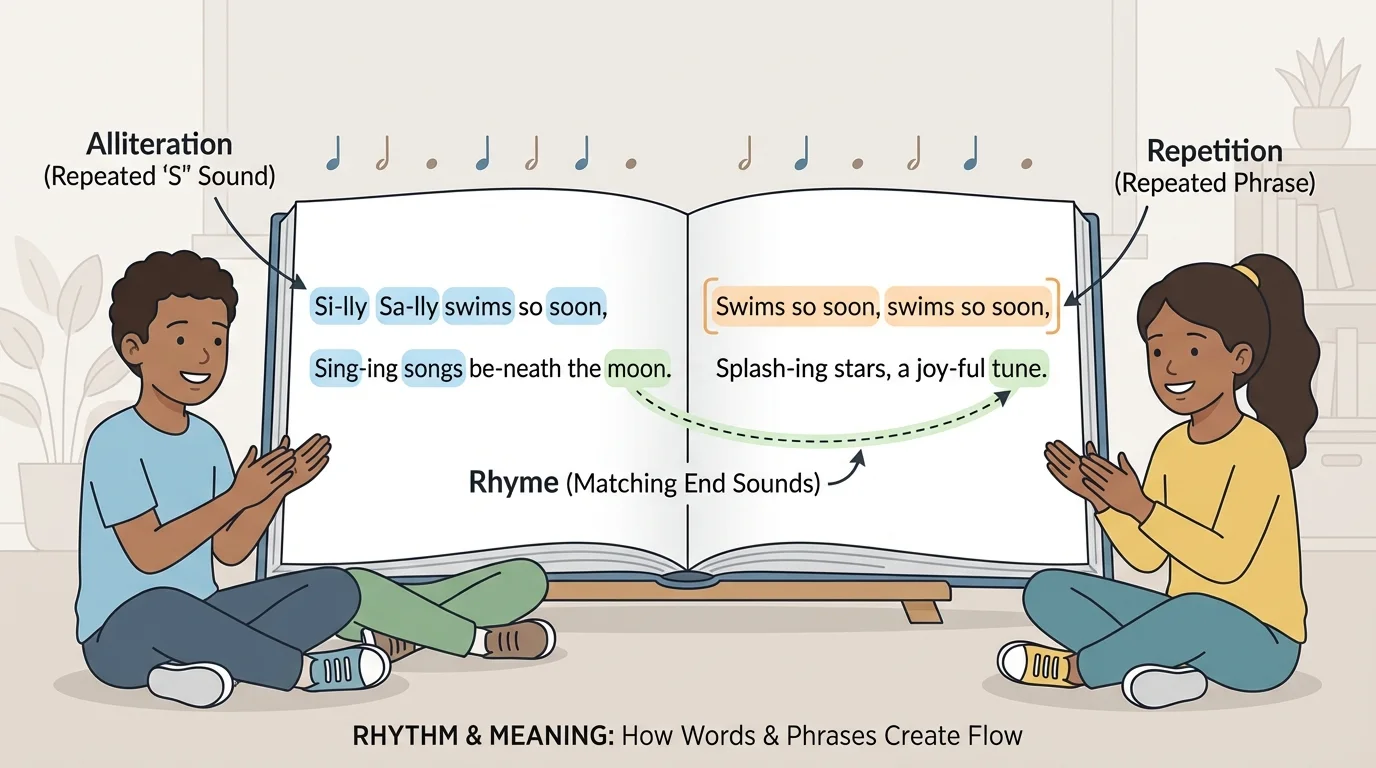
Rhythm can help a reader know how to say the words. If the rhythm is smooth and even, the text may sound calm. If the rhythm is quick and sharp, it may sound exciting. In a story, a writer may use short, punchy words during an action scene. In a lullaby, the writer may use soft, repeating words to sound peaceful.
Rhythm is the beat or flow we hear in words. Regular beat means the pattern sounds steady again and again. Rhyme happens when words have the same or nearly the same ending sound. Alliteration happens when nearby words begin with the same sound. Repeated lines are lines that come again in a poem or song.
Even in a storybook, rhythm matters. As shown in [Figure 2], sound patterns can make certain words stand out. Read these two sentences aloud: The big brown bear bumped the box. Then read: The bear went to the box. Both tell us something similar, but the first sentence has a stronger sound. It feels more lively because of its word choices.
Some words fit together in special ways, and they can help us notice two important sound patterns. One pattern is alliteration. Alliteration happens when words close together begin with the same sound. For example: slippery snakes slide or busy bees buzz. These phrases are fun to say because the beginning sounds repeat.
Another pattern is rhyme. Rhyming words have the same ending sound, like cat and hat, or play and day. Rhymes make lines sound connected. They can make poems and songs easier to remember.
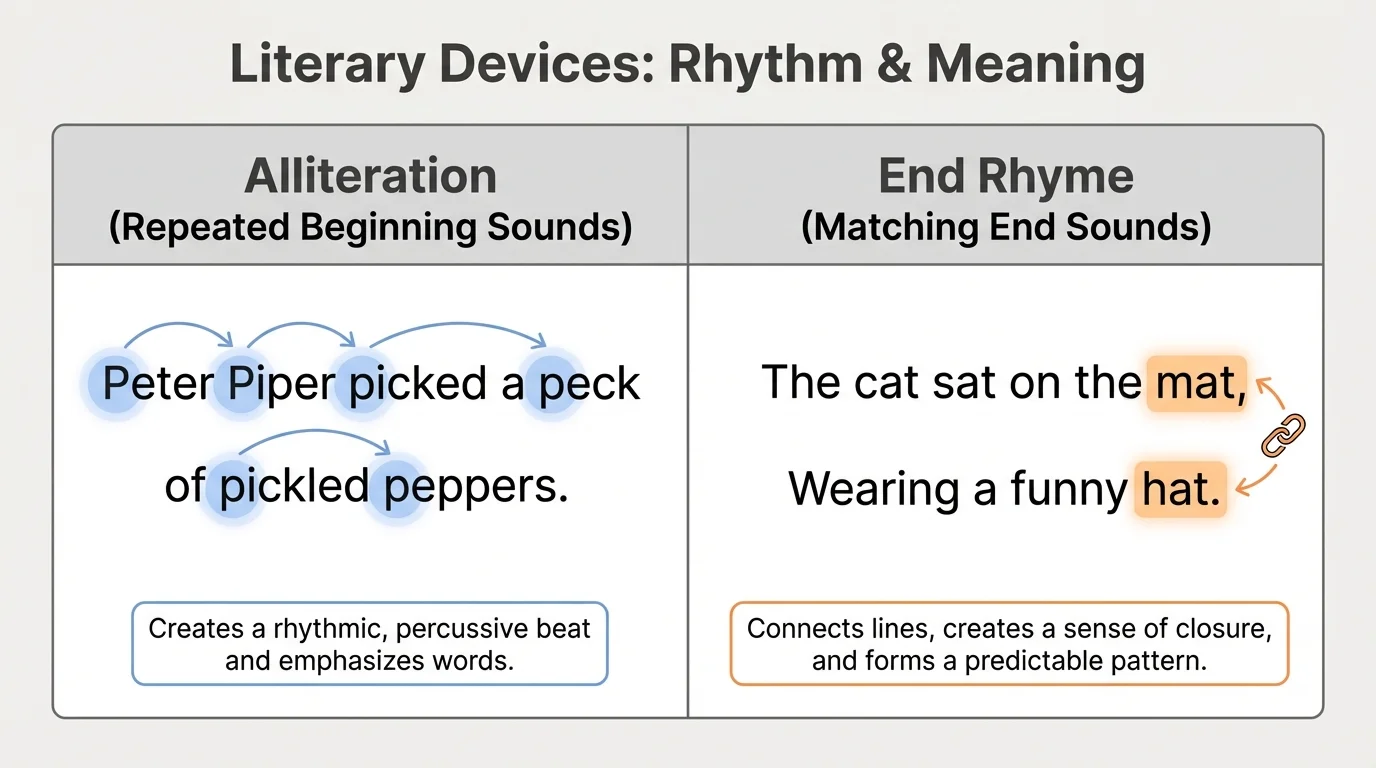
Alliteration often adds energy, silliness, or emphasis. If a writer says, Peter picked purple plums, the repeated beginning sound makes the phrase playful. It also pulls our attention to those words. The writer wants us to hear them clearly.
Rhymes can also help show meaning. Read these lines: The moon is bright tonight. / It fills the dark with silver light. The rhyming words tonight and light make the lines feel neat and complete. The rhyme helps the lines sound peaceful and connected. It also helps us remember the image of the glowing moon.
Many nursery rhymes stay in our minds for years because their rhymes and rhythms are easy for our brains to remember. Sound helps memory.
Alliteration and rhyme do not only make texts sound nice. They can also point to important ideas. If the same sound repeats in a funny part of a story, it can make the scene feel more playful. If rhyming words appear at the end of lines in a song, they can make the message feel strong and finished.
Writers also use repetition. Repetition means using a word, phrase, or line again. In songs, this often happens in the chorus. In poems, a repeated line may return at the end of each part. In stories, a phrase may appear again and again when it is important.
As shown in [Figure 3], repeated lines can stand out clearly in a poem. Look at this example: I hear the rain, drip-drop, drip-drop. The repeated phrase drip-drop sounds like falling water. It also helps us picture and hear the rain. Now read this: We will try again, we will try again. Repeating the line makes the idea of not giving up feel important.
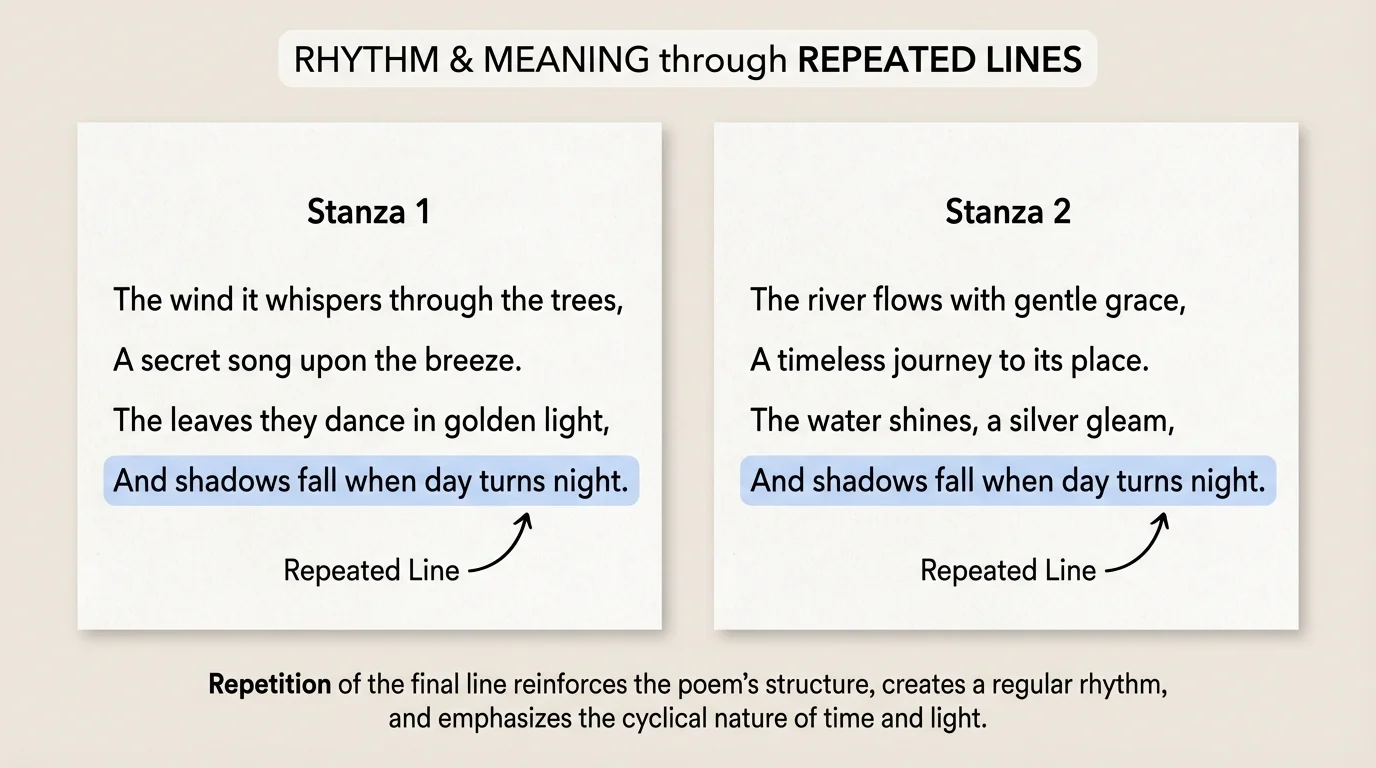
A repeated line can make readers stop and think, "This matters." In a song, the chorus is often repeated because it holds the main message. In a poem, a repeated line can bring back a feeling. In a story, repeated words may show a character's emotion, such as excitement, fear, or hope.
Example: How repetition changes meaning
Read these two versions.
Step 1: Without repetition
The wind blew through the trees.
Step 2: With repetition
The wind blew, blew through the trees.
Step 3: Notice the difference
The repeated word blew makes the wind feel stronger and longer. We can almost hear it.
Repetition can also help readers join in. That is one reason repeated parts are common in songs and chants. People can remember them quickly and say them together.
Words and phrases do more than create sound. They help create meaning. Meaning is the idea, feeling, or message a text gives us. Sound patterns can help us know if something is funny, sad, calm, exciting, spooky, or joyful.
Suppose a poem says, Crash, bang, boom! These sharp sounds feel loud and sudden. They help create excitement or surprise. Now think about: Hush now, little leaves. The soft sounds make the line feel gentle and quiet. The author chooses these sounds to match the feeling.
Alliteration, rhyme, rhythm, and repeated lines all work together. As we saw earlier in [Figure 1], a steady beat can make words feel calm or strong. As we noticed in [Figure 2], repeated sounds at the beginnings or ends of words can make lines catchy. And as shown in [Figure 3], repeating a line can shine a bright light on the big idea.
Sound and meaning work as a team
When authors choose words, they think about both what the words say and how the words sound. A line can tell us about rain, but it can also sound like rain. A song can tell us to be brave, but the repeated chorus can make that message feel powerful and easy to remember.
This is why reading aloud is so helpful. When you read with your ears as well as your eyes, you can hear the writer's craft. You notice the beat, the repeated sounds, and the lines that return. Those choices help you understand the text better.
These sound tools can appear in a poem, a song, or a story. In poems, rhythm and rhyme often stand out clearly. In songs, the beat and repeated chorus are especially important. In stories, writers may use alliteration or repetition in small parts to make a scene more vivid.
For example, a story might say, The tiny turtle tiptoed toward the tulips. That alliteration makes the sentence playful. A poem might say, Star so bright in the night. The rhyme makes it musical. A song might repeat, Shine on, shine on, so listeners remember the main idea.
| Text Type | Sound Feature | What It Can Do |
|---|---|---|
| Story | Alliteration or repetition | Makes a scene stand out |
| Poem | Rhythm and rhyme | Creates musical flow |
| Song | Beat and repeated lines | Helps listeners remember the message |
Table 1. How sound features can work in stories, poems, and songs.
Even when the text types are different, the idea is the same: writers choose words carefully. They want the text to sound right and feel right at the same time.
Good readers notice not only what words mean, but also how they sound. When you hear a regular beat, ask yourself what mood it creates. When you hear rhyme, think about why those lines belong together. When you hear alliteration, notice which words the author wants you to remember. When a line repeats, ask why it is so important.
Here are helpful questions readers can think about: Which words sound alike? Which line comes back again? Does the text sound calm, exciting, funny, or serious? How do the sounds help me understand the message?
Authors make choices on purpose. Earlier reading skills taught you to notice characters, setting, and events. Now you also pay attention to how the author's word choices sound, because sound helps build the whole text.
When readers listen closely, they discover that words can almost act like music. A story can rumble, a poem can dance, and a song can glow with repeated sound. That is the power of craft in language.
