Have you ever looked at directions for building a toy, planting a seed, or using a machine and thought, "The picture helps me understand it"? That is because in informational reading, images are not just there to look nice. They often teach us something important. A skilled reader pays attention to the words and the pictures.
An informational text is a text that gives true facts and teaches about the real world. It might be about animals, weather, machines, space, maps, or how to make something. You can find informational texts in books, magazines, signs, directions, and websites.
When authors write informational texts, they want readers to learn. That is why they often include text features such as headings, captions, labels, and pictures. These features help explain the ideas in a clear way.
Image means a picture, diagram, chart, map, or other visual that gives information. In informational texts, an image helps the reader understand the topic better.
Caption is a short piece of text that tells about an image.
Label is a word or short phrase that names a part of a picture or diagram.
Some images show what something looks like. Other images show how something works, how parts fit together, or what happens first, next, and last.
Informational texts use many kinds of visuals, as [Figure 1] shows. A reader may see a photograph, a drawing, a map, a chart, or a labeled diagram. Each kind helps in a different way.
A diagram is a drawing that explains something. It often has labels and arrows. A diagram can show the inside of a machine, the parts of a plant, or the steps in a process.
A chart organizes information so it is easy to compare. A map shows where places are. A labeled picture points out important parts. A photo can help you see what a real object, animal, or place looks like.
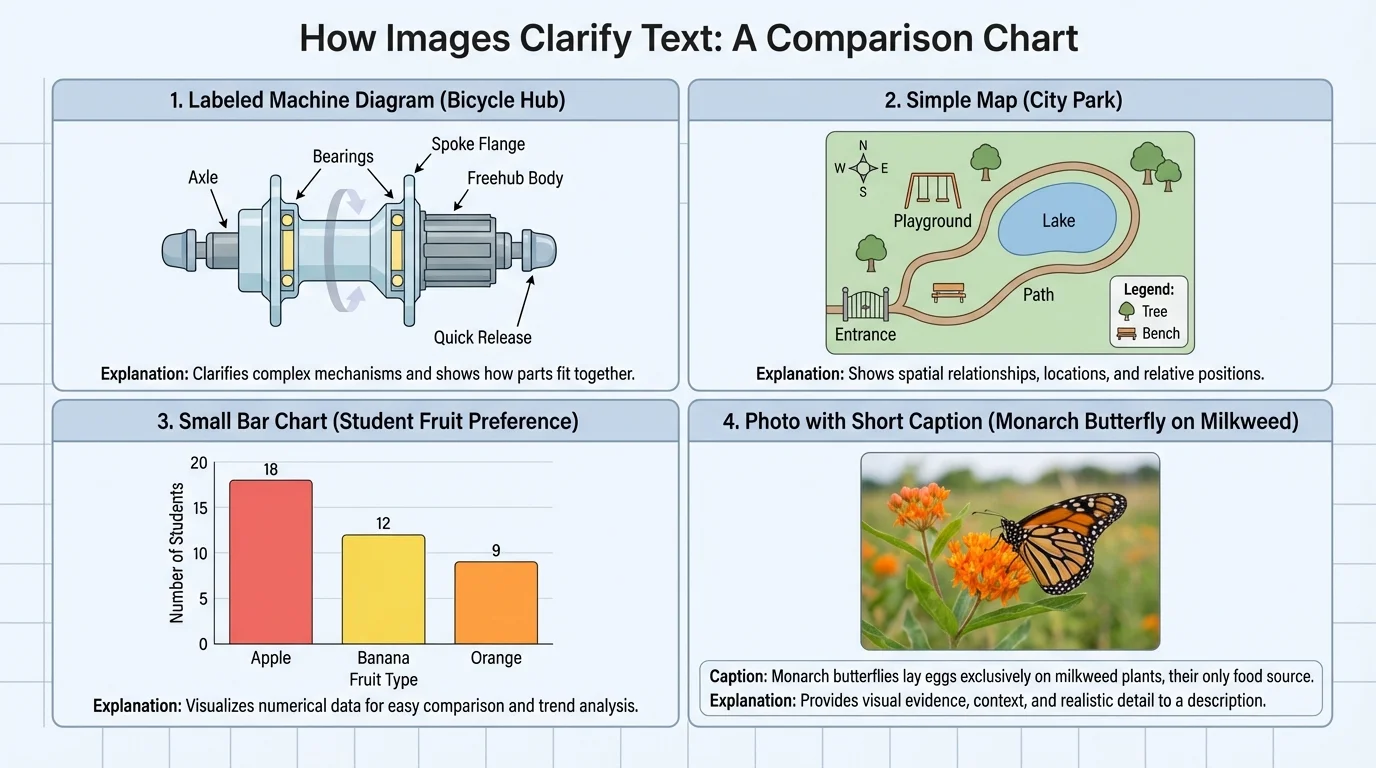
When you look at an image, ask, "What is this helping me learn?" If you can answer that question, you are using the image the way a strong reader does.
Sometimes the words in a text tell one part of the story, and the image tells another part. The text may say that a machine has a handle, a tube, and a wheel. The image may show exactly where each part is.
Images can make hard ideas easier. If a text says air moves through a tube, that may sound confusing at first. But when a diagram shows arrows inside the tube, the movement becomes clearer.
Images can also save words. Instead of writing a very long description, an author can use a labeled picture to show the size, shape, order, or parts of something quickly and clearly.
Words and images work as a team. The words explain with sentences. The image explains with shape, space, labels, and sometimes arrows. When readers use both, they understand more than they would from only one.
This is why good readers do not skip over images. They stop, look closely, and connect the image to what they are reading.
When you read informational text, move back and forth between the words and the image. Read a sentence, then check the picture. Look at the picture, then go back to the text. This helps your brain put the information together.
Suppose a book says, "The roots grow underground and take in water." A labeled picture of a plant helps you find the roots. Then the sentence makes even more sense because now you know exactly which part the text means.
If there is a caption, read it. Captions are important because they often tell what the image is showing. Without the caption, you might miss part of the meaning.
Many adults use images this way too. Cooks read recipes with photos, mechanics study diagrams, and builders follow drawings to put things together correctly.
That means learning to read images is a real-world reading skill, not just a school skill.
A machine diagram is one of the best examples of an image that explains a text. In a nonfiction book about tools, a bicycle pump diagram, as [Figure 2] shows, can help readers understand both the parts and the action of the pump.
The text might say, "When you pull up the handle, air enters the pump. When you push down, air moves through the tube into the tire." Those words tell what happens, but a diagram makes the action easier to follow.
In the diagram, labels name the handle, tube, and hose. Arrows show the direction the air moves. A reader can see that the handle goes up and down, and the air moves from one place to another. Now the machine does not feel mysterious. The image clarifies the text by making the movement visible.
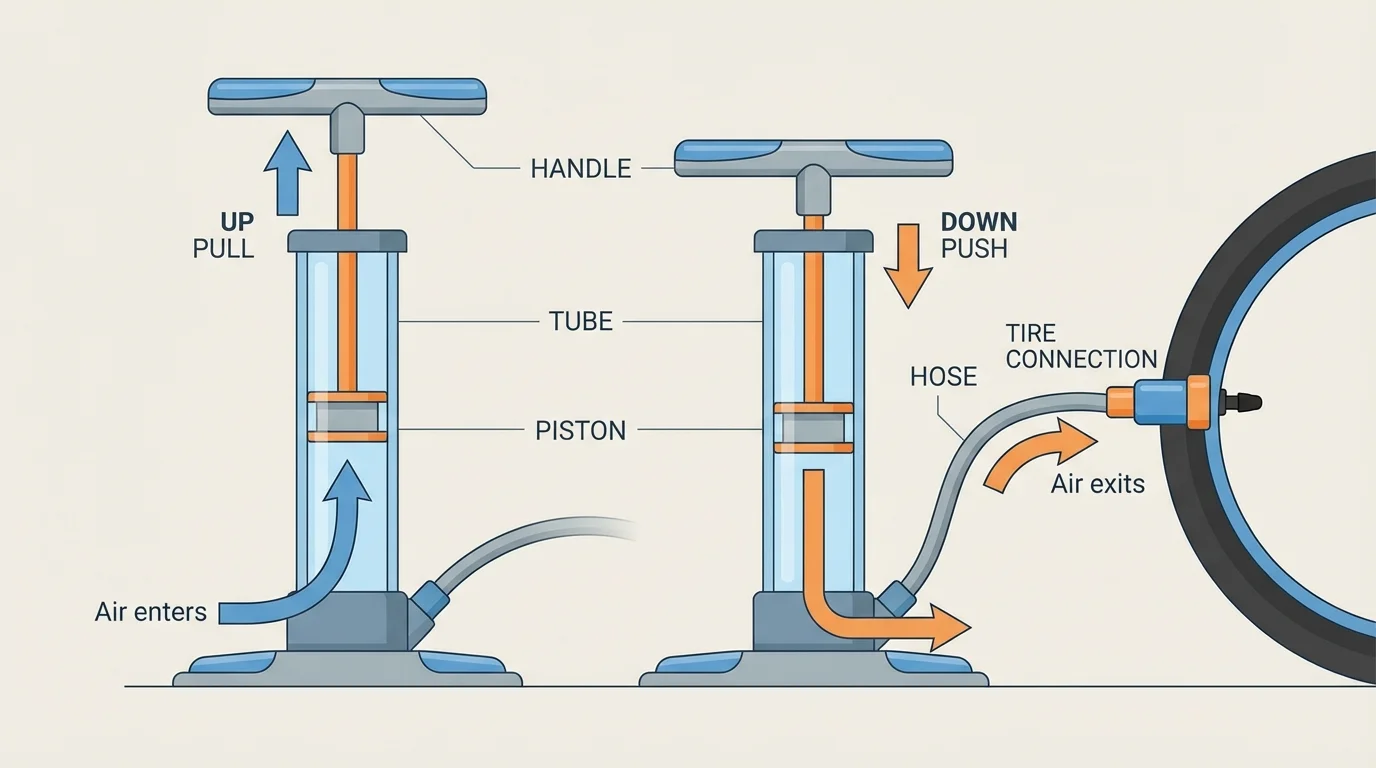
If a reader only read the words, the process might seem hard to picture. If the reader only saw the image, the reason for the movement might be unclear. Together, the words and diagram explain the machine much better.
Using a diagram with text
Text: "The lever lifts the lid when the button is pressed."
Step 1: Read the sentence carefully.
The sentence tells that one part, the button, causes another part, the lever, to move.
Step 2: Study the picture.
The diagram labels the button, lever, and lid. An arrow points from the button to the lever and then up to the lid.
Step 3: Put the information together.
The image helps the reader see how pressing the button makes the lid lift.
The diagram clarifies the text because it shows the parts and the motion.
Later, if you read another machine text, you can use the same idea. Look for labels, arrows, and parts that match the words. That same careful reading helps with many kinds of nonfiction.
Not every useful image is a machine diagram. Some images help readers understand order, as [Figure 3] illustrates with a simple growing process. Step-by-step pictures are helpful when a text explains how to do something.
For example, a book about planting might have three pictures: first the seed goes into soil, next the soil gets watered, and then a sprout appears. These pictures help readers understand the sequence, or order, of events.
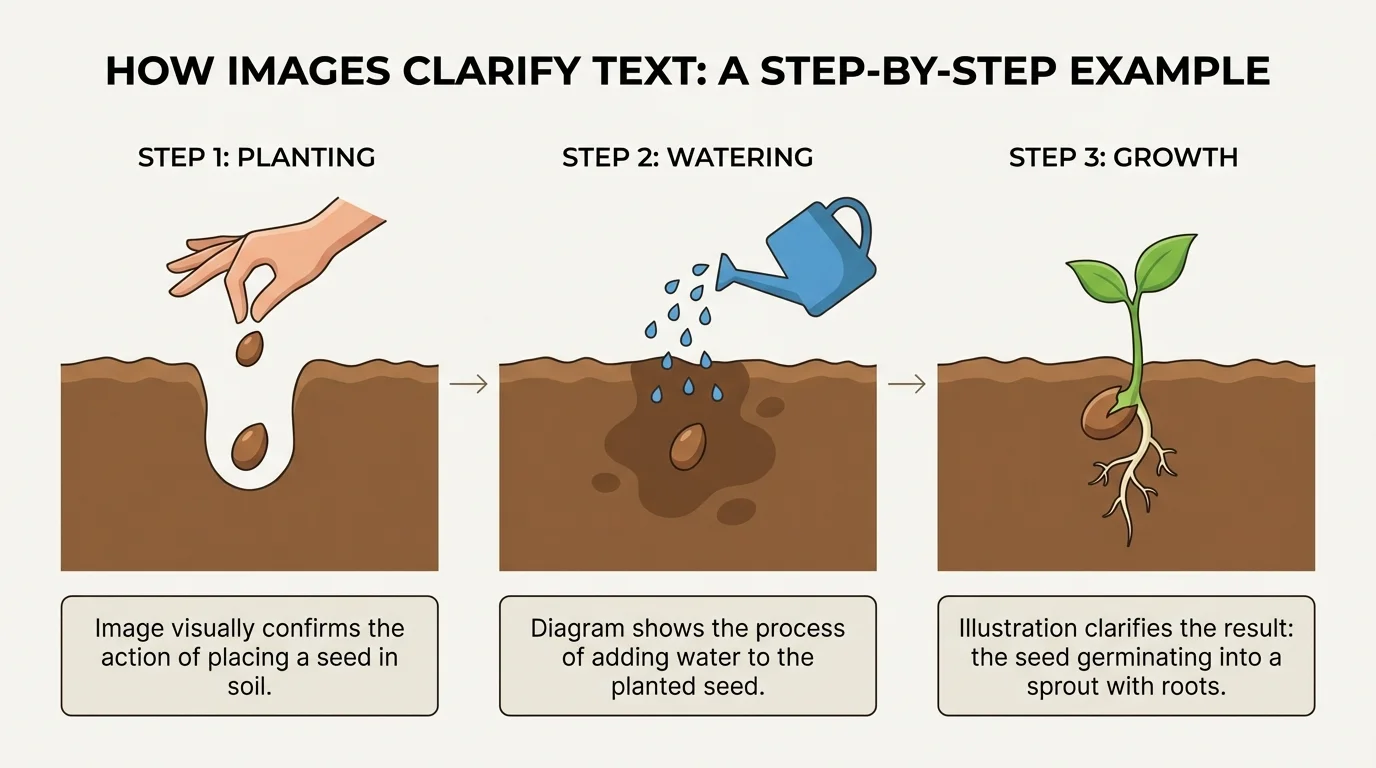
A map helps when the text is about where something is. If a book says a river runs through a state, the map helps you locate it. A chart helps when the text compares things, such as which animal is tallest or which month is rainiest.
As we saw earlier in [Figure 1], different images do different jobs. A map answers "where?" A chart answers "which one?" or "how many?" A diagram often answers "how does it work?"
You can ask yourself a few simple questions while reading. What does this image show that the words do not show by themselves? What part of the text becomes easier because of this image? Does the image show parts, steps, size, or place?
If the image gives new information, then it is helping a lot. For example, a labeled plant picture shows the stem, leaf, flower, and root. That is more exact than just reading "plants have many parts."
If the image repeats the same idea in a clearer way, it is still useful. Clearer understanding is important. A reader does not only gather facts; a reader also makes meaning.
Readers already use clues in stories, like looking at pictures to understand characters and setting. In informational texts, readers do something similar, but they use images to understand facts, parts, steps, and real-world ideas.
One helpful habit is to stop after reading a paragraph and ask, "How did the image help me?" That question trains you to notice what the author wants you to learn.
Sometimes a text has a hard word. Maybe the text says "valve," "tube," or "engine part." If there is a labeled image, you can match the word to the picture. That helps you understand the meaning of the word in the text.
Images also help when a process has several steps. A paragraph about how a pump works may feel confusing at first. But when you look again at the moving arrows in [Figure 2], the steps become easier to follow.
To clarify means to make something easier to understand. A good image clarifies the text by showing what the words mean.
Clarify means to make an idea easier to understand. An image clarifies a text when it removes confusion and helps the reader see the meaning more clearly.
That is why readers should not rush past images. The image may be the key that unlocks a tricky part of the passage.
Images are part of a group called text features. Text features include titles, headings, bold words, labels, captions, diagrams, maps, and charts. These all help organize information for the reader.
When you read nonfiction, notice how the text features work together. A heading tells the topic. A paragraph gives facts. A caption explains the image. Labels point out exact parts. All these features support understanding.
| Text feature | How it helps |
|---|---|
| Heading | Tells what the section is about |
| Caption | Explains the image |
| Label | Names a part |
| Diagram | Shows how something looks or works |
| Map | Shows where a place is |
| Chart | Compares information |
Table 1. Common text features in informational texts and how each one helps the reader.
When you use text features well, you become a stronger nonfiction reader.
One mistake is thinking every picture is just decoration. In informational texts, many images carry important information. If you skip them, you may miss part of the meaning.
Another mistake is looking at the image without reading the words around it. The best understanding comes from using both together. The words explain one part, and the image explains another.
A third mistake is ignoring labels and captions. Small print can be very important. Labels tell what each part is, and captions often explain why the image matters.
Strong readers slow down, notice the image, connect it to the text, and ask how it helps. That is how they understand more deeply.
