Have you ever been in a class discussion where one small idea suddenly helped everyone understand the topic better? That is what happens when students share what they know. A class discussion is not just one person talking; it is a time when many people work together to learn. When you share a fact, an example, or a thoughtful question, you help the whole group deepen its understanding.
A discussion is when people talk together about one subject. To contribute means to give something useful. In a class or small group discussion, you contribute by sharing ideas, facts, examples, or questions that help everyone think more deeply about the topic.
Contributing does not mean talking the most. It means helping the conversation in a useful way. A helpful comment might teach something new, connect to another person's idea, explain a detail, or ask a question that keeps the group thinking.
Contribute knowledge means to share what you know so a group can understand a topic better. This knowledge can be a fact, an observation, an experience, or a thoughtful question.
If the class is discussing butterflies, one student might say, "Butterflies start as caterpillars." Another might add, "They also go through changes inside a chrysalis." A third student might ask, "Why do they need wings at the end?" Each student adds something important. The topic becomes bigger and clearer because many minds are working together.
Good discussion begins with listening. A strong listener pays attention to the speaker, thinks about the words, and waits for the right time to talk. In a group, this helps everyone feel respected, as [Figure 1] shows when one student speaks and others listen carefully.
Listening helps you know what has already been said. If you do not listen, you may repeat the same idea again and again. But when you listen well, you can add something new. You might say, "I want to add on to that," or "I heard Maya say that frogs live near water, and I know they also lay eggs there."
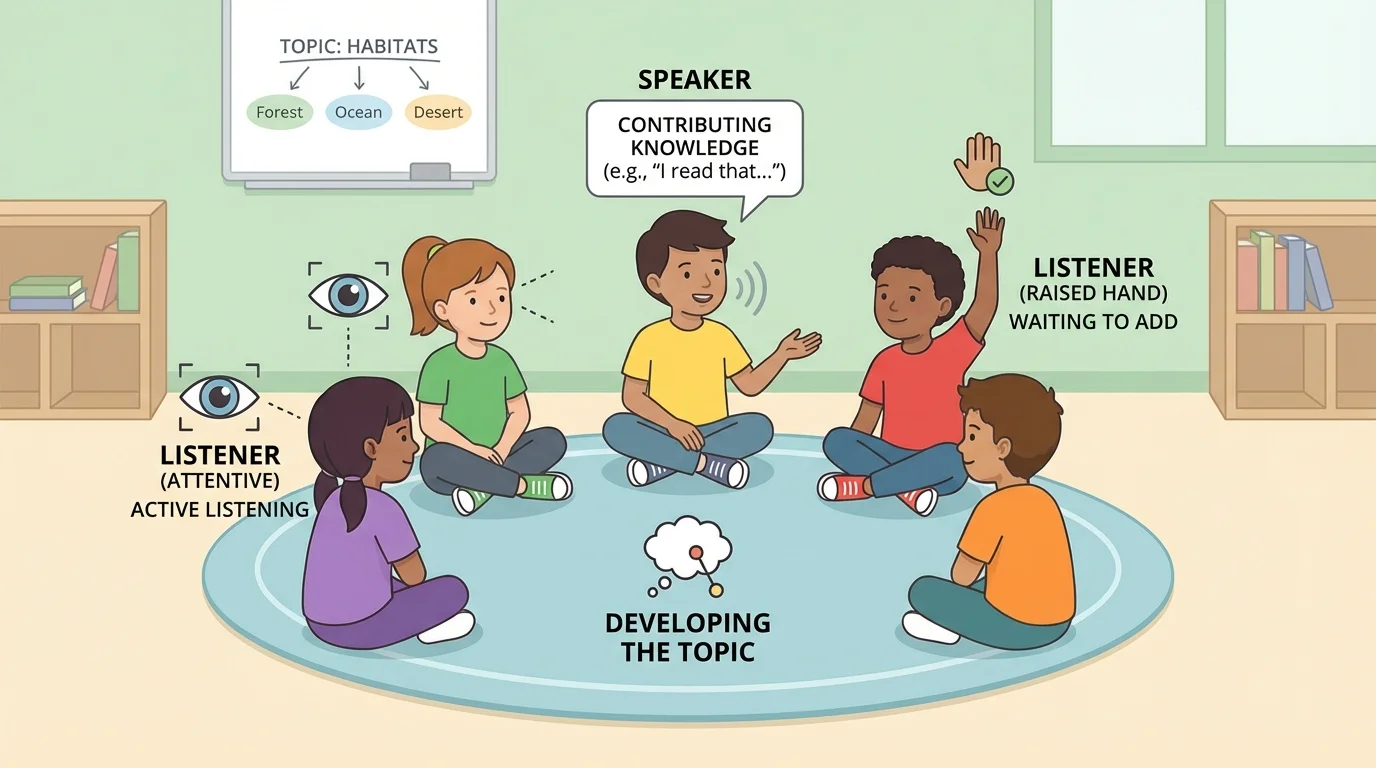
Waiting for your turn matters too. You may raise your hand in a class discussion or watch for a pause in a small group. Interrupting can make others lose their thoughts. Taking turns keeps the conversation calm and fair.
Body language can show listening. Eyes facing the speaker, a quiet body, and a thoughtful face all show attention. Nodding can also show that you are following the ideas. These small actions help the speaker know that the group cares about what is being said.
You already use turn-taking in everyday life. You wait your turn in line, in games, and on the playground. Discussion uses that same skill with words and ideas.
Sometimes listening means hearing something different from what you thought before. That is a good thing. Discussions help us learn new information, not just repeat what we already know.
One of the most important discussion skills is staying on the topic. A topic is the main subject the group is talking about. If the class is discussing how plants grow, comments should connect to seeds, sunlight, water, soil, or growth. Comments about your favorite sandwich do not fit that topic. The difference is easy to notice in [Figure 2], which contrasts on-topic and off-topic ideas.
Before you speak, ask yourself, "Does my idea match what we are talking about?" If the answer is yes, your comment probably belongs in the discussion. If the answer is no, save it for another time.
Staying on topic helps the class learn more in an organized way. When everyone keeps their ideas connected, the discussion grows like a path instead of jumping all over the place.

Here is an example. Suppose the topic is weather. These comments stay on topic: "Wind can move clouds," "Rain comes from clouds," and "Snow happens when it is very cold." This comment goes off topic: "My cousin has a new puppy." The puppy may be exciting, but it does not help the group learn about weather.
If you are not sure whether your idea fits, you can connect it with words such as "This reminds me of...," "I learned that...," or "That matches the topic because...." These sentence starters help you explain the link between your thought and the class subject.
How ideas stay connected
A strong discussion works like links in a chain. Each new comment connects to the one before it or to the main topic. When a comment has no connection, the chain breaks. Students help keep the chain strong by listening, thinking, and making clear connections.
Later, when students begin answering one another more directly, the same idea from [Figure 2] still matters. Even when you agree or disagree, your words should still match the main subject.
There are many good ways to contribute knowledge. You can share a fact you learned, tell about something you noticed, give an example, or ask a question that helps everyone think.
A fact is something true you know. For example, during a discussion about the moon, you might say, "The moon does not make its own light. It reflects light from the sun." That teaches the group something important.
An example can make an idea easier to understand. If the class is discussing kindness, you might say, "Kindness can be helping someone pick up dropped pencils." A clear example helps other students picture the idea.
A question can also be a strong contribution. Good questions move learning forward. If the class is talking about animal homes, you might ask, "Why do some animals live underground?" That question gives the group a new direction for thinking.
Some of the best classroom discussions grow because one student asks a thoughtful question. A question does not mean you know less. It often means you are thinking deeply.
You can also make a connection. If another student says, "Penguins live in cold places," you might add, "That connects to their feathers because feathers help keep them warm." This kind of comment builds the topic in a clear way.
When you contribute, your words should be easy to hear and understand. Speak in a clear voice. Use complete sentences when you can. This helps your classmates follow your thinking.
Respectful speaking matters just as much as clear speaking. Even if you disagree, you should speak kindly. You can say, "I see it a different way," or "I have another idea." You do not need to use harsh words to share a different thought.
Respect also means not laughing at someone's idea and not whispering while another person speaks. A discussion should feel safe. Students share better when they know others will listen with care.
Looking toward the group or the speaker can help too. You do not need to be perfect, and you do not have to stare. Just show that you are part of the conversation. The class learns best when speakers and listeners work together.
Helpful and unhelpful ways to respond
Step 1: Listen to the idea
A student says, "I think bees are important because they help flowers."
Step 2: Choose a respectful response
Helpful response: "I want to add that bees also help plants make seeds."
Step 3: Avoid an unhelpful response
Unhelpful response: "That is wrong," said in a rude voice without explanation.
The helpful response keeps the discussion going and adds knowledge.
A calm voice, kind words, and a clear idea make your contribution stronger. Sometimes a simple sentence is enough if it helps the group understand more.
A good discussion is not just separate people talking one after another. It is a group building ideas together. Students can agree, add on, ask for more detail, or disagree politely. These ways of responding help thoughts grow, as [Figure 3] illustrates with different kinds of speech.
You can use sentence starters to join the conversation. Try "I agree because...," "I want to add...," "Can you explain more?," or "I think something different because...." These phrases help you connect your words to someone else's idea.
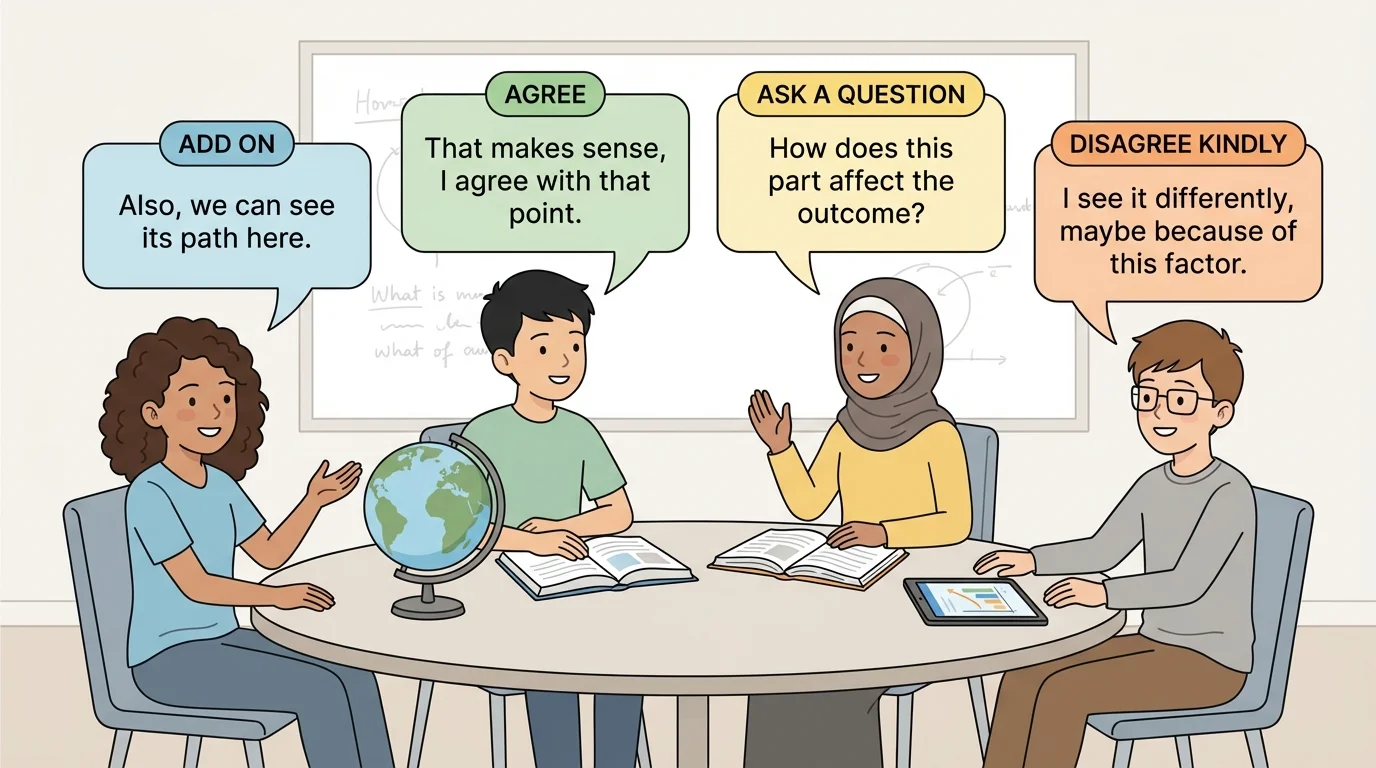
Here is an example. One student says, "Trees are important." Another says, "I agree because trees give shade." A third says, "I want to add that trees are homes for birds." A fourth says, "Can you explain why roots matter?" Now the group is not just talking. The group is growing one topic in many directions.
Polite disagreement is also part of learning. If someone says, "All animals sleep at night," another student might respond, "I think some animals sleep during the day instead. Owls are awake at night." That response is respectful, and it adds useful knowledge.
When you build on ideas this way, the discussion becomes richer. The class does more than share random thoughts. It creates a bigger picture from many voices.
"We learn more when we listen carefully and speak thoughtfully."
Later in any class conversation, the actions shown in [Figure 3] remain helpful. Agreeing, adding on, asking, and politely disagreeing are all ways to keep the topic moving forward.
Being prepared helps you contribute more confidently. Sometimes your teacher gives a story, science topic, picture, or question before the discussion begins. You can think about what you know, what you noticed, and what you wonder.
Preparation does not have to be complicated. You might remember one fact, one example, and one question. That gives you several ways to join the conversation.
Suppose the class reads a story about a character who solves a problem. Before the discussion, you might think: "The character was brave," "She solved the problem by asking for help," and "I wonder why she waited so long." Those ideas can help you enter the conversation with something meaningful to say.
Getting ready to discuss a read-aloud
Step 1: Think of one fact
"The boy lost his dog in the story."
Step 2: Think of one idea
"He kept looking because he cared a lot."
Step 3: Think of one question
"Why did he ask neighbors before calling his family?"
With these ideas ready, you are prepared to contribute in more than one way.
Preparation is not memorizing a speech. It is simply getting your mind ready to talk and listen about the topic.
Strong discussion often sounds smooth, connected, and thoughtful. Students talk one at a time. Their ideas match the topic. They use words that show they are listening to one another.
For example, if the class is discussing why communities need rules, one student might say, "Rules help people stay safe." Another might add, "I agree, and rules can also make things fair." A third might ask, "What would happen if there were no rules at recess?" Each contribution helps develop the topic.
Notice that each student says something a little different. No one has to say a long speech. Short, clear comments can still be powerful if they help the group think.
Sometimes the teacher may ask follow-up questions such as "What makes you think that?" or "Can you give an example?" These questions help students explain their ideas more fully. When you answer with details, your contribution becomes even stronger.
Sometimes discussions become hard for simple reasons. A student may interrupt. Another may repeat what was already said. Someone may speak so softly that others cannot hear. Another person may drift away from the topic.
These problems can be fixed. If you want to interrupt, stop and wait for a pause. If your idea has already been shared, try adding a new detail. If your voice is too soft, speak a little louder and face the group. If you go off topic, think again about the main subject and reconnect your words to it.
| Problem | Smart Fix |
|---|---|
| Interrupting | Wait for your turn to speak. |
| Repeating the same idea | Add a new fact, example, or question. |
| Speaking too softly | Use a clear voice and face the group. |
| Going off topic | Make sure your comment connects to the main subject. |
Table 1. Common discussion problems and simple ways to fix them.
Making mistakes in discussion is normal. The goal is not perfection. The goal is to keep learning how to help the group with your words and your listening.
This skill is useful in many places, not only during school lessons. You use it when you talk with family about plans, when you work with teammates in a game, and when you solve problems with friends.
At home, you might contribute by explaining why a certain plan makes sense. In a game, you might suggest a strategy and listen to what others think. In a class project, you might share an idea, hear another idea, and help the group choose the best one.
People who contribute knowledge respectfully help groups make better choices. They help others feel included. They also show that learning is something we do together.
When you listen carefully, stay on topic, and share useful ideas, you become an important part of the conversation. Your voice can help a small group or a whole class understand a topic more clearly.
