Have you ever noticed that a science discussion sounds different from a discussion about a story? In science, you might hear words like habitat or observe. In reading, you might hear words like character or setting. These special words are like tools. When you use the right tool, your speaking becomes clearer, more precise, and easier for others to understand.
When you speak in class, you are not just saying words. You are sharing ideas. If you use the best words for the topic, people can understand exactly what you mean. This helps when you give a presentation, answer a question, or talk with classmates.
For example, if you are talking about animals, saying "the place where it lives" is okay. But saying habitat is even better. The word habitat is a content-specific word for science. It tells your listener exactly what kind of idea you mean.
Content-specific vocabulary means special words that belong to a subject or topic. These words help people ask better questions and give clearer information.
Topic means the main subject being discussed. Staying on topic means your words match the main idea.
Using these words also helps you stay focused. If your class is discussing weather, your words should connect to weather. If your class is discussing a story, your words should connect to the story. This keeps your speaking clear and organized.
Some words are everyday words, and some are content-specific vocabulary. As [Figure 1] shows, a general word may be broad, but a subject word is more exact. Saying "part of a story" is general. Saying character, setting, or main idea is more exact.
Here are a few examples. In science, you may use observe, life cycle, or predict. In math, you may use estimate or solution. In social studies, you may use map key or location. These words are helpful because they fit the subject.
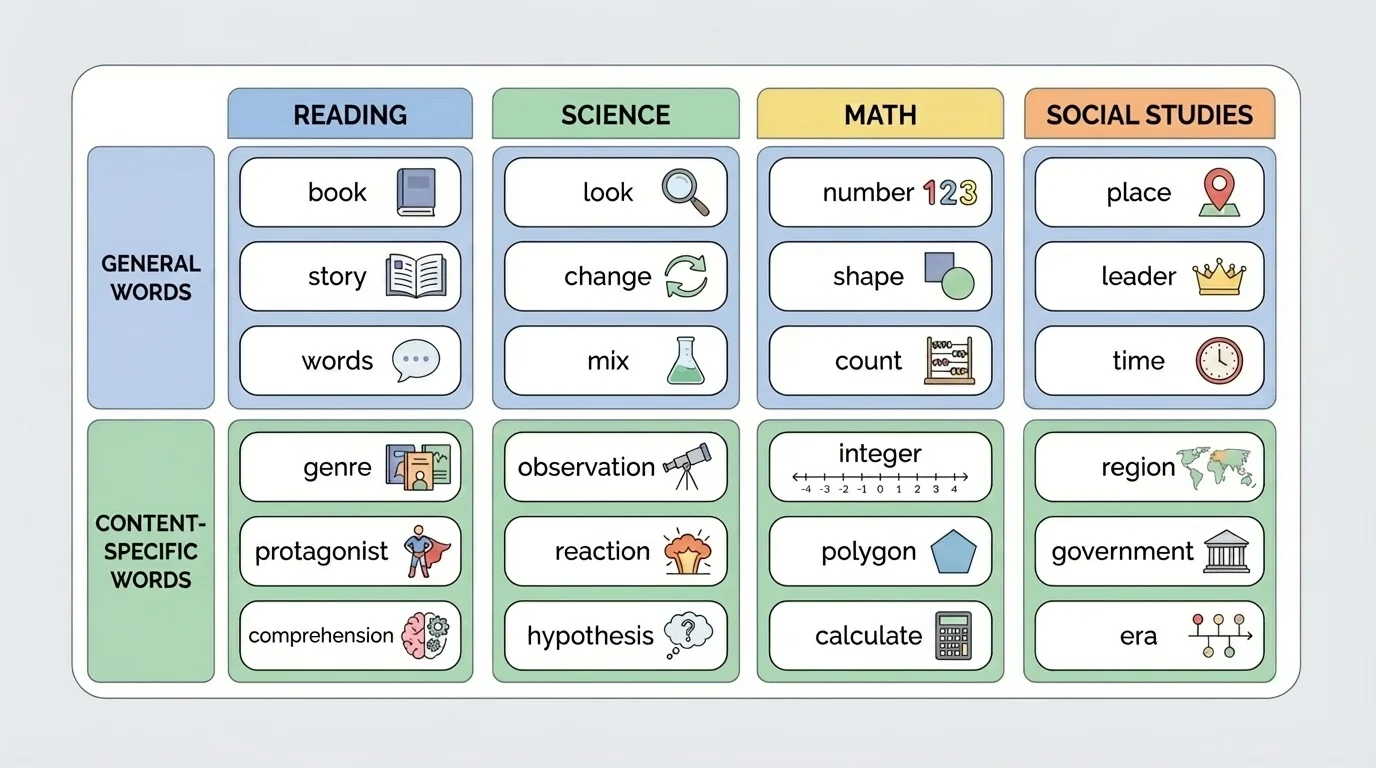
If you use the wrong kind of word, your meaning can become fuzzy. Suppose someone asks, "What did you learn about frogs?" If you answer, "They do stuff in water," your idea is not clear. If you answer, "A frog begins its life cycle in water as a tadpole," your answer is much clearer.
Scientists, readers, mathematicians, and mapmakers all use special words to think and talk clearly. Learning these words helps your brain sort ideas by subject.
When you learn a new topic, it is helpful to notice the words your teacher uses again and again. Those repeated words are often important content-specific vocabulary.
Good questions help everyone learn. A strong question uses the right topic words, and [Figure 2] illustrates how question stems can join with subject words to make a focused question. Instead of asking something too broad like "What is that?" you can ask, "What is the habitat of this animal?"
Question words help you begin. You can use who, what, where, when, why, and how. Then you can add the content word.
Here are some strong question examples:
You can also ask for more information. These question frames are useful:
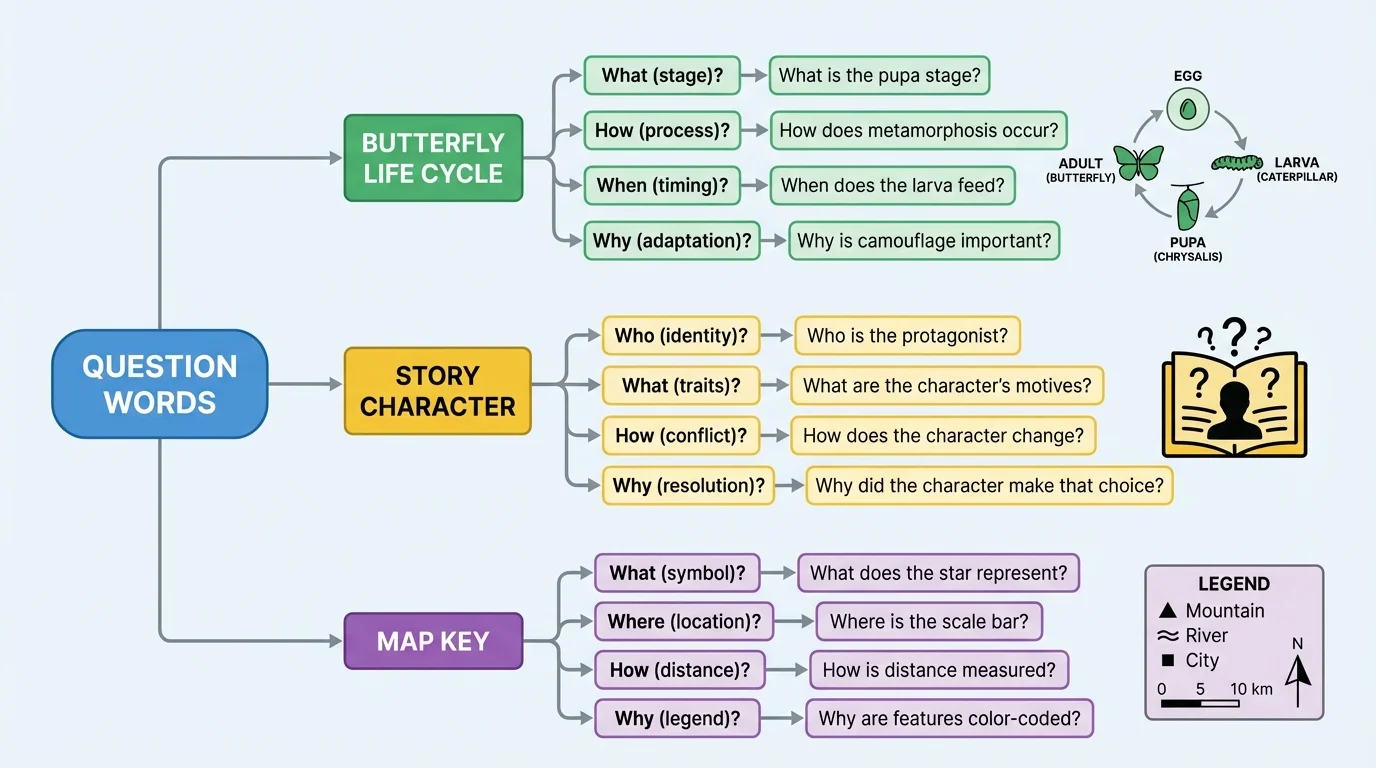
A strong question stays on topic. If a student is presenting about clouds, a good follow-up question is "What did you observe about the storm clouds?" A question like "Do you like pizza?" does not fit the topic. It may be fun, but it does not help the discussion.
How question words and topic words work together
Question words open the door, but content-specific vocabulary points to the exact idea. "Why?" is helpful, but "Why does the character feel nervous?" is much clearer because it names the part of the lesson being discussed.
When you ask a strong question, you show that you were listening. You also help the speaker explain more clearly.
As [Figure 3] shows, when you answer a question or share during a presentation, a short answer may be too weak, but a stronger answer includes the content word and an important detail.
Listen to the difference. Weak answer: "It lives there." Strong answer: "The fox lives in a forest habitat." Weak answer: "He changed." Strong answer: "The character changed from fearful to brave." The stronger answers are easier to understand because they give real information.
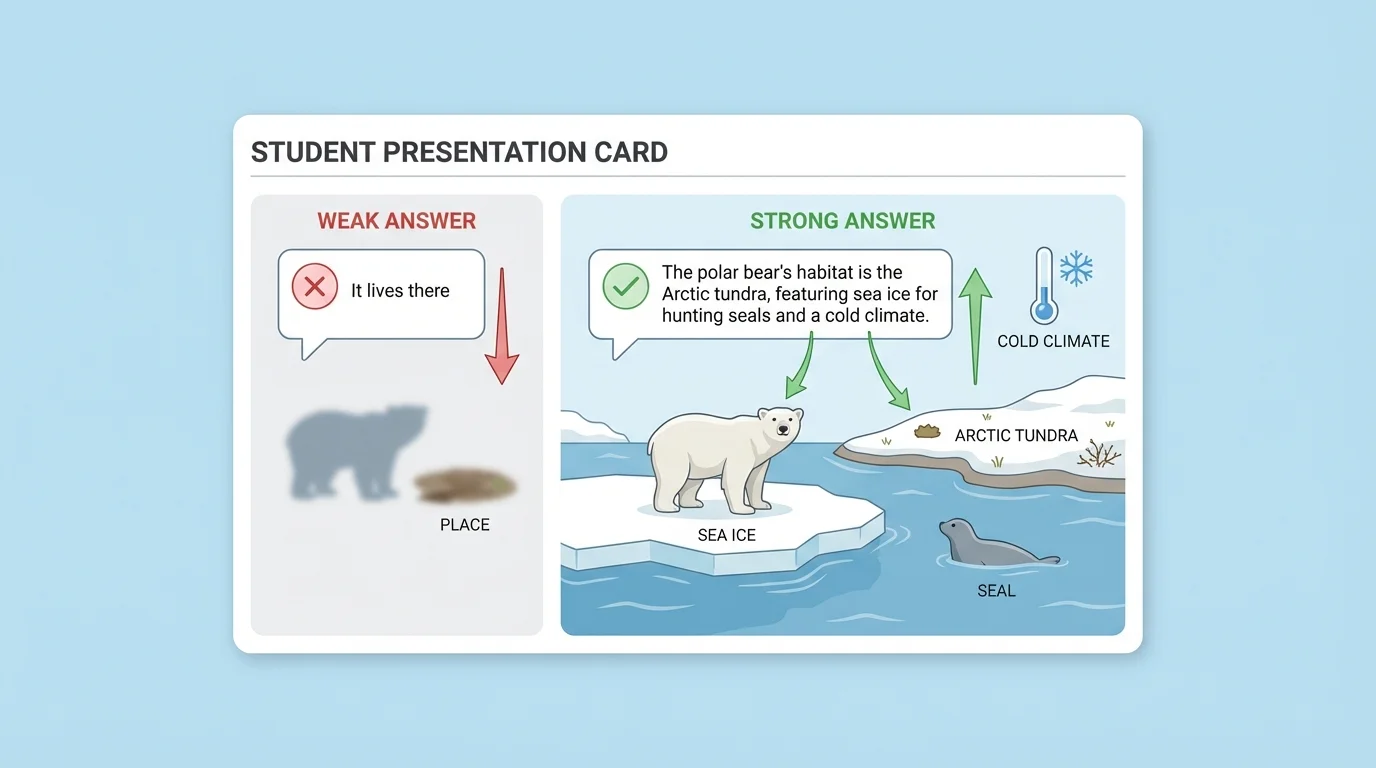
One helpful way to answer is to use this pattern: name the idea, then add a detail. For example, "The setting is a farm, and the story begins early in the morning." Or, "My estimate was close because I rounded the number first."
Another helpful way is to repeat an important word from the question. If someone asks, "What is the map key for?" you can answer, "The map key explains what the symbols on the map mean." Repeating the topic word helps your answer stay focused.
Examples of clear answers
Step 1: Listen for the important word in the question.
Question: "What do you observe about the plant?" Important word: observe.
Step 2: Answer with the topic word and a detail.
Answer: "I observe that the plant has grown taller and has two new leaves."
Step 3: Keep your answer on the same topic.
The answer stays about the plant, not about something unrelated.
Clear information helps your audience. During presentations, listeners need words that tell exactly what you learned, noticed, or figured out.
Different subjects have different kinds of important words. When you know which words belong to which subject, you can choose them more easily while speaking.
| Subject | Content-Specific Words | Example Sentence |
|---|---|---|
| Reading | character, setting, main idea | "The main idea is that helping others matters." |
| Science | habitat, observe, life cycle, predict | "I predict the seed will sprout in a few days." |
| Math | estimate, solution | "My estimate was close to the solution." |
| Social studies | map key, location | "The map key helps us find the location." |
Table 1. Examples of content-specific vocabulary in different school subjects.
Notice that each example sentence sounds more like academic language than everyday conversation. That is not a bad thing. It means the speaker is using precise language for learning.
You already know how to ask questions and answer in complete sentences. Now you are making those skills stronger by adding subject words that fit the topic.
As we saw in [Figure 1], precise words help you say exactly what you mean. Instead of saying "thing," "stuff," or "place," try to choose a word that names the idea more accurately.
As [Figure 4] shows, presentations are not just about talking. They are also about listening and discussing. In a classroom discussion, the speaker and the listeners both use content-specific vocabulary to keep the conversation strong and focused.
When you listen to a presentation, pay attention to important words. If the speaker says "weather," "forecast," and "storm," those words tell you the topic. You can use those same words in your question: "What did the forecast say about the storm?" That question matches the presentation.
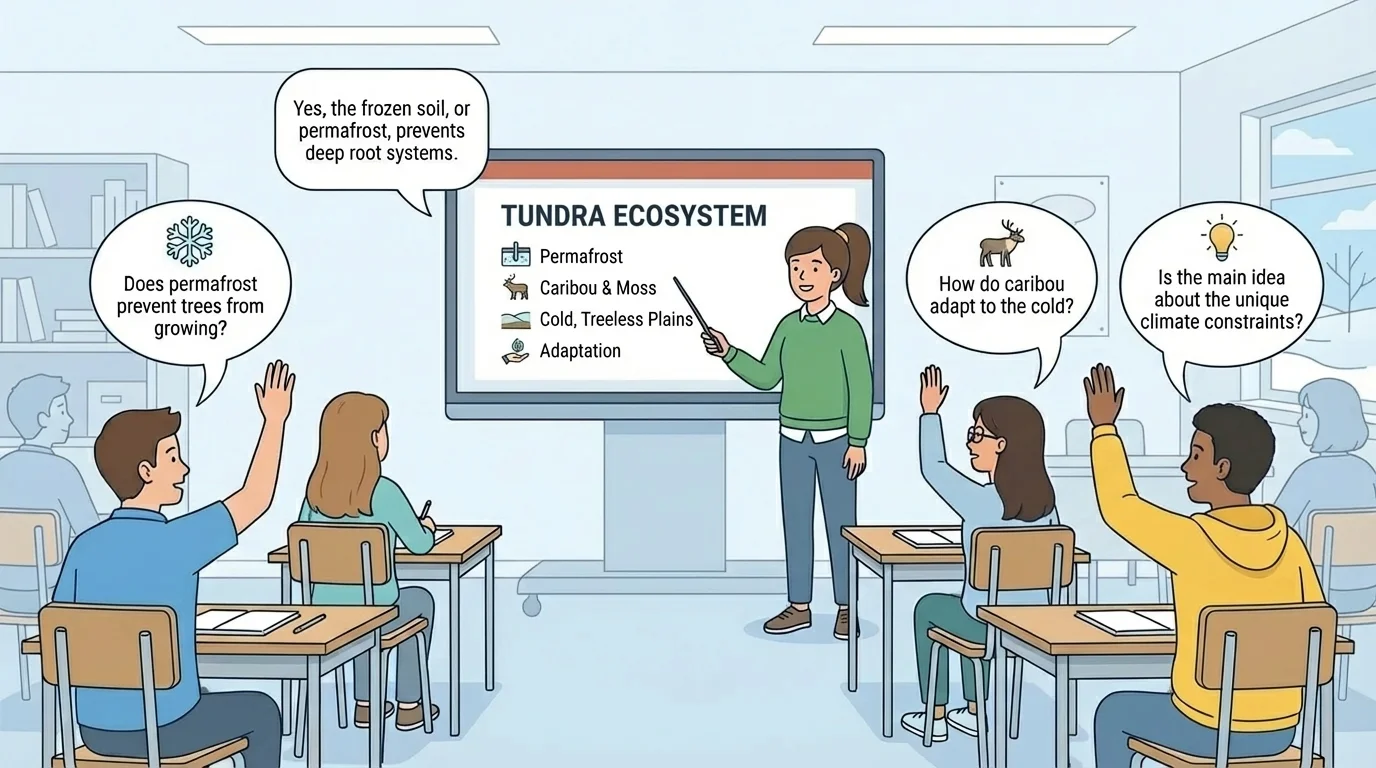
Being prepared to discuss means you are ready to ask, answer, and explain. You might say, "I agree with your main idea because the details match it," or "Can you explain your prediction?" These responses show that you listened carefully.
Respectful discussion also matters. You can wait your turn, look at the speaker, and use a polite voice. Even when you ask a question, you can sound kind and thoughtful. Strong vocabulary and respectful listening work together.
"Good speakers choose words carefully, and good listeners use those words to learn more."
Later, if you think back to the classroom scene in [Figure 4], you can notice that the best questions come from careful listening. The listeners do not jump to random ideas. They build their questions from the speaker's topic words.
Sometimes several words seem possible, but one word is the best fit. If a student says, "The animal's home is the desert," that makes sense. But if the class is studying science, "The animal's habitat is the desert" is more exact.
Choosing the best word means using precise language. Precise language means words that are exact and specific. It helps your listener understand quickly.
Here are some examples of stronger choices:
Strong speakers often think before they answer. They ask themselves, "What word fits this subject best?" That small pause can make speaking much clearer.
A single precise word can replace many fuzzy words. For example, "map key" tells more than saying "the box that explains the little pictures on the map."
As shown earlier in [Figure 3], stronger answers grow when you replace weak words with exact vocabulary and then add a detail.
You do not have to know every special word right away. Good speakers learn content-specific vocabulary one step at a time. Each time you hear an important word, say it, use it, and connect it to the topic.
Before a presentation, it helps to prepare a few key words. If your topic is butterflies, you might prepare life cycle, observe, and predict. If your topic is a story, you might prepare character, setting, and main idea. These words can guide your talking.
When you practice, try to speak in complete sentences. For example: "I predict the caterpillar will change during its life cycle." Or, "The setting helps the reader understand where the story happens." Sentences like these sound clear and thoughtful.
Preparation helps discussion
When you prepare important vocabulary before speaking, you are more ready to answer questions after your presentation. You can stay on topic, explain your thinking, and respond with confidence.
Good speaking is not about using the most sophisticated word. It is about using the right word for the subject and the idea. That is what helps your audience understand and helps you share what you know.
