Have you ever tried to build something, make a snack, or start a game without reading the directions? It can quickly turn into a big mess. Reading is not only for stories. Sometimes we read because we need to do something. We read to learn the steps, follow the order, and finish a job correctly.
When you read to do a task, you are reading informational text. Informational text gives facts, directions, or explanations. It helps the reader learn how something works or how to complete something. A recipe, a game rule card, and directions for planting seeds are all informational texts.
Sometimes the purpose of reading is to enjoy a story. Other times, the purpose is to follow directions. When you read for a specific task, you are trying to find the exact information you need. You may need to know what comes first, what materials to use, or what rule to follow.
This kind of reading asks you to pay close attention. If a recipe says to wash the fruit first, that step matters. If a game says each player gets three cards, that detail matters too. Good readers notice the important parts and use them to act.
Specific task means a job you are trying to complete. Directions are words that tell how to do the job. Steps are the parts of the directions, usually in a certain order.
Reading for a task also means thinking about the author's choices. The author of a how-to text often uses numbers, short sentences, labels, and order words so the reader can follow along easily. These text features are clues that help you understand what to do.
[Figure 1] How-to texts have special parts that help readers find information quickly. A how-to text may have a title, a list of things you need, and steps in order. It may also have pictures, labels, or bold words that point out important ideas.
A title tells what the task is. A materials list tells what you need before you begin. Numbered steps show the order. Pictures can show what each step looks like. Labels help you notice important tools or actions.
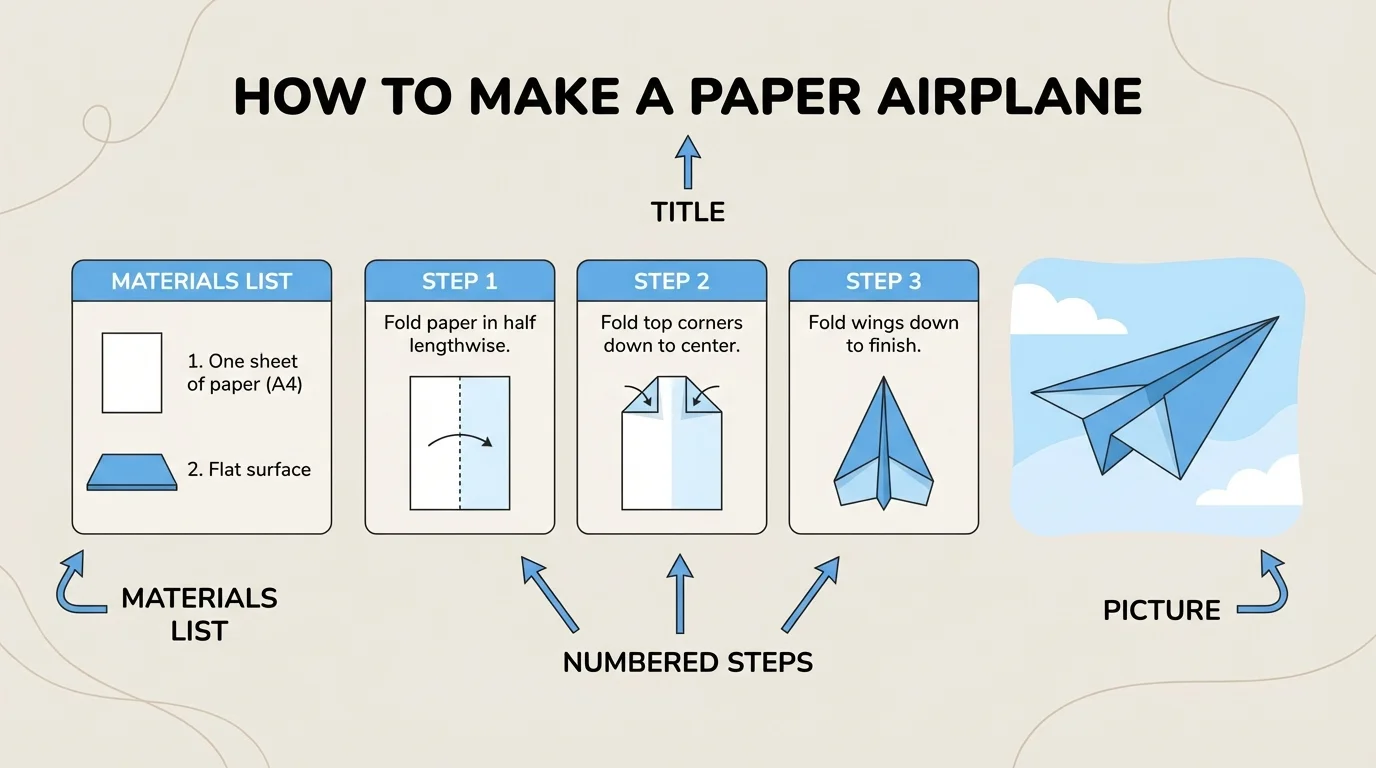
When you start reading a how-to text, look at all the parts before you begin the task. This helps you understand the whole job. You can ask, "What am I making or doing?" and "What do I need first?"
Good readers also notice if the directions are numbered or bulleted. Numbered steps usually must be followed in order. Bullets may list items you need or choices you can make. Looking at the structure of the text helps you know how to read it.
Many cooks and game makers test their directions again and again. They want the words to be clear enough that someone else can follow them without guessing.
Later, when you read a recipe or game card, the same text features help you stay organized. If you skip the list or miss a label, the task may become harder.
[Figure 2] A recipe is a kind of informational text that tells how to make food. A recipe is organized so the reader can prepare the food in the correct order. Recipes often include a title, ingredients, tools, and steps.
Ingredients are the foods you use. A recipe might say bread, peanut butter, and banana. It may also tell how much of each ingredient to use. Tools are things like a spoon, bowl, or knife used with an adult's help when needed.
After the ingredient list come the steps. The steps tell exactly what to do first, next, and last. In a simple recipe, step one might say, "Put peanut butter on one slice of bread." Step two might say, "Place banana pieces on top." Step three might say, "Put the other slice of bread on top."
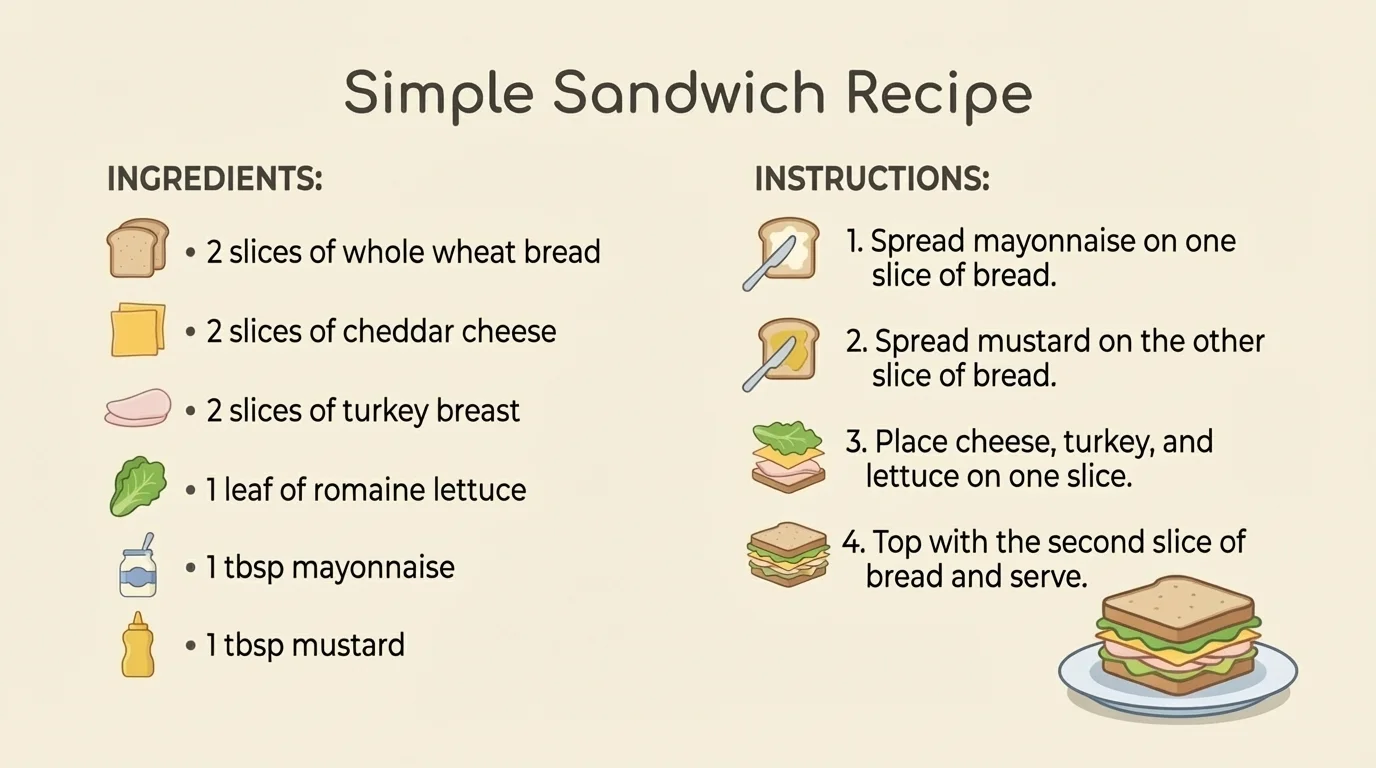
Action words are very important in recipes. Words like mix, pour, spread, cut, and bake tell what action to do. If you do not know an action word, the step may not make sense. Looking at the picture or rereading the sentence can help.
Recipes also teach us to pay attention to details. If a step says to wash the apple before cutting it, the washing comes first. If the recipe says to stir slowly, that is different from dumping everything at once. Careful reading helps food turn out the way it should.
Example: Following a fruit cup recipe
You read these steps: wash grapes, cut bananas, put fruit in a bowl, then stir.
Step 1: Find the first action word.
The first action is wash, so the grapes must be cleaned before anything else.
Step 2: Notice the order of the next actions.
After washing, the directions say to cut bananas and then put the fruit in a bowl.
Step 3: Finish with the last step.
You stir only after the fruit is already in the bowl.
The order of the words tells the order of the job.
When reading recipes, you should also gather everything before starting. That saves time and helps you avoid stopping in the middle. Strong readers think ahead as they read.
[Figure 3] Game directions tell players how to set up a game, take turns, and win. Unlike recipes, game directions often include rules about what players may or may not do.
At the beginning of game directions, you may learn how many players can join and what pieces each player needs. This part is called the setup. The setup must happen before the game starts.
Then the directions explain how to play. They may say who goes first, what happens on a turn, and what to do if a special card or space appears. The rules may use words like must, may, cannot, or skip. These words are important because they tell what is allowed.
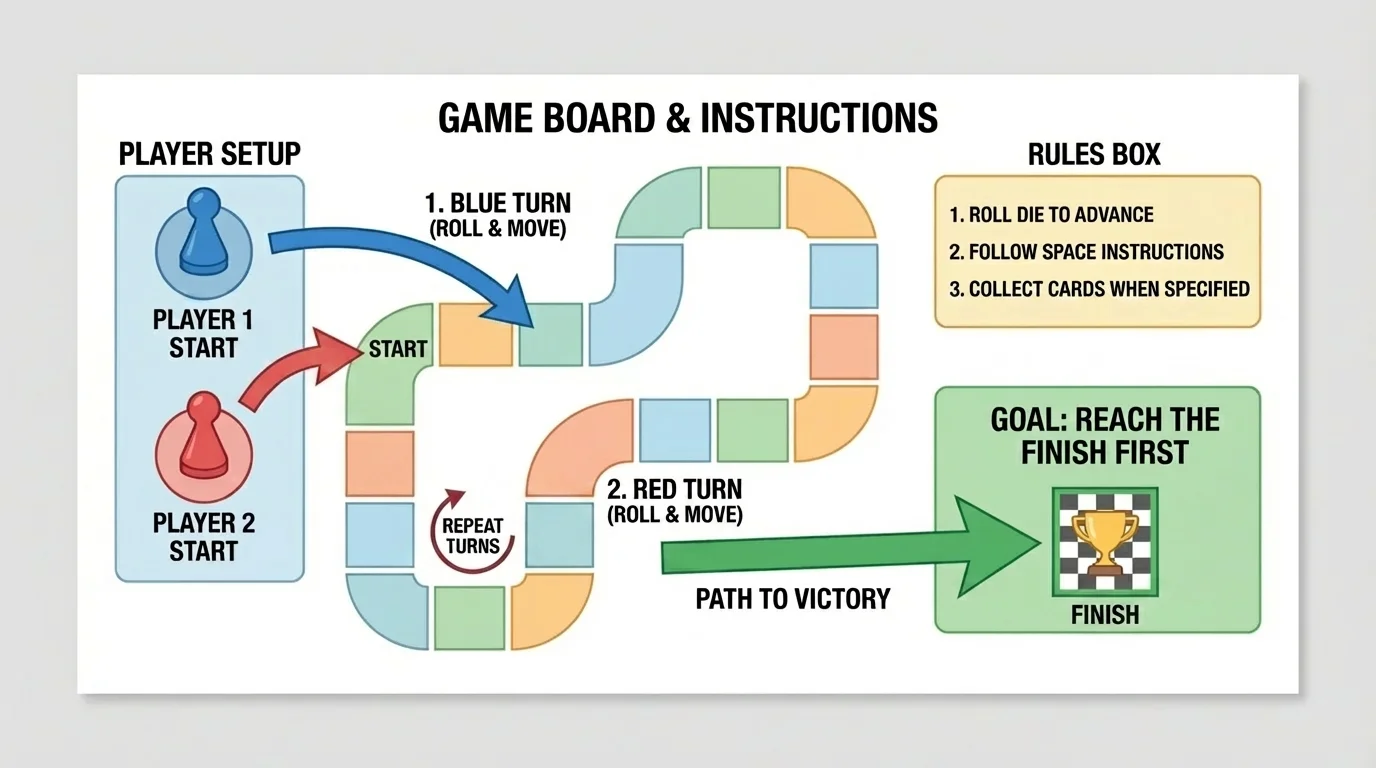
Game directions also tell how the game ends. Some directions say, "The first player to reach the finish wins." Others say, "Count the points. The player with the most points wins." If you miss this part, you may not know the goal of the game.
Sometimes games have special rules. For example, a card might say, "Move ahead two spaces," or "Lose a turn." Readers must pay attention to these exact words. In games, one small rule can change what happens next.
Rules, order, and fairness
Directions in games help everyone play the same way. When all players read and follow the same rules, the game is fair. Reading carefully helps prevent arguments because the text gives the answer.
Later, if players disagree, they can go back to the directions and check them again. That is why keeping the rule card nearby is helpful. The setup, turn order, and winning rule work together to show the whole game.
Before you begin a task, ask yourself what your goal is. Are you making a snack? Are you learning how to play? Then look over the whole text. This quick look helps you know what is coming.
During the task, follow one step at a time. Do not jump ahead too quickly. If something does not make sense, stop and reread. Many mistakes happen when readers rush or skip words.
After you finish, check your work. Does your snack look like it should? Is the game set up the right way? Looking back at the directions can help you fix mistakes.
Good readers already know that words and pictures work together. In task-reading, pictures can support understanding, but the words still matter most because they give the exact directions.
Rereading is not a sign that you are doing a bad job. It is a smart strategy. Skilled readers reread whenever they need to make the task clearer.
[Figure 4] Some small words give big clues about order and action. Words like sequence words tell when something happens. Common sequence words are first, next, then, after, and last.
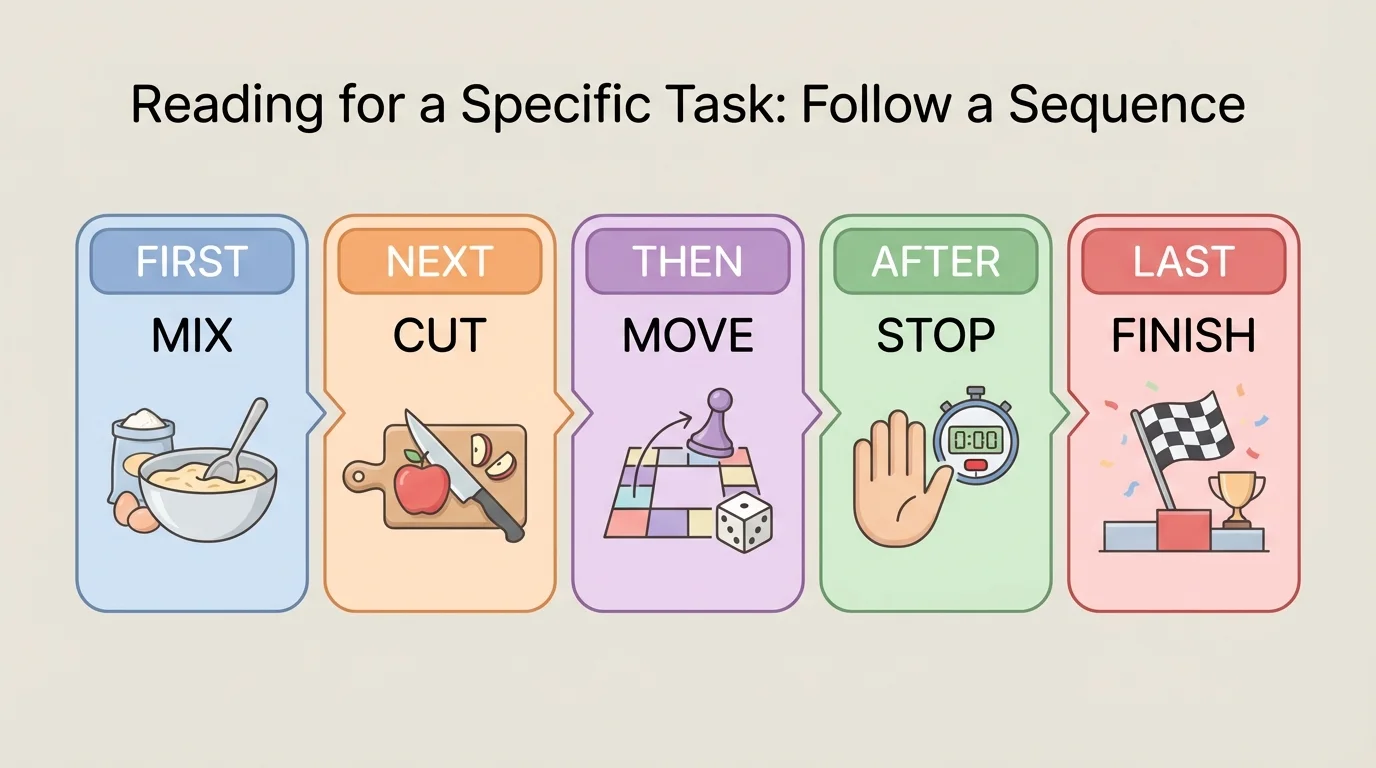
Action words tell what to do. In a recipe, action words might be mix, wash, or pour. In a game, they might be roll, move, draw, or stop. When you notice these words, you understand the directions better.
Headings and bold print can also help. A heading may tell whether you are reading the materials list or the steps. Bold words may point out warnings or important rules. Numbers can show order, amount, or score.
Pictures and diagrams support the text too. A picture may show where pieces go on a game board or what the finished food should look like. The chart of clue words reminds readers that short words can guide the whole task.
| Text feature | How it helps |
|---|---|
| Title | Tells what the task is about |
| List | Shows needed items or ingredients |
| Numbered steps | Shows the order to follow |
| Pictures or diagrams | Shows what a step or object looks like |
| Bold words | Points out important actions or rules |
Table 1. Common text features in how-to texts and the job each feature does.
Sometimes a direction is hard to understand. Maybe a word is unfamiliar. Maybe a step is missing. Maybe the order is not clear. Careful readers do not just guess right away.
First, reread the sentence slowly. Next, look at the words around it. Then, check the picture or diagram if there is one. You can also look back at earlier steps to see how they connect.
If directions still seem confusing, ask a helpful question such as, "What is the job in this step?" or "What should happen before this?" Talking through the direction can make the meaning clearer. When needed, ask a teacher, parent, or partner for help.
Example: Fixing a confusing direction
A game card says, "Place markers on the board, then begin." But you are not sure where the markers go.
Step 1: Reread and look for clues.
You check earlier directions to see whether the setup was explained before this sentence.
Step 2: Study the picture.
The picture may show that each player's marker starts on the space labeled "Start."
Step 3: Confirm before playing.
You make sure all players begin in the same place so the game is fair.
Good readers use the whole text to solve confusion.
When readers slow down and check the text, they become more independent. That means they can do more tasks on their own.
Every day, people read to do things. They read signs, menus, schedules, directions, recipes, and instructions. This makes reading a powerful tool in everyday life.
As you grow, the tasks will become bigger. You may read science directions, art steps, building instructions, or rules for a team game. The same skills still help: know your purpose, find the important parts, follow the order, and reread when needed.
Reading to perform a task means using text in an active way. You are not just saying the words. You are using the words to make, do, solve, or play something successfully.
