Have you ever raced through a funny story but slowed way down when reading game directions? That is exactly what strong readers do. They do not read every single thing at the same speed. They adjust their reading so they can understand better. A reader is a little like a driver: sometimes you go slowly and carefully, sometimes you move along smoothly, and sometimes you just glance to find one thing.
Reading rate means how fast or how slowly you read. Good readers change their reading rate depending on the text and their reason for reading. This helps them understand what they read and use their time wisely.
If you are reading a joke book for fun, you might read quickly. If you are reading directions for building a paper airplane, you need to slow down and notice each step. If you are looking for the date on a calendar page, you might move your eyes quickly until you find it. The speed changes, but the goal is always the same: understand what you need to understand.
Purpose for reading means the reason you are reading. You might read to enjoy a story, learn facts, follow directions, or find one important detail. Your purpose helps you decide how quickly or slowly to read.
When readers use the right speed, reading feels smoother. It also helps them remember more. Reading too fast can make you miss important ideas. Reading too slowly all the time can make simple text feel harder than it really is.
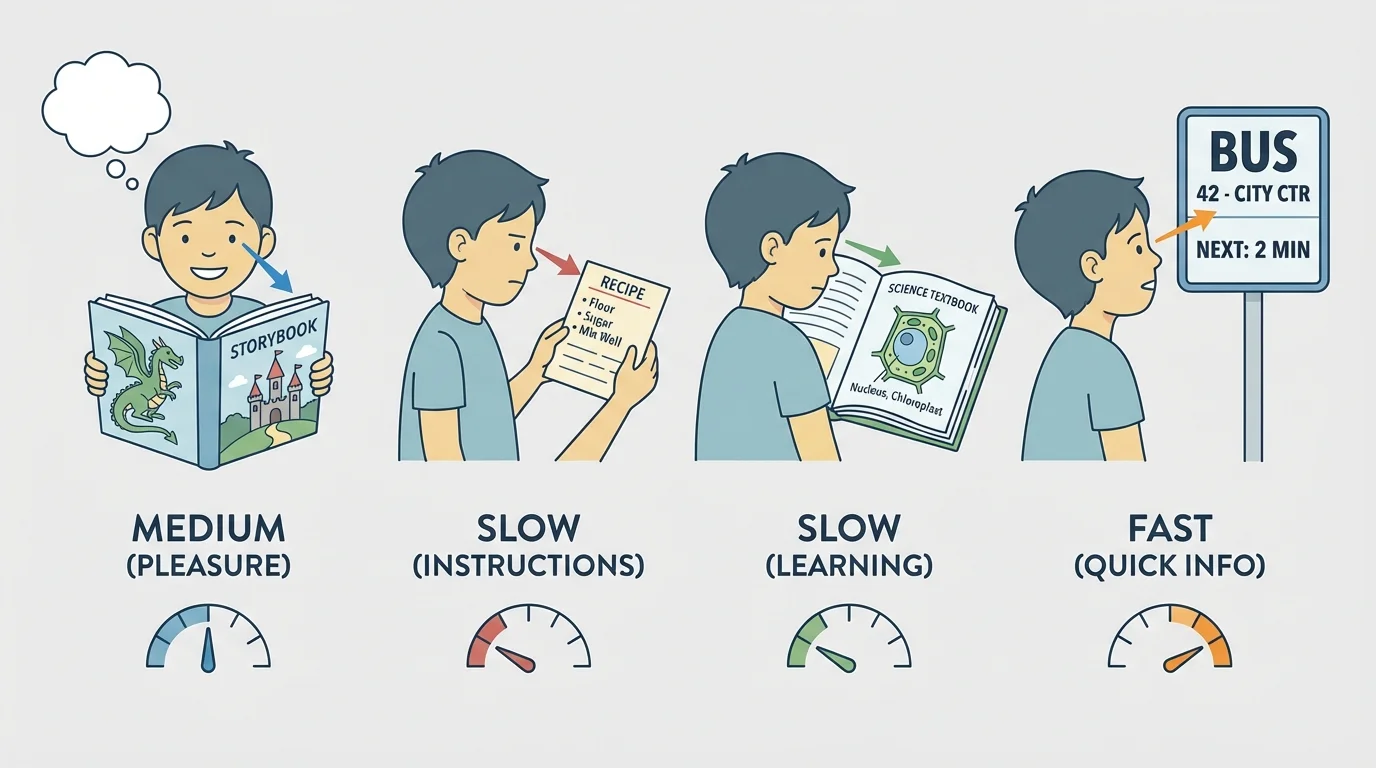
Different texts ask your brain to do different jobs. A storybook may let you read at a smooth, flowing pace. A page in a science book may need slower reading because it has new facts and important words. A sign, label, or menu may only need a quick look. These different needs are easy to compare in [Figure 1], which shows that one reader changes speed for different kinds of text.
Informational text is writing that teaches facts about a topic. It may include headings, bold words, labels, diagrams, or captions. Because informational text often teaches new ideas, readers usually slow down more than they do with a simple familiar story.
Here are some common text types and how readers often respond to them:
| Type of text | What it is for | Usual reading rate |
|---|---|---|
| Storybook | Enjoy the plot and characters | Smooth and steady |
| Directions | Follow steps correctly | Slow and careful |
| Science page | Learn facts | Slow to medium |
| Sign or label | Find one piece of information | Quick |
| Chart or table | Compare information | Slow in important parts |
Table 1. Different kinds of texts and the reading rates readers often use.
A reader does not need to pick just one speed and keep it all day. Even on one page, the speed may change. You might read a heading quickly, slow down for the main paragraph, and stop at a caption to study it carefully.
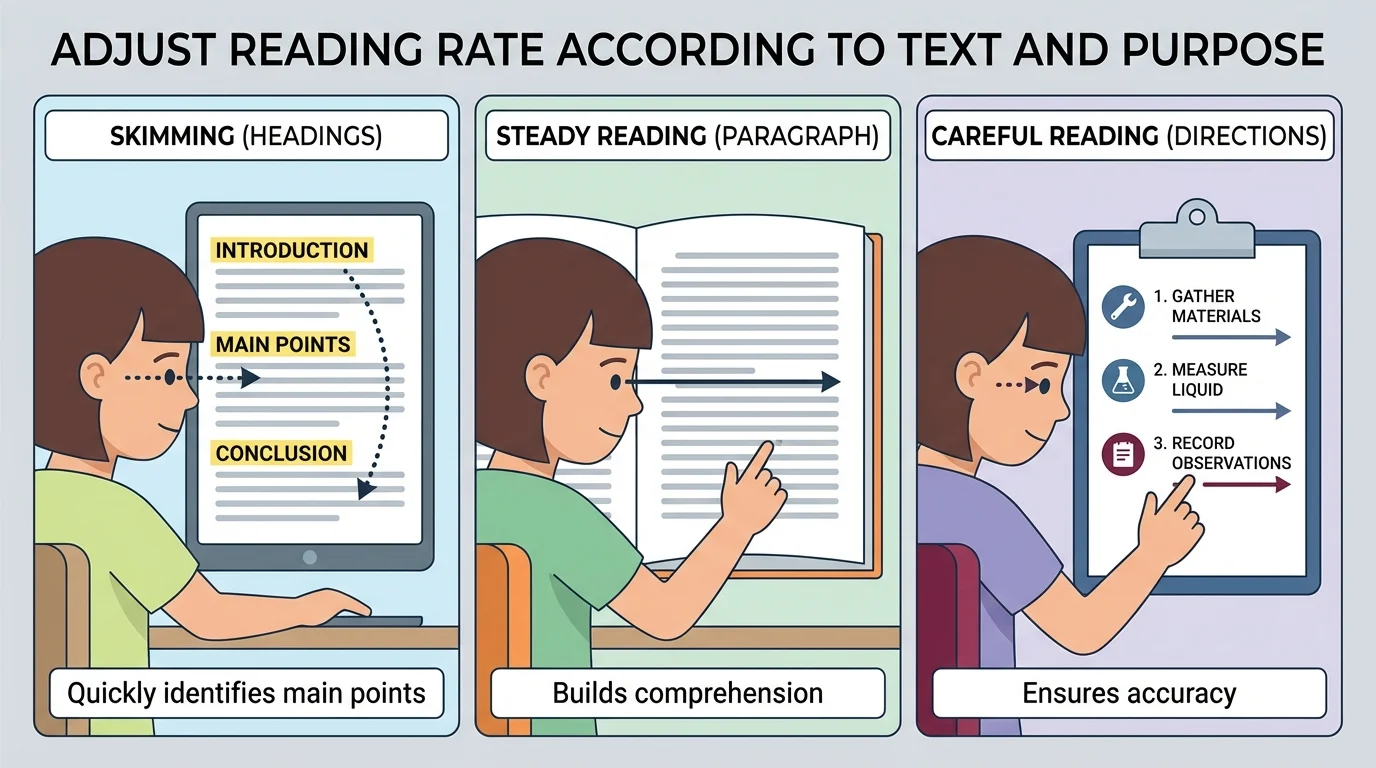
Readers usually use three helpful ways of moving through text, as [Figure 2] shows: scanning, careful reading, and steady fluent reading. Each one has a job.
Scanning helps when you are trying to find one fact, one word, or one part of a page. You may look at headings, the first few words, or labels. You are not trying to remember every detail. You are trying to locate something important.
Careful reading is slow and thoughtful. You use it for directions, hard parts, tricky words, and new learning. This is the right speed when every detail matters.
Steady fluent reading is a comfortable middle speed. You are not rushing, and you are not stopping at every word. This works well for many stories and for easy parts of nonfiction text that you understand.
Think about riding a bike. Sometimes you coast, sometimes you pedal steadily, and sometimes you slow down to avoid a bump. Reading works in a similar way. The text gives you clues about how fast to go.
Matching speed to meaning
The best reading rate is the one that helps you understand. Fast is not always better, and slow is not always better. What matters is whether your reading speed fits the text and your purpose.
When children first learn about changing reading speed, they sometimes think slower always means smarter. That is not true. If you are reading a very easy sentence or just looking for the word Saturday on a calendar, reading too slowly wastes time. Smart readers are flexible.
Your purpose tells you what to do. Before reading, it helps to ask, "Why am I reading this?" That simple question helps you choose the best pace.
If your purpose is to enjoy, a smooth pace works well. If your purpose is to learn, you may need to slow down and think about the ideas. If your purpose is to find one answer, you can move quickly until you spot the right place. If your purpose is to follow steps, you should read carefully and maybe reread.
Examples of matching reading rate to purpose
Step 1: A child reads a comic book to enjoy the story.
The best rate is smooth and fairly quick because the purpose is fun and understanding the action.
Step 2: A child reads how to care for a class plant.
The best rate is slow and careful because the purpose is to learn the exact steps.
Step 3: A child looks at a lunch menu to find out if pizza is served today.
The best rate is quick because the purpose is to find one detail.
Sometimes your purpose changes while you read. You might begin by quickly looking over a page. Then you find an important section and slow down. Later, you may speed up again. That is what strong readers do naturally.
Texts give helpful signals. If you notice these clues, you can choose a better reading rate.
Slow down when you see new words, lots of facts, directions, numbers, bold words, labels, or a part that does not make sense right away. Slow down when the ideas are important and you need to remember them.
Headings and short labels often help you move quickly to the part you need. A chart, caption, or bold word may tell you where to focus. In informational text, these text features guide your eyes to important information.
Your eyes and brain do not really read every page in exactly the same way. Skilled readers naturally spend more time on important or difficult parts and less time on easy or familiar parts.
Speed up when the text is easy, familiar, or when you are only searching for one small fact. But if you speed up so much that the words stop making sense, it is time to slow down again.
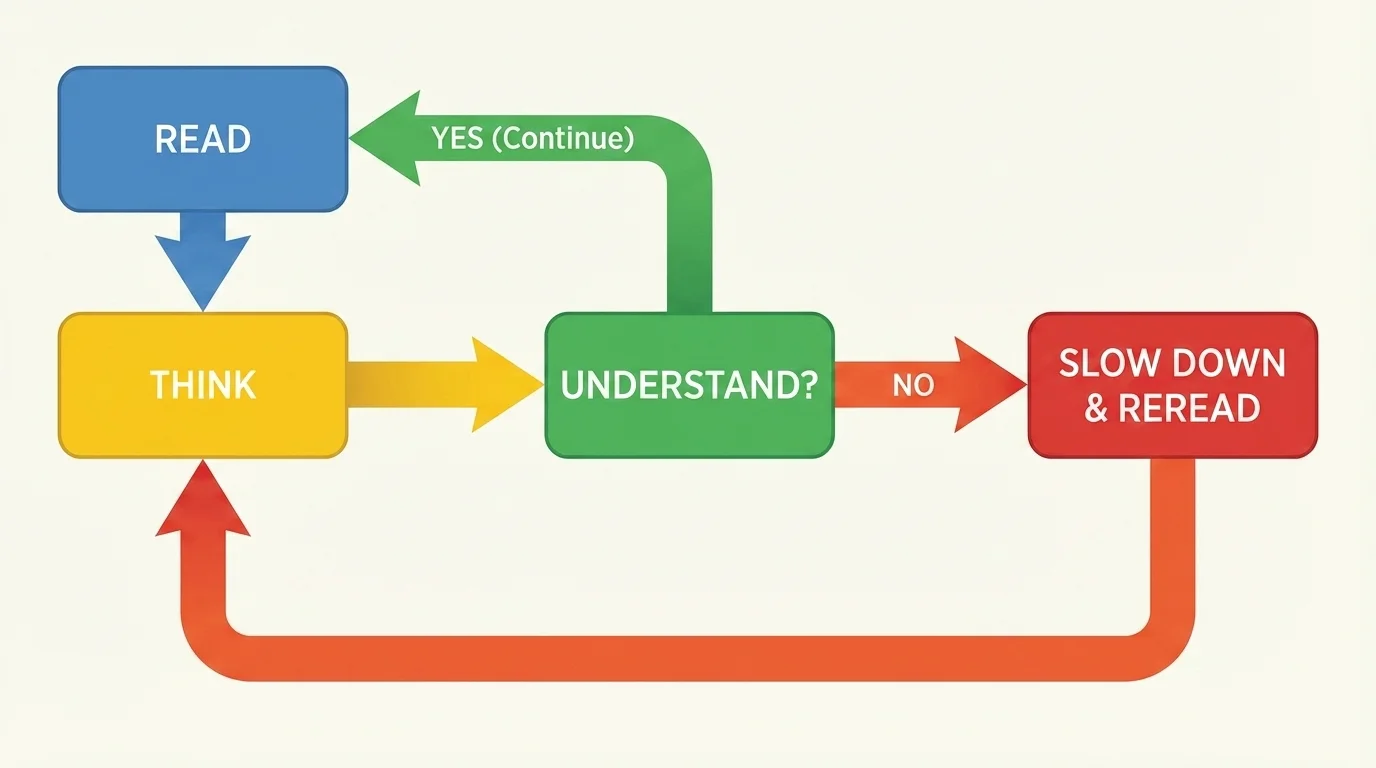
[Figure 3] Strong readers focus on comprehension, which means understanding what they read. They pay attention to whether the words make sense, and the figure shows this as a simple loop: read, think, notice confusion, and adjust the speed.
This is called monitoring. Monitoring means checking yourself while you read. You might think, "Do I get this?" If the answer is no, a good next step is to slow down, reread, or look again at the heading or picture.
When a sentence is confusing, do not just keep zooming ahead. Stop. Go back. Read more slowly. Sometimes reading one part a second time is the smartest choice. Careful readers are not readers who never get confused. They are readers who notice confusion and fix it.
You can also check understanding by asking yourself simple questions: "What is this mostly about?" "What did I just learn?" "What step comes next?" These little checks help you know whether your reading speed is working.
You use this skill in many places, not only during reading class. When you read game rules, you need careful reading so everyone plays correctly. When you read a cereal box to find the flavor, quick reading is enough. When you read a page about penguins in a science book, you may read steadily but slow down at the hardest facts.
Think about cooking with an adult. A recipe might have a list of ingredients and then directions. You may quickly scan the ingredient list to see whether you have milk. Then you slow down for the steps so the food turns out right. That is adjusting reading rate in real life.
In school, this skill helps with tests and assignments too. You may quickly look over the page first. Then you read the important question carefully. Later, you might go back to a passage and reread one part slowly to find the answer. The self-checking habit helps here because you notice when you need to change speed.
You already know that good readers use pictures, titles, and important words to help them understand. Adjusting reading rate is another tool that works with those skills.
One important idea stays true in every situation: the best readers are not always the fastest readers. The best readers are the ones who choose a speed that fits the text, the task, and their understanding. Just as we saw earlier in [Figure 1], one person may read a story, a sign, and a fact page in three different ways.
As you grow as a reader, this skill becomes more natural. You will begin to notice, almost without thinking, when to glide, when to pause, and when to reread. That is a sign of a thoughtful, flexible, and confident reader.
