Have you ever heard someone read a story like a robot: one... word... at... a... time? The words may be correct, but the story does not sound alive. Strong readers do more than say words. They read smoothly, pay attention to punctuation, and make their voices match the meaning. That is what helps a story sound funny, exciting, surprising, or calm.
When you read well, your brain does not have to work so hard on every single word. That means you can think more about what the text is saying. Reading with accuracy and fluency is like riding a bike and keeping your balance. At first, you think about every move. Later, it feels smoother, and you can enjoy where you are going.
Accurate reading means reading the words correctly. Fluent reading means reading smoothly, at a steady pace, and with expression. Fluent readers do not rush, and they do not read too slowly. They read in a way that sounds natural.
As you become a stronger reader, you also learn to notice phrasing, intonation, and punctuation. These are big ideas, but they are easy to understand. Phrasing means grouping words together so they make sense. Intonation means changing your voice to match the meaning. Punctuation is the set of marks, like periods and commas, that help show how to read a sentence.
Accuracy means saying the words correctly.
Fluency means reading smoothly, correctly, and with expression so the meaning is clear.
Good reading sounds natural. Listen to the difference between these two ways of reading: The little dog ran across the yard. A choppy reader might pause after every word. A fluent reader says the sentence smoothly because the words belong together.
To read accurately, readers use what they know about letters, spelling patterns, and word parts. This is called decoding. When you see a new word, you do not just guess. You look carefully at the letters and think about the sounds and parts you know.
For example, if you see the word sunshine, you can notice two smaller parts: sun and shine. If you see jumped, you may know the base word jump and the ending -ed. If you see reading, you can spot read and -ing. Breaking words into parts often makes them easier to read.
Spelling patterns help too. A reader may know that night and light share the same ending pattern. A reader may also know common vowel teams in words like team, boat, and rain. When you know these patterns, you can read more words quickly and correctly.
Word meaning can also help. If a sentence says, The kitten curled up on the soft blanket, the word blanket makes sense there. If someone accidentally reads bucket, the sentence no longer sounds right. Accurate readers use both the letters they see and the meaning of the sentence.
You already know that letters stand for sounds and that many words have parts you can recognize. Strong readers keep using those skills even in longer grade-level text.
Sometimes a reader meets a longer word such as helpful, snowing, or careless. Looking for a base word and an ending can help: help + ful, snow + ing, care + less. This makes reading more accurate and helps with understanding too.
[Figure 1] Fluent readers do not read one word at a time in a long line of stops. They read groups of words that belong together. These groups are called phrases. Phrases help a sentence sound smooth and make the meaning easier to follow.
Look at this sentence: After lunch, the children played on the sunny playground. A fluent reader might group it like this: After lunch, / the children played / on the sunny playground. Those groups help the listener understand the sentence more easily.
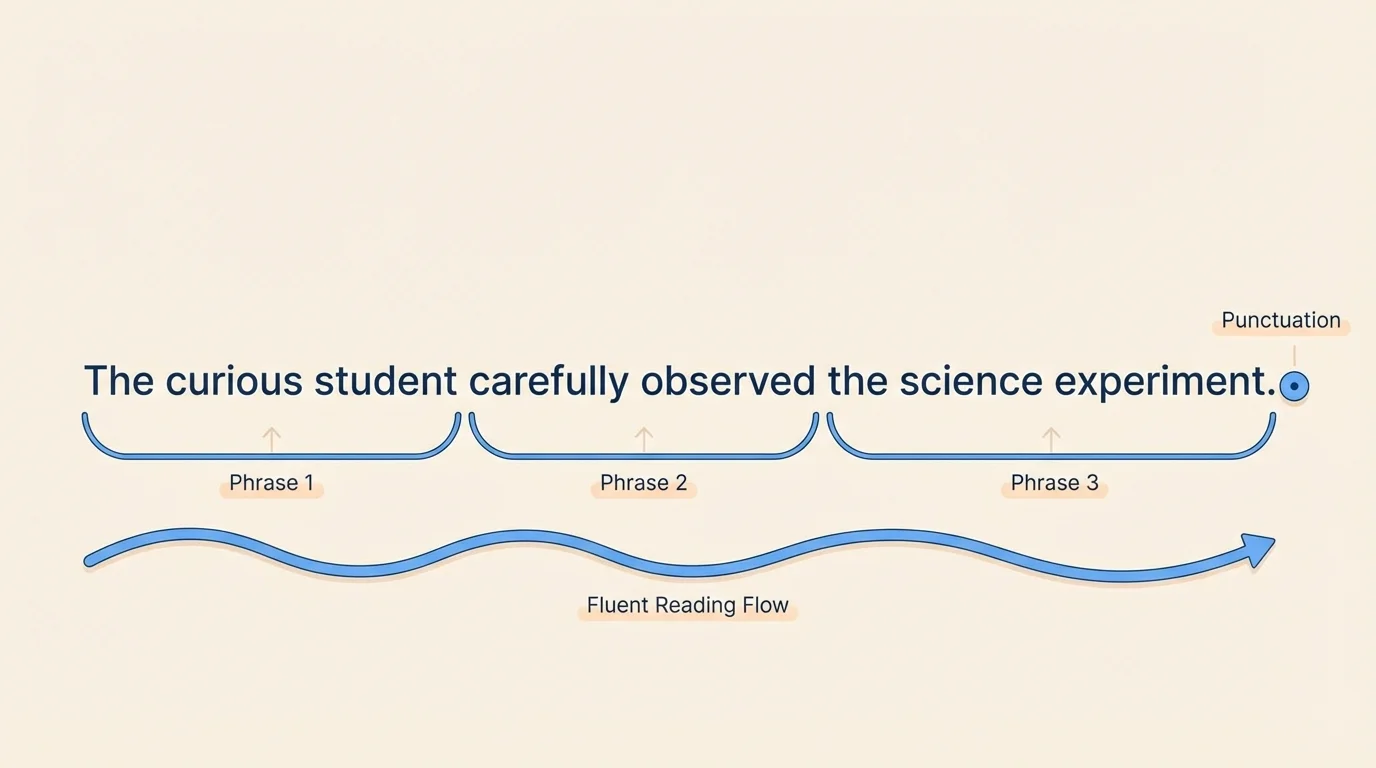
If a reader says every word separately, the meaning can get lost. Compare these two readings: The boy / with the red hat / waved sounds clear. But The / boy with / the red / hat waved sounds awkward because the words are broken apart in the wrong places.
Reading in phrases is a little like singing a song with the right rhythm. The words move together in a pattern. Later, when you read stories aloud or read silently, this smooth pattern helps your brain hold on to the meaning.
Example of phrasing
Sentence: My grandmother baked warm cookies for the whole family.
Step 1: Find ideas that belong together.
My grandmother is one idea, baked warm cookies is another, and for the whole family is another.
Step 2: Read the sentence in groups.
My grandmother / baked warm cookies / for the whole family.
Step 3: Say it smoothly.
The sentence sounds more natural and is easier to understand.
When you hear someone read well, you may notice that they pause at natural places, not random places. That is one sign of fluency. As we saw in [Figure 1], grouping words into chunks helps the reader sound more like a speaker telling a meaningful message.
Expression is the feeling and life in your voice when you read. Intonation is part of expression. It means your voice goes up, down, louder, softer, faster, or slower to match what the words mean.
If a character says, I can't believe it!, the voice should sound surprised. If a sentence says, She whispered in the quiet room, the voice might become softer. If a question asks, Are you coming with us?, the voice often rises at the end.
Expression is important because writing carries meaning not just through words, but through the way those words should sound. A sentence like We won the game! should not sound flat and sleepy. The voice should show excitement. A sentence like The baby is sleeping. should sound calm and gentle.
Readers who sound expressive are often better able to understand what they read because they are paying attention to the meaning, not just saying the words.
When reading dialogue, expression matters even more. Dialogue means the words spoken by characters. If one character is scared and another is cheerful, the voices should not sound exactly the same. You do not need to act like you are on a stage, but you do want your voice to match the feeling in the text.
[Figure 2] Punctuation acts like a set of reading signals. These marks tell you when to stop, when to pause, when to ask, and when to show excitement.
A period tells you to stop at the end of a statement. A question mark tells you the sentence is asking something. An exclamation mark shows strong feeling such as excitement, surprise, or alarm. A comma tells you to make a short pause inside a sentence.
Read these examples and notice how the punctuation changes the voice: You found it. This sounds calm. You found it? This sounds like a question. You found it! This sounds excited or amazed.
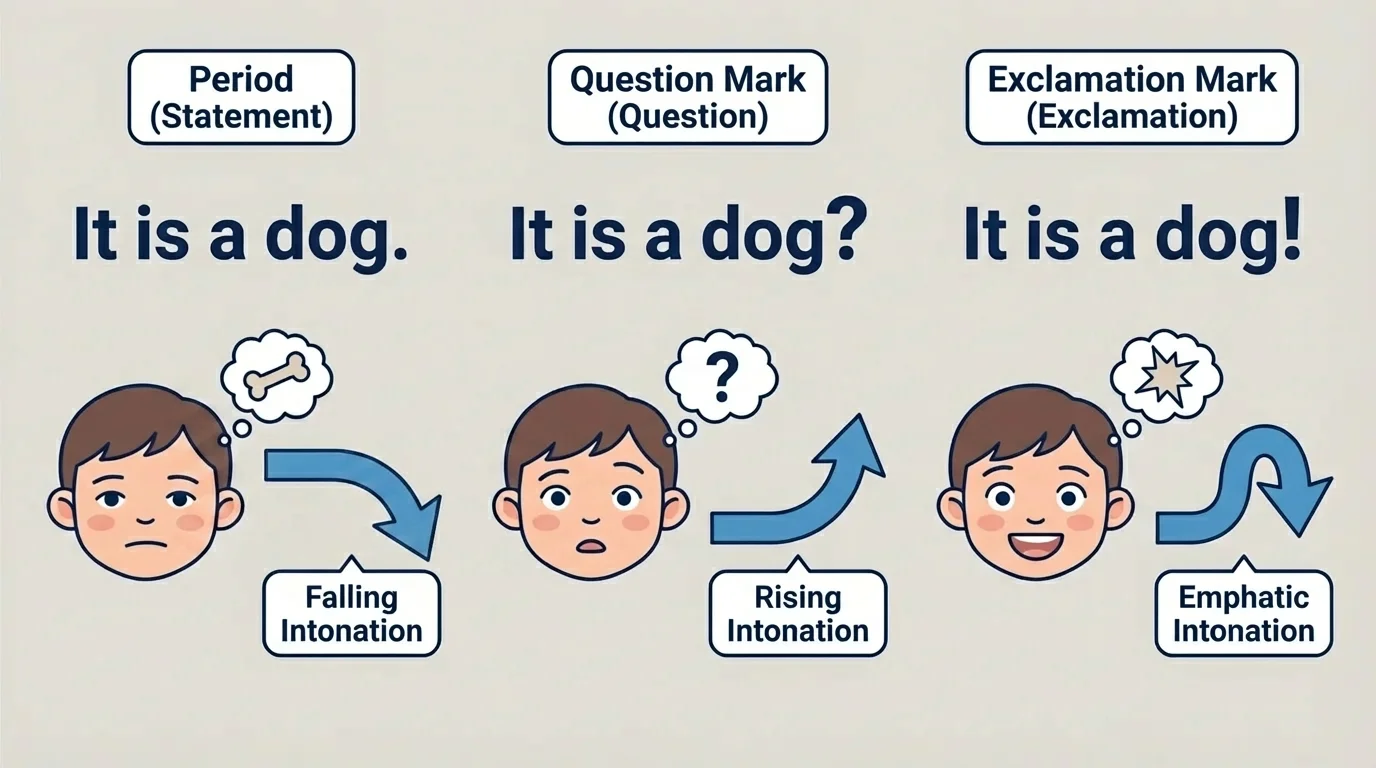
Quotation marks also matter. They show the exact words a character says. In a sentence like "Wait for me!" said Sam., the words inside the quotation marks are spoken aloud by Sam. The exclamation mark helps you know Sam is speaking with strong feeling.
Commas can change how smoothly a sentence is read. In Before dinner, we washed our hands, the comma helps separate the beginning part from the rest. Without that pause, the sentence may sound rushed. Punctuation supports both fluency and meaning.
| Punctuation mark | What it tells the reader | Example |
|---|---|---|
| Period | Stop at the end of a statement | The rain has stopped. |
| Question mark | Use a questioning voice | Can we go outside? |
| Exclamation mark | Show strong feeling | Watch out! |
| Comma | Pause briefly | After school, I drew a picture. |
| Quotation marks | Show spoken words | "I am ready," Maya said. |
Table 1. Common punctuation marks and how they guide a reader's voice.
Later, when you hear a reader pause smoothly and use the right voice changes, you can often tell they are paying attention to punctuation. That is why punctuation is not just for writing. It is also a reading tool.
[Figure 3] Strong readers listen to themselves while they read. This is called self-monitoring. It means noticing when something does not look right, sound right, or make sense.
Suppose a sentence says, The horse galloped across the field, but a reader says The house galloped across the field. The word house begins with similar letters, but it does not make sense. A self-monitoring reader stops, goes back, and corrects the mistake.
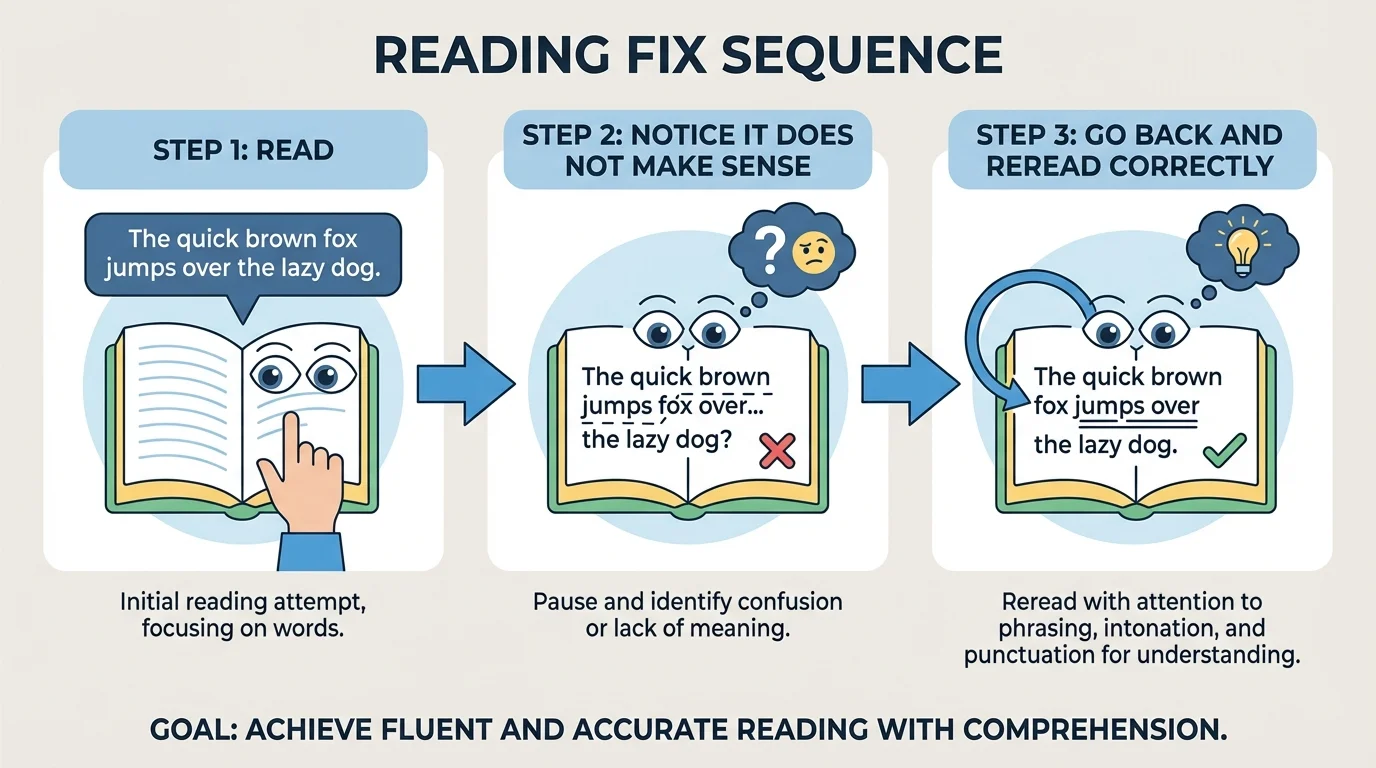
Sometimes the mistake is about expression, not just a word. If a reader says a question as if it were a plain statement, the sentence may sound wrong. Going back and rereading can fix that too.
Here are clues that tell you to stop and check your reading: the sentence does not make sense, the words sound strange together, punctuation was ignored, or the reading sounds too choppy. Good readers do not pretend mistakes never happen. They fix them.
How self-monitoring helps
When readers notice errors and correct them, they protect meaning. That means they understand more of the story or information text because they keep checking that the words, the sounds, and the ideas all fit together.
The process is simple but powerful: read, notice, reread, and fix. That habit helps readers become more accurate and more fluent over time.
Comprehension means understanding what you read. Fluency supports comprehension because when reading becomes smoother, your brain can spend more energy thinking about the meaning.
If a reader struggles over many words, it is harder to remember what happened at the beginning of the sentence. But if the words come more easily, the whole sentence stays together in the mind. Then the reader can picture events, understand facts, and notice details.
Think about this sentence: The tiny seed pushed through the dark soil and reached for sunlight. A fluent reader can hear the action and picture the growing plant. A reader who gets stuck on several words may miss the image and the meaning.
Fluency also helps with different kinds of text. In stories, it helps you follow characters and events. In information books, it helps you understand directions, facts, and explanations. Smooth reading supports learning in every subject.
"Read the words, hear the meaning, and let your voice show it."
That idea is important because reading is not only about sounding out words. It is about making meaning from print. Accuracy and fluency work together to help you do that well.
Fluent reading is useful in many real places, not just during reading time at school. You use it when reading signs, game directions, recipes, classroom instructions, poems, and short plays. In all of those places, punctuation and expression matter.
When you read a poem aloud, your voice may follow rhythm and feeling. When you read directions for a game, accuracy matters because one wrong word can change what to do. When you read a note from a friend, punctuation can help you understand whether the message is calm, silly, or excited.
Even when reading silently, fluency still matters. Your mind often "hears" the words inside your head. Smooth inner reading helps ideas connect. That is one reason fluent readers often understand text better, even when they are not reading out loud.
Every strong reader started as a beginner. At first, reading may feel slow because you are learning how letters, patterns, words, and meaning fit together. With time, your reading becomes more accurate, your phrasing grows smoother, and your voice begins to match the text naturally.
One wonderful thing about reading is that many parts work together at once. You look at the words, think about spelling patterns, notice endings, connect ideas, watch punctuation, and use expression. It may sound like a lot, but each part helps the others.
When you read grade-level text accurately and fluently, you are doing more than saying words on a page. You are turning print into meaning. You are helping stories come alive and helping information become clear. That is the power of strong reading.
