Some words look very large at first, almost like a mountain to climb in reading. But here is the secret: big words are usually not one giant mystery. They are made of smaller parts. When readers know how to break a long word apart, that "hard" word becomes much easier to read. That is how skilled readers tackle new words in books, science texts, signs, and stories.
When you see a long word, you do not have to guess. Guessing can lead to mistakes. Instead, you can be a word detective. You can look for parts you know, patterns you have seen before, and clues from the sentence. These strategies help you read with more accuracy, which means reading the word correctly.
A long word may have syllables, familiar spelling patterns, and word parts with meaning. Good readers often use more than one strategy at the same time. For example, they may break a word into syllables and also notice a suffix at the end.
You already know that every syllable has a vowel sound. You also know many short-vowel and long-vowel patterns. Those earlier skills help you decode bigger words now.
As words get longer, the same reading rules still help. You just use them in smaller chunks instead of trying to read the whole word at once.
A multisyllabic word is a word with more than one syllable. The word sunset has two syllables: sun and set. The word animal has three syllables: an, i, and mal. The word helicopter has four syllables.
Syllable means a word part with one vowel sound. A multisyllabic word has two or more syllables. To decode means to figure out how to read a word by using letter sounds, spelling patterns, and word parts.
Sometimes a multisyllabic word is made of two smaller words, like sunflower. Sometimes it has a base word with an ending, like jumping. Sometimes it has several parts, like careless or replaying.
One strong strategy is chunking. Chunking means breaking a long word into smaller, readable parts, as [Figure 1] shows. Instead of staring at the whole word, you find one part, then the next part, and then blend them together.
You can clap the beats in a word to hear its syllables. For example, robot has two beats: ro and bot. banana has three beats: ba, na, na. Hearing the beats helps you know where to split the word.
When you read pumpkin, you can split it into pump and kin. When you read computer, you can try com, pu, and ter. Read each part, then say the whole word smoothly.
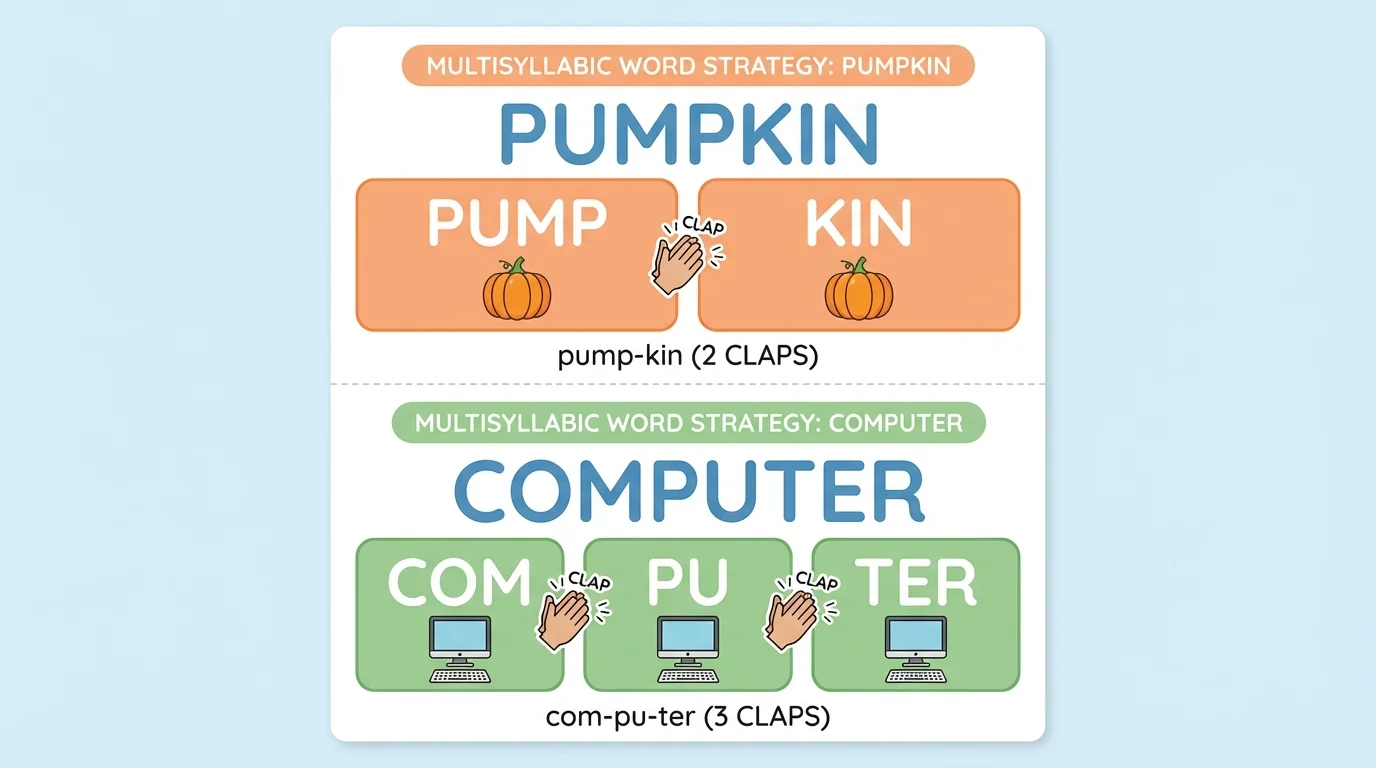
This strategy is helpful because your brain can handle small pieces more easily than one long string of letters. If one chunk does not sound right, go back and try a different split.
Later, when you read words such as dinosaur or yesterday, the same idea still works. As in [Figure 1], you read the chunks in order and blend them together.
Another important strategy is noticing vowel patterns. Vowels give big clues about how each syllable may sound, as [Figure 2] illustrates. When readers notice the vowel pattern, they are more likely to pronounce the syllable correctly.
A closed syllable usually has a short vowel sound, like pic in picnic. An open syllable often ends with a vowel and may have a long vowel sound, like ti in tiger.
Some syllables have vowel teams, such as team or rain. Some words have a silent e, like cupcake. In cupcake, the first part is cup and the second part is cake. Seeing a-e in cake helps you know the vowel says its name.
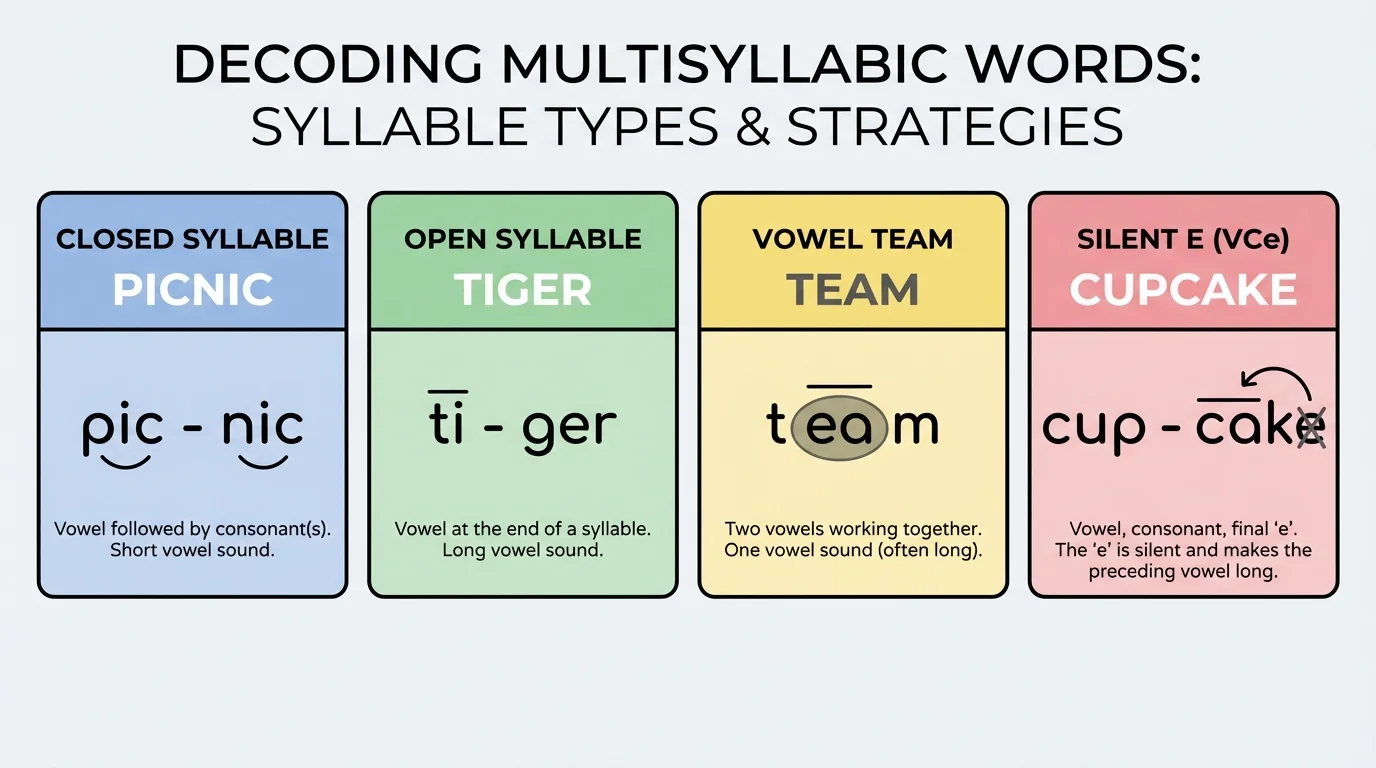
If you are unsure about a word, look carefully at the vowels in each chunk. For example, in sunshine, the first chunk sun has a short vowel sound, and the second chunk shine has a long i because of the silent e.
Using vowel clues to decode
Step 1: Look at the word inside.
Step 2: Split it into chunks: in and side.
Step 3: Notice the vowel pattern. In has a short vowel sound. Side has a long i because of the silent e.
Step 4: Blend the chunks: inside.
Looking at vowel patterns helps the reader say each syllable more accurately.
These clues are useful in many school words, story words, and words you hear every day.
Many long words include parts that mean something. This is where prefixes, suffixes, and a base word help, as [Figure 3] shows. If you spot these parts, you can read the word more easily and understand it better too.
A prefix comes at the beginning of a word. In unhappy, un- is the prefix. A base word is the main word, like happy. A suffix comes at the end, like -ful in helpful or -ness in kindness.
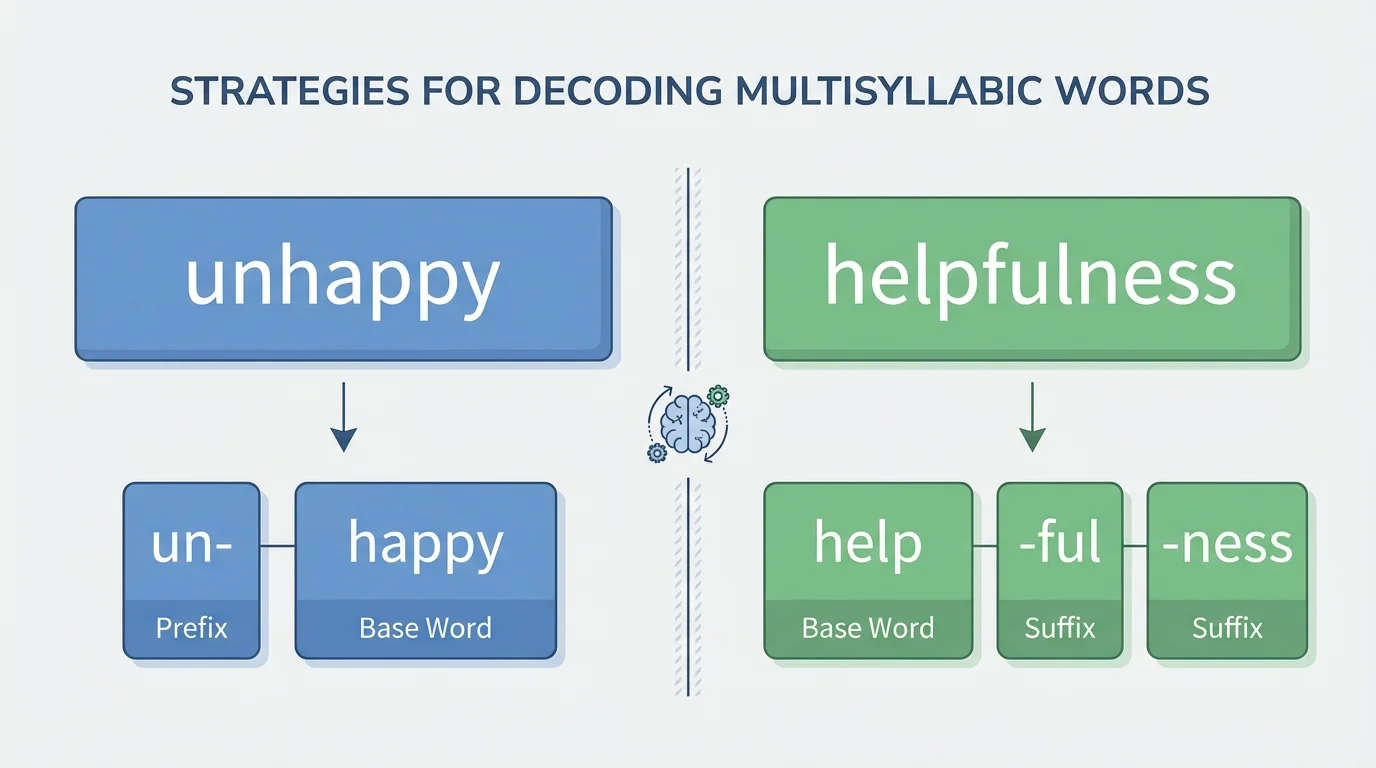
When you see replay, you may notice re- and play. When you see jumping, you may notice jump and -ing. When you see careless, you may notice care and -less. These meaningful parts make long words less confusing.
Word parts can also help fix mistakes. If a reader says helper when the word is helpful, noticing the suffix can help. The ending is different, so the word must be read differently.
Meaning and reading work together
When you find a base word you know, the word becomes easier to decode. For example, if you know play, then played, playing, and replay are easier because the main part stays familiar.
As you build stronger reading skills, you will notice more and more of these meaningful pieces, just as [Figure 3] breaks bigger words into helpful parts.
After you decode a word, check it in the sentence. Ask yourself, "Does it sound right?" and "Does it make sense?" This is called using context. Context means the words and ideas around the word.
Suppose the sentence says, The kitten is playful. If you read the word as playfell, it does not sound right and it does not make sense. But playful fits the sentence. The sentence helps you check your reading.
Context is a checking strategy, not a guessing strategy. First, look closely at the letters and word parts. Then use the sentence to make sure your reading matches the word.
Strong readers often reread a sentence after decoding a tricky word. That quick reread helps the word sound smoother and helps the meaning click into place.
This strategy is especially helpful when two words look similar. The sentence can help you decide which one makes sense.
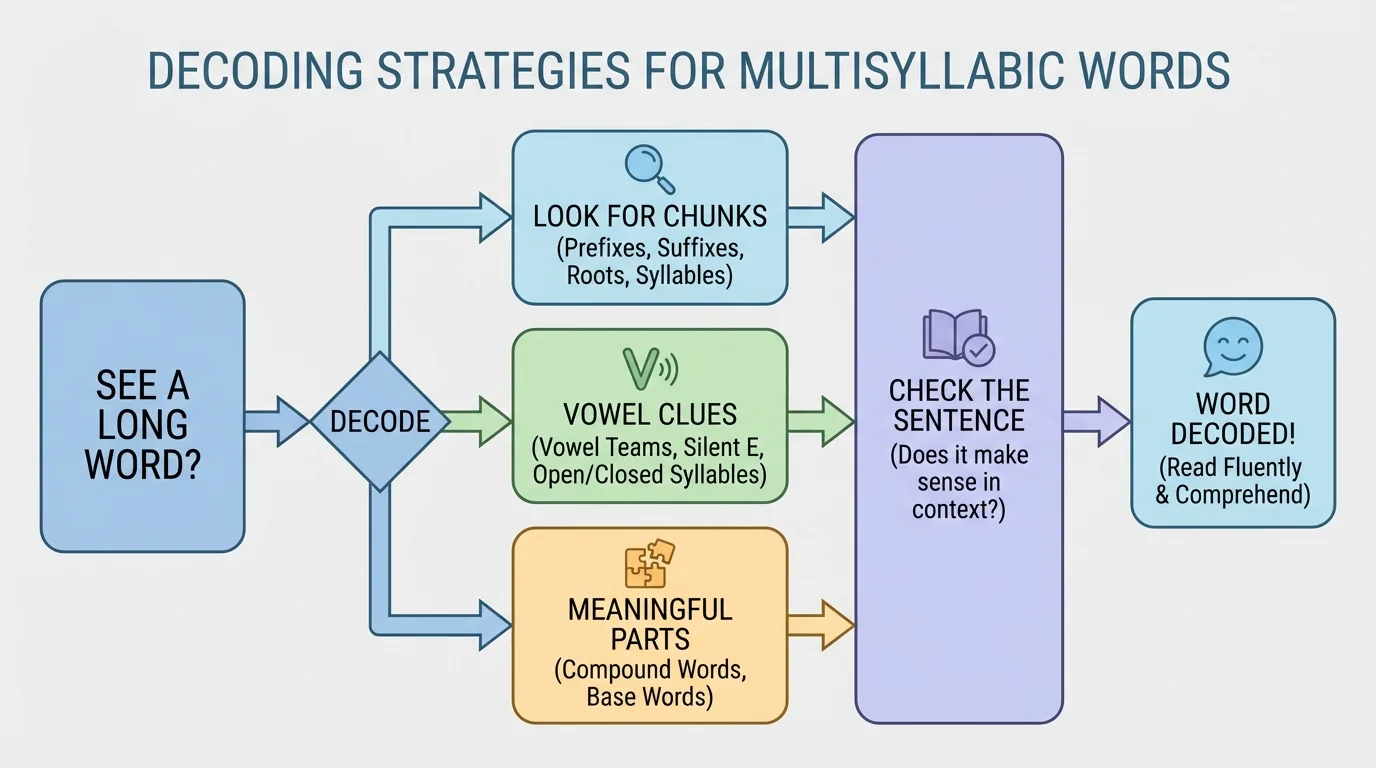
[Figure 4] Good readers choose strategies based on what they see in the word. If the word is long, start by chunking it into syllables. If one part has a special vowel pattern, use that clue. If you notice a prefix or suffix, use that too.
Sometimes one strategy is enough. Sometimes you need two or three strategies together. For sunflower, chunking may be enough: sun plus flower. For replaying, you might use meaningful word parts and syllables: re plus play plus ing.
Here are some smart choices readers make:
| What you notice | Helpful strategy | Example |
|---|---|---|
| A very long word | Break into syllables | ba-na-na |
| A special vowel clue | Look at the vowel pattern | cup-cake |
| A familiar beginning or ending | Look for prefix, base word, suffix | un-happy |
| The word still seems odd | Read the sentence again and check meaning | The puppy is playful. |
Table 1. Decoding strategies matched to the clues a reader notices in a word.
As [Figure 4] reminds you, decoding is not only about one rule. It is about choosing a strategy that matches the clue you see.
One common mistake is skipping part of the word. A reader may see remembering and only read remember. To fix this, look all the way to the end of the word and check for a suffix.
Another mistake is guessing from the first letter. If a sentence says The rabbit hopped quickly, a reader might guess happy just because both words begin with h. That is why readers must look through the whole word, not just the beginning.
A third mistake is reading each chunk correctly but not blending them smoothly. If that happens, say the chunks again a little faster until they sound like a real word.
Fixing a decoding mistake
Step 1: A reader sees careless and says care.
Step 2: The reader looks again and notices the ending -less.
Step 3: The reader puts the parts together: care plus less.
Step 4: The reader checks the sentence to be sure careless makes sense.
Looking through the whole word helps the reader avoid leaving off important parts.
Each time you slow down, notice the parts, and reread if needed, you become a stronger decoder.
You can use these strategies everywhere: while reading a story, learning new science words, following game directions, or reading signs in the world around you. Bigger words stop feeling scary when you know what to do with them.
When you meet a new multisyllabic word, remember this plan: break it into chunks, notice the vowels, look for meaningful word parts, and check the sentence. These habits help you read accurately and understand more of what you read.
Every long word is a chance to practice smart reading. The more you use these strategies, the more automatic they become. Soon, words that once looked enormous will feel like words you know how to solve.
