Have you ever said, "Recess is the best part of school," and then quickly added why? Maybe you said it is fun, you can run, and you get to play with friends. That is what strong writers do. They do not just say what they think. They connect their opinion to reasons so the reader understands them.
When you write about what you think or feel, you are sharing an opinion. An opinion is not the same as a fact. A fact can be checked and proved. An opinion tells what someone likes, believes, or chooses.
A reason tells why you have that opinion. Reasons help your writing sound strong and clear. If you say, "Dogs are great pets," the reader may wonder, "Why?" A reason answers that question. You might write, "Dogs are great pets because they are playful."
Opinion means what someone thinks or feels.
Reason means why someone thinks or feels that way.
Linking words are words that connect ideas so writing flows smoothly.
Here are some examples of opinions and reasons:
Opinion: Ice cream is a tasty dessert.
Reason: It is sweet and cold.
Opinion: Reading before bed is a good habit.
Reason: It helps me feel calm.
Opinion: Art is an exciting class.
Reason: I get to paint and draw.
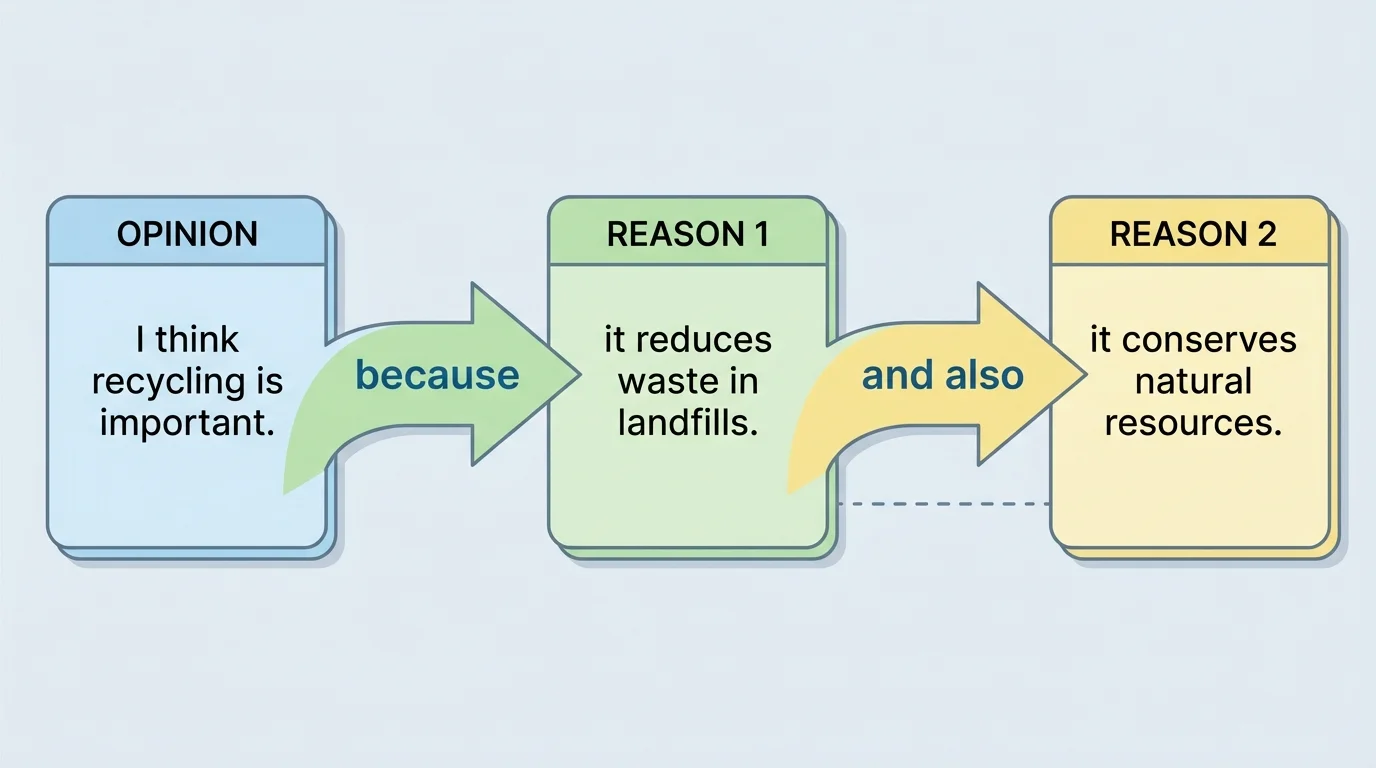
Linking words join ideas together, as [Figure 1] shows with an opinion connected to reasons. They are like little bridges in a sentence. Instead of writing choppy ideas, writers use linking words to help the reader follow the meaning.
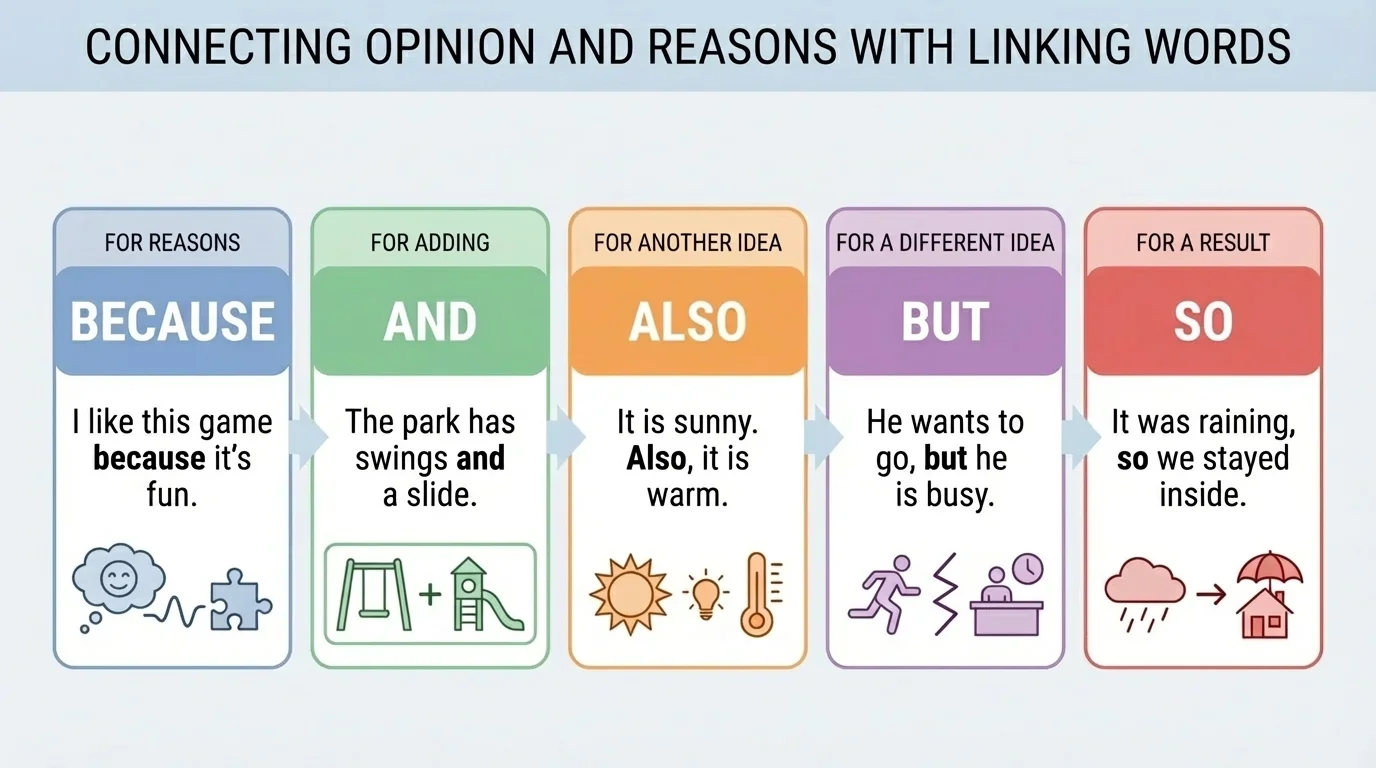
Some helpful linking words are because, and, also, but, and so. Each one has a job. One word may tell why, another may add a new reason, and another may show a different idea.
Look at these examples:
I like rainy days because I can read inside.
Pandas are fun to learn about, and they have unusual habits.
My sandwich was delicious. It also had my favorite cheese.
I wanted to play outside, but it started to snow.
I finished my homework, so I could relax.
Writers often use because, and, and also when they share an opinion and support it with reasons. These words help ideas stay connected instead of sounding bumpy or unfinished.
Read this sentence: "Soccer is fun." That is an opinion, but it is short. Now read this one: "Soccer is fun because I get to run fast." The second sentence tells more. It explains the opinion.
Now read: "Soccer is fun because I get to run fast and play with my team." This sentence is even stronger. It gives more than one reason.
You can also add another sentence with also: "Soccer is fun because I get to run fast and play with my team. I also like scoring goals." Now the writing sounds connected and complete.
How connection helps the reader
When ideas are linked, the reader can follow your thinking step by step. First the writer shares an opinion. Next the writer gives a reason. Then the writer may add another reason. Linking words help the reader move from one idea to the next without getting confused.
Without linking words, writing can sound like a list: "Pizza is the best food. It is cheesy. It is warm. I like the crust." With linking words, the same idea becomes smoother: "Pizza is the best food because it is cheesy and warm. I also like the crust."
A strong piece of opinion writing often begins with an opinion sentence. Then it gives one or more reasons. Linking words help each part fit together.
Here are some useful sentence frames:
My favorite ______ is ______ because ______.
I think ______ is the best because ______.
I like ______ because ______ and ______.
I think ______ is great. I also like it because ______.
Now look at a short paragraph:
"I think the library is a wonderful place because it is quiet and full of books. I also like the library because I can find stories about animals. The library helps me learn new things."
This paragraph starts with an opinion. Then it gives reasons. The linking words help the ideas fit together.
Example: turning simple ideas into connected writing
Simple ideas: "Birds are amazing. They can fly. They sing."
Step 1: Start with the opinion.
"Birds are amazing."
Step 2: Add a reason with because.
"Birds are amazing because they can fly."
Step 3: Add another reason with and or also.
"Birds are amazing because they can fly and sing beautiful songs."
The connected sentence is stronger than the short list of ideas.
When you write a paragraph, each sentence should stay on the same topic. If your opinion is about a favorite animal, your reasons should tell why that animal is your favorite. Do not jump to a different topic in the middle.
Different linking words do different jobs, and [Figure 2] helps compare them. If you want to tell why, because is usually the best choice. If you want to add ideas, and or also works well. If you want to show a different idea, use but. If you want to show what happened next, use so.
Read these pairs:
"I like carrots because they are crunchy." The word because gives a reason.
"I like carrots, and I like peas." The word and adds another idea.
"I like carrots. I also enjoy cucumbers." The word also adds one more idea.
"I like carrots, but I do not like celery." The word but shows a difference.
"I packed my lunch, so I was ready for school." The word so shows a result.
| Linking word | What it does | Example |
|---|---|---|
| because | tells why | I like music because it makes me happy. |
| and | adds an idea | I like music and dancing. |
| also | adds another idea | I also like singing. |
| but | shows a different idea | I like loud drums, but my sister likes soft piano. |
| so | shows a result | I practiced, so I got better. |
Table 1. Common linking words, the job each one does, and a simple example sentence.
Many opinion pieces use because most often because writers need to explain their thinking. Later, they may use and or also to add more reasons, just like the pattern shown earlier in [Figure 1].
Even very short writing can become much clearer with one small linking word. The word because often turns a plain opinion into a convincing sentence.
You do not need to use every linking word in one piece of writing. Good writers choose the word that matches what they want to say.
Linking words help, but they work best when the whole sentence is clear. Start with a capital letter. End with the right punctuation mark. Make sure your sentence tells a complete idea.
Read this incomplete writing: "My favorite season because snow." It has a linking word, but it is missing important parts. A complete sentence would be: "Winter is my favorite season because I love playing in the snow."
Writers should also check that each reason matches the opinion. If you write, "My favorite fruit is strawberries because my backpack is blue," the reason does not fit. A better reason would be, "My favorite fruit is strawberries because they are sweet."
If you use and too many times, your sentence can become too long. It is okay to stop and start a new sentence. For example: "I like the park because it has swings and a slide. I also like it because I can play tag there." This is clearer than writing one very long sentence.
Students often write opinions about school, books, animals, foods, games, and places. These are great topics because they are familiar. Here are some examples of opinion writing:
"I think science is exciting because we learn about nature."
"My favorite book character is kind and brave. I also like this character because she helps others."
"Lunch should have more fruit because fruit is healthy and tasty."
"I like drawing after school because it helps me relax."
Example: opinion about a book
Opinion: "Charlotte's Web is a wonderful book."
Step 1: Add a reason with because.
"Charlotte's Web is a wonderful book because the characters are memorable."
Step 2: Add another reason.
"Charlotte's Web is a wonderful book because the characters are memorable and the story is heartwarming."
Step 3: Add one more connected sentence.
"I also like how the friends care for one another."
Together, these sentences make a clear opinion with supporting reasons.
When you write about a book, make sure your reasons come from the story. When you write about a topic, make sure your reasons connect to that topic. This keeps your writing focused.
Sometimes writers forget to include a reason. They write only the opinion: "Cats are the best." The reader still needs to know why. Adding "because they are soft and playful" improves the writing.
Sometimes writers choose the wrong linking word. If you mean to tell why, use because instead of and. "I like summer and I can swim" sounds odd. "I like summer because I can swim" sounds right.
Another mistake is repeating the same pattern too many times: "I like art because I paint. I like art because I draw. I like art because I create." This is not wrong, but it can sound dull. You can improve it by mixing linking words: "I like art because I paint and draw. I also enjoy making new creations."
Good writers reread their work. They ask, "Did I state my opinion? Did I give reasons? Did I use linking words to connect my ideas?" Those questions help make writing stronger.
You may already know that a sentence begins with a capital letter and ends with punctuation. Those rules still matter in opinion writing. Linking words connect ideas, but complete sentences make the writing easy to read.
When you use linking words well, your opinion writing becomes easier to understand. Your reader can see what you think and why you think it. That is the power of clear, connected writing.
