Have you ever read a story or an article and then been asked a question about it? Sometimes one tiny sentence is not enough. A strong writer does more than give a quick answer. A strong writer tells the answer, proves it, and explains it. That is how writing about reading becomes clear and powerful.
When you answer a question about a text, your job is to help your reader understand why your answer makes sense. You do this by using facts, definitions, and details from the text. These parts work together. They make your writing sound thoughtful, careful, and complete.
If a teacher asks, "Why did the boy bring an umbrella?" an answer like "Because he did" is not helpful. It does not tell enough. But an answer like "The boy brought an umbrella because dark clouds filled the sky and the text says rain was coming" is much better. It gives a point and support.
Writers use information from the text so their answers are not just guesses. Good answers are based on what the author says. That means you stay close to the reading and use what you learned.
Main point is the big answer you want to say. Fact is something true that the text tells you. Definition tells what a word or idea means. Relevant detail is a detail that fits the question and helps explain your answer.
When you write, think of your answer like building a small tower. The main point is the top. The facts and details are the strong blocks under it. Without those blocks, the answer can fall apart.
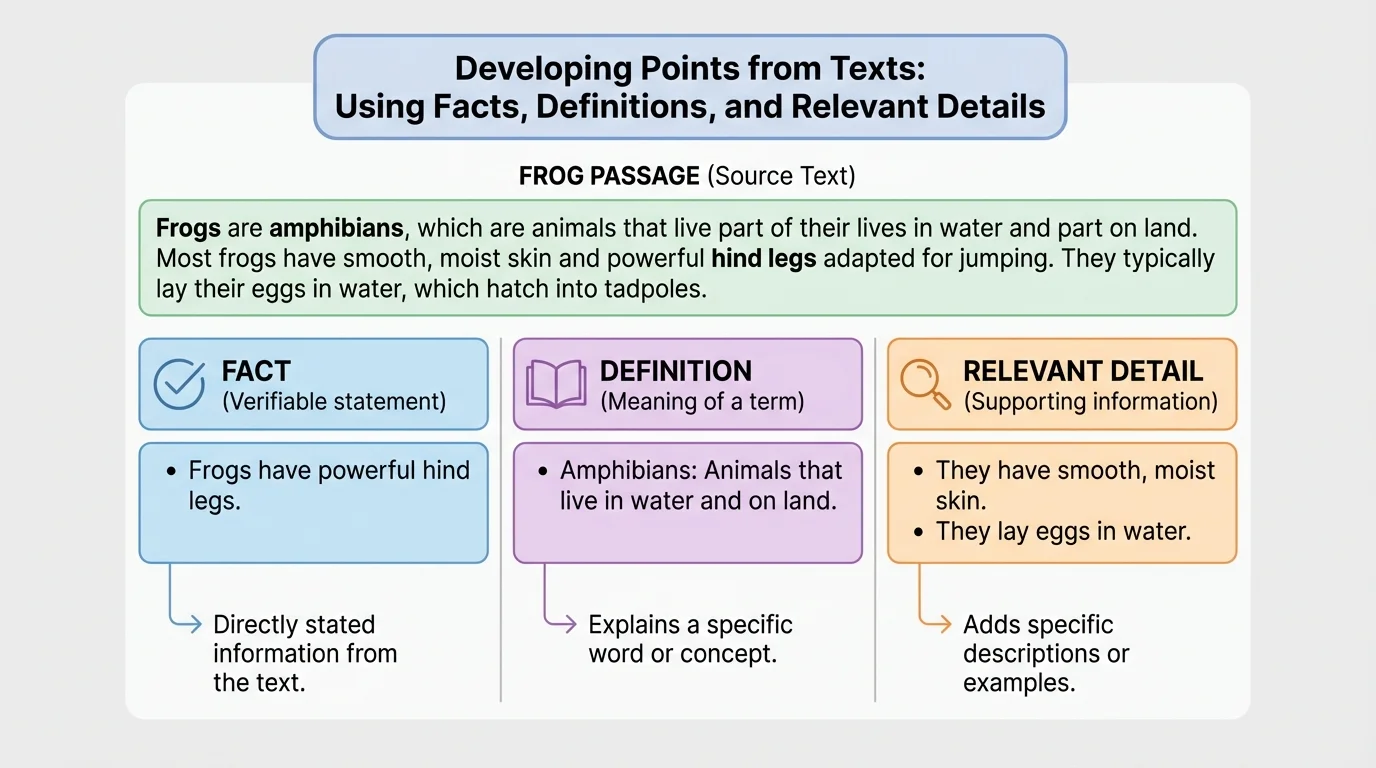
A fact, a definition, and a relevant detail do not all do the same job. They support writing in different ways, as [Figure 1] shows. A fact gives true information from the text. A definition explains a word or idea. A relevant detail adds a piece of information that matches the question.
Think about a short article about frogs. A fact might be: "Frogs lay eggs in water." A definition might be: "Amphibian means an animal that can live in water and on land." A relevant detail might be: "The text says frogs have strong back legs for jumping." If the question is about how frogs move, the detail about back legs helps. The eggs detail would not help as much.
That is why writers must choose carefully. The best support is not just any fact from the text. The best support is the fact or detail that answers the question most clearly.
Some answers sound strong because they are longer, but length is not the same as quality. A short answer with the right fact can be stronger than a long answer with extra information.
As you saw with frogs in [Figure 1], each kind of support has a purpose. When you know the purpose, you can build better responses.
Before adding details, first answer the question. This is your main point. The reader should understand your answer right away.
If the question is "Why is Mia a good friend?" you can begin with, "Mia is a good friend because she helps others." That sentence gives the main point. After that, you can add facts and details from the text.
Starting with the answer helps your writing stay focused. If you begin with random details, the reader may not know what you are trying to say. Say the point first, then support it.
After your main point, add facts from the reading. Facts help prove your answer. They show that you are using the text, not only your own opinion.
Read this question: "How do bees help flowers?" A strong answer could be: "Bees help flowers by carrying pollen from one flower to another. The text says pollen sticks to a bee's body while it drinks nectar." The second sentence gives a fact from the text.
Facts are especially important in informational texts, such as articles about animals, weather, or space. If the article says, "Penguins use their wings to swim," and the question asks how penguins move in water, that fact belongs in your answer.
Use the text as your proof
When you answer a question about reading, the text is like evidence. Evidence means proof. Facts and details from the text help your reader trust your answer because they can see where your idea came from.
You do not need to copy whole paragraphs. Pick the fact that matters most. Then put it into your own words when you can.
Sometimes a question includes a word from the text that may need explaining. A definition can make your answer easier to understand. Definitions are very helpful when the text teaches a new word.
Suppose a science article says, "A habitat is the place where a plant or animal lives." If the question asks, "Why is the forest a good habitat for bears?" you can write, "The forest is a good habitat for bears. A habitat is the place where an animal lives, and the text says the forest gives bears food and shelter." The definition helps explain the idea.
Definitions can come right from the text or from what the text teaches you. They should be simple and connected to the question. If the definition does not help explain your answer, you do not need it.
Writers must be careful not to grab every detail they remember. Choose the details that match the question. A detail is support only when it helps explain your main point.
Look at this example. A story says Leo ran to his sister, shared his snack, and laughed at recess. The question asks, "How do you know Leo is caring?" The best detail is "he shared his snack with his sister." The detail about laughing at recess may be true, but it does not show that he is caring.
Relevant details are like puzzle pieces that fit. If a detail does not fit the question, leave it out. This keeps your writing neat and strong.
Example: Picking the best detail
Question: "Why was the garden healthy?" Text details: it got sunlight, a red fence stood nearby, and the plants were watered every day.
Step 1: Find the main point.
The garden was healthy because it got what plants need to grow.
Step 2: Choose the helpful details.
Sunlight and water are relevant details because they explain healthy growth.
Step 3: Leave out the extra detail.
The red fence may be true, but it does not explain why the garden was healthy.
A strong answer is: "The garden was healthy because it got what plants need to grow. The text says the plants were watered every day and got sunlight."
Notice that the answer does not include every fact from the text. It includes only the details that help answer the question.
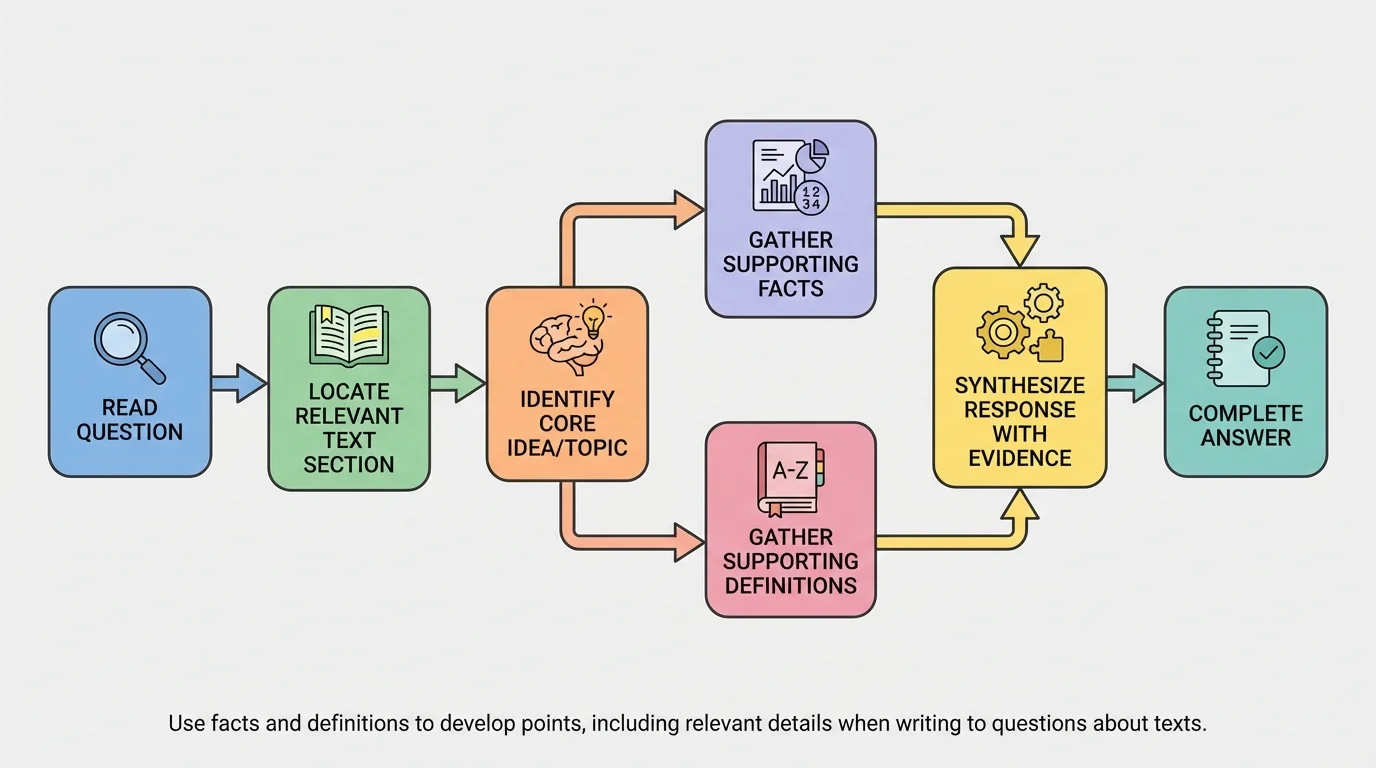
Good writing has a clear order, and [Figure 2] illustrates a simple pattern you can follow: answer the question, add a fact or detail, and explain how it supports your point. This order helps the reader follow your thinking.
One easy way to organize your response is this: first state your main point, next add support from the text, and then explain the support. Sometimes you may end with a short closing sentence that repeats the answer in a fresh way.
Here is the pattern in simple form: point, proof, explanation. You do not need to memorize hard words. Just remember: say it, show it, explain it.
You can hear this order in a strong answer: "Ana was brave when she crossed the bridge. The story says the bridge shook and the river rushed below. This shows Ana was brave because she kept going even though she was scared."
Later, when you write longer answers, the same order still works. As shown earlier in [Figure 2], clear writing often moves step by step.
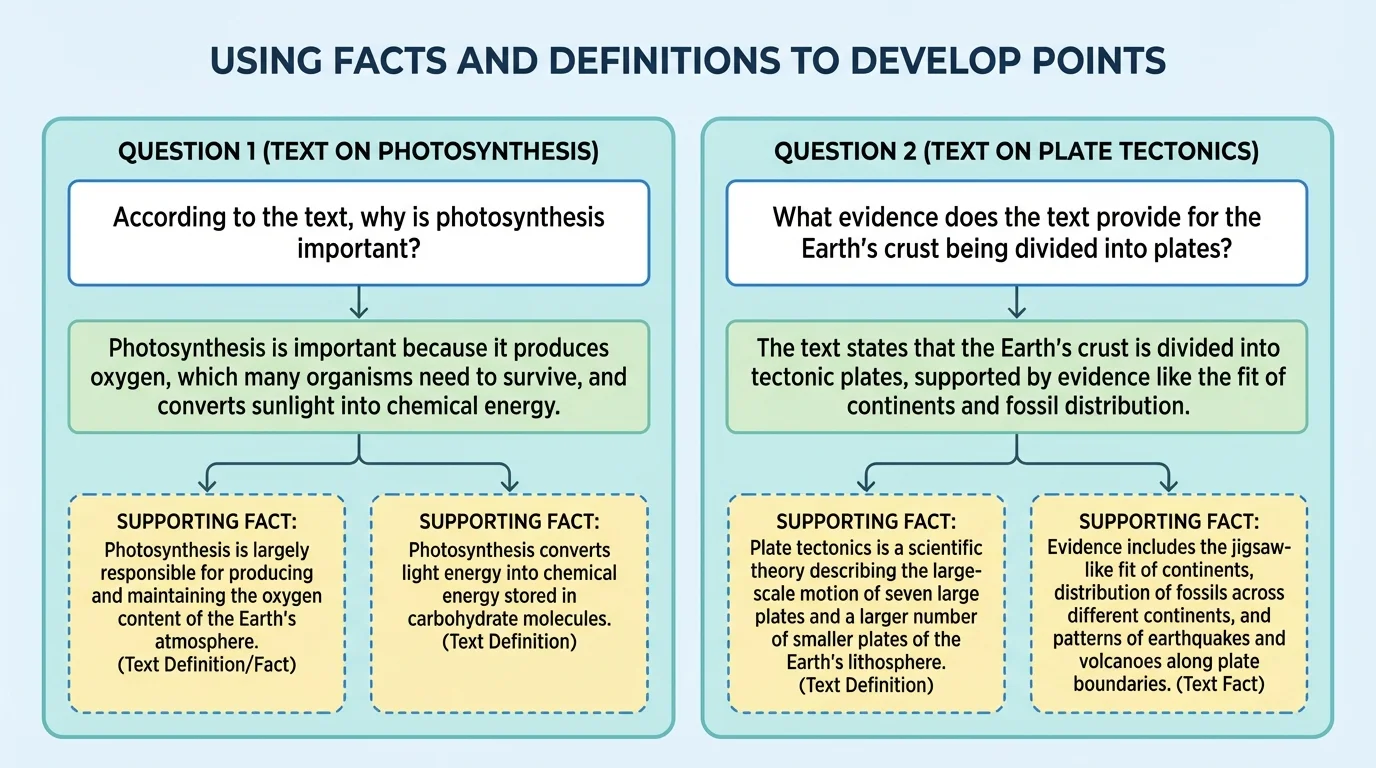
Stories and informational texts are different, but both can be answered with facts and details from reading, as [Figure 3] shows. In a story, you may write about characters, settings, or events. In an informational text, you may write about real animals, places, or ideas.
For a story question, you might answer, "Why did Tia return to the park?" A strong response could be: "Tia returned to the park because she wanted to find the lost dog. The story says she heard barking near the swings, so she went back to help." This answer gives a main point and a detail from the story.
For an informational text question, you might answer, "How do turtles protect themselves?" A strong response could be: "Turtles protect themselves with their shells. The article explains that many turtles pull their heads and legs inside when danger is near." This uses a fact from the article.
Both kinds of answers work because they stay close to the text. The writer does not wander away from the question. The writer chooses support that fits.
Remember that reading and writing work together. First you read carefully to understand the text. Then you write carefully to explain your thinking.
When you compare the two models in [Figure 3], you can see the same writing pattern in both: main point first, support next, explanation after that.
Clear writing is easy to follow. Use complete sentences. Name the person, animal, or topic so the reader knows what you mean. If you use words like he, she, or it, make sure the reader knows who or what those words name.
Helpful sentence starters can make writing easier. You might begin with "The text shows that...," "I know this because...," "The article says...," or "This means...." These starters help connect your ideas.
It is also important to check that your answer is complete. Ask yourself: Did I answer the question? Did I use a fact or detail from the text? Did I explain how the detail supports my answer? If you can say yes, your writing is probably strong.
Example: Turning a weak answer into a strong answer
Question: "Why was the puppy tired?"
Step 1: Weak answer
"Because it was."
Step 2: Add the main point
"The puppy was tired because it played all morning."
Step 3: Add support from the text
"The puppy was tired because it played all morning. The text says it chased a ball, ran across the yard, and jumped after leaves."
Step 4: Explain the support
"The puppy was tired because it played all morning. The text says it chased a ball, ran across the yard, and jumped after leaves. These details show it used a lot of energy."
The last answer is clear, supported, and complete.
Sometimes just one added sentence can make a big difference. Support helps your ideas sound stronger and more thoughtful.
One common mistake is giving an answer with no support. Another mistake is adding details that do not match the question. A third mistake is copying too much from the text without explaining it.
Be careful with answers that are true but not helpful. If the question asks why a character is kind, use details that show kindness. If the question asks how a plant grows, use facts about water, sunlight, or soil. Stay on topic.
Also check that your answer makes sense from beginning to end. Sometimes writers know the answer in their minds, but they skip important words on the page. Reading your answer again can help you notice missing parts.
"Say it, show it, explain it."
— A simple rule for strong writing about reading
When you use facts, definitions, and relevant details well, your answers become more than quick responses. They become writing that teaches the reader something and clearly shows your understanding of the text.
