Have you ever tried to make a sandwich from directions that forgot a step? You might put the jelly on first, then wonder where the bread went. Writing works the same way. When we write a letter or explain how to do something, our ideas need to go in the right order so the reader can follow along easily.
Writers share information in many ways. Some writing tells about a topic. Some writing tells a story. Some writing helps someone do something. Letters and how-to writing are both useful kinds of informative writing. They are organized around a main idea, and they use details to help the reader understand.
Logical order means putting ideas or steps in a sequence that makes sense. Format means the way a piece of writing is arranged on the page. A letter has one format, and a how-to has another format.
When you write clearly, you help your reader. A reader should know what your writing is about, what comes first, what comes next, and when the writing is finished. Good writers think, "Will this make sense to someone else?"
A letter usually shares a message with a person. A how-to usually explains a task or process. In both kinds of writing, order is important. If your ideas jump around, your reader may feel confused.
Suppose you are writing directions for planting a seed. If you say "Put it in the sun" before you say "Put the seed in the soil," the order does not make sense. A reader needs the steps in a clear sequence: first, next, then, and last.
Order also helps writing feel calm and neat. It is like lining up toys by size or putting books back on a shelf. Everything has a place. In writing, each idea or step should be where it belongs.
Many things children read every day use order: game rules, recipes, craft directions, and notes from family members all depend on clear steps.
When writing has logical order, the main idea is easier to understand. The details support the main idea instead of getting in the way.
[Figure 1] A friendly letter is a message you write to a person, such as a grandparent, a friend, or a teacher. It has special parts that help the reader know who wrote the letter and what the message is about.
The parts of a friendly letter are the heading, the greeting, the body, the closing, and the signature. The heading tells the date. The greeting says hello. The body tells the message. The closing ends the letter politely. The signature tells who wrote it.
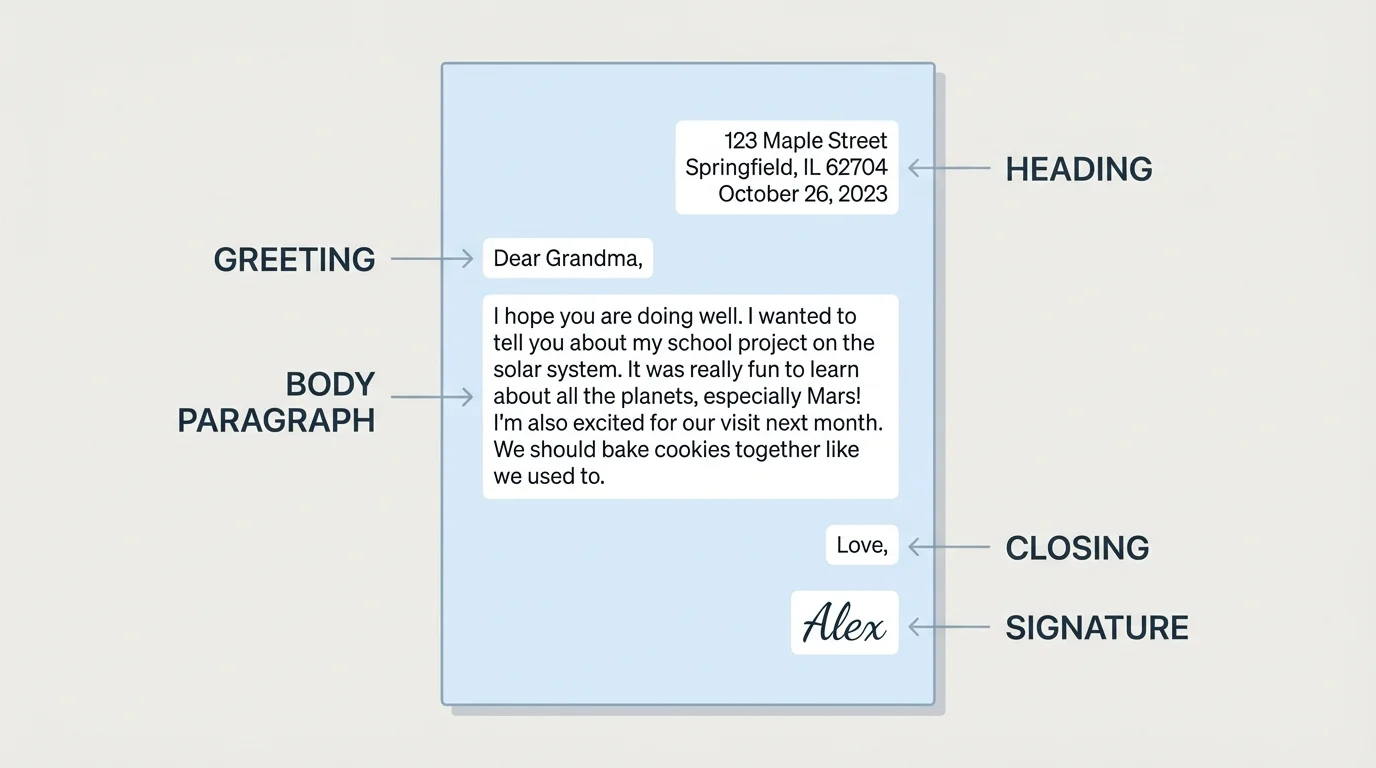
Here is what those parts can look like in a simple letter:
Date
Dear Maya,
Thank you for coming to my birthday party. I liked playing tag with you. My favorite gift was the book about frogs. I hope you can come over again soon.
Your friend,
Sam
This letter has one clear purpose: to thank a friend. The ideas stay on the same topic. Later, when you compare kinds of writing, [Figure 1] still helps because it reminds you that letters have named parts, not numbered steps.
[Figure 2] A procedure, a set of directions, or a recipe tells how to do something. This kind of writing is often called how-to writing. It explains a task step by step.
How-to writing can teach many things: how to tie a shoe, how to water a plant, how to get from the classroom to the library, or how to make fruit salad. The main idea is always the same: help the reader do something correctly.
Unlike a letter, a how-to usually does not begin with "Dear" or end with a signature. Instead, it may have a title, a list of things needed, and steps in order.
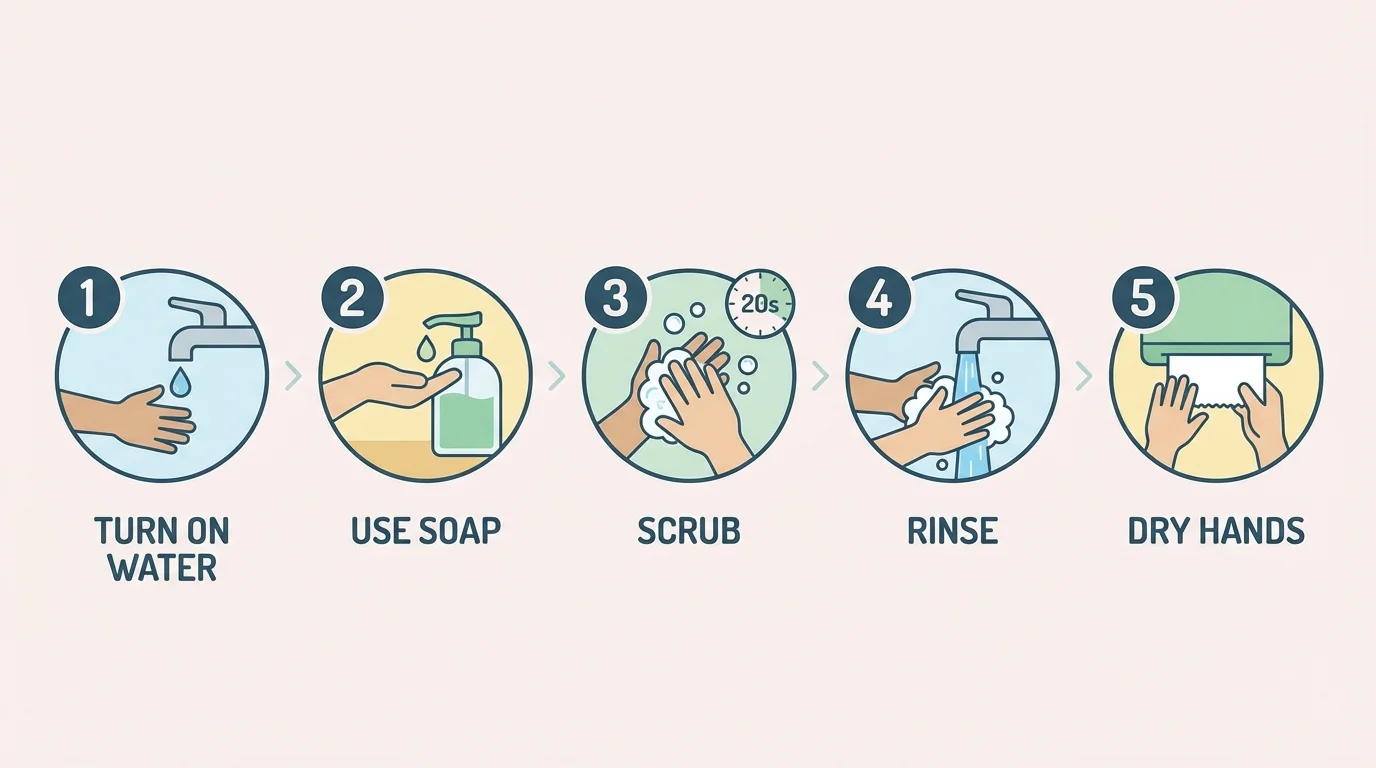
How how-to writing works
Good how-to writing starts with the goal, tells what is needed, and gives steps in the exact order the reader should follow. Each step should be short, clear, and easy to do.
Recipes are a special kind of how-to writing. A recipe tells what ingredients are needed and what to do with them. Directions tell how to get somewhere. Procedures explain how to do a job. All of them use order to help the reader succeed.
When you write steps, think about what must happen first. Then decide what comes next. If a step is missing, the reader may get stuck. If two steps are switched, the task may not work.
Sequence words are very helpful. Words like first, next, then, after that, and last show the order of ideas. They act like little road signs for your reader.
Read these two examples:
Out of order: Put on your backpack. Open the door. Walk to the bus stop. Put on your shoes.
Better order: First, put on your shoes. Next, put on your backpack. Then, open the door. Last, walk to the bus stop.
The second example is easier to follow because the steps happen in a sensible order.
Example: How to sharpen a pencil
Step 1: Get your pencil and sharpener.
Step 2: Put the pencil into the sharpener.
Step 3: Turn the pencil gently.
Step 4: Stop when the point is sharp.
Step 5: Use the pencil carefully.
These steps are short, clear, and in the right order.
Before finishing a how-to, writers can read the steps in their minds. If they can picture the task from beginning to end, the order is probably strong.
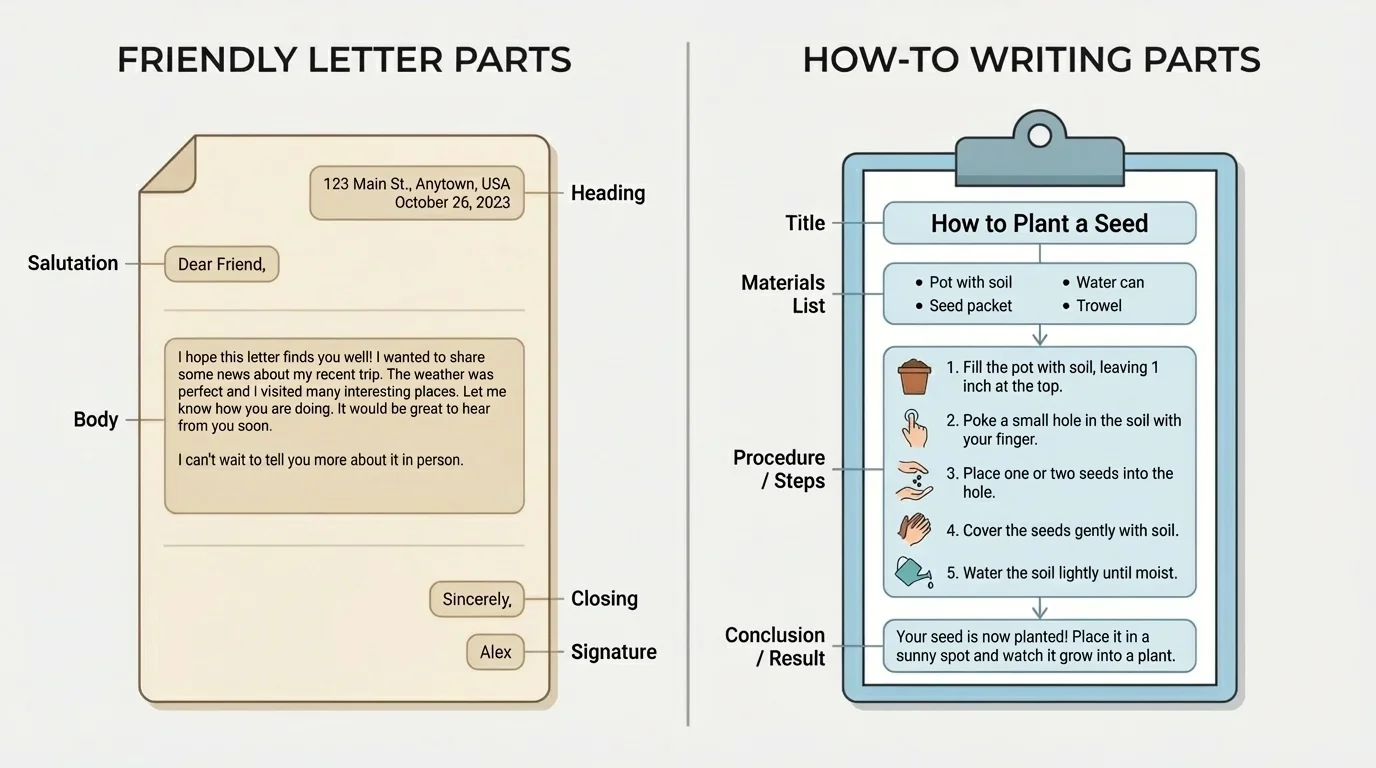
[Figure 3] Different kinds of writing need different arrangements. A letter has special parts, while a how-to often uses a title and steps. This difference in format is easy to notice when the two kinds of writing are compared.
If you are writing a letter, include the date, greeting, body, closing, and signature. If you are writing a recipe, include the title, ingredients, and steps. If you are writing directions, include where to start and where to go next.
| Type of Writing | Purpose | Common Parts |
|---|---|---|
| Friendly letter | To send a message to a person | Date, greeting, body, closing, signature |
| Directions | To tell how to get somewhere | Starting place, ordered steps, ending place |
| Procedure | To tell how to do a task | Title, materials if needed, ordered steps |
| Recipe | To tell how to make food | Title, ingredients, ordered steps |
Table 1. A comparison of common formats for letters and kinds of how-to writing.
When writers choose the correct format, readers know what kind of writing they are reading. That is why [Figure 3] matters: it makes the differences clear at a glance.
Good informative writing needs more than order. It also needs helpful details. A detail can name a tool, explain an action, or tell exactly what to do.
For example, "Make a snack" is not very clear. "Spread peanut butter on crackers" is clearer. The second sentence tells exactly what action to take.
Words like tiny, gently, carefully, one cup, or turn left at the office can help the reader picture what to do. Strong details support the main idea.
Complete sentences begin with a capital letter and end with correct punctuation. Clear writing is easier to follow when each sentence is complete and neat.
You should also use words that match the task. In a recipe, ingredient names matter. In directions, place names matter. In a letter, the message and feelings matter. As shown earlier in [Figure 2], each action in a procedure is specific, not vague.
Here is a simple example of a letter:
April 10
Dear Grandma,
I planted bean seeds at school today. First, we filled a cup with soil. Next, we put in the seed. Then, we watered it. I cannot wait to see it grow.
Love,
Ana
This letter uses letter format, but it also tells about an event in order. Writers can sometimes use both a message and ordered details together.
Example: Directions to the playground
Start at the classroom door.
Step 1: Walk down the hall.
Step 2: Turn right at the office.
Step 3: Go through the back door.
Step 4: Walk to the swings.
These directions are easy to follow because they begin at a starting place and move in order.
Here is a simple recipe:
Apple Snack
Ingredients: apple slices, cinnamon
Steps: First, wash the apple slices. Next, put them on a plate. Then, sprinkle a little cinnamon on top. Last, eat and enjoy.
This recipe is short, but it still has a title, ingredients, and steps in order.
Sometimes writers leave out a step. For example, a recipe might say to bake cookies but forget to tell the reader to put the dough on a tray. Missing steps can confuse the reader.
Another mistake is using unclear words. If you say "Put it over there," the reader may not know what it means or where there is. Try using exact words instead.
A third mistake is mixing formats. A friendly letter should not suddenly turn into a list of directions without warning. A recipe should not end with "Your friend," because that closing belongs in a letter. As we saw in [Figure 1], each kind of writing has parts that belong to it.
Writers can improve their work by checking three things: Is it in order? Does it use the right format? Are the details clear? If the answer is yes, the writing will help the reader understand.
"Good writing helps the reader know what to do, what to think, or what to understand."
Letters and how-to pieces are both useful because they share information. One speaks to a person. The other explains how to complete a task. When both are written in a clear way, they become easy and enjoyable to read.
