Have you ever opened a book about sharks, weather, or space and noticed that the information feels neat and easy to follow? That does not happen by accident. Writers organize facts carefully so readers can learn one idea at a time. When informational writing is well organized, it is like a tidy backpack: everything has a place, and it is easy to find what you need.
An informational text is writing that teaches about a real topic. It gives facts, explains ideas, and helps readers understand something in the world. A book about butterflies, an article about firefighters, and a page that explains how plants grow are all informational texts.
Informational texts are different from stories. A story usually tells about characters and events. Informational writing teaches. It may still be interesting and exciting, but its job is to explain, describe, and inform.
Main idea is the most important point the writer wants the reader to understand.
Supporting details are facts, examples, descriptions, or definitions that help explain the main idea.
When writers organize informational texts, they make sure the big point is clear and the facts match that point. This helps readers learn without getting confused.
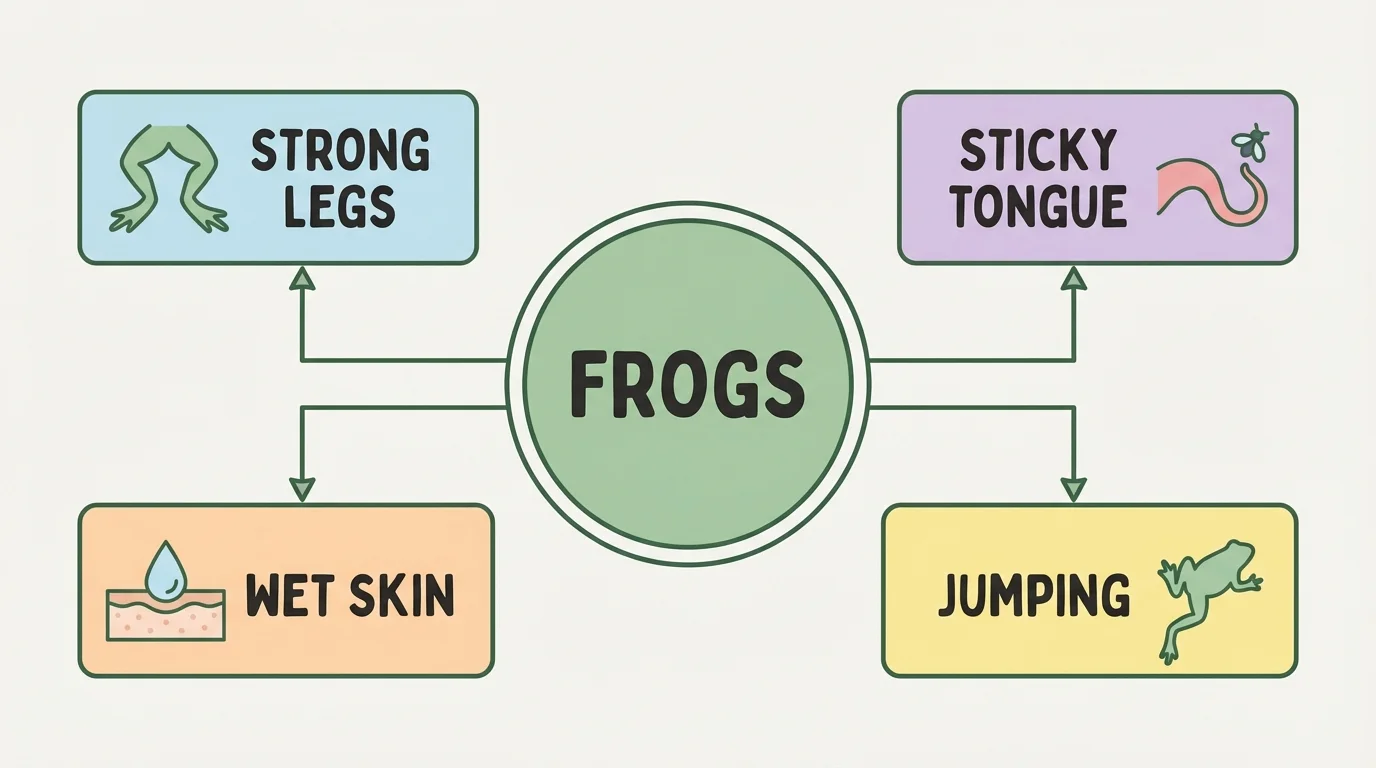
[Figure 1] A main idea is the big thought in a paragraph or section. The supporting details are the smaller pieces of information that tell more about it. If the main idea is "Frogs need special body parts to live," then details might tell about frogs' strong legs, sticky tongues, and wet skin.
Think of the main idea as the trunk of a tree. The details are like branches growing from it. If a branch does not connect to the trunk, it does not belong. In the same way, every detail in informational writing should connect to the main idea.
Here is an example. Main idea: Dogs can help people in many ways. Supporting details: dogs can guide people who cannot see well, some dogs help police officers, and some dogs comfort people who feel sad or scared. Each detail tells more about the same main idea.
Sometimes a writer gives a detail that does not fit. Suppose the main idea is about how dogs help people, but one detail says, "Dogs can be brown, black, or white." That fact may be true, but it does not explain how dogs help people. A true fact is not always the right fact.
Some nonfiction books use hundreds of facts, but strong writers still make those facts feel simple by grouping them under clear main ideas.
When you read or write, ask, "What is this part mostly about?" That question helps you find the main idea. Then ask, "Do these details help explain it?" That helps you check the organization.
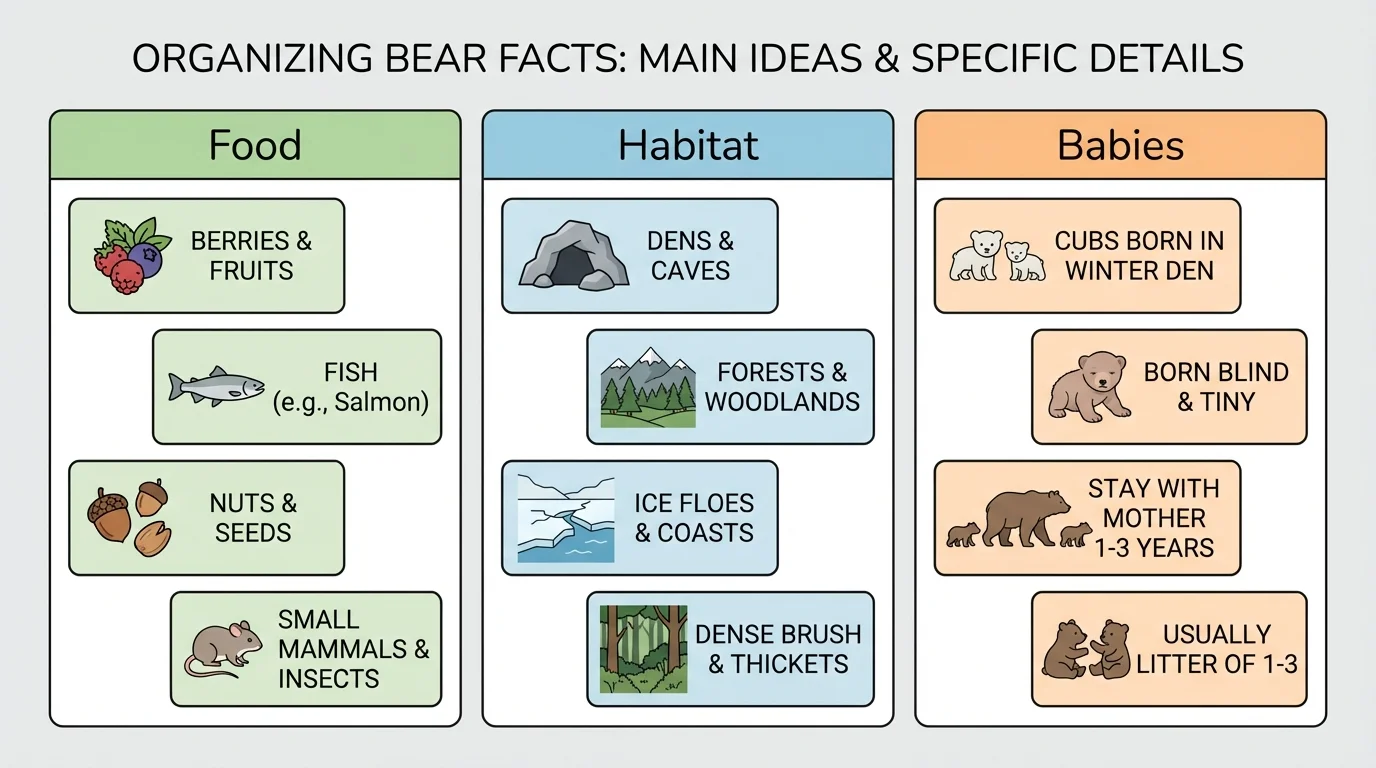
[Figure 2] Writers do not toss facts onto a page in random order. They group similar details together so readers can stay focused on one part of the topic at a time. This process is called organizing information.
For example, if a writer is teaching about bears, one group of details might be about what bears eat. Another group might be about where bears live. A third group might be about how bears care for their babies. Each group can become its own paragraph or section.
Grouping details helps writing feel calm and clear. Without groups, the reader might jump from food to homes to baby bears and back to food again. That feels messy. Good organization keeps related information together.
A writer often begins by thinking, "What are the parts of my topic?" If the topic is apples, the parts might be how apples grow, kinds of apples, and foods made from apples. If the topic is rain, the parts might be what rain is, how it helps living things, and what people do on rainy days.
Each paragraph should usually stay with one main idea. That way, the reader knows exactly what that paragraph is teaching.
Not every fact belongs in every piece of writing. Writers choose relevant details, which means details that match the topic and help explain the main idea. Relevant details are useful details.
Writers may use different kinds of helpful details. They can use facts, which are true pieces of information. They can use examples, which show what something is like. They can use descriptions, which help the reader picture something. They can also use a definition, which tells what a word or idea means.
Here is a simple example. Main idea: Seeds need certain things to grow. Helpful details: seeds need water, seeds need sunlight, and seeds need soil or a place to grow. A definition might explain that soil is the top layer of earth where many plants grow. These details all help the reader understand the main idea better.
Helpful details answer reader questions. A good supporting detail often answers one of these questions: What is it? What does it do? What is it like? Why is it important? When writers answer these questions, their information becomes stronger and clearer.
Writers also try to be specific. Instead of saying, "Birds are nice," a writer can say, "Birds use feathers to stay warm and help them fly." Specific details teach more than vague details.
[Figure 3] Informational writing often includes text features that help readers find ideas quickly. Text features are parts such as titles, headings, labels, and lists.
A title tells the whole topic. A heading tells what one section is about. A list can show several details in a neat way. Labels can name parts of a picture or diagram. These features make information easier to follow.
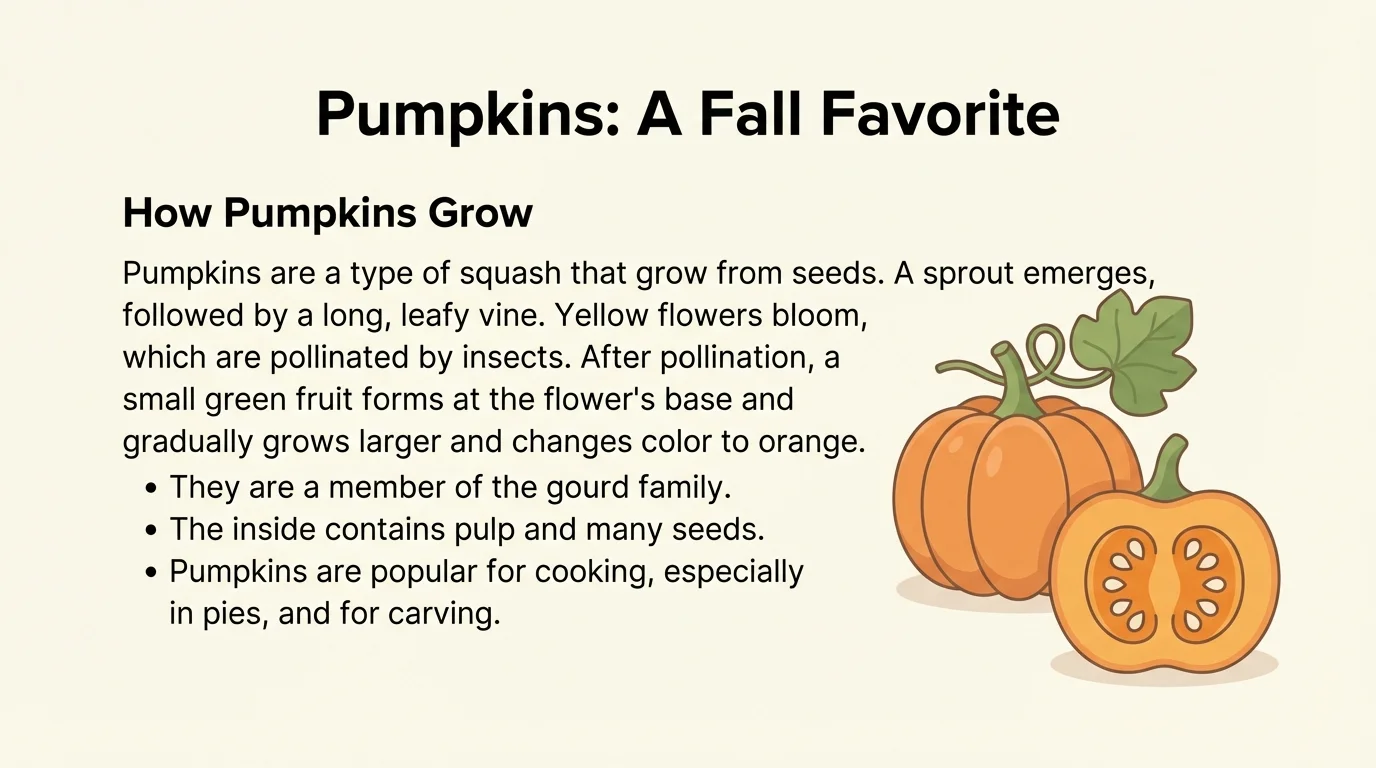
For example, a report called All About Pumpkins might have headings like How Pumpkins Grow, Parts of a Pumpkin, and Foods Made from Pumpkins. Readers can tell where to look for each kind of information.
Writers may also include an introduction that names the topic and a closing that finishes the explanation. Even young writers can make their work stronger by starting with the topic clearly and ending after the important information has been shared.
One strong paragraph often begins with a sentence that states the main idea. After that, the writer adds details that explain it. This creates a paragraph that feels complete and organized.
Suppose the topic is turtles. A clear paragraph might begin, Turtles have body parts that help them survive. Then the writer adds details: their hard shells protect them, their legs or flippers help them move, and their beaks help them eat. All the details stay on the same subject.
Example paragraph plan
Topic: Bees
Step 1: Choose the main idea.
Main idea: Bees are important insects.
Step 2: Add specific supporting details.
Details: bees carry pollen, bees help flowers grow seeds and fruits, and many foods depend on pollination.
Step 3: Put the ideas in order.
Start with the main idea sentence. Then add the details in a smooth order.
A finished paragraph might read: Bees are important insects. They carry pollen from flower to flower. This helps many plants make seeds and fruits. People depend on bees for some of the foods they eat.
Notice that the paragraph does not suddenly switch to a different topic like spider webs or clouds. Staying focused helps the reader learn.
[Figure 4] A longer informational piece can have one big topic and several smaller main ideas. Each paragraph teaches one part of the topic, and together the paragraphs teach the whole subject.
Think about a report on bees. The big topic is bees. One paragraph might be about bee body parts. Another might be about jobs inside a hive. Another might be about how bees help plants and people. Each paragraph has its own main idea, but all of them fit the same topic.
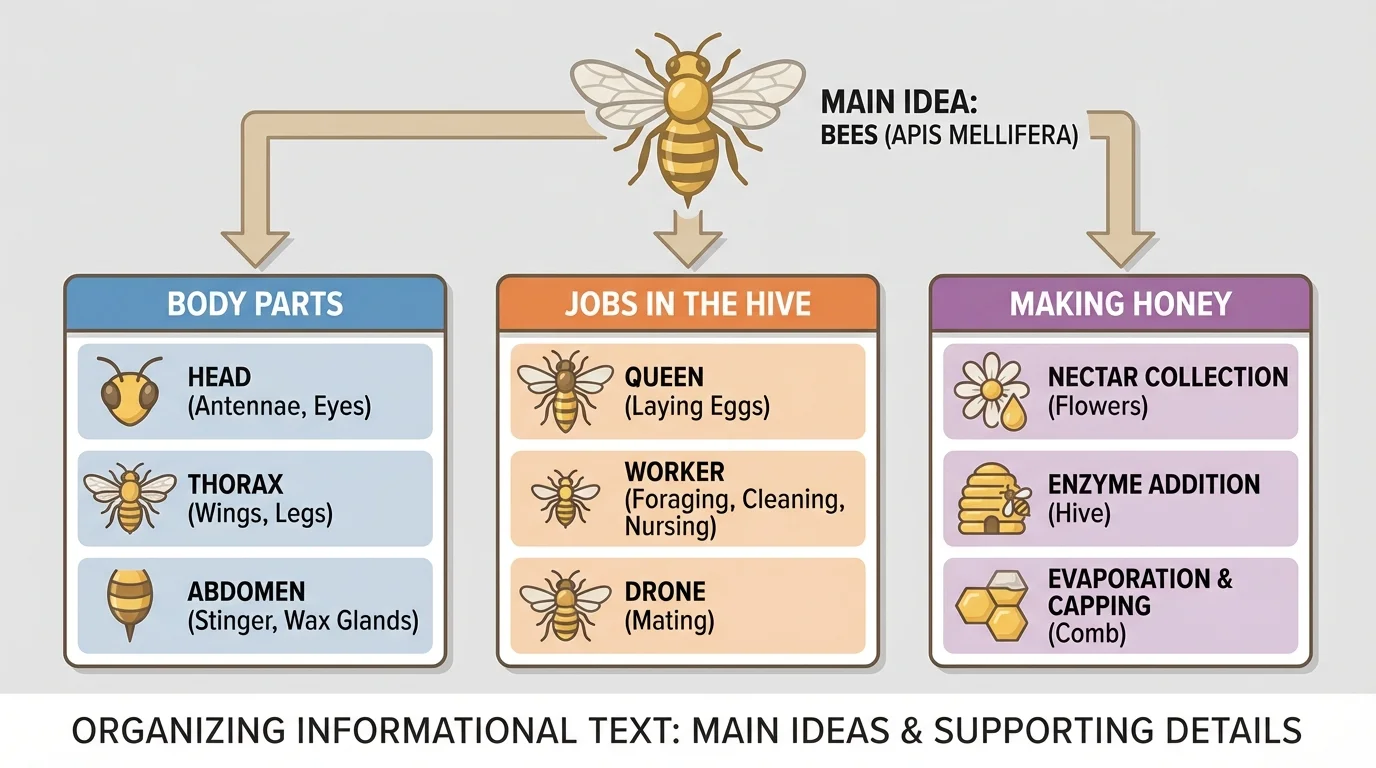
This kind of organization helps readers move step by step through the information. It also helps writers avoid mixing everything together. As shown earlier in [Figure 1], each main idea needs matching details. In a longer piece, each paragraph works the same way.
Sometimes writers put information in an order that makes sense for the topic. They may go from general to specific, from first to next, or from one part to another. A report about a butterfly might begin with what a butterfly is, then explain its life cycle, then tell why butterflies matter in nature.
One common problem is adding details that do not match the main idea. If a paragraph is about what penguins eat, a sentence about how penguins slide on ice may not belong there. The fix is simple: move the sentence to a better paragraph or take it out.
Another problem is repeating the same idea again and again. Writers should give new information, not the same sentence in different words. Repeating can make writing feel slow and less helpful.
A third problem is having a main idea but not enough details. If a paragraph says, "Owls are amazing birds," the reader still needs to know why. Good supporting details might explain owl eyes, hearing, and hunting at night.
Readers use the same thinking that writers use. When you read nonfiction, look for the big idea first. Then notice which facts support it.
Writers can check their work by asking these questions: What is my topic? What is the main idea of this paragraph? Do all my details fit? Did I include facts or definitions that teach the reader?
Organized writing helps readers understand new information faster. It also helps them remember what they learned. When facts are grouped clearly, readers do not have to guess how ideas connect.
This matters in school and in everyday life. Science books, news articles for kids, posters, instructions, and reports all need clear organization. Even a short page about recycling becomes stronger when the main idea is clear and the details are carefully chosen.
Text features remain useful here too. A heading can guide the reader to the right part, and the simple page design we saw in [Figure 3] helps show how information can be easy to scan. Good organization is a gift from the writer to the reader.
When writers choose a clear topic, state a main idea, and add specific supporting details, their informational texts become strong, helpful, and interesting. That is how facts turn into learning.
