Have you ever listened to someone tell a story that jumped from one idea to another so fast that it felt bumpy? Writing can feel that way too. Good writers use special words to help ideas move smoothly, like stepping-stones across a stream. Those helpful words make writing easier to read and easier to understand.
When we write informative pieces, we often share a main idea and then add facts, details, and definitions. But if the ideas are not connected well, the writing can sound choppy. Transition words act like bridges between ideas, as shown in [Figure 1]. They help readers know what comes next and how one sentence connects to another.
Read this set of sentences: "Bats sleep in the daytime. They wake up at night. They look for food." The facts are clear, but the writing sounds plain and jumpy. Now read: "Bats sleep in the daytime. Then, they wake up at night. Next, they look for food." The second version flows better because the ideas are linked.
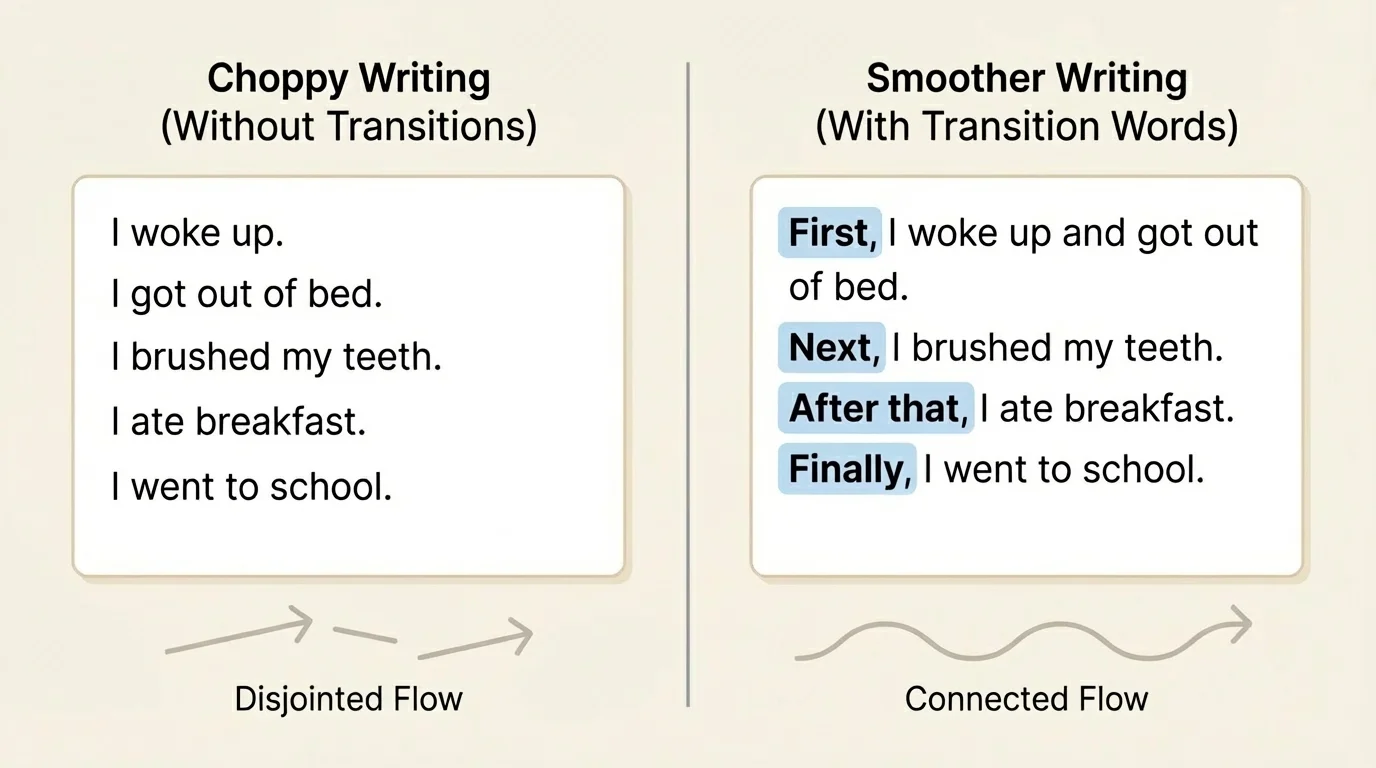
Transitions are especially important when you teach the reader about something. If you are writing about frogs, weather, or how to grow a plant, your reader needs help following your thinking from one detail to the next.
Transition words are words or short phrases that connect ideas in writing. They help show order, add information, give examples, compare ideas, show causes and effects, or bring writing to a close.
A transition does not add a new fact by itself. Instead, it shows the relationship between facts. That is why transition words are so useful in explanatory writing.
An informative writing piece teaches the reader about a topic. It usually has a main idea, supporting details, and clear organization. Transition words help hold those parts together. They tell the reader, "This detail comes first," or "Here is another fact," or "This happened because of that."
Think about building with blocks. The blocks are your facts and details. The way you place them together matters. Transition words help the whole piece stay in order so it does not feel messy.
Here is an example: "Penguins have wings. They do not fly." These sentences are fine, but they can be connected more clearly: "Penguins have wings. However, they do not fly." Now the reader understands that the second idea is different from what might be expected.
Transition words come in groups with different jobs, and [Figure 2] organizes these groups so you can see how each kind helps a reader. Good writers choose a transition that matches the meaning they want to show.
One important group is sequence words. These tell the order of ideas. Examples include first, next, then, after that, and finally. These are helpful when writing steps, life cycles, or events in order.
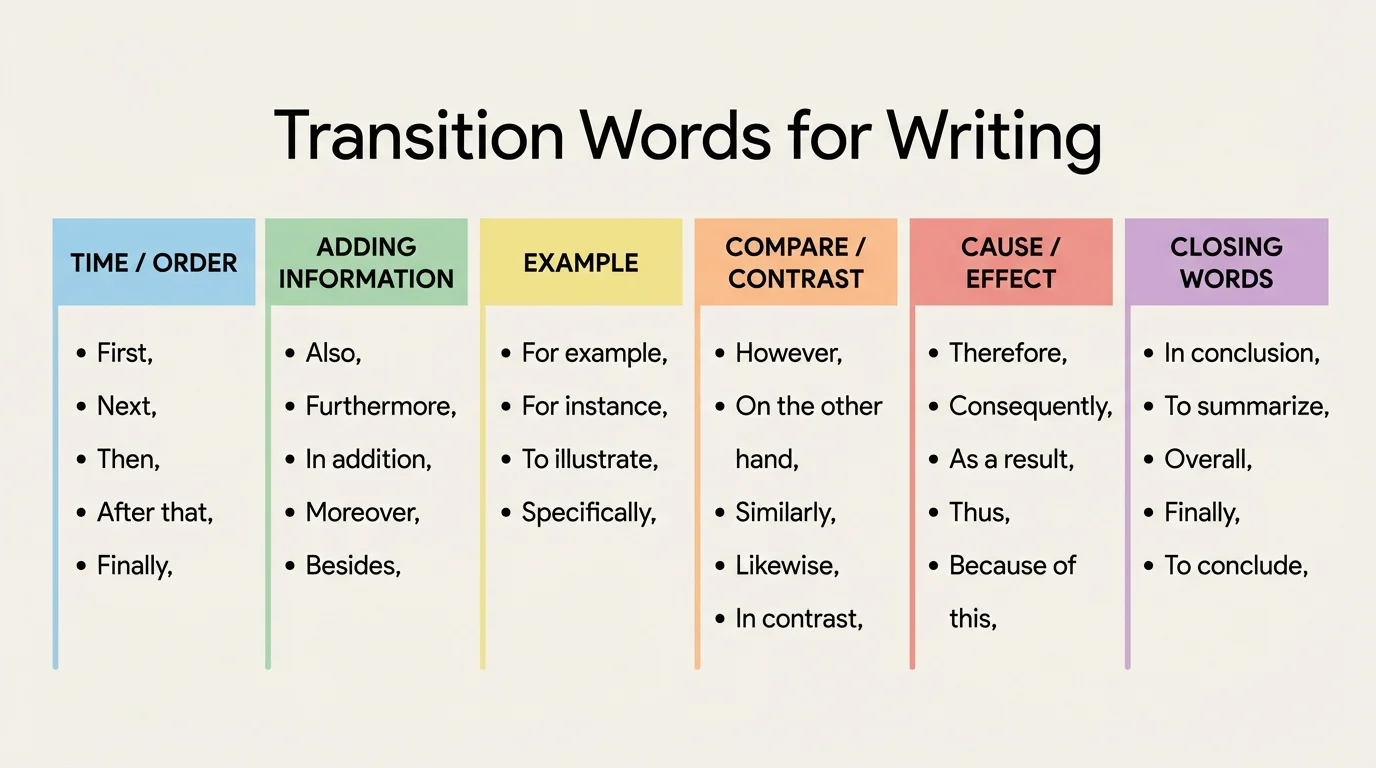
Another group adds information. Words such as also, too, another, and in addition tell the reader that one more fact is coming. For example: "Sharks have sharp teeth. Also, they have strong senses."
Some transition words give examples. These include for example, for instance, and such as. Example words help the reader understand a general idea better. "Many animals are nocturnal. For example, owls hunt at night."
Some transitions show how ideas are alike or different. Comparison words include like, same as, and similarly. Contrast words include but, however, and instead. "A turtle moves slowly. However, a rabbit moves quickly."
Other transitions show a cause and effect relationship. These include because, so, therefore, and as a result. "It rained all night. As a result, the grass was wet in the morning."
Writers also use closing transitions. These help bring the writing to an ending. Examples include in conclusion, to sum up, and finally when it introduces the last point.
Some transition words can do more than one job. The word finally can show the last step in a sequence, and it can also help bring a piece of writing to a close.
Because different transitions do different jobs, a writer has to think carefully before choosing one. The best word is the one that matches the connection between the ideas.
Before you pick a transition word, ask: "How are these ideas connected?" If one idea happens after another, use a time-order word. If you are adding a new fact, use an adding word. If the second sentence gives an example, choose an example word.
Look at these pairs of sentences. "Bees help flowers. They carry pollen." A good transition is because: "Bees help flowers because they carry pollen." Now the relationship is clear.
Try another one: "Some birds migrate in winter. Geese do this." A good transition is for example: "Some birds migrate in winter. For example, geese do this."
Now think about a poor choice. "The sun is hot. However, it gives Earth light." The word however suggests contrast, but these ideas are not really opposites. A better sentence is: "The sun is hot, and it gives Earth light." If you want an adding transition, you could say, "The sun is hot. Also, it gives Earth light."
Choosing a fitting transition
Sentence pair: "Caterpillars change over time. They become butterflies."
Step 1: Think about the relationship.
The second idea happens later in time.
Step 2: Pick a transition that shows order.
Words like then or later fit.
Step 3: Write the improved sentence.
"Caterpillars change over time. Later, they become butterflies."
The same chart from [Figure 2] helps here too. If you know the kind of connection you want to show, you can look for the category of transition that matches it.
Informative writing often begins with a main idea. Then it adds facts, details, and definitions. Transition words help the reader move through those parts in a clear order.
Suppose you are writing about how a seed grows. You might begin with a main idea: "A seed grows into a plant in several stages." Then you can add details with sequence transitions: "First, the seed gets water. Next, it begins to sprout. Then, roots grow. Finally, leaves appear."
Now suppose you are writing a report about dolphins. You may want to add details instead of steps. You could write: "Dolphins are smart ocean animals. Also, they live in groups. For example, they work together to find food." In this case, the transitions help connect information instead of showing a process.
Definitions can use transitions too. "A habitat is the place where an animal lives. For instance, a pond is a habitat for frogs." The definition becomes easier to understand because the example is introduced clearly.
Strong informative writing does more than list facts. It guides the reader. Transition words are part of that guidance.
Transition words can appear in more than one place in a piece of writing, and [Figure 3] shows these common positions. Many transitions come at the beginning of a sentence, but some can appear in the middle. Others help connect whole paragraphs.
At the beginning of a sentence, transitions are easy to notice. "First, the class planted seeds." "Next, the students watered them." Beginning transitions are very common for young writers because they clearly signal what comes next.
Some transitions fit in the middle of a sentence. "Bears sleep in winter because food is harder to find." Here, the transition joins two ideas in one sentence.
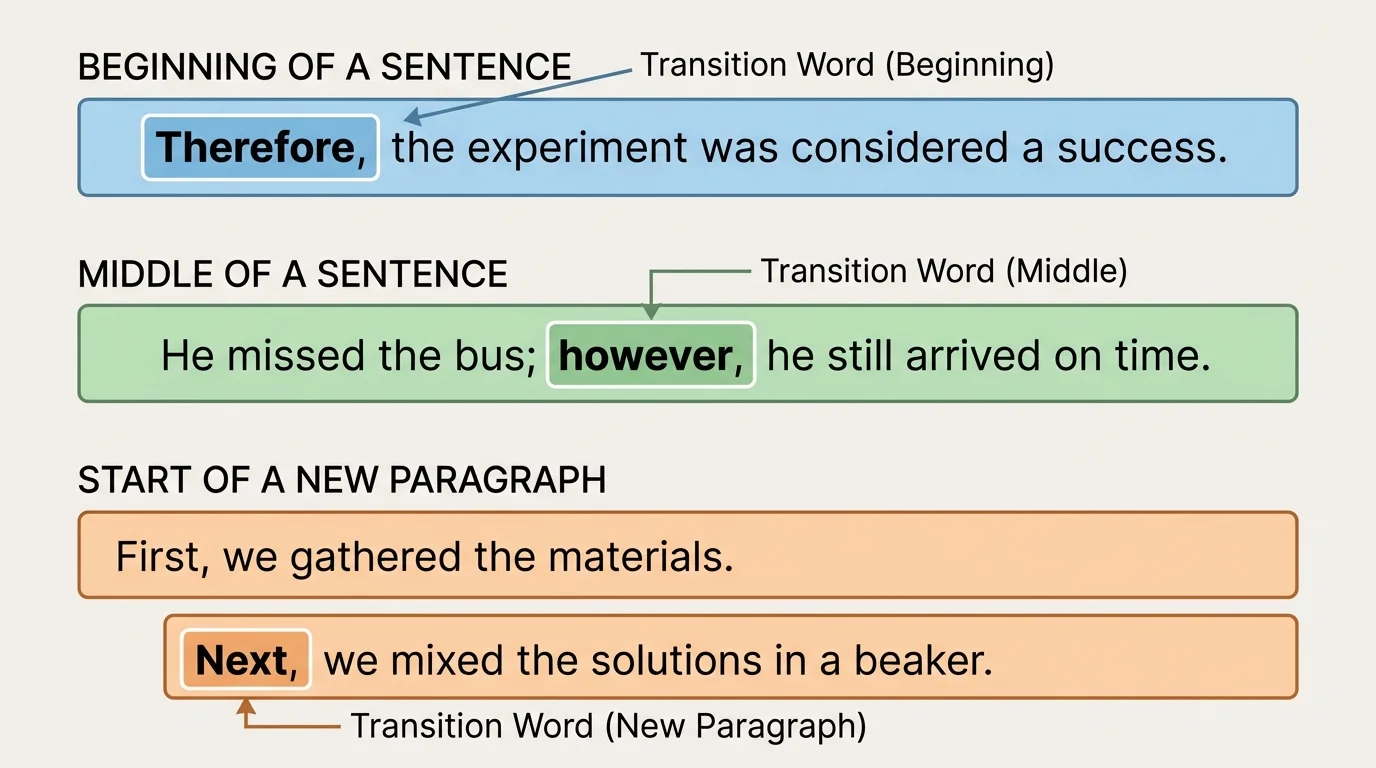
Transitions can also connect paragraphs. One paragraph might explain what butterflies eat. The next paragraph might begin, "In addition, butterflies help plants by carrying pollen." That opening tells the reader that a new but related idea is starting.
Writers often use a comma after a transition at the beginning of a sentence, especially with words like first, next, however, and for example. For grade-level writing, it is helpful to notice this pattern: the transition comes first, then a comma, then the rest of the sentence.
You already know that a sentence begins with a capital letter and ends with punctuation. When a transition word starts the sentence, it becomes part of that sentence and still follows those same rules.
Later, when you revise your writing, you can check whether each transition is in a good spot and whether the sentence sounds smooth.
Sometimes writing has no transitions. Sometimes it has the wrong ones. Sometimes it repeats the same one too often. Looking at examples can help you notice the difference.
Weak version: "Koalas sleep a lot. They eat eucalyptus leaves. They live in Australia." This sounds like a list. Better version: "Koalas sleep a lot. Also, they eat eucalyptus leaves. In addition, they live in Australia." The improved version links the facts.
Here is another weak version: "Frogs begin life as eggs. However, they hatch into tadpoles." The transition is not a good match. Better version: "Frogs begin life as eggs. Then, they hatch into tadpoles."
Now look at repetition: "Then the bear wakes up. Then it looks for food. Then it walks to the river." The meaning is clear, but the writing sounds repetitive. A smoother version is: "The bear wakes up. Next, it looks for food. After that, it walks to the river."
Improving a short paragraph
Original paragraph: "Clouds form in the sky. Water droplets collect. Rain falls to the ground. Plants use the water."
Step 1: Find how the ideas connect.
The first three ideas happen in order, and the last idea adds another result.
Step 2: Add transitions that match.
Use order words like first and then, and an adding or result word like afterward.
Step 3: Rewrite the paragraph.
"First, clouds form in the sky. Then, water droplets collect. Next, rain falls to the ground. Afterward, plants use the water."
As [Figure 3] illustrates, some of these transitions work best at the start of a sentence, where the reader can notice them right away.
Transition words are helpful, but too many can make writing sound crowded. A writer does not need to begin every sentence with a transition. If every sentence starts with first, next, or also, the writing may feel stiff.
Good writers use transitions when they truly help the reader. Sometimes the ideas are already clear. In that case, a transition might not be needed. The goal is smooth writing, not extra words.
It also helps to use a variety of transitions. Instead of saying then again and again, you might choose next, later, or after that. Instead of using also every time, you might try another or in addition.
When you reread your writing, listen for flow. Ask yourself: Do my ideas connect clearly? Does each transition match the meaning? Did I repeat one word too many times? Revising these choices can make your writing much stronger.
"Good writing helps the reader move from idea to idea with ease."
Transition words may be small, but they do a big job. They guide the reader through facts, details, and examples so the writing feels organized and clear.
