Have you ever read words that made you feel like you were standing in the middle of a rainy street, smelling wet grass, and hearing drops tap on your umbrella? That is one of the special powers of poetry. A poem can be short, but it can still be full of pictures, sounds, and feelings. When you write a descriptive poem, you are like an artist using words instead of paint.
A descriptive poem tells about something in a way that helps the reader imagine it clearly. The poem might describe a red kite in the sky, a sleepy cat on a windowsill, a trip to the beach, or even a dragon made of smoke and stars. Some poems tell about one still picture. Other poems move through a small event, such as watching snow begin, playing in puddles, or seeing the sun go down.
Descriptive poem means a poem that uses detailed words to help the reader imagine what something looks like, sounds like, feels like, smells like, or tastes like.
Line means one row of words in a poem. Stanza means a group of lines that belong together.
A descriptive poem does not need to be long. In fact, many strong poems are short. Each word matters. Good descriptive poems often focus on one clear topic and one clear feeling. They may be about a image, such as moonlight on a pond, or a small moment, such as picking the first apple of fall.
Writers can make poems from real life or from imagination. A poem based on real life might describe a family picnic. An imagined poem might describe a cloud castle floating above the town. Both kinds can be rich and beautiful when they use clear details.
One of the best ways to make a poem vivid is to collect details with your senses, as [Figure 1] shows. A poet does not only say what something looks like. A poet also notices what can be heard, smelled, tasted, or felt. These details help readers step inside the poem.
Think about a playground. You might see yellow swings, hear children laughing, feel warm metal bars, smell fresh dirt after rain, and taste cold water from a fountain. When you gather details like these, your poem becomes more alive.
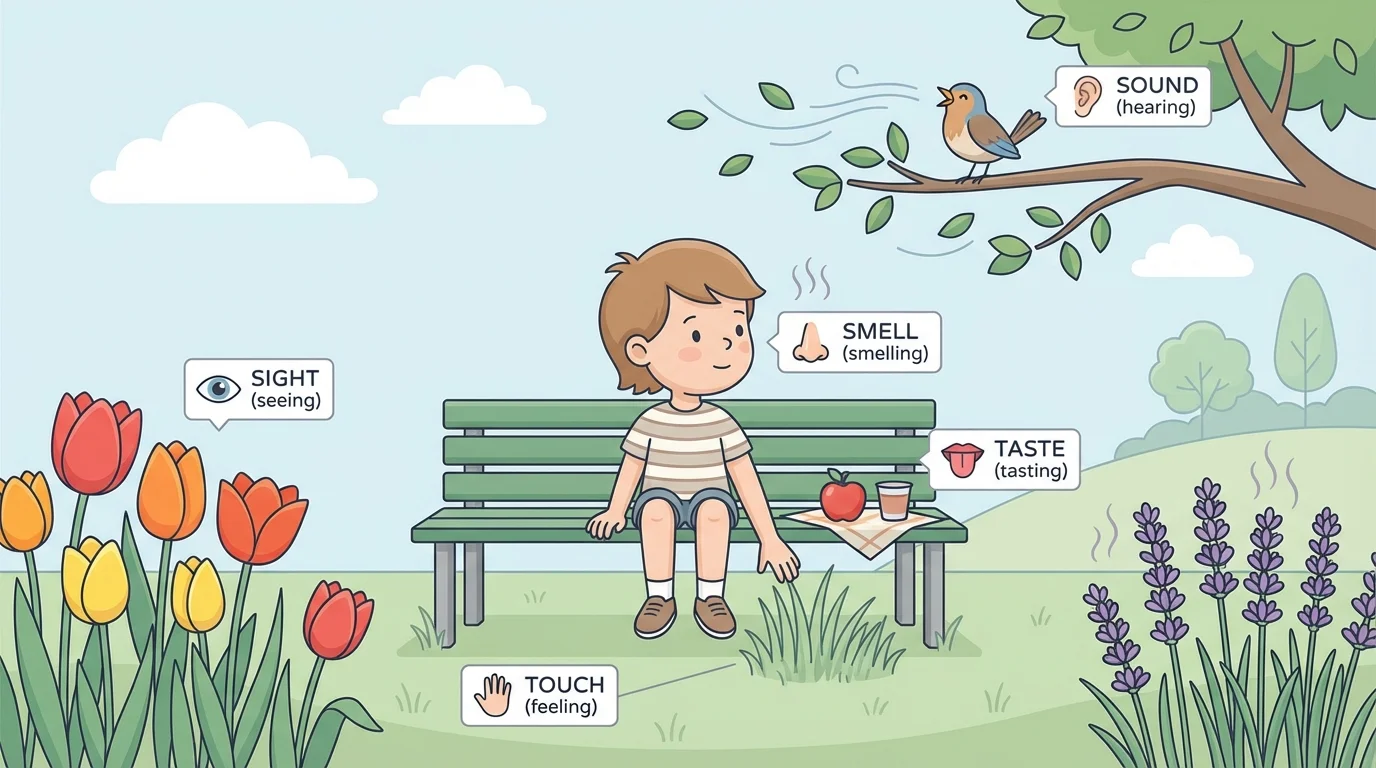
You do not have to use all five senses in every poem. Even two or three strong details can make a poem shine. The important part is to choose details that match your topic. If you are writing about popcorn, the smell and sound may be especially important. If you are writing about snow, touch and sight may matter most.
How sensory details help
Sensory details help a reader do more than understand a poem. They help the reader experience it. Instead of reading, "The day was nice," the reader can feel the soft breeze, hear buzzing bees, and see sunlight flicker on leaves.
Here is an example of a plain sentence and a more descriptive one. Plain: "The dog ran." Descriptive: "The muddy dog splashed through the puddle, barking at the silver rain." The second one gives a stronger picture because it uses sensory details.
Later, when you shape your poem, the sensory details in [Figure 1] can remind you that good poetry often begins with careful noticing.
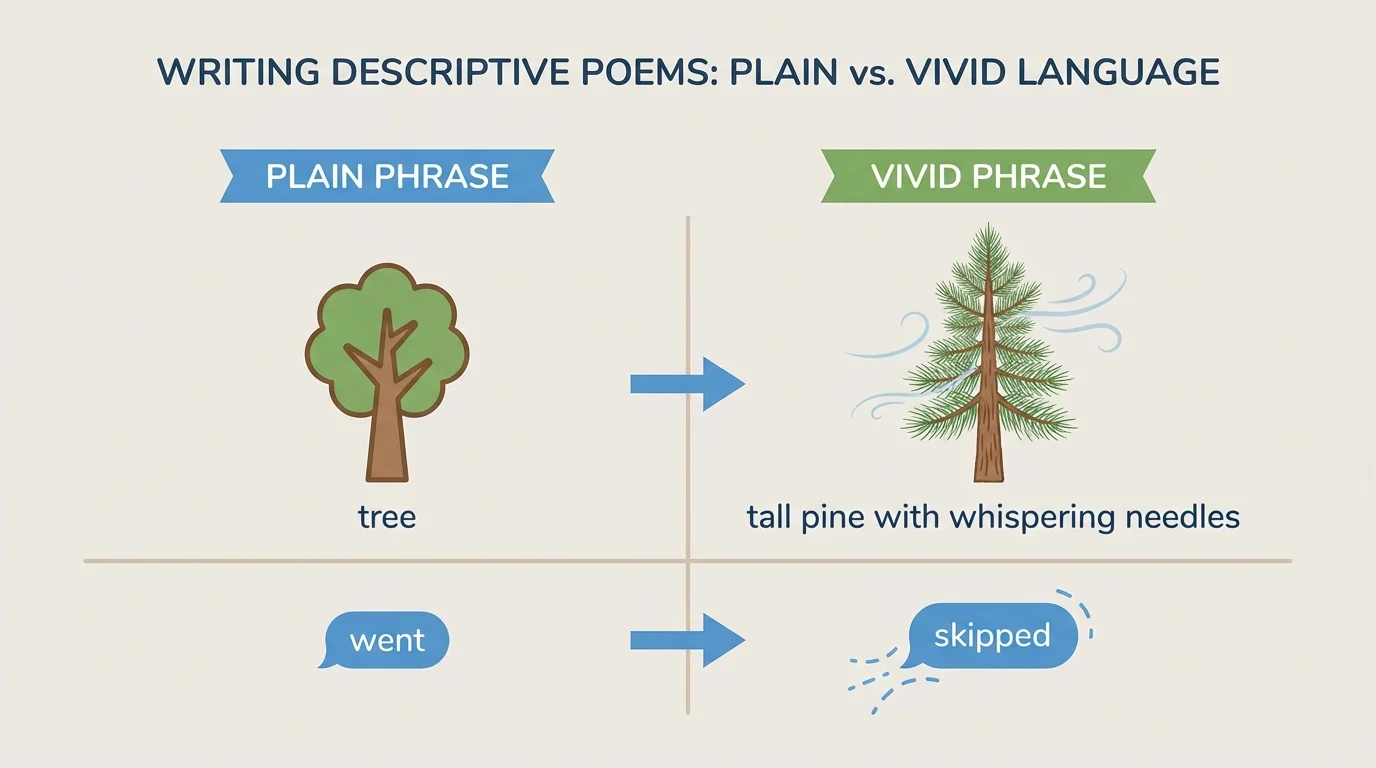
Descriptive poems become clearer when writers pick exact words, as [Figure 2] illustrates. A strong word can do the work of many weak words. Instead of saying "a bird," you might say "a robin." Instead of saying "went," you might say "marched," "tiptoed," or "skipped."
Nouns name people, places, animals, or things. Specific nouns make your writing sharper. Compare "flower" with "sunflower," or "tree" with "pine." The second choices help the reader see more.
Verbs show action. Strong verbs add movement and energy. Compare "The leaves moved" with "The leaves fluttered." Compare "The creek made noise" with "The creek bubbled." A lively verb makes the line more interesting.
Adjectives describe nouns. They can be helpful, but they work best when they are precise. "Nice flower" is not as strong as "golden sunflower." "Good smell" is not as clear as "sweet cinnamon smell."
Example: making a line stronger
Start with a simple line: "The rain came down."
Step 1: Add a specific noun.
"The rain came down on the roof."
Step 2: Add a stronger verb.
"The rain drummed on the roof."
Step 3: Add a sound or feeling detail.
"The rain drummed on the roof like busy little feet."
The line now gives the reader a sound and a picture.
When you revise a poem, look for words like "nice," "good," "thing," and "went." Sometimes those words are fine, but often they can be replaced with stronger ones. The comparison in [Figure 2] shows how specific words help a poem feel brighter and clearer.
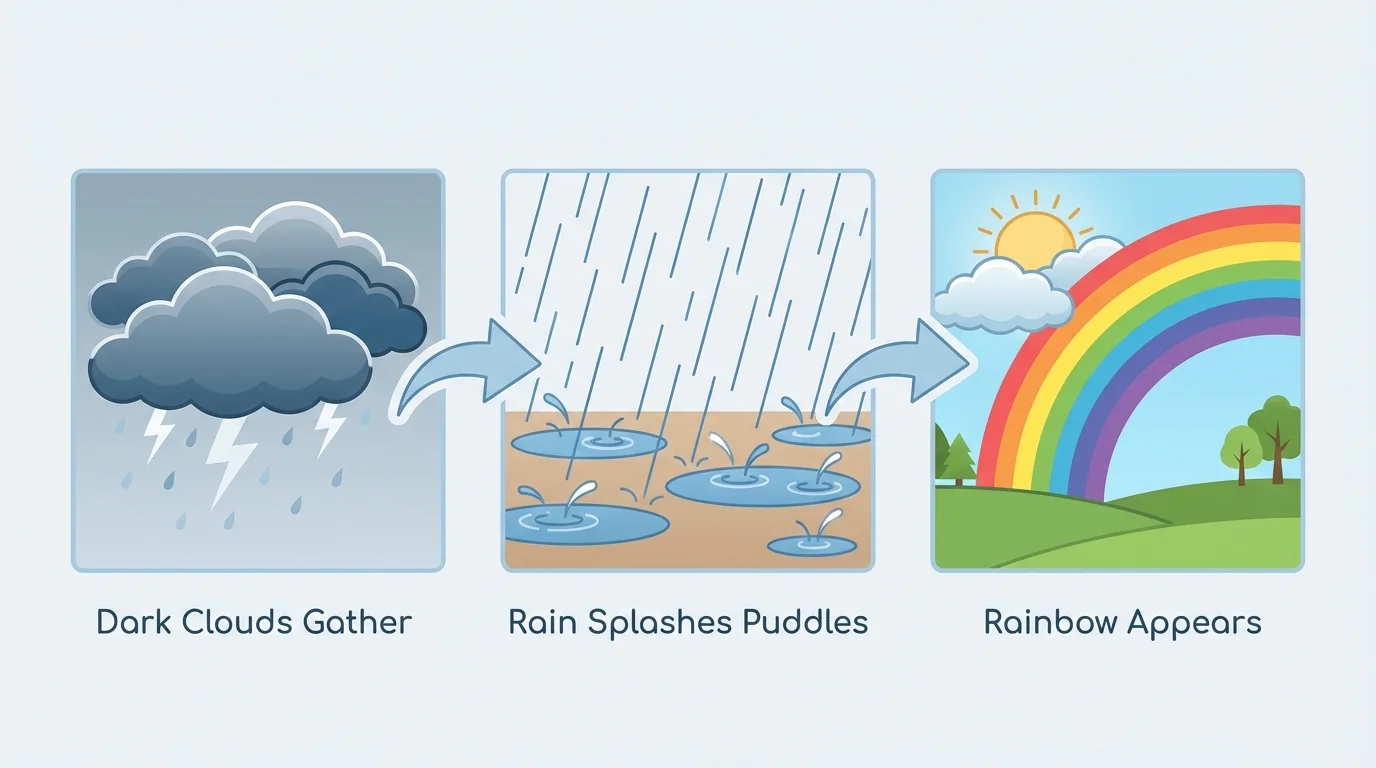
Some descriptive poems do more than describe one object. They describe a short event or moment in sequence, as [Figure 3] explains. This means the poem moves in order: first, next, and last. Even a very small poem can do this.
For example, a poem about a storm might begin with dark clouds, move to rain splashing on the sidewalk, and end with a rainbow. This order helps the reader follow what is happening. It also helps the poem feel complete.
A poem with sequence still uses descriptive details. It does not become plain reporting. Instead of saying, "Then it rained," a poet might write, "Then cold drops danced on the porch rail." The event is moving forward, but the words still paint a picture.
Writers often think about three parts: a beginning, a middle, and an ending. The beginning introduces the topic or moment. The middle adds important details or action. The ending gives a final picture, thought, or feeling. The flow in [Figure 3] shows how a poem can be small yet still travel somewhere.
Stories and narratives often tell events in order. A descriptive poem can do that too, even if it is shorter and more focused on images and feelings.
Here is a short poem that moves in sequence:
Gray clouds huddle high and low.
Wind shakes every maple row.
Puddles wake with silver rings.
Then a rainbow softly springs.
This poem begins with clouds, moves to wind and rain, and ends with the rainbow. That last line gives the poem a sense of closure, which means it feels finished.
Poems look different from regular paragraphs because they are built with lines and sometimes stanzas, as [Figure 4] shows. A line break is where one line ends and the next begins. The writer chooses where to break the lines.
Line breaks can slow the reader down and help important words stand out. For example, if the last word on a line is "whisper," the reader notices it. Short lines can feel light or quick. Longer lines can feel fuller.
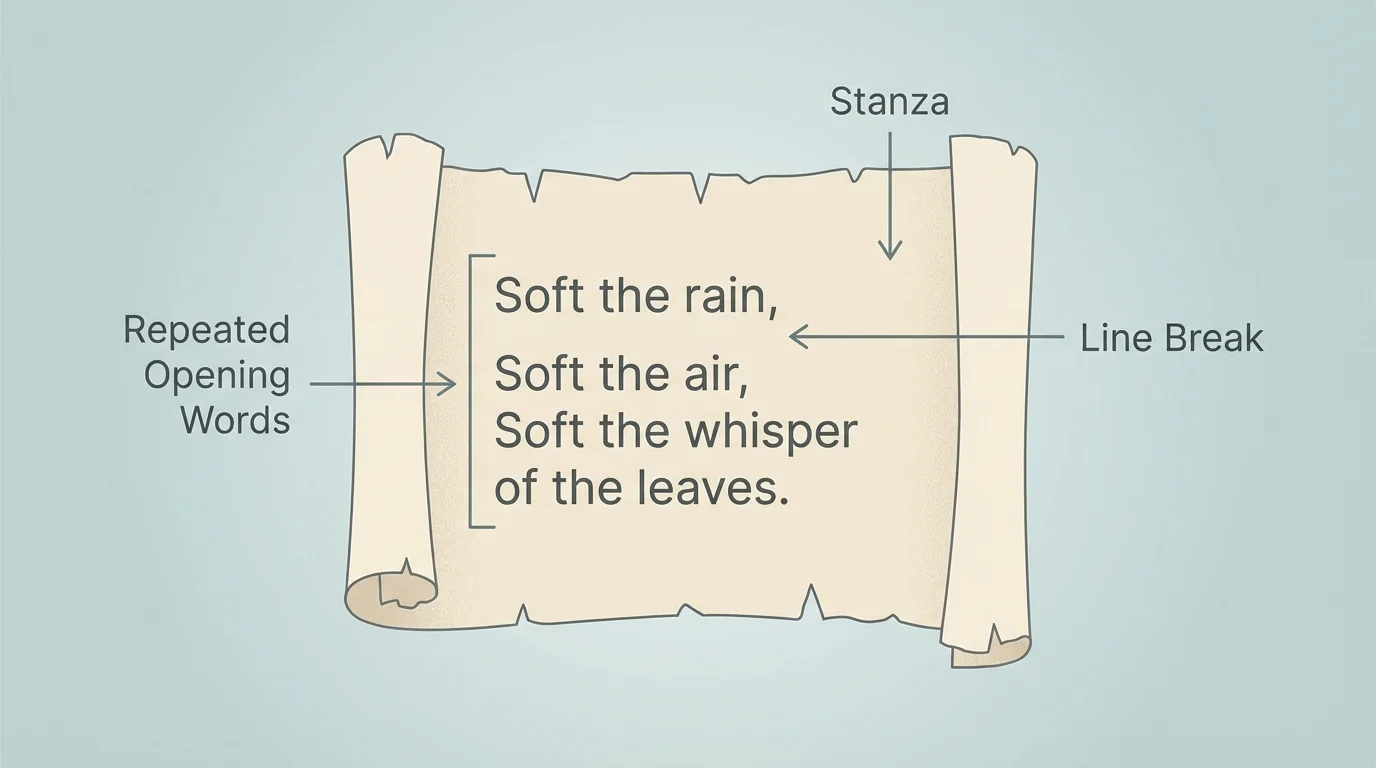
A stanza is a group of lines. Some poems have one stanza. Others have two or more. Young writers often begin with one short stanza, and that is a great way to start.
Repetition means using a word or phrase more than once on purpose. Repetition can make a poem sound musical. For example, a poet might begin each line with "I hear" or "In the dark." The page shape in [Figure 4] shows how repeated words and line breaks work together.
Many poems do not rhyme at all. A poem can still sound beautiful because of strong word choice, repetition, and clear images.
Rhyme can be fun, but it is not required. Sometimes young writers try so hard to rhyme that they pick weak words. It is better to choose the best words for your meaning. If a rhyme happens naturally, that is wonderful. If not, the poem can still be strong.
A descriptive poem can come from something true, something imagined, or a mix of both. A true poem might describe making pancakes with a grandparent. An imaginary poem might describe a moon made of ice cream. In both kinds, the writer uses sensory details and strong words.
Real-life topics are helpful because you can notice exact details. You know how the pancakes smell, how the batter looks, and how the spoon sounds against the bowl. Imagined topics are exciting because you can invent surprising details. Maybe the moon tastes like vanilla, or maybe stars crackle like cereal.
Two topic ideas turned into poem beginnings
Real: Grandma flips round pancakes, / warm and gold as morning light.
Imagined: On the marshmallow moon, / my boots sink in sugary snow.
Both lines are descriptive. One comes from life. One comes from imagination.
Whether the topic is real or imagined, the poem should stay focused. A short poem does not need to tell everything. It needs to tell a few things clearly and beautifully.
Reading examples can help you notice what poets do. Listen for strong words, sensory details, and endings that feel complete.
Blue cup on the table,
steam curls in the air.
Cinnamon and cocoa
warm the kitchen chair.
This poem describes hot chocolate. It uses sight in "steam curls" and smell in "cinnamon and cocoa."
My red kite leaps upward,
pulling on the string.
It tugs against the spring wind
like a bright, wild thing.
This poem uses movement and color. The word "leaps" is stronger than "goes."
Example: a poem with sequence and closure
First, the seed sleeps underground.
Then soft rain taps the garden round.
Next, a green shoot lifts to see.
At last, a sunflower smiles at me.
This poem moves in order from seed to flower. The last line gives a happy ending picture.
Notice that these poems are short. They do not need many lines to be effective. They choose one topic, add clear details, and end in a way that feels finished.
An ending matters. Without a strong ending, a poem can feel like it simply stops. A good ending gives the reader one last image, idea, or emotion to carry away.
One kind of ending gives a final picture. A poem about winter birds might end with one bird flashing red against white snow. Another kind of ending gives a feeling. A poem about bedtime might end with the room growing quiet and safe.
You can also end by showing a change. The sky grows dark, then pink. The acorn becomes an oak. The child who was nervous jumps into the pool and laughs. Change helps a poem feel complete because something has happened.
What closure feels like in a poem
Closure is the feeling that the poem has reached a natural end. It may come from a final image, a last sound, a small change, or a feeling that settles at the end.
Here is a poem with a clear ending:
Fireflies blink above the grass.
Night grows deeper as they pass.
One last lantern glows for me,
then slips into the dark oak tree.
The final line leaves the reader with a clear picture. That is a strong way to close a poem.
When poets write descriptive poems, they pay close attention. They notice, choose, arrange, and end with care. A simple poem can be tiny, but it can still feel full of life.
