Have you ever heard someone say, "Something happened, and then we went somewhere, and it was nice"? That story is hard to picture. But if someone says, "The puppy chased the yellow ball across the muddy yard, and then we hurried home before dinner," the story comes alive. Strong writers pick words that help readers see the action, know what happens first, next, and last, and feel satisfied when the story ends.
When you write a narrative, you tell about real events or imagined events in order. Good narratives have a beginning, a middle, and an ending. They also use strong word choice. Three kinds of words help a lot: precise nouns, active verbs, and descriptive adjectives. These words make your writing clear, interesting, and easy to understand.
A story is like a movie in a reader's mind. If the words are too general, the movie looks blurry. If the words are exact, the movie becomes sharp and bright. Word choice helps readers know who is in the story, what happens, where it happens, and how it feels.
Compare these two sentences. "The thing moved." This sentence is not very clear. What is the thing? How did it move? Now read this: "The wagon rattled down the rocky path." The second sentence tells much more. We can picture the wagon, and we can almost hear it.
Precise nouns are exact naming words, such as beagle instead of dog. Active verbs are strong action words, such as darted instead of went. Descriptive adjectives add details about nouns, such as shiny, tiny, or bumpy.
When these three kinds of words work together, they help a reader follow events in sequence. They also make the ending feel complete because the reader understands exactly what happened.
[Figure 1] A precise noun names the exact person, place, animal, or thing you mean and can be shown with general and exact labels in one scene. Instead of using words like thing, stuff, animal, or place, choose a word that tells more.
Look at these examples. Instead of bird, you might write robin. Instead of food, you might write apple slices. Instead of toy, you might write stuffed rabbit. These exact words help the reader build a clear picture.
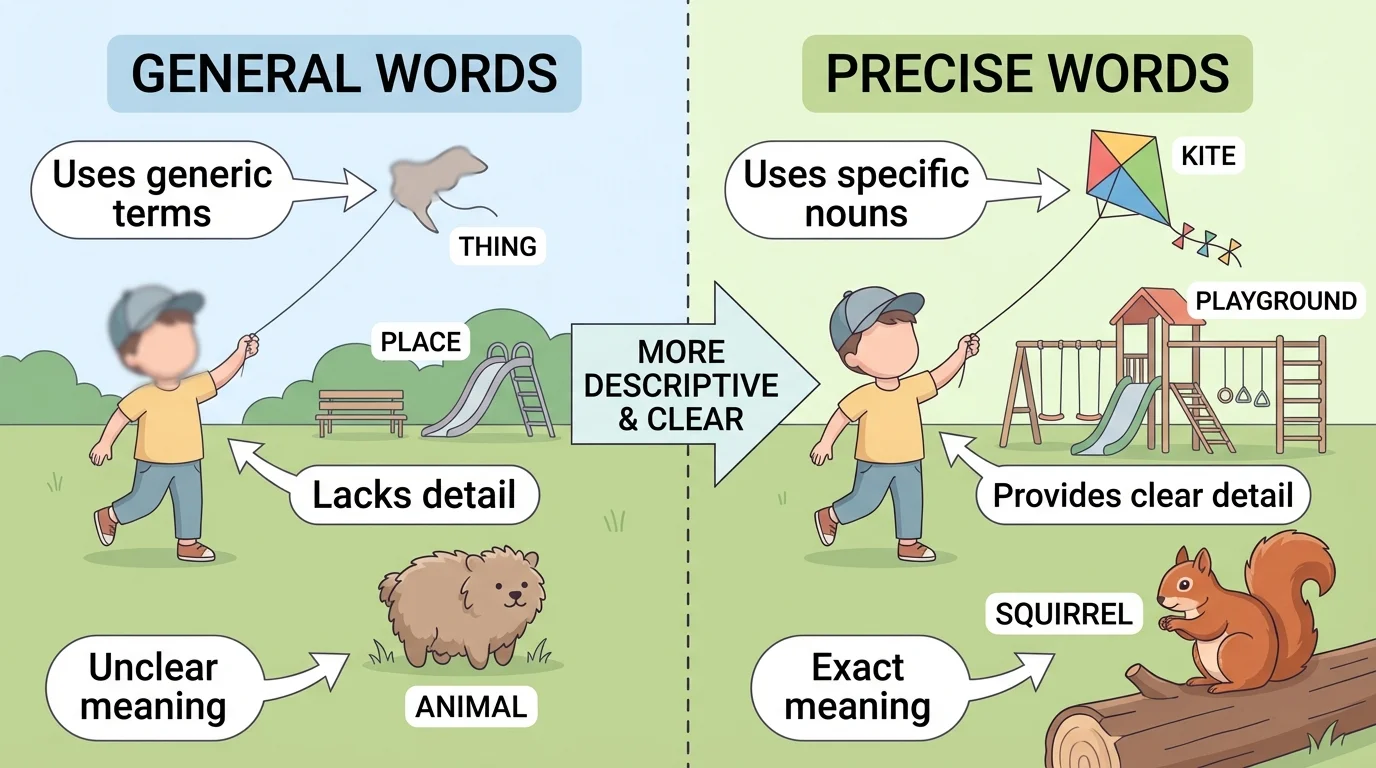
Precise nouns are very useful in narrative writing because they make each event easier to follow. If you write, "The girl dropped her lunchbox," the reader knows more than if you write, "The kid dropped her thing." If you write, "We ran to the wooden bridge," the place becomes easier to imagine than if you write, "We ran to the place."
Sometimes a broad noun is fine, but often a more exact noun makes the sentence stronger. Read this pair: "I saw an animal in the yard." "I saw a raccoon in the yard." The second sentence gives a much better picture. Later, when the story continues, the reader remembers the raccoon more easily than an unnamed animal.
Making nouns more precise
Step 1: Start with a general sentence.
"The boy carried a thing to the place."
Step 2: Replace the general nouns with exact nouns.
boy becomes brother, thing becomes lantern, and place becomes porch.
Step 3: Read the stronger sentence.
"My brother carried the lantern to the porch."
The new sentence is clearer and more interesting.
Later in a story, exact naming still matters. The park scene is easy to picture because words like squirrel and playground tell more than animal and place.
[Figure 2] An active verb tells what someone or something does in a strong, lively way and can be illustrated with different ways of moving. Some verbs are weak because they do not tell much. Words like went, did, and got can work, but stronger verbs often paint a better picture.
For example, instead of saying "Mila went to the door," you might say "Mila tiptoed to the door" or "Mila rushed to the door." Each verb changes the feeling. Tiptoed sounds careful and quiet. Rushed sounds fast and urgent.
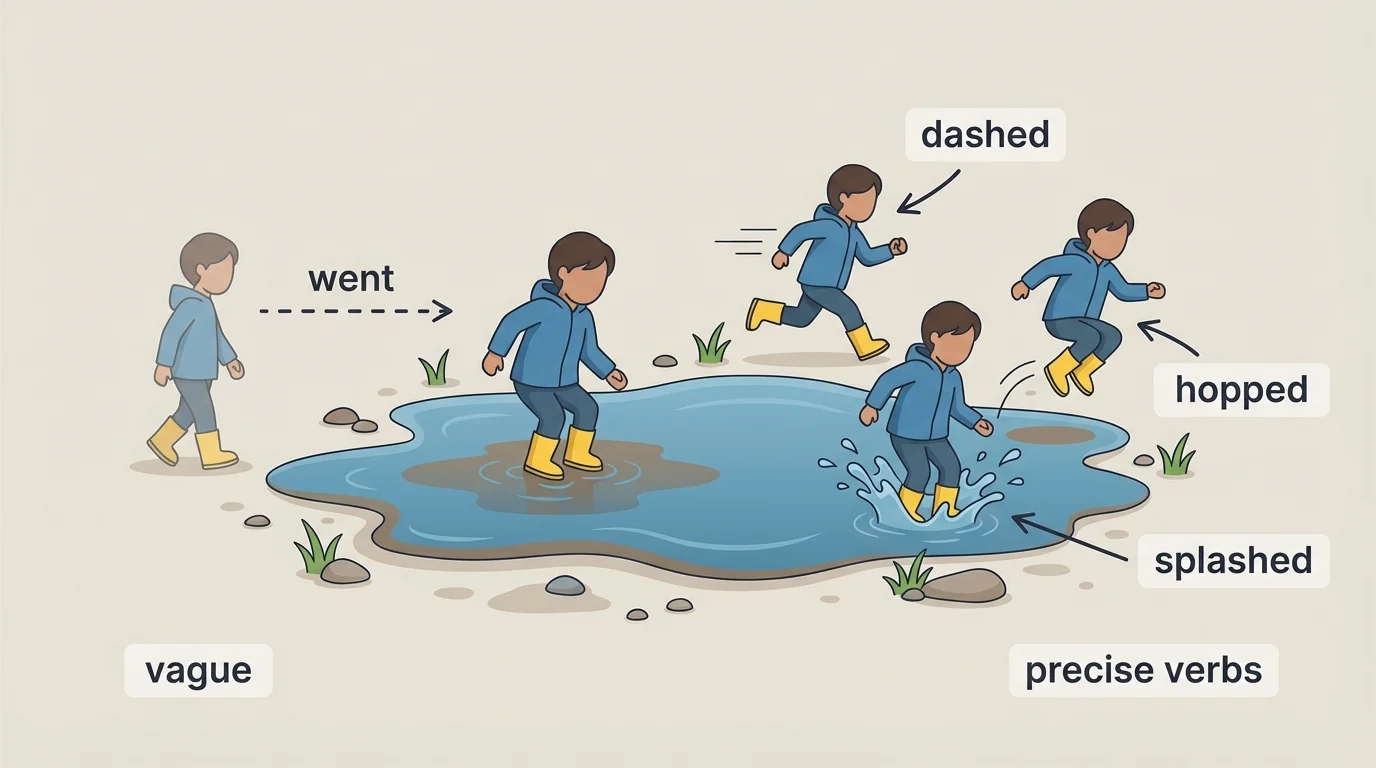
Strong verbs make events in a sequence easier to understand. In a story, "Leo opened the gate, grabbed the leash, and jogged after the puppy" is more exciting and clearer than "Leo did things and went after the dog." The reader can follow each action step by step.
Here are more examples of weak and stronger verbs.
| Weak Verb | Stronger Verb |
|---|---|
| went | hurried |
| looked | peeked |
| said | whispered |
| ran | sprinted |
| ate | munched |
Table 1. Examples of weaker verbs and stronger, more specific verbs.
Be careful, though. A strong verb should still make sense. If a turtle is moving, sprinted may not fit. If someone speaks softly, shouted would not be right. The best active verb is both strong and correct.
Authors often spend time changing just one verb in a sentence because the right verb can change the whole mood of a story.
The action words make a big difference. A child who went near a puddle is hard to picture, but a child who hopped or splashed becomes easy to imagine.
[Figure 3] A descriptive adjective gives more information about a noun and can show one wagon described in richer ways. Adjectives can tell about color, size, shape, sound, feel, or number. They help readers notice important details.
Read these two sentences. "I found a shell." "I found a tiny, striped shell." The second sentence helps the reader picture the shell better. The adjectives tiny and striped add useful details.
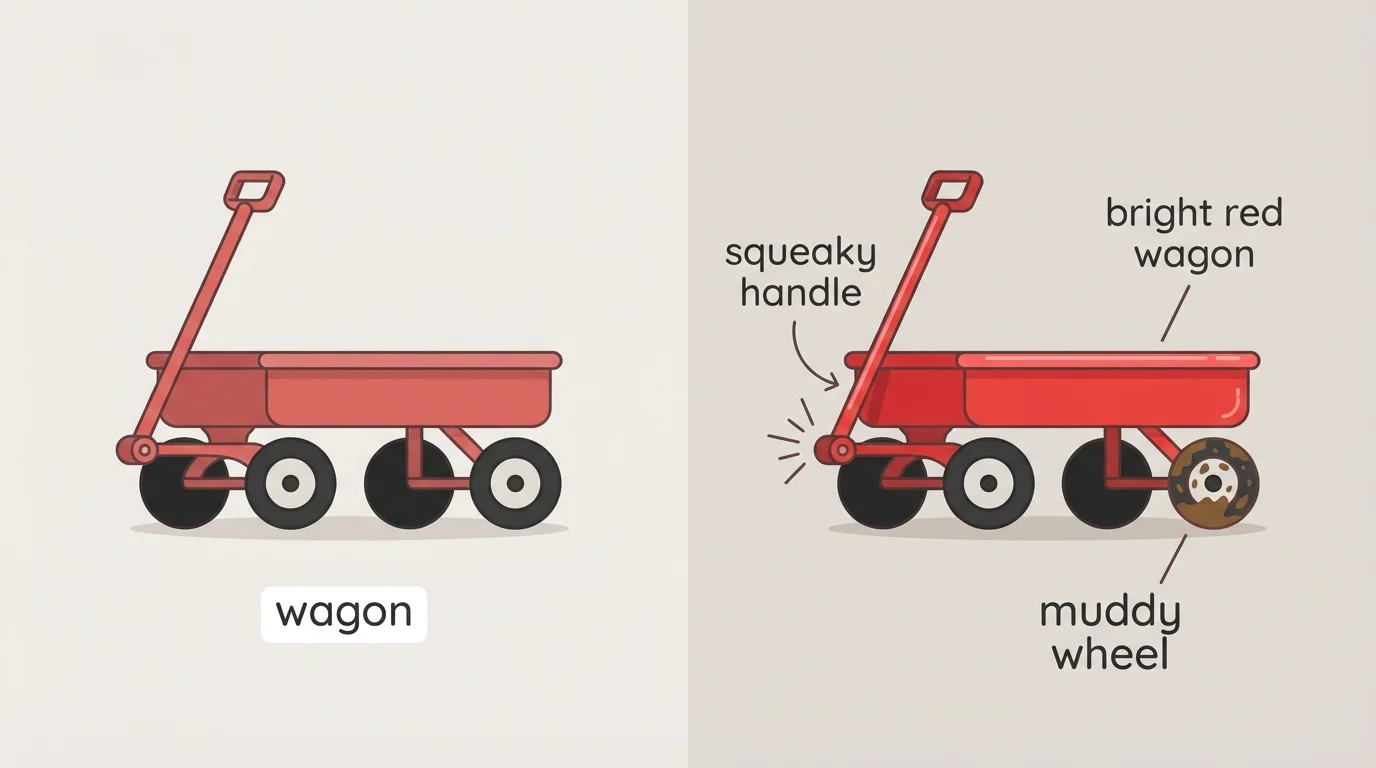
Adjectives can also help set a mood. A cozy cabin sounds warm and safe. A dark cabin sounds different. A creaky cabin may sound old or a little spooky. Choosing the right adjective helps the reader feel what the character feels.
Good adjectives are helpful, but too many can make a sentence crowded. "The little tiny round shiny smooth bright red ball" has many details, but it may feel stuffed with words. It is usually better to choose one or two adjectives that matter most, such as "the shiny red ball."
Choose details that matter most
Strong writers do not add describing words just to add more words. They choose details that help the reader understand the scene, the character, or the action. A story about a lost kitten may need adjectives like shivering, muddy, or tiny because those details matter.
The wagon becomes more vivid because the adjectives point to clear details instead of giving random extra words.
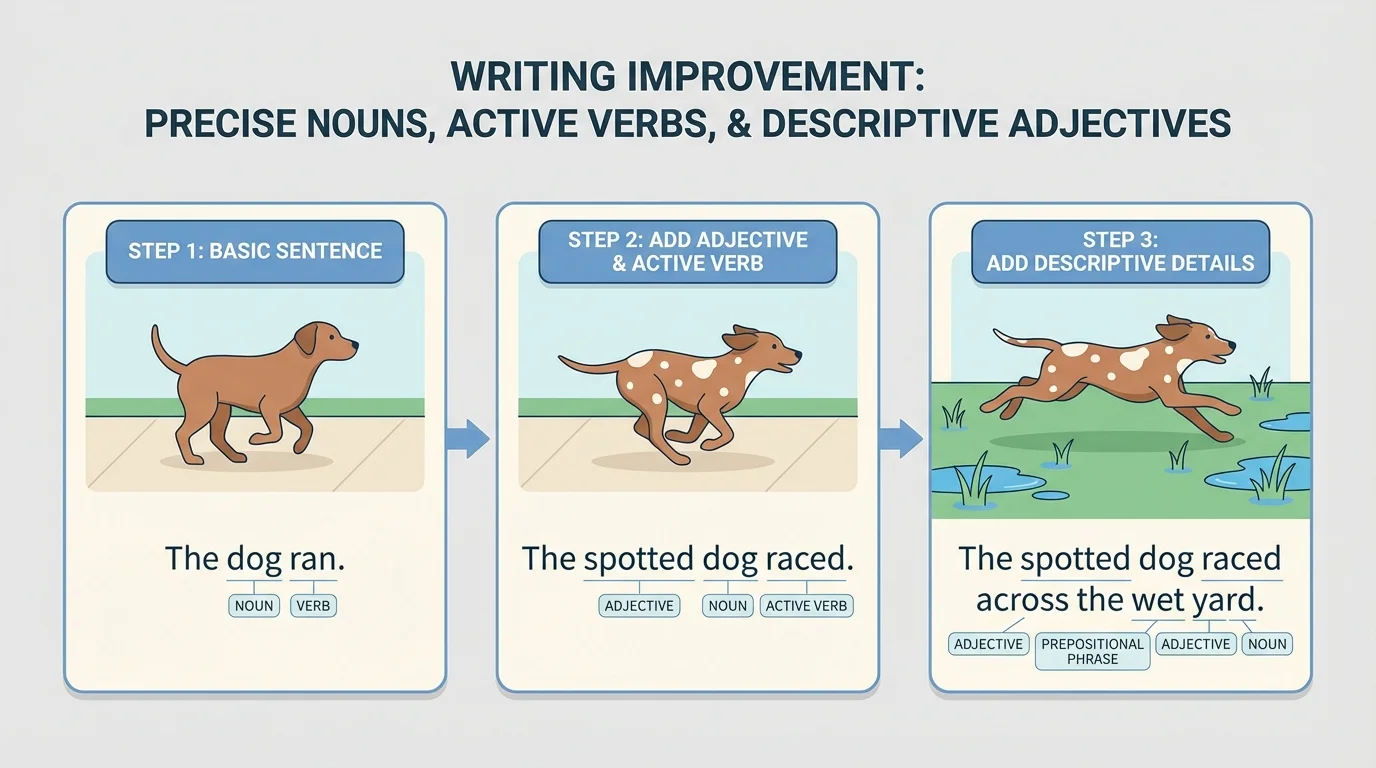
[Figure 4] When you put precise nouns, active verbs, and descriptive adjectives together, your writing grows stronger by building one sentence step by step. You can start with a simple sentence and revise it to make it clearer.
Start with: "The dog ran." This sentence is complete, but it does not tell much. Which dog? How did it run? Where did it go?
Now make it stronger: "The spotted dog raced across the wet yard." The noun phrase dog becomes more specific with the adjective spotted. The verb raced is stronger than ran. The adjective wet adds a detail about the yard.
Here is another example. "A girl went outside." This can become "My neighbor Emma skipped onto the sunny sidewalk." The sentence now gives the reader a person, an action, and a setting.
Revising one narrative sentence
Step 1: Read the plain sentence.
"The kid went to the tree."
Step 2: Make the noun more exact.
Change kid to Ava and tree to oak tree.
Step 3: Strengthen the verb.
Change went to climbed or hurried, depending on the action.
Step 4: Add one helpful adjective.
Add tall to describe the oak tree.
Step 5: Read the revised sentence.
"Ava hurried to the tall oak tree."
The revised sentence is much clearer.
The growing sentence reminds us that strong writing is often built one careful word at a time.
Narratives describe events in sequence. That means the events happen in order. Strong word choice helps each part of the story feel connected.
In the beginning, introduce who, where, and what is happening. Precise nouns are especially helpful here. "One windy afternoon, my cousin Nora carried a blue kite to the hill" tells more than "One day, someone took something somewhere."
In the middle, show the action clearly. Active verbs keep the story moving. "The kite tugged, dipped, and soared above the field" gives the middle of the story energy.
In the ending, bring the story to a close. A good ending lets the reader know what happened at the end and gives a feeling that the story is finished. "At last, Nora caught the kite, laughed, and folded it under her arm as the sun slipped down" gives a stronger sense of closure than "Then it was over."
"The right word can help a reader see the whole story."
Notice how the words in the beginning, middle, and ending work together. Exact nouns tell us who and what. Strong verbs show action. Careful adjectives add just enough detail to make the final scene feel complete.
Revise means to go back to your writing and make it better. Writers often revise by looking for words that are too general. Then they replace them with stronger choices.
When revising, ask simple questions. Can I name this more exactly? Can I choose a stronger action word? Can I add one detail that helps the reader picture the scene? These questions help you improve a sentence without making it confusing.
Read this plain short story: "I went to the park. I saw a bird. It made a sound. I went home." Now read a revised version: "I hurried to the park. A robin chirped from the tall fence. After a few minutes, I walked home smiling." The second version is clearer and more enjoyable to read.
You already know that a sentence begins with a capital letter and ends with punctuation. Strong word choice works best when your sentences are complete and easy to read.
Revision is not about using the fanciest word. It is about using the best word. A clear word that fits the story is better than a big word that sounds strange.
One mistake is using words that are too vague. Words like thing, stuff, and nice do not tell enough. Another mistake is adding too many adjectives. If every noun has many describing words, the sentence can become hard to read.
A third mistake is choosing a strong word that does not fit. "The pillow sprinted off the bed" sounds silly unless the story is meant to be funny or make-believe. Word choice should match what is happening.
Also remember that not every sentence needs many details. Writers choose where to zoom in and where to keep things simple. Important moments often need stronger details. Small connecting moments may need fewer.
Good narrative writing sounds clear, not crowded. It gives enough information for the reader to understand the sequence of events and enjoy the ending.
