Have you ever met a story character who felt so real that you could almost hear that person talking? Strong characters are like that. They do not feel flat or empty. They feel like real people because writers tell us about them in two big ways: what they are like inside and what they are like outside.
A character is a person, animal, or creature in a story. Some characters are in many parts of the story, and some appear only a little. But even a small character can feel more real when the writer gives good details.
In narratives, events happen in order. A character helps move those events along. What a character wants, fears, or decides can change what happens next. That is why learning to build characters is such an important part of writing stories.
Internal traits are the thoughts, feelings, wishes, and worries a character has on the inside.
External traits are the details we can notice on the outside, such as hair, face, size, expression, movement, and clothing.
When writers use both kinds of details, readers can picture the character and understand the character better. A reader may know that a girl wears red rain boots, but the reader also wants to know whether she feels brave, shy, excited, or worried.
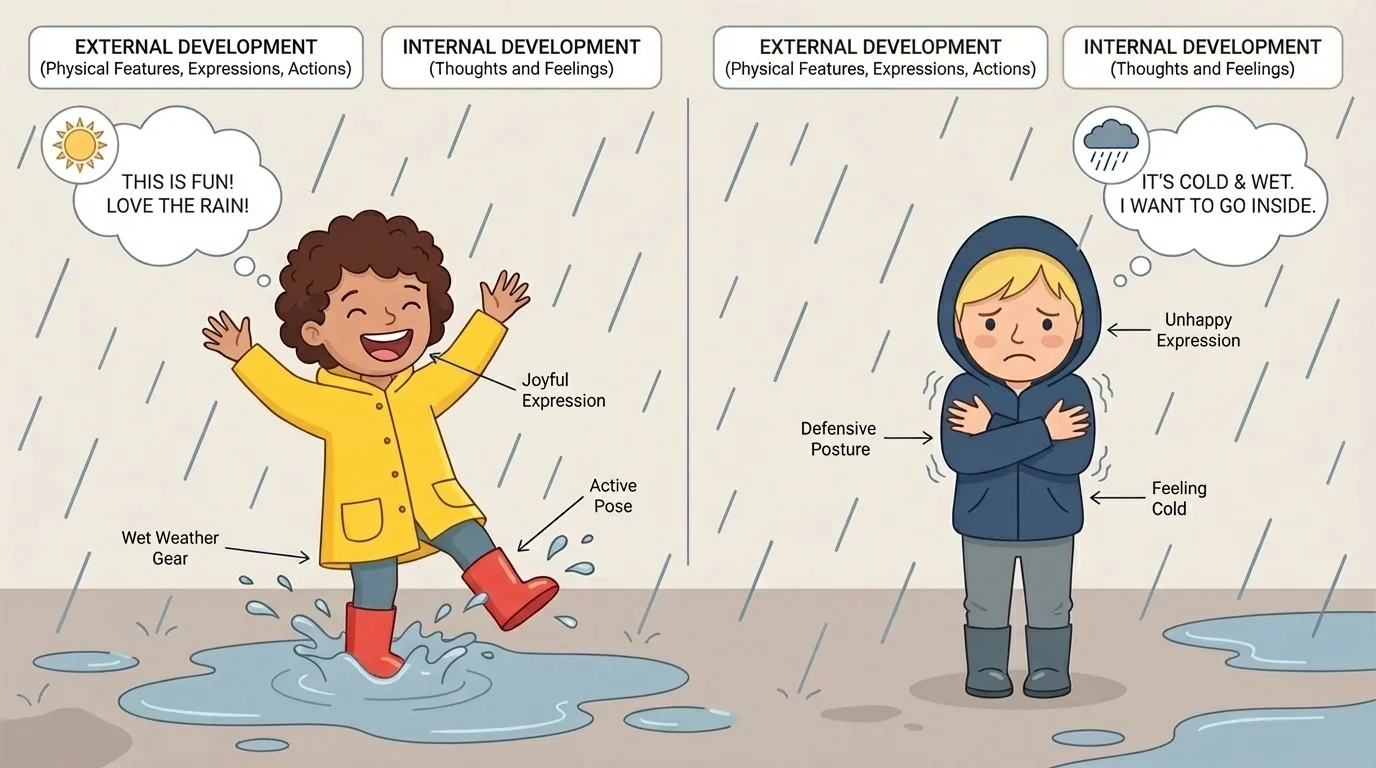
The inside of a character includes thoughts and feelings. These are not always visible on the outside right away. Two children can stand in the same rainstorm and feel completely different, as [Figure 1] shows. One may think, "This is fun!" while the other may think, "I want to go home."
Internal details can include what a character wants. A boy may want to win the spelling bee. A puppy may want to find its owner. A dragon in a fantasy story may want a quiet cave to sleep in. These wants help explain actions.
Internal details can also include worries and problems. A girl might worry that her new classmates will not like her. A child may feel nervous before singing on stage. These feelings make readers care about what happens next.
Writers can show the inside of a character in several ways. They can tell us directly: "Mina felt scared." They can also show it through actions and words: "Mina held her breath and gripped the door handle." Both ways help the reader understand the character.
Inside details shape actions. A character does not act for no reason. If a character feels jealous, the character may stomp away. If a character feels proud, the character may stand tall. If a character feels kind, the character may share a snack or help a friend. The inside often explains the outside action.
Think about how this works in a story. If Leo hears thunder and hides under a blanket, the writer can help us know why by sharing his thoughts: "Thunder is too loud. I wish the storm would stop." Now Leo feels more real than a character who only hides.
Later in the story, the same character may change. Leo may still hear thunder, but after helping his little sister feel calm, he may think, "I can be brave too." As we saw in [Figure 1], the same kind of event can lead to different feelings, and feelings can change over time.
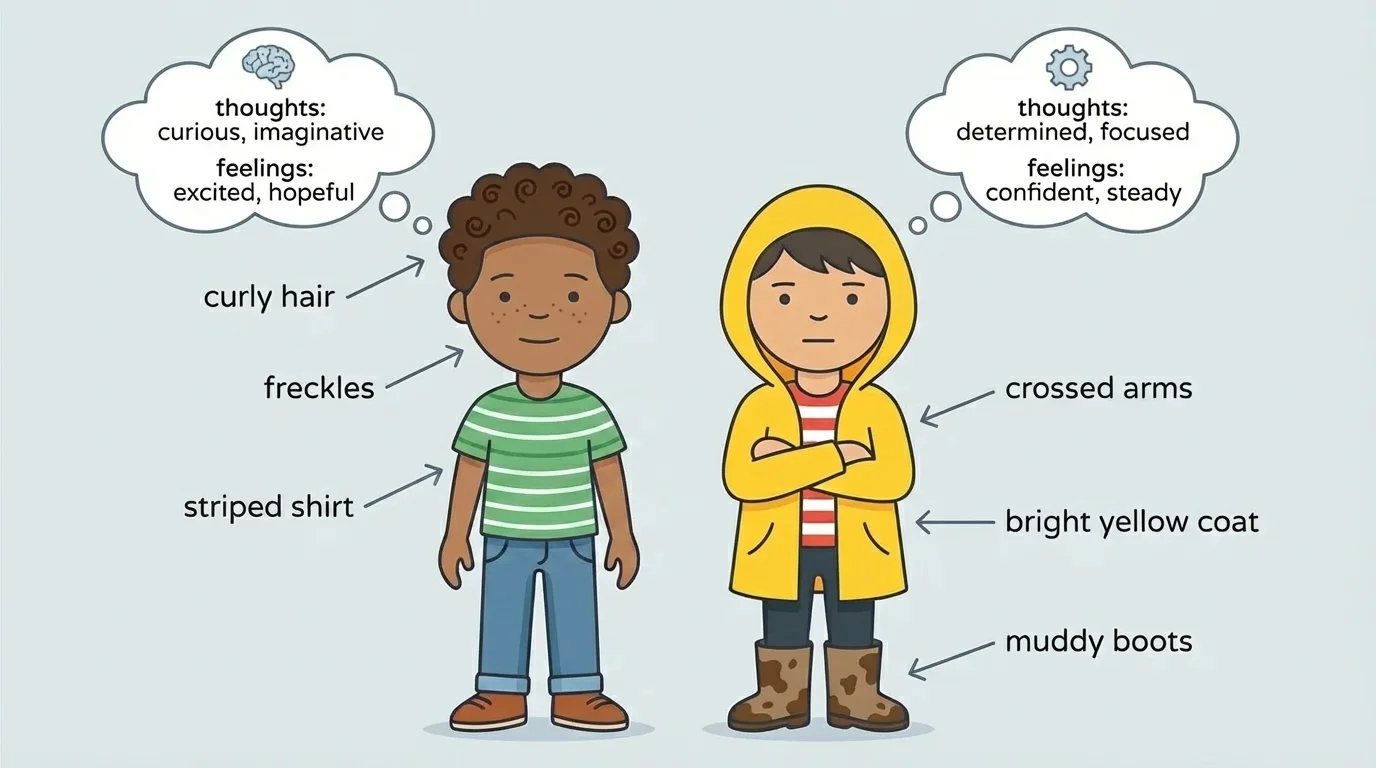
The outside of a character includes the way the character looks. These physical features may include height, hair, skin tone, freckles, glasses, or the way the character walks. They also include face and body clues, such as a smile, a frown, drooping shoulders, or bouncing steps, as [Figure 2] illustrates.
Clothing is another useful outside detail. Clothes can tell us a lot. A child in a soccer uniform may be heading to practice. A character in a sparkly cape may love pretending. A raincoat with torn pockets may suggest the character plays hard outside.
Expressions matter too. Raised eyebrows can show surprise. A tight mouth can show anger. Wide eyes can show fear or wonder. Crossed arms can make a character seem upset, stubborn, or chilly, depending on the moment in the story.
Good outside details are clear and specific. Instead of writing "She looked nice," a writer can write, "She had two braids, a purple sweater, and a missing front tooth." That picture is much stronger in the reader's mind.
Writers do not need to list every single detail. Too many details can feel crowded. Pick a few strong ones. In [Figure 2], only a handful of details help each child look different. That is often enough to help the reader picture the character.
Readers often remember one small, special detail about a character for a long time, such as green boots, a crooked hat, or a giant grin. One strong detail can make a character stick in the mind.
Outside details can also match the inside of a character or contrast with it. A child may wear bright, cheerful clothes but feel lonely inside. Another may look serious on the outside yet feel excited on the inside. That mix can make a character even more interesting.
The strongest characters use both kinds of details together. If a writer only tells the inside, readers may understand the feelings but not picture the person. If a writer only tells the outside, readers may picture the person but not care as much about what the person is thinking.
Here is a simple example. "Tariq had messy black hair and a backpack covered with star stickers. He chewed his lip when the teacher called on him because he was afraid of giving the wrong answer." Now we know something outside and something inside.
Here is another example. "Nora wore a paint-splashed shirt and always had blue smudges on her fingers. She smiled when she saw blank paper because she loved making new pictures." The outside details help us see Nora, and the inside details help us know her.
Example: A flat character and a stronger character
Step 1: Flat version
"Sam went to the park."
Step 2: Add outside details
"Sam, a small boy in a red cap and loose sneakers, went to the park."
Step 3: Add inside details
"Sam, a small boy in a red cap and loose sneakers, went to the park. He felt lonely and hoped someone would ask him to play."
The last version helps the reader picture Sam and understand what he feels.
When a reader knows both the outside and the inside, the character becomes easier to remember. The character also becomes easier to place into story events because the reader understands why the character acts in certain ways.
Stories have a beginning, middle, and end. A good character fits into that sequence. The character may start with one feeling, face a problem, and end with a new feeling or a lesson learned in a simple story sequence.
[Figure 3] At the beginning, the writer can introduce the character with a few outside details and one or two inside details. In the middle, the events test the character. In the end, the character may solve the problem, change, or understand something new. This helps give the story a sense of closure.
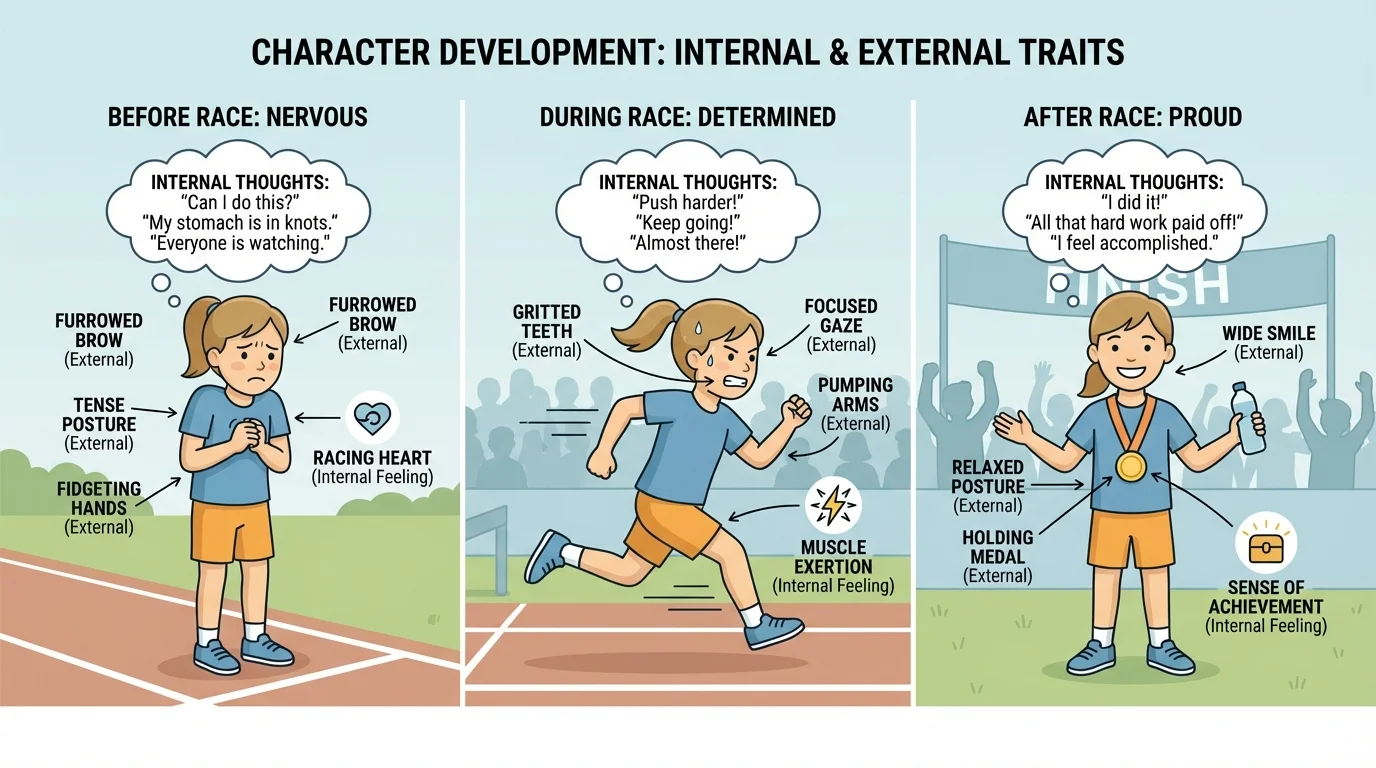
For example, "Elena tied her bright orange shoelaces before the race. Her hands shook because she was afraid she would trip. During the race, she stumbled but got up quickly. At the finish line, Elena grinned. She had not come in first, but she felt proud because she did not quit." This character changes across the story.
Notice how the events happen in order. First, Elena is nervous. Next, she runs and faces trouble. Finally, she finishes and feels proud. Her inside feelings and outside actions work together.
Later in your writing, you can think back to [Figure 3] and ask: does my character stay the same all the way through, or does the story help the character grow? Even a small change can make an ending feel complete.
Stories often have more than one character. If every character looks the same, talks the same, and feels the same, the story can get confusing. Writers should give each character something special.
One character may be bold, while another is careful. One may wear neat clothes, while another always has grass stains on the knees. One may speak quickly, while another takes time to think. These differences help readers keep track of who is who.
A friend character can also help reveal the main character. If the main character is shy, a cheerful friend may pull the character into new experiences. If the main character worries a lot, a calm grandparent may offer comfort. Characters often shine more clearly when they are beside someone different.
| Character detail | Example | What it shows |
|---|---|---|
| Thought | "I hope I do not make a mistake." | The character feels nervous. |
| Feeling | Excited about the field trip | The character looks forward to something. |
| Expression | Eyes wide and mouth open | The character is surprised. |
| Clothing | Overalls with seed packets in the pocket | The character may love gardening. |
| Movement | Slow steps and drooping shoulders | The character may feel tired or sad. |
Table 1. Examples of inside and outside character details and what they can show.
As Table 1 shows, one small detail can tell a lot. Writers choose details on purpose. Each detail should help the reader know the character better.
Let us build a full character for a short narrative. Meet Ruby. Ruby has short curly hair, a backpack with a broken zipper, and a green jacket with one shiny button missing. She usually squints when she is thinking hard. On the inside, Ruby is curious, helpful, and a little worried about trying new things.
Now place Ruby in a story. At the beginning, Ruby finds a small box under the library steps. She wonders who lost it, but she feels nervous about opening it. In the middle, she asks questions, follows clues, and learns the box belongs to the school janitor. At the end, she returns it and feels proud that she was brave enough to help.
Good narratives do more than list events. They connect events to a character who thinks, feels, and acts. When the ending shows how the character solved the problem or changed, the story feels finished.
Ruby works because we know what she looks like and what she feels. Her outside details help us picture her. Her inside details help us understand why she hesitates at first and why returning the box matters to her.
When you develop characters, ask yourself simple questions. What does this character look like? What does this character wear? How does this character feel at the start? What does this character want? How does the character change by the end? Those questions can guide strong story writing.
A well-developed character does not need to be perfect. Characters can be scared, grumpy, silly, brave, gentle, messy, or stubborn. What matters is that the details work together to make the character feel alive in the story.
