Some words show up again and again in stories, directions, notes, and school writing. Words like said, because, there, and little are everywhere. When you can spell these words correctly, your writing becomes easier to read, easier to understand, and stronger.
Spelling helps a reader know exactly what you mean. If you write a word the wrong way, your reader may stop, guess, or get confused. Correct spelling is one part of clear writing. Writers also use capitals, punctuation, and complete sentences, but spelling is one of the first things a reader notices.
When you spell common words correctly, your brain has more room to think about your ideas. Instead of stopping to worry about every word, you can focus on telling a story, giving information, or sharing an opinion. Good spelling helps your thoughts shine.
Why common words matter so much
High-frequency words are words we read and write often. Because they appear so many times, learning to spell them correctly makes a big difference. A writer who knows these words well can write more smoothly and edit more carefully.
Many high-frequency words are small, but that does not always make them easy. Some sound just the way they are spelled, while others have parts that must be remembered. That is why strong spellers use more than one strategy.
High-frequency words are words that appear very often in reading and writing. Examples include the, and, was, come, here, they, and from. You see them in books, on signs, in classroom directions, and in your own sentences.
Because these words are so common, writers should learn them well enough to spell them quickly and correctly. Some can be sounded out easily. Others are a little unusual. For example, said does not sound exactly like it looks, so a writer may need to study it and remember it.
Spelling pattern means a letter pattern that appears in many words, such as -ake in make and take.
Tricky part means the part of a word that is harder to spell because it may not sound the way you expect.
Edit means to check writing and fix mistakes.
Knowing these ideas helps you become a better writer. You do not just guess at words. You look carefully, think carefully, and check carefully.
As shown in [Figure 1], strong spellers study words closely. They notice the beginning letters, the middle vowel sound, the ending, and any tricky part that must be remembered. For example, in little, a writer can notice lit at the start and then remember the ending -tle.
You can also look for chunks inside a word. A word family is a group of words with the same ending pattern, such as make, take, and bake. When you know one pattern, you can use it to help spell other words. But you still need to watch for words that break the pattern.
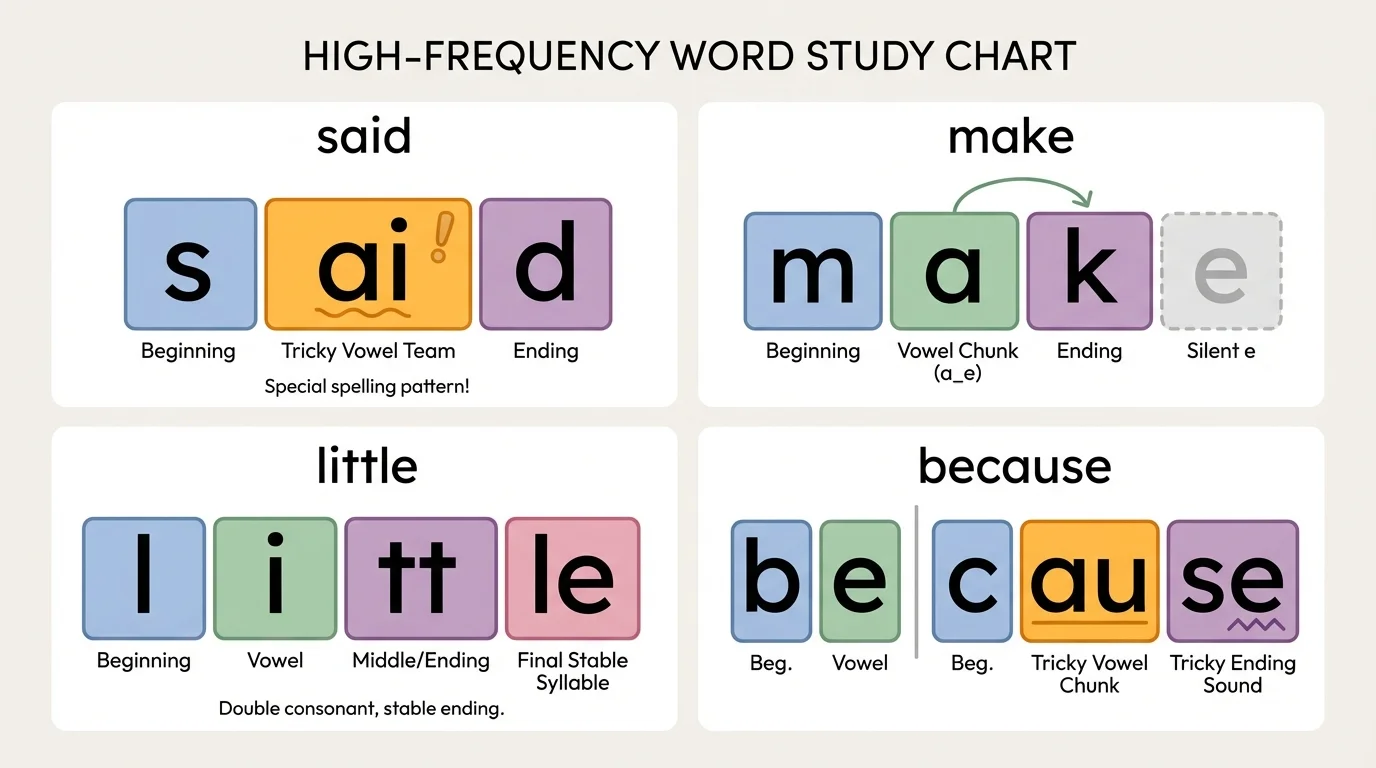
Sometimes a word has a part that you can sound out and a part that you need to remember. In because, you may hear some sounds clearly, but the whole word is easier to spell when you remember its letter order. In there, the ending -ere needs careful attention.
A good writer does not rush past these details. Looking carefully at words helps you store them in your memory. Later, when you write, the word is easier to call back.
Some of the words people use the most are also some of the ones they misspell the most. That is why practicing common words helps writing so much.
As you keep noticing word parts, you begin to see patterns everywhere. The same careful looking that helps with spelling also helps with reading.
Many high-frequency words follow patterns you already know. Some have short vowel sounds, like big, not, and get. Some end with a silent e, like make, these, and time. In these words, the final e helps the vowel say its name.
Some words have double letters, like little and still. Some have endings you will see again and again, like -ing in going or -ed in looked. Some words are irregular, which means they do not fully match the usual sound rules. Words like one, said, and come must be learned by close study and memory.
| Pattern or feature | Example words | What to notice |
|---|---|---|
| Short vowel | get, not, had | The vowel often makes a quick sound. |
| Silent e | make, these, time | The last e changes the vowel sound. |
| Double letters | little, still | Watch for two of the same consonant. |
| Irregular spelling | said, one, come | Some parts must be remembered. |
Table 1. Common spelling features found in many high-frequency words.
When you learn patterns, spelling gets easier. Instead of treating every word as brand new, you connect it to words you already know. That makes your writing faster and more accurate.
Good spellers use both sound and memory. First, they listen for the sounds in a word. Then they think about what they know about spelling patterns. Finally, they check whether the word looks right.
For example, if you want to write train, you can hear the sounds and remember the vowel team ai. If you want to write said, sounding out alone may not be enough. You also need to remember the unusual spelling. That is why both strategies matter.
Example: using sound and memory
A student wants to write the sentence: I said thank you because she helped me.
Step 1: Listen for the easy words.
The student can hear and spell I, thank, you, she, helped, and me.
Step 2: Notice the tricky high-frequency words.
Said and because may need memory because they are not always easy to sound out.
Step 3: Reread and check.
The student rereads the sentence and makes sure each common word looks correct.
Using sound plus memory helps the whole sentence come out clearly.
Over time, many words become automatic. That means you can spell them without stopping for a long time to think. Automatic spelling is helpful because it makes writing smoother.
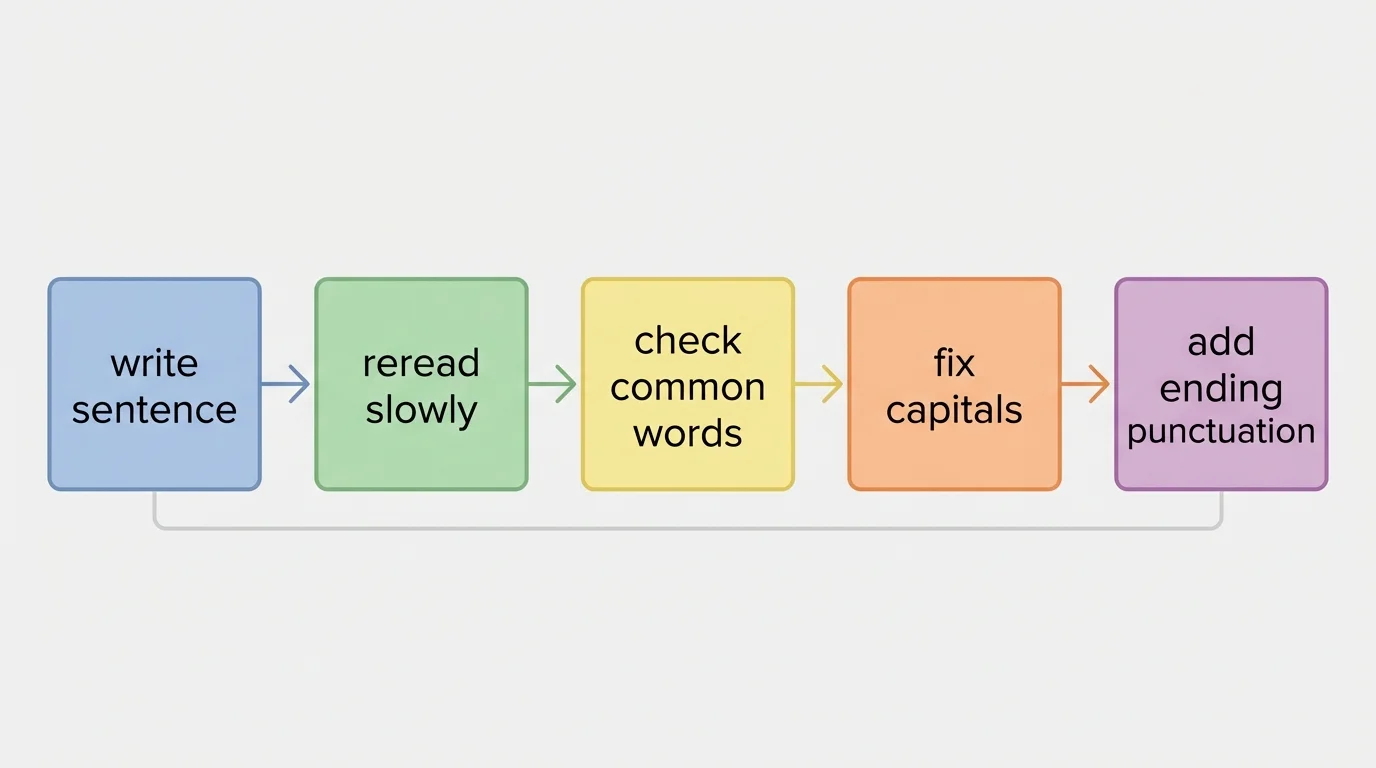
As [Figure 2] shows, writers do not only think about spelling before they write. They also check after writing. After you finish a sentence or a short paragraph, reread it slowly. Touch each word with your finger or track it with your eyes.
When you edit, check your most common words first. Look for words such as they, there, because, were, friend, and little. These are words many students use often and sometimes misspell. If a word does not look right, stop and fix it.
A smart order for checking is this: read the sentence, check high-frequency words, check capitals, and then check punctuation. This order helps you stay organized and careful.
Editing is part of the writing process. First you get your ideas down. Then you improve your writing by fixing mistakes. This is how writers make their work clear for others.
You already know that a sentence begins with a capital letter and ends with an end mark such as a period, question mark, or exclamation point. When you edit spelling, check those sentence clues too.
Later, when you reread a longer piece of writing, the same process still works. As you saw earlier in [Figure 2], going step by step helps you catch mistakes without feeling rushed.
Correct spelling works together with capitalization and punctuation. A sentence such as my friend said we can come. needs a capital at the beginning: My friend said we can come. Now it looks complete and correct.
Punctuation marks help readers know when a sentence ends or what kind of sentence it is. Compare these: Can you come here? and Come here! The words may be similar, but the punctuation changes the meaning and feeling.
When you check your writing, do not look at spelling by itself. Think about all the conventions of good writing together. Correct words, capitals, grammar, and punctuation make your ideas easier to understand.
Some high-frequency words are extra tricky because they sound alike or look alike. For example, their and there are different words with different meanings. To, too, and two sound the same but are spelled differently. A careful writer chooses the correct one for the sentence.
Other words are tricky because they have unexpected letters, such as friend, does, again, and would. These words become easier when you read them often, write them often, and notice exactly how they are spelled.
Example: checking tricky words in sentences
Read these sentence pairs.
Step 1: Look at meaning.
We went over there. The word there tells a place.
Step 2: Compare with a similar word.
Their dog is playful. The word their shows that the dog belongs to them.
Step 3: Notice the spelling change.
The words sound similar, but the spellings are different because the meanings are different.
Good writers pay attention to both spelling and meaning.
When you learn these confusing pairs, your writing becomes more exact. You are not just writing a word that sounds right. You are choosing the word that is right.
Strong spelling grows through habits. Read carefully. Notice common words in books. Look for patterns. Write carefully. Reread your work. Fix mistakes. Each time you do this, you build stronger word memory.
It also helps to slow down when a word feels tricky. If you are unsure, ask yourself questions: What sounds do I hear? Do I know a pattern in this word? Is there a tricky part I need to remember? Does the word look right in my sentence?
As we saw earlier in [Figure 1], breaking words into chunks helps you study them closely. When you combine that close study with the step-by-step editing routine from [Figure 2], you become a more independent writer.
Every correct high-frequency word makes your message clearer. When your reader can move smoothly from one word to the next, your ideas are easier to enjoy and understand.
