Have you ever wondered why a polar bear has thick fur, how to spell a tricky word, or what a ladybug eats? One question can lead to many more. Smart researchers know a big secret: the answer is not always in the same place. Some questions are best answered by a book. Some are best answered by a dictionary. Some are easier to answer with a library computer. Learning where to look is part of becoming a strong reader, writer, and thinker.
When we want to learn something new, we use resources. A resource is something that gives us information. People use resources at school, at home, in libraries, and even at work. Doctors, cooks, builders, and teachers all look for information in different places.
Not all resources give the same kind of information. A dictionary helps with words. A book about animals helps us learn facts about animals. A library database helps us search for articles and pictures. An internet web page can share information quickly, but we must be careful to check if it is correct.
Resource means a source of information.
Research means looking for information to answer questions.
Inquiry means asking questions and trying to find out more.
Good researchers do not just grab the first thing they see. They stop and think, What kind of question am I asking? Then they choose a resource that fits that question.
A resource can be printed on paper or found on a screen. It can be a small book, a big book, a magazine article, a database article, or a web page. Some resources are made mostly of words. Others may include photographs, diagrams, maps, or charts.
Resources help us answer different kinds of questions. For example, if you ask, "What does habitat mean?" a dictionary is helpful. If you ask, "Where do frogs live?" a trade book or database article may be better. If you ask, "What happened at the zoo this week?" an internet web page from the zoo might help.
A dictionary is a special book or online tool that tells us about words. One dictionary page can hold many clues, as shown in [Figure 1]. It can tell us how to spell a word, what the word means, and sometimes how to say it aloud.
Dictionaries often include guide words at the top of a page. These help readers find words in alphabetical order. A dictionary entry may also show whether a word is a noun, verb, or adjective. Some dictionaries include a sentence to show how the word is used.
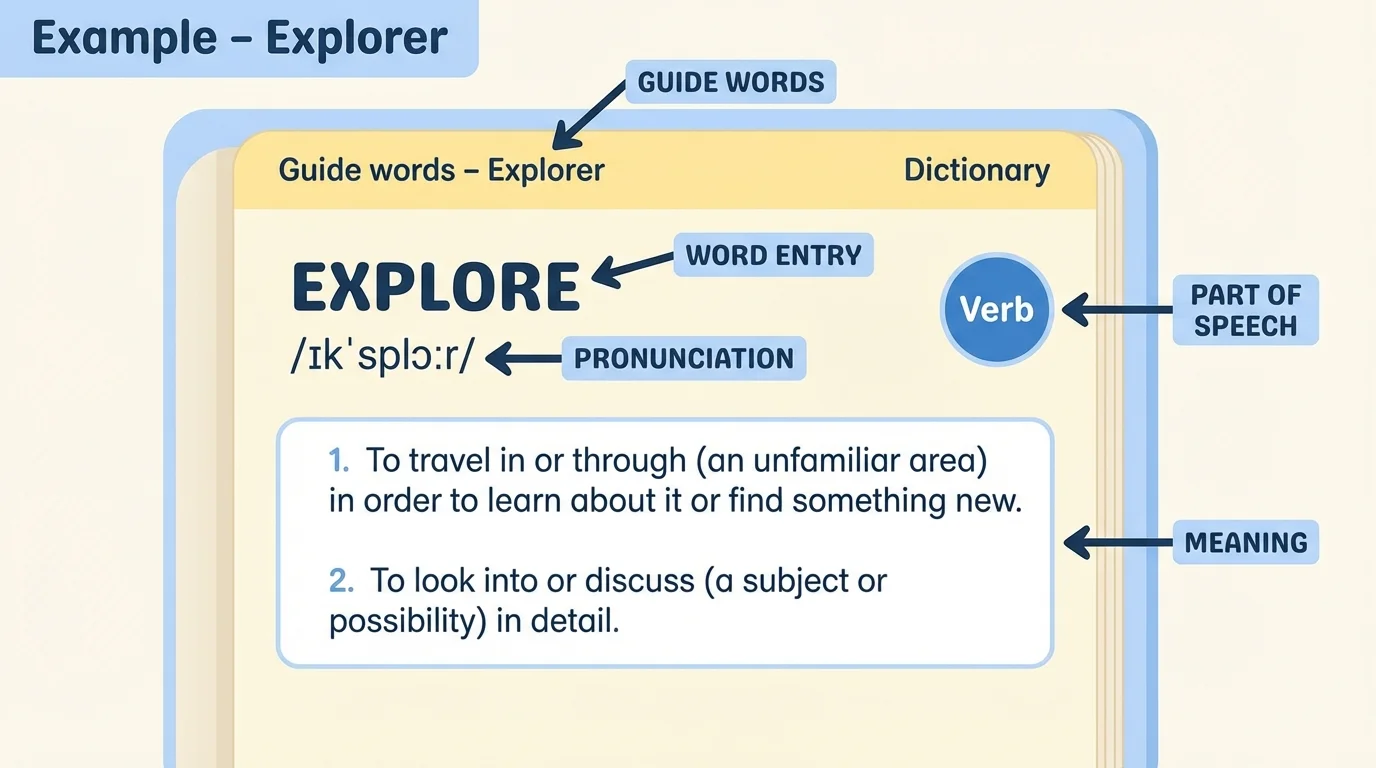
If you want to know the meaning of the word enormous, a dictionary is a great choice. If you want to know whether rabbit is spelled with one b or two, a dictionary helps with that too. But a dictionary usually does not give many deep facts about rabbits, such as what they eat or where they live.
That is why researchers must match the resource to the question. The dictionary in [Figure 1] helps best with word questions, not with long topic studies.
Example: Using a dictionary
A student asks, "What does camouflage mean?"
Step 1: Choose the right resource.
A dictionary is the best place because the student needs the meaning of a word.
Step 2: Find the word in alphabetical order.
The student looks for words that begin with c, then finds ca, then cam.
Step 3: Read the entry.
The dictionary explains that camouflage is a way an animal blends in with its surroundings.
The dictionary answers a word question clearly and quickly.
Some dictionaries are printed books, and some are online. Both can be useful. The important thing is knowing that dictionaries are built for learning about words.
A trade book is a book made for readers, not just for a textbook lesson. Trade books can be fiction or nonfiction. In research, nonfiction trade books are especially helpful because they teach facts about real topics such as weather, insects, space, or communities.
A trade book may contain photographs, labels, captions, a table of contents, headings, and an index. These text features help readers find information. If you want to learn many facts about sharks, a trade book about ocean animals can teach much more than a dictionary can.
Trade books are useful when you want to stay with a topic for a while. They often explain ideas in order. A book about butterflies may start with eggs, then caterpillars, then chrysalises, and then adult butterflies. This helps readers understand a whole topic, not just one tiny fact.
Many nonfiction books for children are written by experts who study the topic carefully, then explain it in ways young readers can understand.
Some trade books are stories based on true information. For example, a book about a child visiting a farm may tell a story while also teaching facts about animals, crops, and farm jobs.
A library database is a collection of information that people can search on a computer or tablet. It gathers trusted articles, pictures, and facts in one place, as [Figure 2] shows. Many school and public libraries provide databases made for children.
When a student types a topic into a database, the database searches for matches. It may bring up articles, photographs, diagrams, and sometimes videos. If you search for penguins, you might find an article about emperor penguins, a map of Antarctica, and photos of chicks and adults.
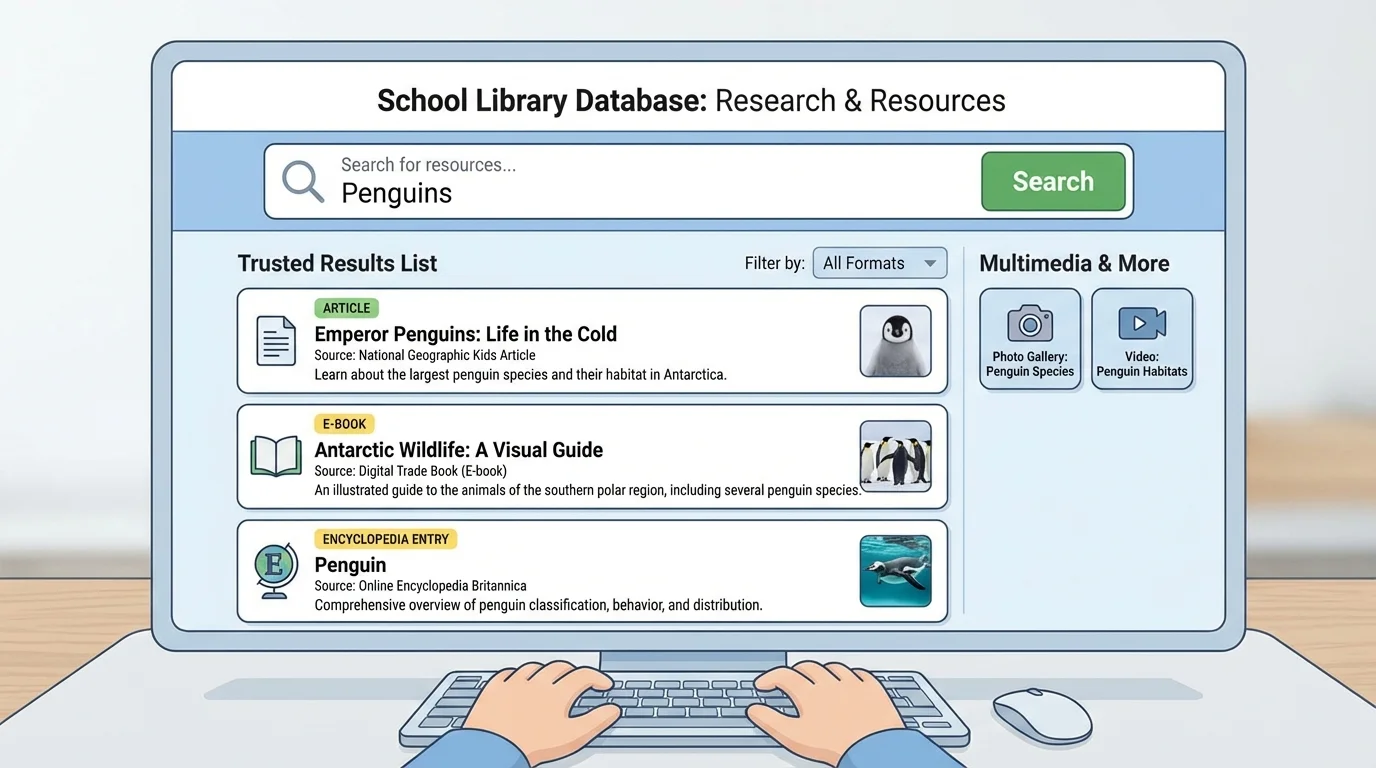
Library databases are helpful because the information is usually checked before it is added. That means the articles are often more trustworthy than random places on the internet. Databases also help students search by topic, keyword, or subject.
Another useful thing about databases is that they can be updated. A printed book stays the same after it is published, but a database can add new information. When students study current events, animals, science, or famous people, a database may provide newer details.
When researchers want facts from a trusted digital source, the kind of search shown in [Figure 2] is very useful. It saves time and gathers several helpful items together.
An internet web page is a page on the internet that we can open in a web browser. Web pages can contain words, pictures, videos, maps, and links to other pages. A zoo web page, for example, may tell the hours it is open, show animals that live there, and share news about new baby animals.
Internet web pages can be very helpful because they are easy to reach and can be updated quickly. A weather web page can show today's temperature. A museum web page can share information about a new exhibit. A school web page can post important announcements.
But web pages must be used carefully. Anyone can make a web page, so not every page is correct. Good researchers ask questions such as: Who made this page? Is it from a school, museum, library, or another trusted group? Does the information match what I find in other resources?
Checking if information is trustworthy
When readers check whether information is likely to be true and safe to use, they look at the source. Trusted sources often come from libraries, schools, museums, science groups, or well-known organizations. Researchers also compare information from more than one place.
If one web page says bats are birds, that is a clue something is wrong. A trade book, a database, and a trusted science web page would all show that bats are mammals. Comparing resources helps students catch mistakes.
[Figure 3] Strong researchers match the question to the resource. The resource you choose depends on what you need to know.
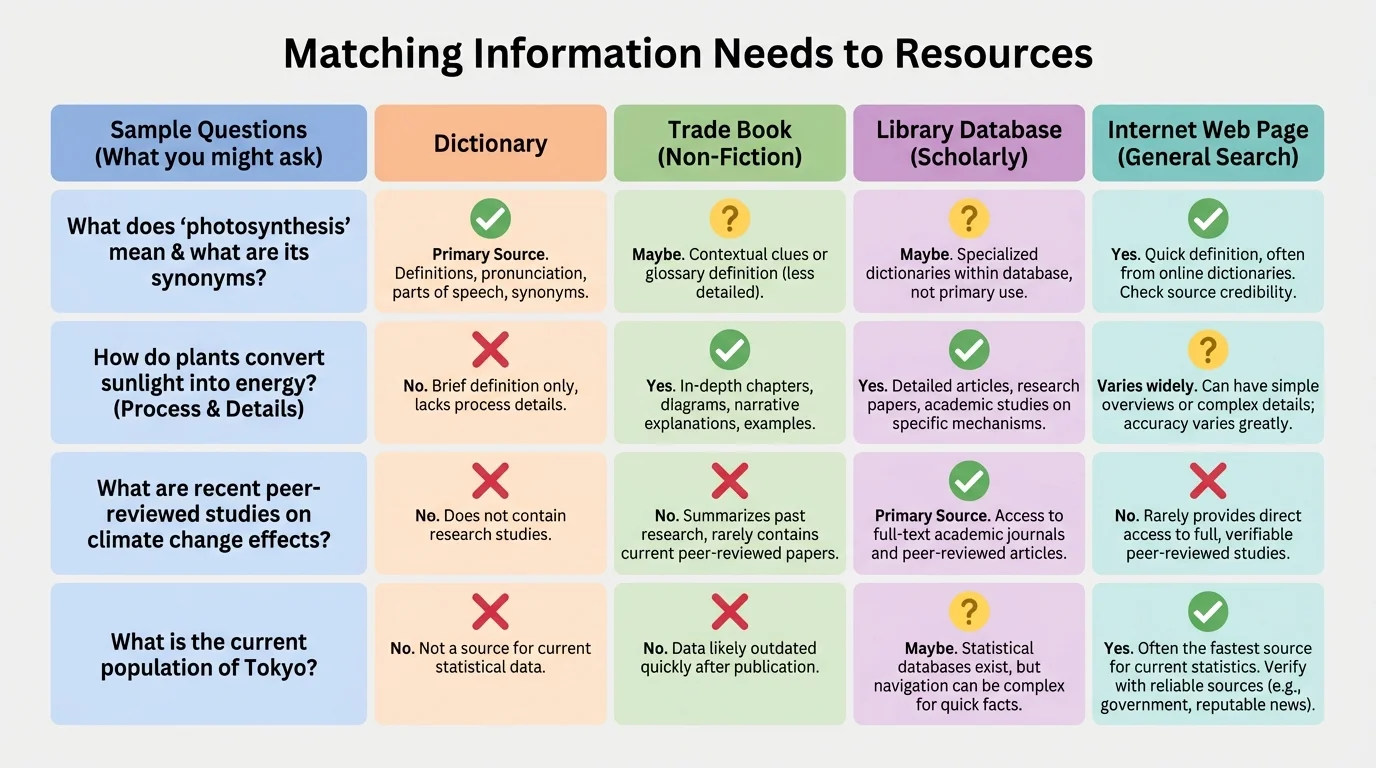
Here are some examples. If the question is "What does migrate mean?" the best resource is a dictionary. If the question is "How do geese migrate?" a trade book or database is better. If the question is "When does the bird center open today?" the best resource may be the center's web page.
| Question | Best Resource | Why |
|---|---|---|
| What does predict mean? | Dictionary | It gives word meanings and spelling. |
| How do plants grow? | Trade book | It explains a whole topic in detail. |
| What are three facts about volcanoes? | Library database | It gives trusted articles and pictures. |
| What time does the library close today? | Internet web page | It gives current information quickly. |
Table 1. Questions matched with resources that best answer them.
Sometimes more than one resource can help. A student learning about bees might start with a trade book, then use a database for extra facts, and then check a nature center web page for current information about local bees.
The matches in [Figure 3] remind us that one resource is not "best" all the time. It is best only for a certain kind of question.
Good research often means using more than one resource. One source may give a basic answer, while another adds details. A dictionary can explain a word in an article. A trade book can explain the topic. A database can add fresh facts or photos. A web page can provide the newest information.
Using several resources also helps us check our work. If two or three trusted resources say the same thing, we can feel more sure the information is correct. If one source says something very different, that tells us to look more carefully.
Example: Researching frogs
A class wants to answer the question, "How do frogs change as they grow?"
Step 1: Read a trade book.
The class learns about eggs, tadpoles, and adult frogs.
Step 2: Use a library database.
Students find an article with labeled pictures and extra facts.
Step 3: Check a trusted web page.
A nature center web page shares current photos and local frog information.
Using more than one resource gives the class a fuller answer.
Researchers often work together too. In shared research, one student may look in a book while another searches a database. Then they talk about what they found and put the facts together.
Research begins with questions. Some questions are short, such as "How do you spell beautiful?" Some are larger, such as "Why do leaves change color?" A strong question helps students know what kind of resource to use.
Here are some question types researchers ask: word questions, fact questions, topic questions, and current-information questions. Word questions fit dictionaries. Topic questions often fit trade books and databases. Current-information questions often fit trusted web pages.
As students gather information, they may ask new questions. That is part of inquiry. One answer can lead to another question, and that new question may lead to a new resource.
Readers already know how to ask questions before, during, and after reading. Research uses that same skill, but now the questions help readers choose resources and collect facts.
When students know what each resource can do, they become better at finding answers. They save time, choose wisely, and learn more deeply. That is what real researchers do every day.
