Have you ever wondered why some leaves are huge and others are tiny, or why one bird sings in the morning while another stays quiet? People learn about the world by asking questions. But strong learners do more than just wonder. They choose a question carefully, look for information on purpose, and use what they find to build an answer.
When we investigate, we are not just guessing. We are doing inquiry. Inquiry means asking a question and trying to learn the answer by looking, listening, reading, observing, and thinking. Good inquiry starts with a question that is not too big and not too small. Then it uses information from different places.
Investigation is a careful search for information to answer a question. A resource is something that helps you find information, such as a book, a picture, a person, or an observation. Observation is something you notice by using your senses.
When you investigate, you have a job to do: stay focused on the question. If your question is about what a butterfly eats, then facts about how fast a butterfly flies may be interesting, but they do not fully answer your question. Purposeful investigation means gathering information that fits your goal.
Questions help our brains grow. A question gives us a path to follow. Without a question, information can feel like a giant pile of puzzle pieces. With a question, we know which pieces matter.
Some questions are for quick answers. For example, "What color is the school bus?" can be answered right away by looking. Other questions need more than one source of information. "Why do school buses have big windows?" may need observation, reading, and talking with someone who knows about buses.
Researchers, scientists, readers, and historians all ask questions. Children do too. If a class wants to learn, "Which playground surface stays coolest in the sun?" the class can observe, compare, and record what they notice. That is purposeful learning.
Many great discoveries begin with a simple question. People often notice something surprising first, and then they investigate to find out more.
[Figure 1] Good questions help us avoid random searching. Instead of collecting every fact we can find, we collect facts that help us answer one idea clearly.
A specific question is easier to answer than a broad one. A broad question might be, "What are birds like?" That question is so big that it could lead to hundreds of facts. A more specific question might be, "What foods do robins eat in spring?" Now the investigation has a clear target.
When you make a question specific, you often add details such as one animal, one place, one time, or one part of a topic. For example, "How do plants grow?" is broad. "What does a bean plant need to grow in our classroom?" is more specific. A class can observe bean plants, read about plant needs, and answer that question more clearly.
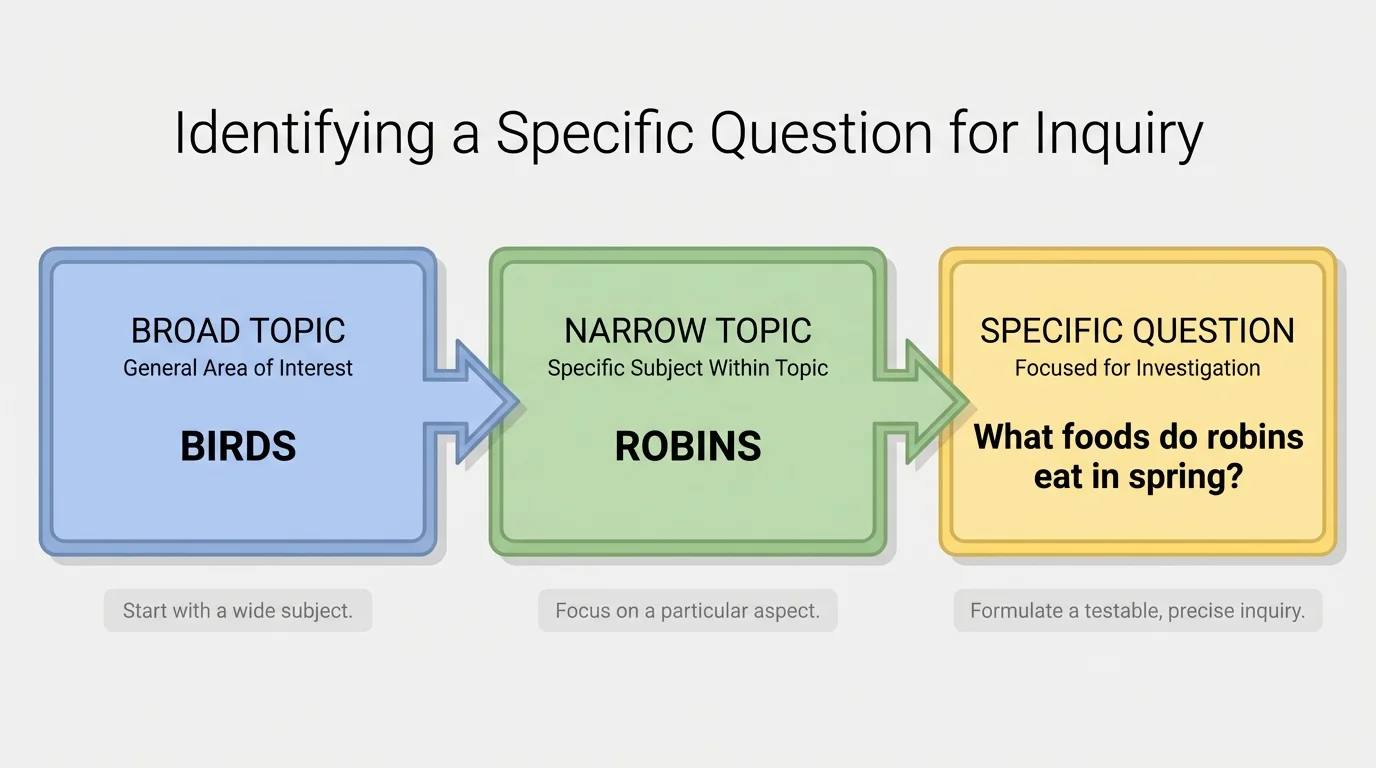
Specific questions are helpful because they tell you what kind of information to look for. If your question is "Which kind of paper towel soaks up the most water?" you know you need observations and comparisons. If your question is "What do firefighters wear to stay safe?" you may need books, pictures, or an interview.
Here are ways to make a question stronger:
Ask about one topic. Instead of asking about all insects, ask about one insect.
Use clear words. Make sure the question says exactly what you want to know.
Think about what you can find out. A good question can be answered by looking for information.
Making a question more specific
Step 1: Start with a broad topic.
Topic: weather
Step 2: Turn it into a broad question.
Question: "What is weather?"
Step 3: Add details to focus the investigation.
Specific question: "What kind of weather do we usually have at recess in winter?"
The last question is easier to investigate because it tells you what to observe and when to observe it.
Later, if you compare resources about robins or bean plants, the same idea still matters: the clearer the question is, the easier it is to find matching facts.
Before gathering information, it helps to make a simple plan. A plan is like a road map. It helps you know where to begin and what to do next.
A good plan asks: What is my question? What information do I need? Where can I find it? How will I keep track of what I learn? These small choices make the investigation organized instead of confusing.
[Figure 2] Suppose the question is, "What does a class pet turtle eat?" The plan might be: look in a pet care book, ask the teacher, observe the turtle at feeding time, and write down what each source says. That way, the investigation uses more than one resource.
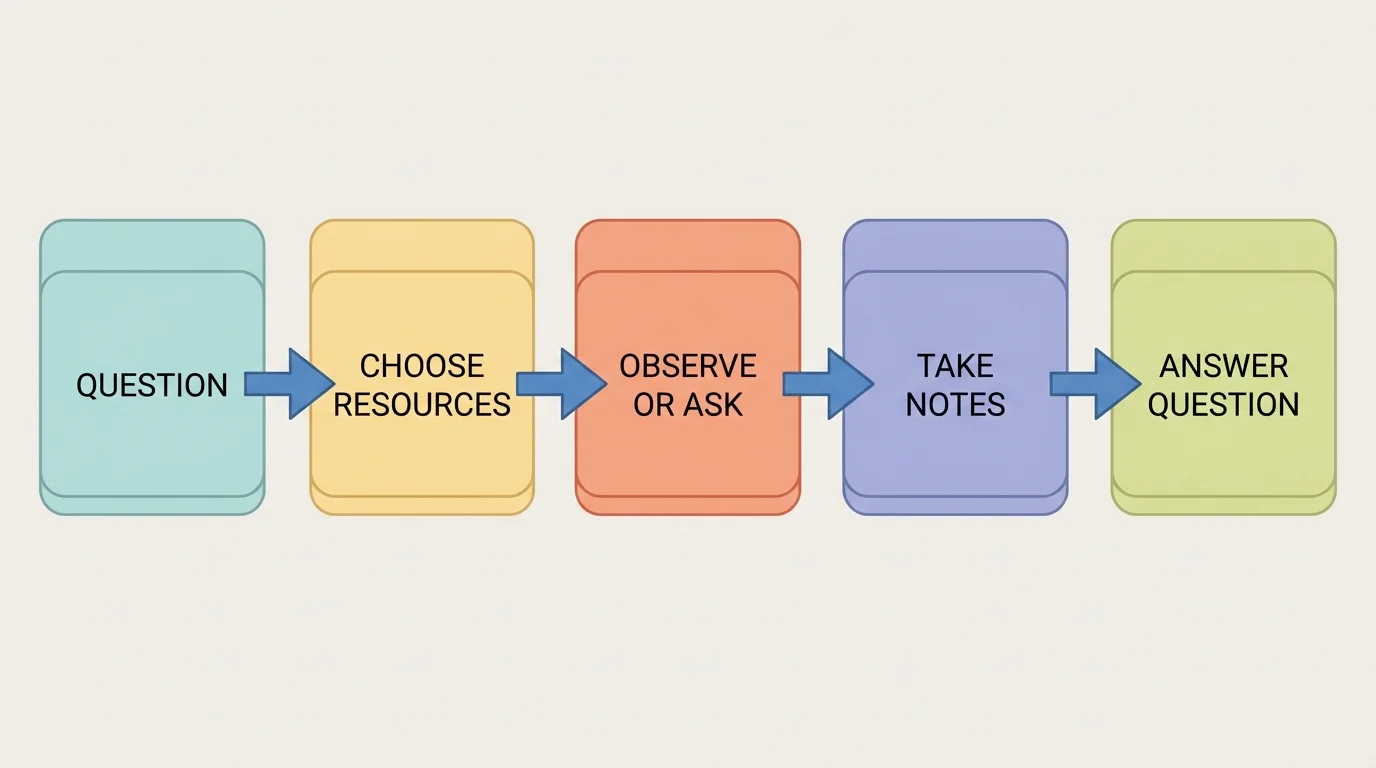
Planning also means thinking about tools. You might need a notebook, a chart, a pencil, sticky notes, a ruler, or a classroom tablet with adult help. The tools depend on the question.
Purpose guides the search
When you know your purpose, you know what to collect. If your purpose is to learn what birds eat, you look for food facts. If your purpose is to learn where birds build nests, you gather location facts. The purpose acts like a flashlight, helping you shine attention on the information that matters.
Even young students can make strong plans. A simple plan keeps the question in the center, and that leads to better answers.
Strong investigators use a variety of sources. A source is where information comes from. You can learn from books, photographs, videos chosen by a teacher, classroom websites, maps, labels, experts, and your own observations.
Books are useful because they often have facts, pictures, and labels. A nonfiction book about frogs can tell you where frogs live, what they eat, and how they grow. Pictures and captions can also give information.
People can be helpful sources too. A teacher, librarian, zookeeper, gardener, or family member may know a lot about a topic. Asking questions politely can help you learn details that are not in front of you.
[Figure 3] Observation is another important source. If your question is about how a shadow changes during the day, you can watch, measure, and record. If your question is about what a plant needs, you can observe the plant over several days.
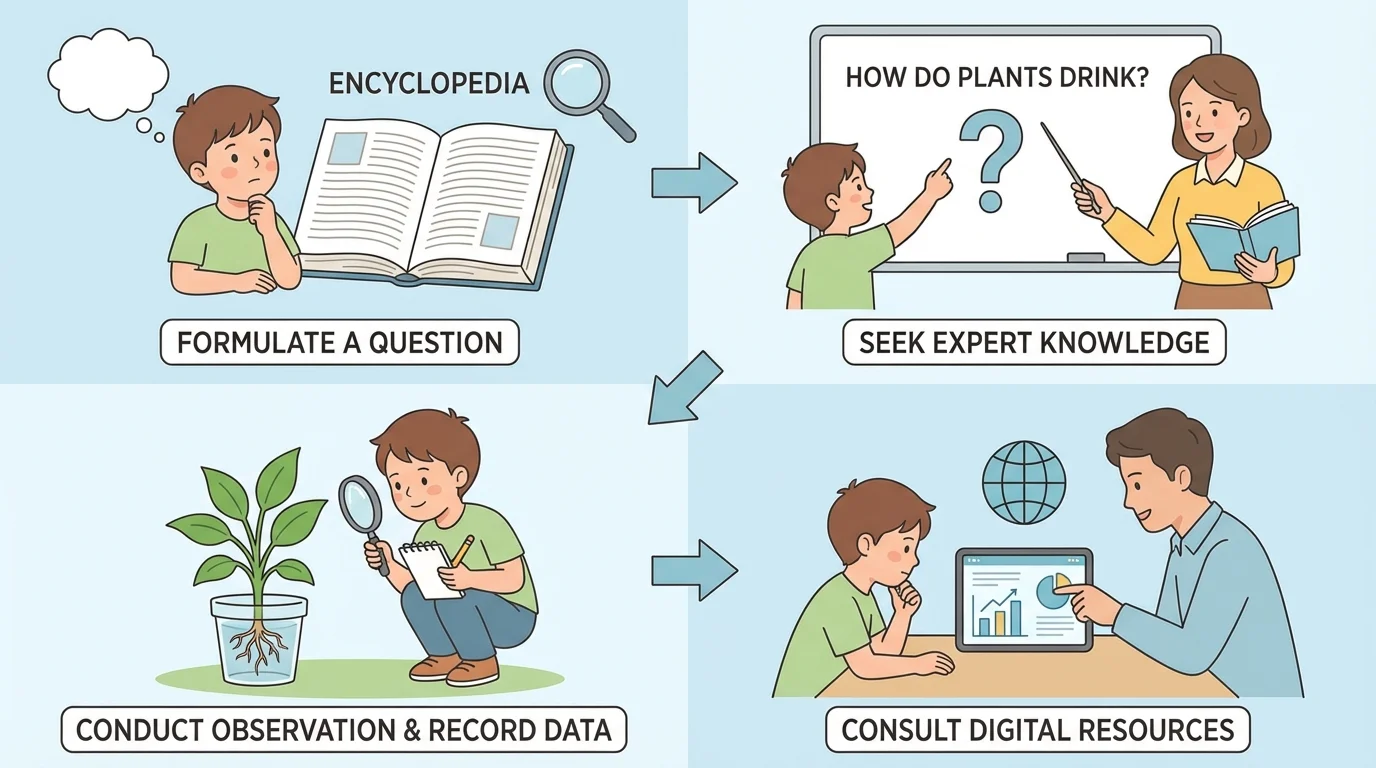
Sometimes one source is enough for a simple question, but often more than one source gives a better answer. A book may say that ladybugs eat tiny insects. An observation may show a ladybug on a leaf. Together, those sources give a fuller picture.
Not every source fits every question. If you want to know the sound a bird makes, a drawing will not help as much as listening to a recording. If you want to know the shape of a leaf, a labeled picture or real observation may help more than a short sentence.
Remember that a question comes first. Resources come next. We do not gather random facts and then hope they fit. We choose resources because they help answer the question.
When you use several sources, compare them. If two sources say the same thing, that can make the information stronger. If they say different things, look more carefully. Maybe one source is about a different animal or a different season. Each resource gives one part of the answer, and good investigators put the parts together.
As you collect information, you need to remember it. That is why notes are useful. Notes are short pieces of information you write or draw so you can use them later.
Notes do not need to be long. A few words, a labeled sketch, or a simple chart can work. If the question is "What do squirrels eat?" your notes might say: "acorns," "seeds," "fruit," and "saw squirrel digging near tree." Those notes are short, but they connect to the question.
[Figure 4] You can sort notes into categories. For example, if you are learning about weather, your categories might be temperature, clouds, wind, and rain. Sorting helps your brain see patterns.
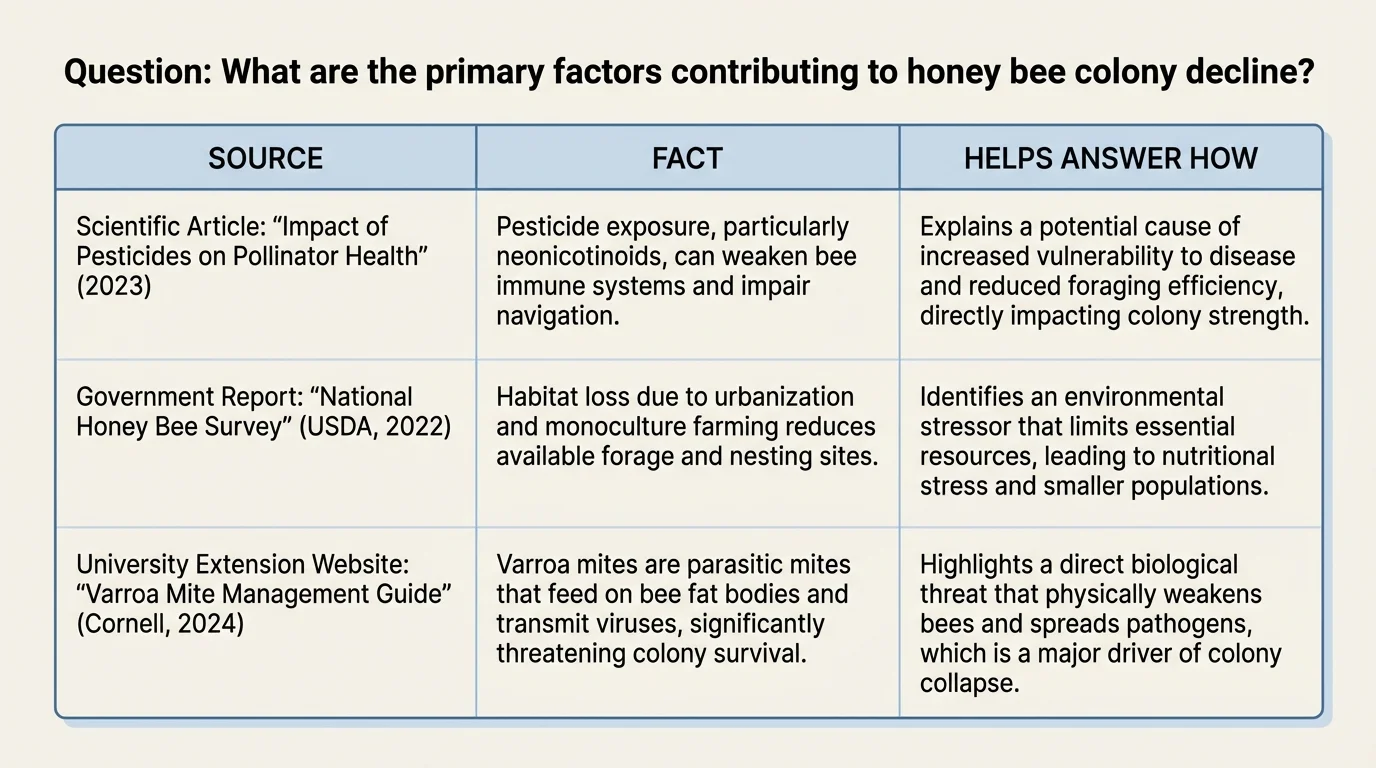
A chart can help keep track of where each fact came from. That matters because different resources may give different details. If a book says one thing and an observation shows another, your chart helps you remember both.
| Question | Source | Fact |
|---|---|---|
| What do robins eat? | Book | Worms and insects |
| What do robins eat? | Observation | Robin pulling worm from grass |
| What do robins eat? | Teacher | Sometimes berries too |
Table 1. A simple note chart showing how one question can be answered with facts from different sources.
Notice how each note in the table connects to the same question. That is purposeful note-taking. The organizer helps students see that a note is most useful when it tells both the fact and the source.
Short note-taking example
Step 1: Write the question.
"What does a bean plant need to grow?"
Step 2: Gather facts.
Book: plants need water and light.
Observation: plant near window grows taller.
Teacher: plants also need soil and air.
Step 3: Sort the facts.
Needs: water, light, soil, air
Now the notes are ready to help answer the question.
Keeping track of information is part of being a careful learner. Good notes make it easier to speak, write, or draw what you learned.
After gathering facts, stop and ask: Does this information answer my question? If the question is "How do ducks move in water?" then a fact about duck feathers may help only if it connects to movement. A fact about where ducks sleep may not fit very well.
This is called using evidence. Evidence is information that helps support an answer. Not every fact is evidence for every question. The best evidence matches the question closely.
Sometimes information is interesting but extra. Extra facts are not wrong, but they can make an answer messy. Clear answers use the strongest facts first.
Finding matching evidence
Step 1: Read the question.
"Why do bees visit flowers?"
Step 2: Look at the facts.
Fact A: Bees collect nectar from flowers.
Fact B: Bees have six legs.
Fact C: Pollen can stick to bees.
Step 3: Choose the facts that fit best.
Fact A and Fact C help answer the question best.
The number of legs may be true, but it does not strongly answer why bees visit flowers.
If two sources do not match, do not panic. Read more carefully. Maybe one source talks about one kind of bee and another talks about a different kind. Good investigators notice differences and keep asking careful questions.
At the end of an investigation, you use your question and your evidence to make an answer. The answer can be spoken, written, drawn, or shown on a chart. What matters is that the answer is based on the information you collected.
A strong answer often starts by restating the question. Then it gives facts from sources. For example: "Robins eat worms, insects, and sometimes berries. I learned this from a book, my teacher, and an observation of a robin on the grass." That answer is clear because it includes evidence.
You can also explain which source helped most. Maybe your observation helped you see behavior, while a book helped you learn words you did not know before. Each source can add something useful.
"Good answers grow from good questions."
When you share findings with classmates, they may ask new questions. That is part of inquiry too. One answer often leads to another investigation.
Purposeful investigation is not only for science time or library time. People use it every day. If you want to know which shoes are best for rainy weather, you might observe the weather, read labels, and ask an adult. If you want to know why ice melts faster in one place than another, you can observe, compare, and record.
At school, inquiry helps with reading, science, social studies, and even art. A class might ask, "How were toys different long ago?" and use pictures, books, and family stories. Another class might ask, "Which materials make the tallest block tower?" and gather observations from tests.
Being a strong investigator means being curious, careful, and focused. You ask a specific question, choose useful resources, collect matching facts, and build an answer from evidence. Those are powerful learning habits that help in every subject.
